Colosseum
The Colosseum, or Flavian Amphitheatre, was the largest amphitheatre of ancient Rome and one of the main symbols of the imperial capital. It was built under the Flavian dynasty after the civil war of 69 CE and opened under Titus in 80.
The building was a political statement. On a site associated with Nero's palace complex, the Flavians created a space of public spectacle where the emperor displayed generosity, control over the city and connection with the Roman people.
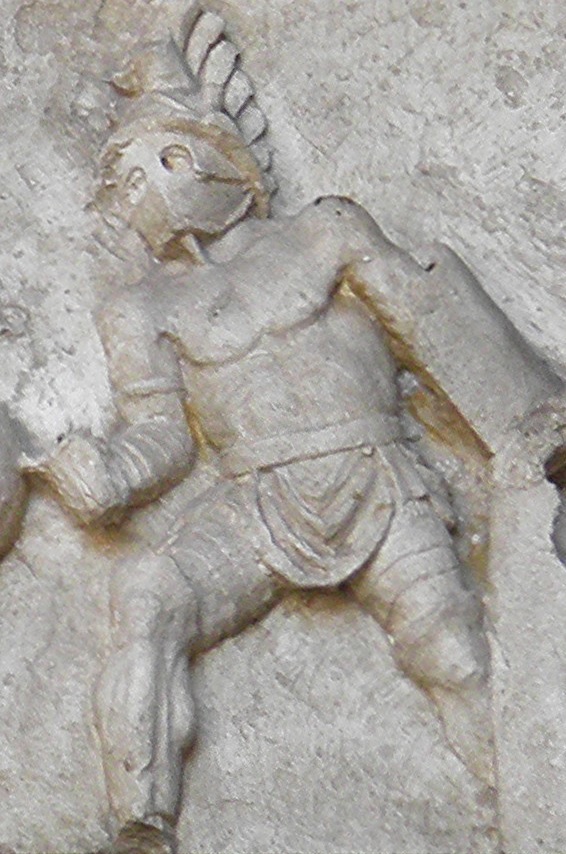 Roman relief showing a gladiator with the upper part of his subligaculum covered by a belt.
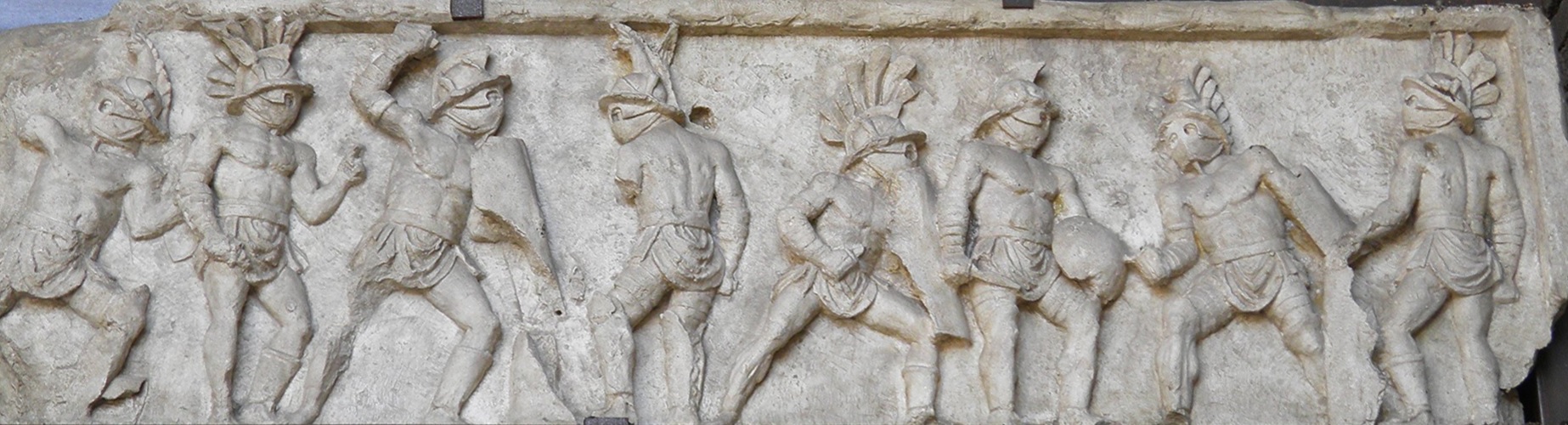 Bas-relief in honor of the gladiator games in the city of Teate (Chieti). Colosseum Alley,Rome,AD 20-40
Architecture
The Colosseum had an oval form, a multi-level system of arcades and a complex network of entrances. Numbering of passages and sectors helped direct spectators to their seats; surviving Roman numerals at entrances show how organized the building's logistics were.
Inside was an arena with a wooden floor covered in sand. Beneath it developed the hypogeum, a system of corridors, cages, lifts and service spaces. This infrastructure made it possible to change scenes quickly and bring out animals, people and equipment.
Spectators and order
Seating in the amphitheatre reflected Rome's social hierarchy. The emperor, senators, equestrians and honoured guests sat closer to the arena; ordinary citizens, women and poorer spectators sat higher. The Colosseum was therefore not only a place of entertainment, but also a visible model of Roman society.
The organization of entrances, stairs and sectors made it possible to manage a huge crowd. Spectacle required as much administrative order as a military camp or forum: schedule, security, supply, equipment and control of behaviour were all part of the system.
Games
The Colosseum is associated above all with gladiatorial games, but a programme could include animal hunts, executions, mythological scenes and formal ceremonies. For Romans these spectacles were part of politics, religion, urban life and imperial propaganda.
Over time the character of games changed. In Late Antiquity they were affected by fiscal difficulty, Christian criticism, changing tastes and the transformation of civic institutions. The building itself continued to live: it was used, repaired, quarried for materials and reinterpreted as a monument of ancient Rome.
Related topics
Literature and sources
- Martial. Liber Spectaculorum.
- Suetonius. Divus Titus.
- Claridge A. Rome: An Oxford Archaeological Guide.
- Hopkins K., Beard M. The Colosseum.
- Welch K. The Roman Amphitheatre.
Interested in Ancient Rome beyond reading? Join Legio X Fretensis or explore our reenactment directions.


