Early Dynastic Egypt
Early Dynastic Egypt is usually dated to about 3100-2686 BC. It covers the First and Second Dynasties and the formation of royal rule over Upper and Lower Egypt, early writing, accounting, court administration and the royal funerary cult. This was not yet the Egypt of pyramids, but it was already a state able to collect resources from a large territory, express power through symbols and maintain networks of officials, craftsmen and shrines.
The dates of the early period remain approximate. Egyptian writing was still developing, later king lists do not preserve every name in the same way, and archaeological contexts do not always allow a secure sequence of events. The Early Dynastic Period is therefore best understood as a stage of state formation: regional centres of the Nile Valley were drawn into one political system, while kingship acquired the language, institutions and rituals by which later Egyptian power was recognized.
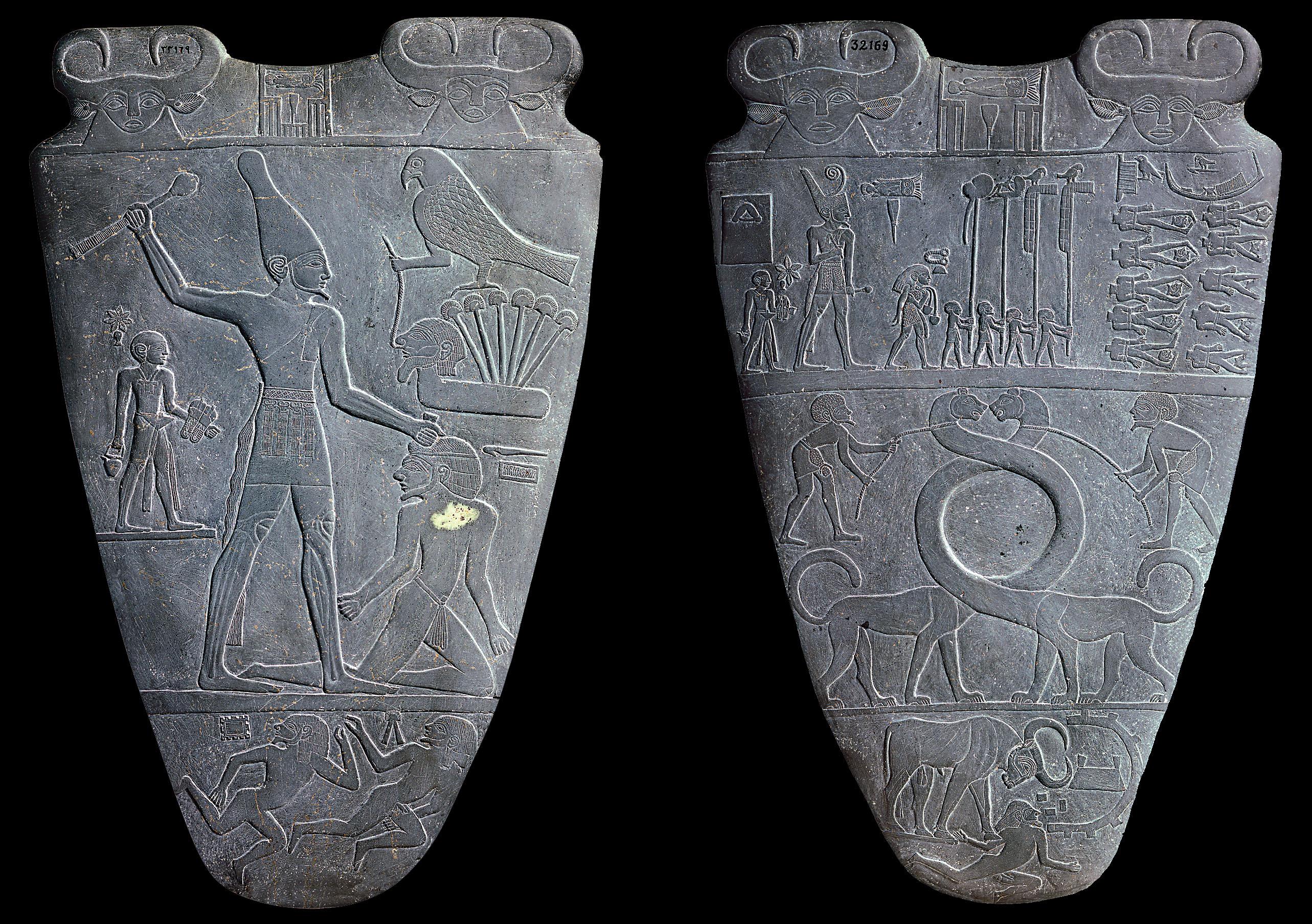 Narmer Palette. Hierakonpolis, late Predynastic to early First Dynasty; Egyptian Museum, Cairo.
Before the Dynasties: Naqada and Regional Centres
The Early Dynastic Period grew out of the late Predynastic Naqada culture, especially Naqada II-III. In Upper Egypt the centres of Naqada, Hierakonpolis and Abydos gained strength; in Lower Egypt Delta settlements and contacts with Palestine mattered. Regional elites controlled exchange, craft production, prestige goods and access to stone, metal, ivory and exotic materials. Already in the fourth millennium BC elite burials became richer, while the authority of rulers was expressed through maceheads, palettes, vessels, sealings and images of victory.
This background matters because unification did not appear from nowhere. By the beginning of the dynasties there were already developed craft traditions, long-distance exchange routes, local cults, early royal symbols and habits of administrative recording. Finds from Abydos, Hierakonpolis, Tarkhan, Naqada and the Delta show that Egyptian statehood arose from the rivalry and integration of several centres, not from one city alone.
Unification of Upper and Lower Egypt
The unification of Egypt is most often associated with Narmer. His name appears on monuments, and the famous Narmer Palette shows the king with the crowns of Upper and Lower Egypt, scenes of smiting enemies and processions with defeated foes. This is not a documentary record of one event, but a ceremonial image of victory and rule over the two parts of the country. Near Narmer at the end of the Predynastic age stand the names of Ka, Iry-Hor and probably Scorpion; their exact order is debated, but they show a close group of early rulers before the stable First Dynasty.
Unification was probably a long process. It may have combined military pressure, marriage and kinship alliances, control of exchange routes, absorption of local elites and the creation of a common ideology. The White Crown of Upper Egypt, the Red Crown of Lower Egypt, the Double Crown, the falcon Horus, the serekh with the royal name and scenes of defeated enemies became a language of power. These signs did not merely decorate objects: they explained who had the right to mobilize people, direct resources, build shrines and speak for the whole country.
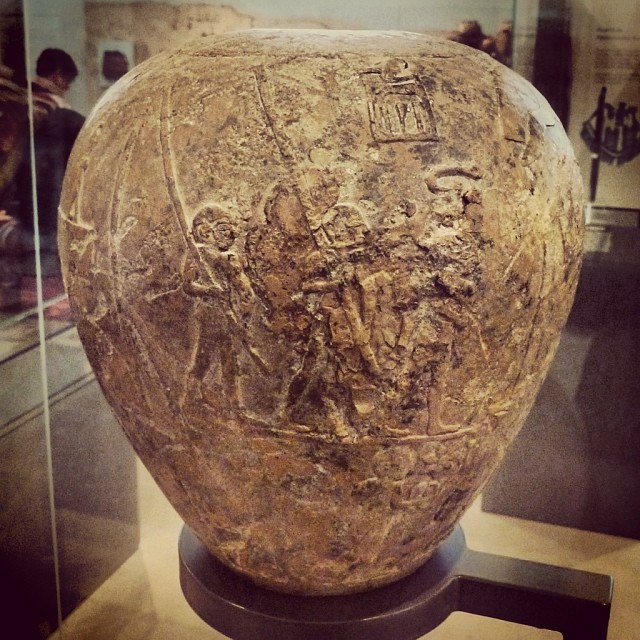 Mace-head of King Narmer from the Main Deposit at Hierakonpolis. Late Predynastic to early First Dynasty, c. 3000 BC; Ashmolean Museum, AN1896-1908 E.3631.
The First Dynasty: Court, Abydos and Memphis
The First Dynasty begins with Narmer or his immediate successors; in later tradition Menes stands at this beginning as the first king. Whether Menes should be identified with Narmer, Aha or another early ruler remains unresolved. After Narmer the dynasty usually includes Aha, Djer, Djet, Den, Anedjib, Semerkhet and Qa'a. Their names are known from sealings, vessels, labels, tombs and later lists; the details of their reigns are unevenly reconstructed.
The royal cemetery at Umm el-Qaab near Abydos became the main place of memory for the early rulers. Underground tombs were built there with brick structures, storage spaces, offering areas and subsidiary burials. At the same time the north was not peripheral. The Memphis region, placed at the meeting point of valley and delta, became a convenient administrative node. Later tradition connected the foundation of Memphis with the first king, while archaeologically the important point is its location: from this region royal power could control the movement of people, grain, craft products and tax deliveries between south and north.
The Second Dynasty: Tension and Restoration
The Second Dynasty is less clear than the First. Its rulers include Hetepsekhemwy, Nebra or Raneb, Nynetjer, Peribsen, Sekhemib and Khasekhemwy; their order and political setting remain debated. The name Hetepsekhemwy is often translated as "the two powers are at peace", which may preserve a memory of restored order after changes at the dynastic boundary. Under Nynetjer and his successors some scholars suspect divided rule or a serious administrative crisis, although no narrative account survives.
Peribsen is especially important: instead of the usual falcon of Horus above his serekh, he used the Seth animal. This may reflect a local cult, a political programme or conflict within royal ideology. Khasekhemwy, by contrast, used both Horus and Seth, and his name is associated with restored unity. Monuments from Hierakonpolis speak of victories and suppressed opponents; the literal interpretation is debated, but the end of the Second Dynasty appears as a time when royal power was strengthened again. From that restoration grew the Third Dynasty and the age of Djoser, already part of the Old Kingdom.
Main Events
- c. 3300-3100 BC
- late Predynastic Naqada III; spread of early writing, royal symbols and powerful centres in Upper Egypt.
- c. 3100 BC
- unification of Upper and Lower Egypt in the early royal tradition; Narmer, Ka, Iry-Hor and possibly Scorpion belong to this horizon.
- Beginning of the First Dynasty
- formation of the royal court, the serekh with the king's name, the Abydos cemetery and the administrative role of the Memphis region.
- Reign of Den
- a noticeable strengthening of royal imagery: his monuments show developed titulary, rituals of power and the connection between south and north.
- End of the First Dynasty
- the reigns of Anedjib, Semerkhet and Qa'a; royal power preserved the Abydos tradition, while signs of tension among elites became more visible.
- Second Dynasty
- reworking of royal ideology and probably phases of political tension; the use of Horus and Seth names changed.
- Peribsen
- one of the most unusual kings of early Egyptian history, using the Seth animal in the royal name.
- Khasekhemwy
- end of the Second Dynasty, suppression of opponents and restoration of unified rule; transition to the Third Dynasty and the Old Kingdom.
This chronology should not be read as a modern annal with exact dates for every year. For early Egypt the sequence of processes matters more: the growth of regional centres, the formation of unified kingship, the development of accounting, the fixation of funerary ritual and the transition to the larger state of the Old Kingdom.
Main Figures
Narmer is the central figure of early unification. His palette, macehead and other monuments show the image of a victorious king who combines military force, ritual and authority over the Two Lands. Even if unification was a long process, Narmer became its main symbol.
Aha, perhaps connected with the later figure of Menes, stands at the beginning of the First Dynasty as one of the first kings of the stable dynastic tradition. Djer and Djet are known from Abydos complexes, vessels and sealings; they show the continuation of the royal cemetery and the expansion of the court system. Den is especially important: his reign is associated with the development of titulary, ceremonies, economic documentation and the image of a king active in both parts of the country.
Merneith occupies a special place among early royal women. Her burial at Abydos and connection with the royal line show exceptional status; she is often interpreted as a regent for the young Den or as a member of the royal house whose authority was visible in court memory. Peribsen matters because he used Seth in the royal name, while Khasekhemwy appears as the ruler under whom royal power was again gathered into a unified system.
Chronology depends not only on royal names, but also on where those names are attested. Ka and Iry-Hor are visible above all in late Predynastic Abydos material; Narmer connects Abydos evidence with images of victory and dual kingship; Aha and Den show a more stable court and economic system. In the Second Dynasty the names of Peribsen and Khasekhemwy mark tension around royal ideology and the later restoration of unity. Early kings should therefore not be reduced to a simple table: each is known through different kinds of monuments rather than through a continuous chronicle.
Centres and Administration
Abydos was not only a cemetery. It connected early kingship with the southern tradition, ancestral memory and a cult landscape that remained important throughout Egyptian history. Hierakonpolis retained significance as an ancient centre of power and the cult of Horus. The Memphis region, by contrast, was convenient for ruling a unified country: it stood at the entrance to the Delta, controlled the route north and allowed the royal court to be close to the economic flows of both parts of Egypt.
Administration in the Early Dynastic Period was built around the court, royal domains, storehouses, officials and local representatives of power. Clay sealings closed vessels, bags, storerooms and doors; the impression showed which office or person was responsible for a delivery. Bone, wooden and ivory labels record royal names, products, year events, economic notes and regions. Such small objects show the essential point: the early state could turn grain, cattle, craft goods and labour into managed royal resources.
Writing and Accounting
Early Egyptian writing did not begin as long literature. Its first stable tasks were administrative and ritual: to write the king's name, identify an owner, mark the contents of a vessel, record a delivery, name a place or note an event. Signs were carved or written on labels, vessels, sealings, stone and bone objects. Many inscriptions are extremely short, but they show how the state learned to connect power, economy and memory.
For the Early Dynastic Period the serekhs with royal names are especially important. The serekh depicted a palace facade and placed the king's name inside an architectural frame, usually with the falcon Horus above. This sign was at once a signature, a symbol of the palace and a claim to legitimate rule. Later Egyptian titulary became more complex, but its early basis is already visible here: the king is not presented as a private war leader, but as the holder of an office connected with the gods, the palace and the whole land.
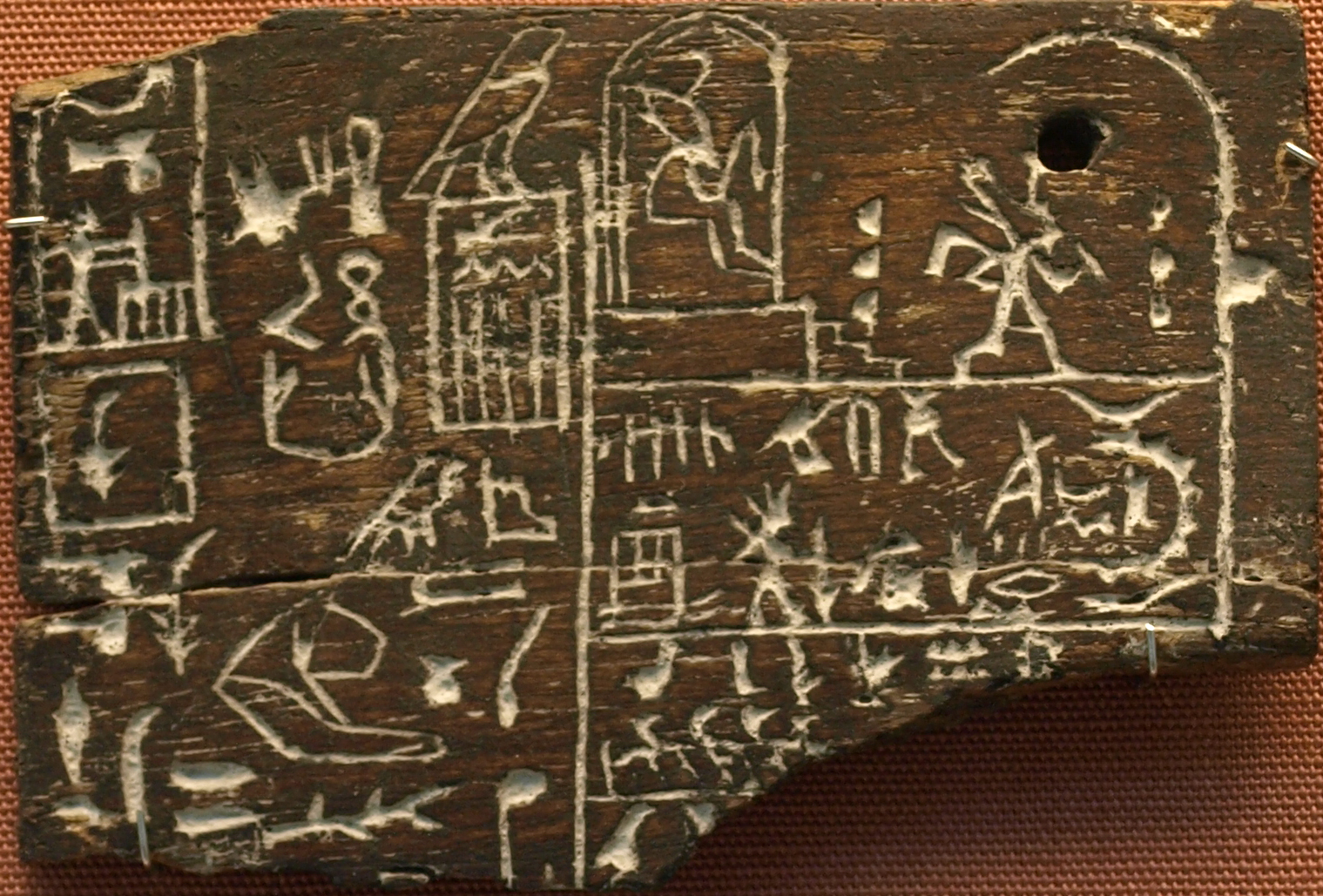 Ebony label of King Den from his tomb at Abydos, mid-First Dynasty, c. 3000 BC; British Museum, EA 32650. It shows the heb-sed ritual, the king enthroned and scenes of victory.
Religion and Royal Ideology
Religion in the Early Dynastic Period is known only in fragments, but its main lines are already visible. The king is closely connected with Horus, and royal power is expressed through victory over disorder, protection of order and control of the lands of the Nile. Scenes of smiting enemies, processions, standard bearers, symbolic animals and cult objects form an early set of images from which later Egyptian ideas of maat, royal ritual and divine protection developed.
Yet the early pantheon does not look like the fully formed system of later temples. Local cults and regional symbols were gradually fitted into a common royal language. Horus is especially important for the ruler's image; Seth becomes visible in crisis and transitional contexts of the Second Dynasty; protective goddesses, sacred animals and nome standards helped connect the king's power with particular lands. Early Egypt was already creating a state religion, but it was built from living regional traditions.
Burials and Material Culture
Royal tombs of the Early Dynastic Period were not yet pyramids. They were built of mudbrick and wood, with underground chambers, storerooms and above-ground markers. At Abydos royal burials were surrounded by complexes where archaeologists have found vessels, sealings, ivory objects, stone vessels, traces of offering practices and subsidiary graves. These complexes show that the death of a king was a state event: it required labour, materials, ritual and control over memory.
In the north, especially at Saqqara, large elite mastabas show another aspect of the same system. They belonged to high-status people connected with the court and administration. Rich supplies, imported materials, craft objects and the elite imitation of royal status language are visible in them. The development of brick architecture, stone vessels, ivory carving, sealings and vessel inscriptions prepared the technical and organizational base for the monumental building of the Old Kingdom.
Written and Archaeological Evidence
The Early Dynastic Period is studied primarily through objects, not through later narratives. The main groups of evidence are royal and elite tombs at Abydos and Saqqara, seal impressions, labels, inscribed vessels, palettes, maceheads, stone vessels, early images and settlement traces. Later king lists from Abydos, Saqqara and Turin help construct the dynastic frame, but they were created many centuries after the events and reflect the memory of an already mature Egypt. The Palermo Stone and related annal fragments matter for early royal years, but they survive only incompletely.
Early history is therefore assembled from several levels. A king's name on a seal shows administrative control, but it does not necessarily describe a campaign or reform. A rich tomb shows status, but does not always identify a precise political event. A later list gives the order of rulers, but may omit disputed names. Secure reconstruction appears where these data converge: archaeological context, inscription, repeated royal names in different places and the monument's place in the wider sequence.
The Narmer Palette is valuable precisely as an early monument of royal ideology. It shows crowns, standards, the serekh with the royal name, scenes of defeated enemies and procession, but it is not a literal report of one battle. Abydos tombs, Saqqara mastabas and seal impressions add another side of the evidence: storerooms, vessels, court names, funerary logistics and the circle of people serving the royal house.
Significance of the Early Dynastic Period
The Early Dynastic Period matters not only as a prologue to the pyramids. It created the main forms of Egyptian statehood: the king as ruler of the Two Lands, the court as an administrative centre, writing as an instrument of power, the necropolis as a place of political memory, religious symbols as a language of legitimacy and economic accounting as the basis for mobilizing resources. Without these elements neither the Old Kingdom nor the later durability of Egyptian tradition can be understood.
By the end of the Second Dynasty Egypt already had experience of unification, crisis and restoration. Khasekhemwy and the beginning of the Third Dynasty show the transition from early brick monumentality to far larger projects. When the Step Pyramid appeared under Djoser at Saqqara, it was not a sudden invention from nothing. Behind it stood two centuries of Early Dynastic power: accounting, craft, ritual, royal memory and the state's ability to direct labour toward large building tasks.
Related Topics
Literature and sources
- Wilkinson T. A. H. Early Dynastic Egypt.
- Wilkinson T. The Rise and Fall of Ancient Egypt.
- Shaw I. The Oxford History of Ancient Egypt.
- Kemp B. Ancient Egypt: Anatomy of a Civilization.
- Wengrow D. The Archaeology of Early Egypt.
- Spencer A. J. Early Egypt: The Rise of Civilisation in the Nile Valley.
- Trigger B. G., Kemp B. J., O'Connor D., Lloyd A. B. Ancient Egypt: A Social History.
Interested in Ancient Rome beyond reading? Join Legio X Fretensis or explore our reenactment directions.


