Old Kingdom Egypt
Old Kingdom Egypt is usually dated to about 2686-2181 BC and covers the Third to Sixth Dynasties. It was the age in which early monarchy became a mature centralized state, while the authority of the pharaoh acquired its most visible material form: the royal pyramid complex. The Memphite region, Saqqara, Dahshur, Abusir and Giza became the main places where royal ideology was expressed through stone, necropolis planning, inscriptions and organized labour.
The period cannot be reduced to the building of Egyptian pyramids. The Old Kingdom shaped the court, vizieral administration, the nome system, royal workshops, supply accounting, expeditions for stone and copper, the economic role of temples and the idea of the king as the centre of ma'at. This state machine made enormous complexes possible, but it also created a class of nobles, scribes and local governors whose growing strength contributed to the crisis at the end of the period.
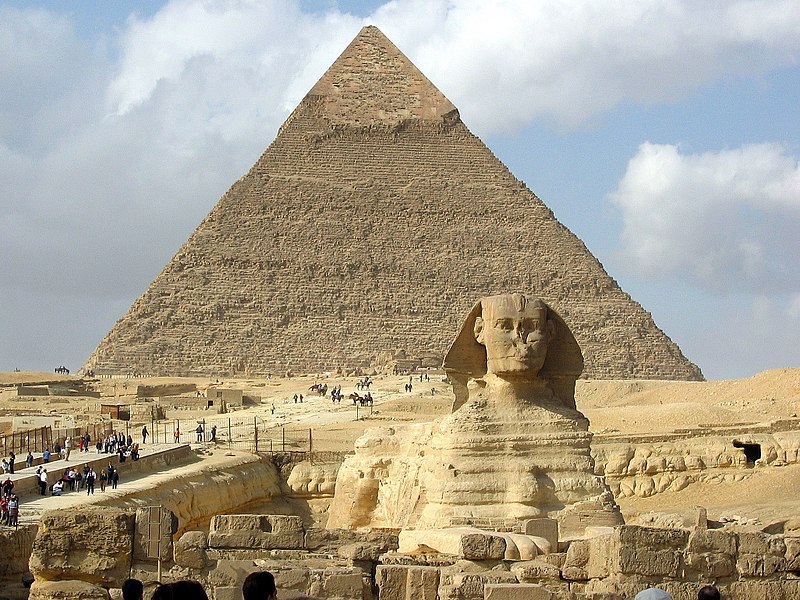 Pyramids of Giza and the Great Sphinx. Fourth Dynasty necropolis, Old Kingdom.
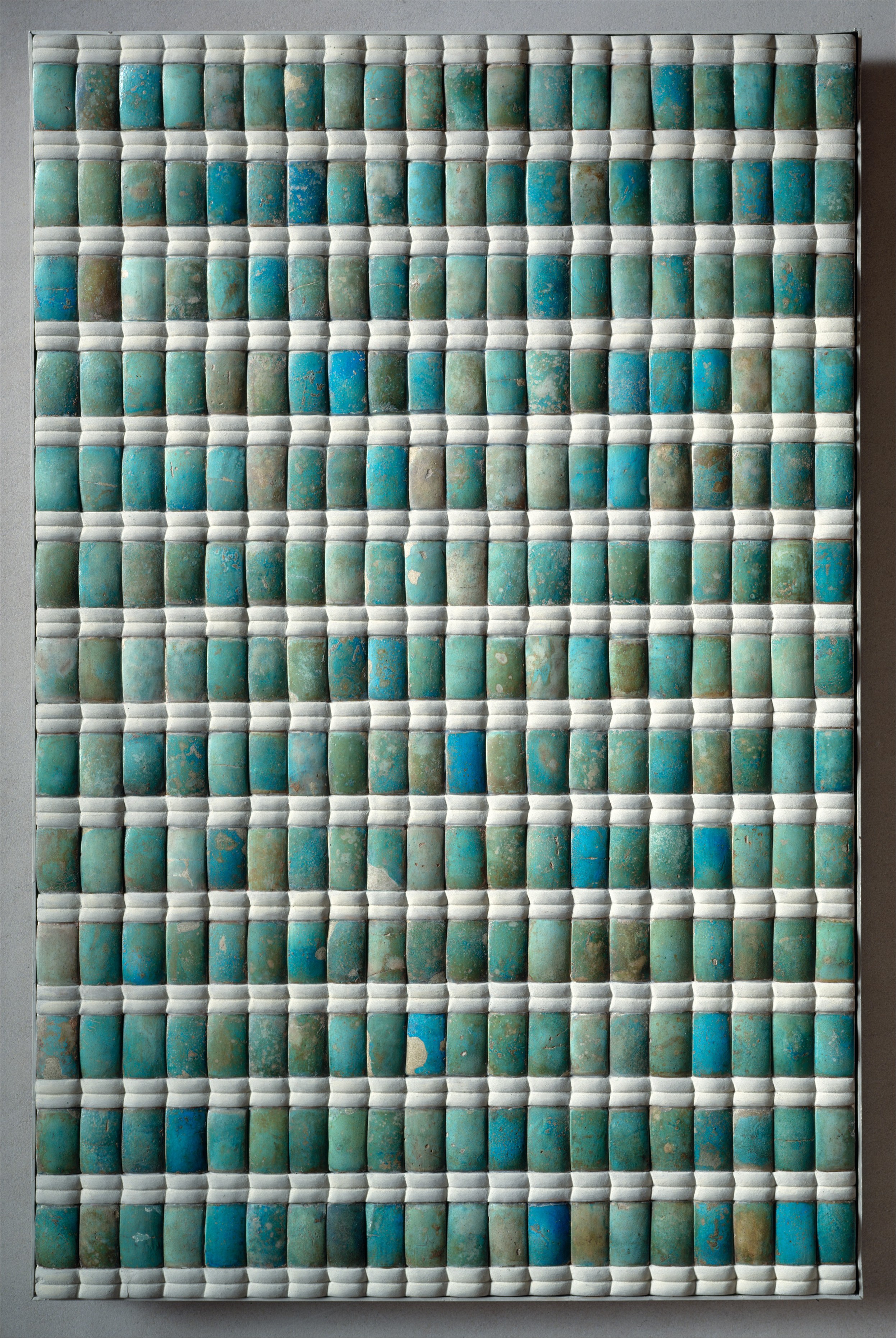 Faience wall tiles from Djoser's funerary apartments at Saqqara. Dynasty 3, ca. 2630-2611 BC; Metropolitan Museum of Art.
Third Dynasty: Saqqara and the Beginning of Stone Monumentality
The Third Dynasty marked the transition from Early Dynastic brick complexes to large-scale stone architecture. Its central figure was Djoser, whose Step Pyramid at Saqqara formed part of a large enclosed complex with courts, dummy buildings, underground galleries and the South Tomb. Later tradition connected the project with Imhotep, a royal official and architect, but the archaeological point is the complex itself: it shows that the court could plan, supply and maintain a long stone building project.
Saqqara was not only the tomb of one king. It was a landscape of power near Memphis, where royal burial, ritual spaces and elite mastabas formed a single system of memory. The faience tiles from Djoser's underground chambers imitated palace matting and show how funerary architecture transferred the earthly court into durable material. Under Sekhemkhet, Khaba and Huni building experiments continued, although not every complex was completed.
Fourth Dynasty: Sneferu, Khufu, Khafre and Menkaure
The Fourth Dynasty was the age of maximum concentration of resources. Sneferu built or completed several pyramid projects at Meidum and Dahshur; the Bent Pyramid and the Red Pyramid show the search for a stable smooth-sided pyramid form. Under Khufu the Great Pyramid was built at Giza, surrounded by tombs of the royal family, boat pits, causeways, temples and workers' settlements. Giza was not a desert backdrop, but a complex economic and ritual node.
Khafre continued the development of the Giza plateau: his complex included pyramid, mortuary temple, valley temple, causeway and the area of the Great Sphinx. Menkaure built a smaller pyramid, but his complex preserved the same logic of the royal funerary landscape. In this age royal power appeared especially integrated: stone, statues, rituals, food supply, work crews and the position of the elite were organized around the royal house as the centre of the country.
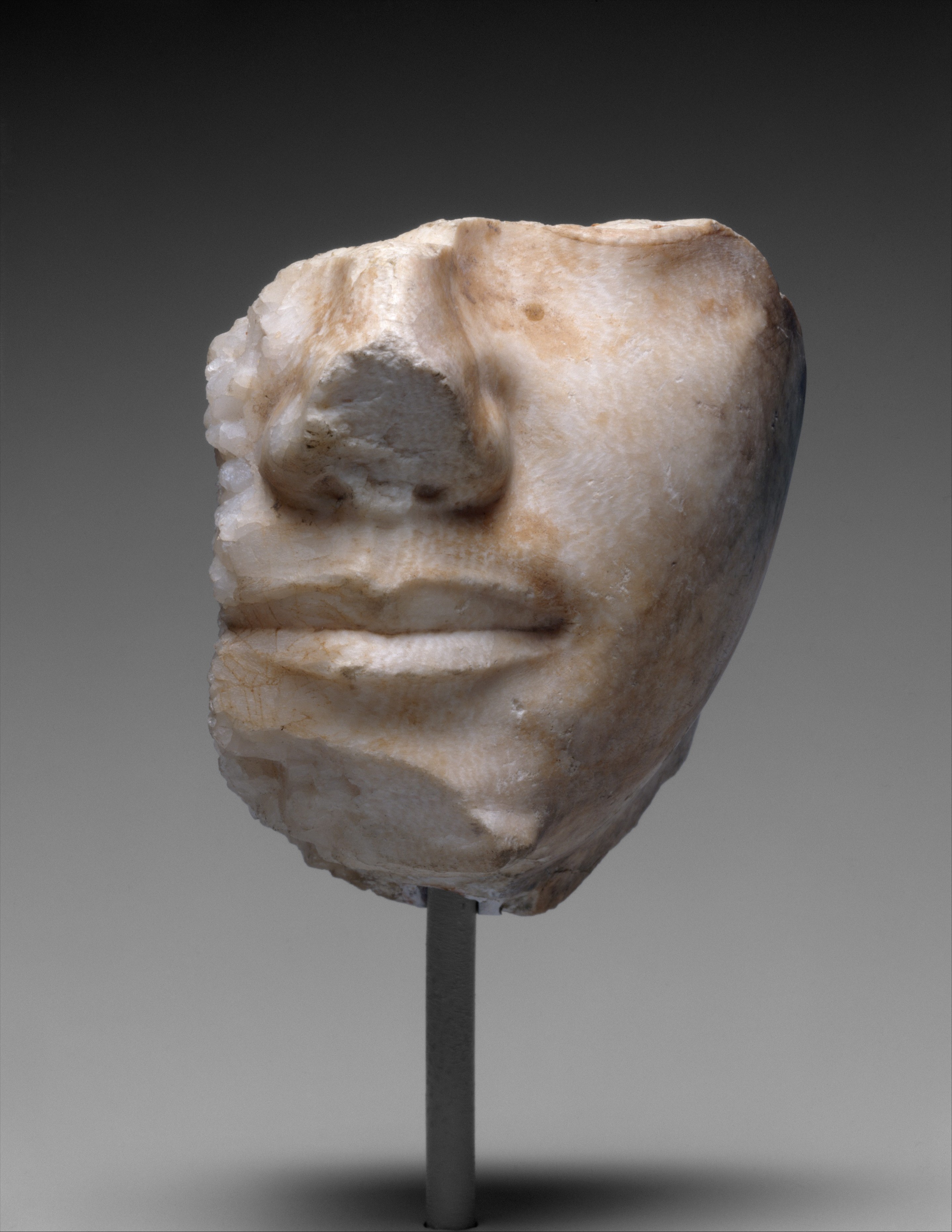 Fragmentary face of King Khafre. Dynasty 4, ca. 2520-2494 BC; Metropolitan Museum of Art.
Fifth Dynasty: Solar Cult, Abusir and Administration
In the Fifth Dynasty the focus of royal cemeteries shifted toward Abusir and Saqqara, while the solar cult of Ra became especially prominent in royal ideology. Userkaf, Sahure, Neferirkare, Niuserre and their successors built pyramid complexes smaller than those at Giza, but accompanied them with developed temple systems, reliefs and economic archives. The Abusir papyri show the daily work of temple estates: priestly rotations, supplies, inventories, distribution of goods and accounting.
Under Sahure there are scenes of maritime and land expeditions and contacts with Byblos, Punt and Nubia. These scenes are not always neutral chronicle, but they reflect the range of royal interests: timber, copper, stone, incense, exotic animals and prestige goods. At the end of the Fifth Dynasty the Pyramid Texts appear in the pyramid of Unas, forming a crucial body of funerary spells and showing how royal death and afterlife were imagined.
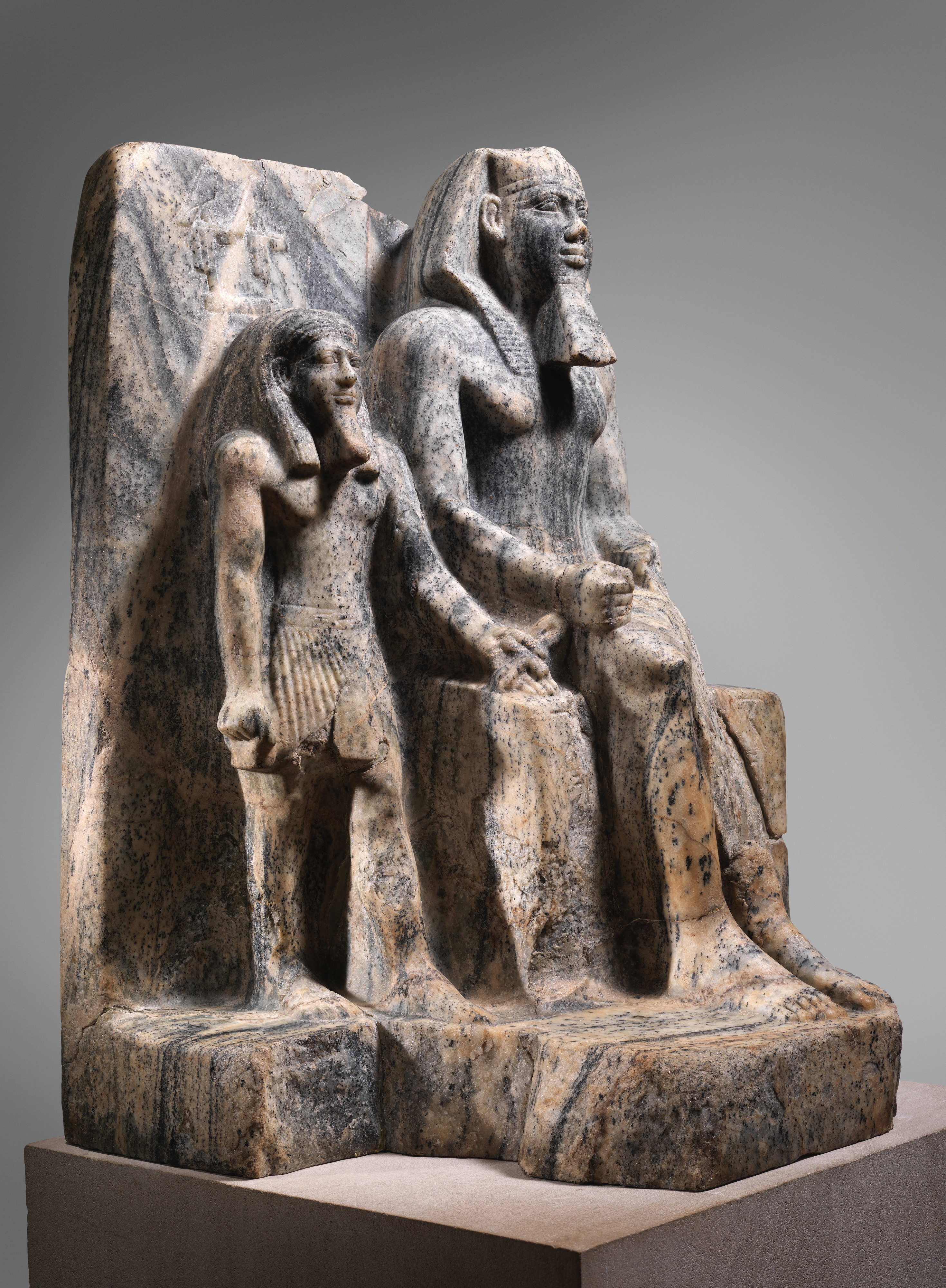 King Sahure accompanied by a divine figure. Dynasty 5, ca. 2458-2446 BC; Metropolitan Museum of Art.
Sixth Dynasty and the Crisis of the Centre
The Sixth Dynasty began with Teti and continued with the reigns of Pepi I, Merenre and Pepi II. Royal power still retained great prestige: pyramids were built, expeditions went to Wadi Hammamat, Sinai and Nubia, and high officials such as Weni and Harkhuf served the crown. Their autobiographical inscriptions are important because they reveal official careers with unusual clarity: military assignments, judicial work, building projects, diplomatic journeys and relations with the king.
Gradually the nomarchs and local centres grew stronger. The long reign of Pepi II, the growth of regional tombs, hereditary offices and possible climatic stress at the end of the third millennium BC weakened the old balance. The end of the Old Kingdom was not an instant collapse after one event; it was a dispersal of power, as Memphis ceased to monopolize resources and political initiative. This opened the First Intermediate Period.
Chronology of Main Events
- c. 2686 BC
- beginning of the Third Dynasty and Old Kingdom; the Memphite region becomes the main political centre.
- Reign of Djoser
- construction of the Step Pyramid and great complex at Saqqara.
- Late Third Dynasty
- continued experimentation with royal pyramids and underground galleries.
- Reign of Sneferu
- pyramids at Meidum and Dahshur; development of the smooth-sided pyramid.
- Reign of Khufu
- construction of the Great Pyramid at Giza and development of the Fourth Dynasty royal necropolis.
- Reigns of Khafre and Menkaure
- completion of the classic form of Giza.
- Fifth Dynasty
- stronger solar cult, building at Abusir, temple archives and expedition scenes.
- Reign of Unas
- earliest known Pyramid Texts inside a royal pyramid.
- Sixth Dynasty
- careers of major officials, expeditions to Nubia and growing regional elites.
- After the long reign of Pepi II
- weakening of central authority and transition to the First Intermediate Period.
Archaeological Evidence
Old Kingdom evidence falls into several groups. Royal pyramid complexes provide the layout of power: pyramid, temple, causeway, valley temple, boat pits, subsidiary pyramids and cemeteries of nobles. Mastabas at Giza, Saqqara and provincial cemeteries show the society around the king: titles, offices, scenes of production, offerings, crafts and economic accounting. Sixth Dynasty elite inscriptions make it possible to see not only royal ideology, but also the workings of the administration.
Old Kingdom images must be read carefully. They often show an ideal order: fields produce crops, workshops function, officials receive offerings, the king triumphs and resources arrive. Yet the repetition of these scenes, their connection with particular tombs and materials, makes them evidence for economy, labour and social hierarchy. The pyramids do not replace this evidence; they are joined to it as products of the same administrative system.
Related Topics
Literature and sources
- Lehner M. The Complete Pyramids.
- Verner M. The Pyramids.
- Kemp B. Ancient Egypt: Anatomy of a Civilization.
- Shaw I. The Oxford History of Ancient Egypt.
- Wilkinson T. The Rise and Fall of Ancient Egypt.
- Strudwick N. Texts from the Pyramid Age.
- Metropolitan Museum of Art: Wall tiles from the funerary apartments of king Djoser, 48.160.1.
Interested in Ancient Rome beyond reading? Join Legio X Fretensis or explore our reenactment directions.


