Pyramids of Giza
The Pyramids of Giza form the main Fourth Dynasty necropolis on the western edge of the Nile valley. The site includes the pyramids of Khufu, Khafre and Menkaure, satellite pyramids, temples, causeways, elite cemeteries, boat pits, the Great Sphinx and traces of working infrastructure. These are not three isolated mountains of stone, but a connected royal landscape in which burial, cult, power and labour organisation formed one system.
Giza matters not only for the exterior appearance of the pyramids. Inside the Great Pyramid a complex system of corridors and chambers survives, while around the pyramids stand temples, causeways, burials, construction traces and later layers of the monument's history. Giza is distinguished by the relationship between the royal complexes, their internal chambers and the surrounding cemeteries.
The Plateau and General Plan
The Giza plateau was not chosen at random. It lies on stable limestone ground west of the Nile, near ancient routes for material transport and close enough to the royal capital of Memphis. The pyramids stand on the edge of the desert, a zone Egyptians associated with necropoleis, while remaining visible from the inhabited valley.
Each royal complex included more than the pyramid. From a valley temple near an ancient water route a covered causeway led to the mortuary temple beside the pyramid. Nearby stood queens' pyramids, boat pits, cemeteries of family members and officials, workshops and working areas. The apparent simplicity of Giza conceals a complex network of routes in which the king's body, priests, offerings and memory moved through a fixed ritual order.
The complex changed from king to king. Khufu set the enormous scale, Khafre linked his pyramid with a powerful valley temple and the Sphinx, and Menkaure built a smaller pyramid while retaining the main elements of the royal funerary complex. Together they show not one project, but several generations of building on the same plateau.
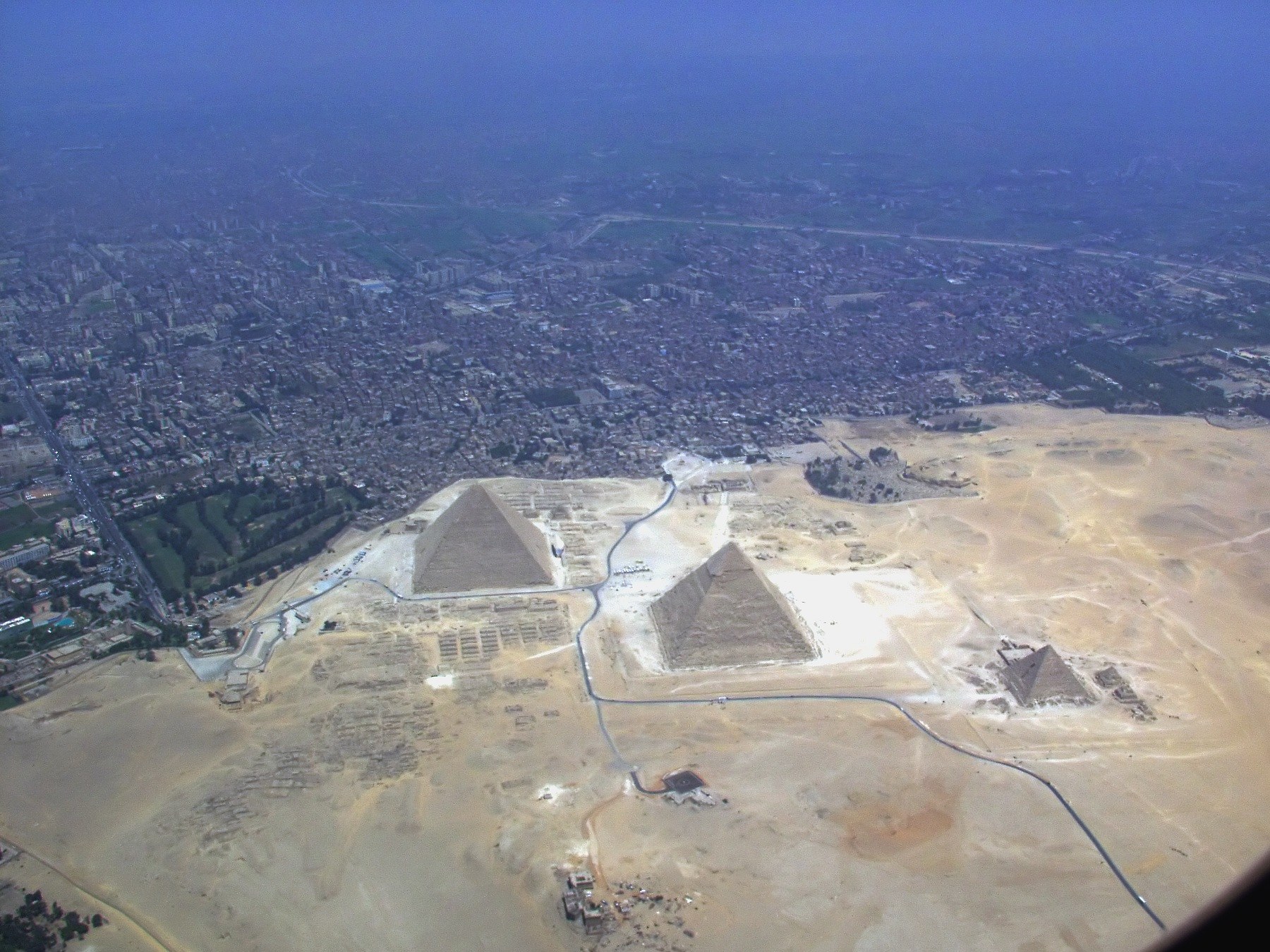 Giza pyramid complex from the air: pyramids of Khufu, Khafre and Menkaure, causeways, temples and cemeteries on the plateau.
Khufu's Pyramid from the Outside
Khufu's pyramid, or the Great Pyramid, was the largest monument at Giza. Its base is almost square and aligned to the cardinal directions with very small error. Today the stepped surface of the core is visible, but originally the pyramid was covered with smooth white Tura limestone casing and finished with a pyramidion at the top.
The mass of the pyramid consists of local limestone quarried near the plateau. Finer casing came from Tura, while granite for the King's Chamber and relieving blocks came from Aswan. This combination of local core and distant prestige materials shows the organisation of the project: builders saved transport where possible and spent enormous effort where strength or visible effect demanded it.
The entrance is on the north side above ground level. The original entrance and the modern visitor route do not fully coincide: part of the accessible path is connected with a later breach. This matters because a modern visit does not necessarily repeat the ancient ritual or construction route.
Interior Structure of the Great Pyramid
Inside Khufu's pyramid are the descending passage, subterranean chamber, ascending passage, Grand Gallery, the so-called Queen's Chamber, King's Chamber and relieving chambers above it. Some of these names are conventional: "Queen's Chamber" does not mean that a queen was buried there. They are useful modern labels for parts of a complex internal system.
The descending passage leads to an unfinished subterranean chamber in the bedrock. From it the ascending passage rises toward the Grand Gallery. The gallery is marked by its high corbelled roof and precise masonry; its purpose is debated, but technically it was an important transition to the upper spaces and probably played a role in closure or the organisation of the burial route.
The King's Chamber is built of granite and contains a plain granite sarcophagus. Above it are relieving chambers that distribute the mass of stone and protect the main chamber from pressure. Small shafts leading from the chambers connect the architecture with ventilation, construction practice or symbolic orientation toward the sky; their exact interpretation remains debated.
The interior of the Great Pyramid shows that builders worked not only with exterior form. They had to coordinate corridors, chambers, roofs, blocking systems and the load of an enormous mass in advance. A disruption in the sequence of work could make the burial chamber inaccessible or damage part of the structure.
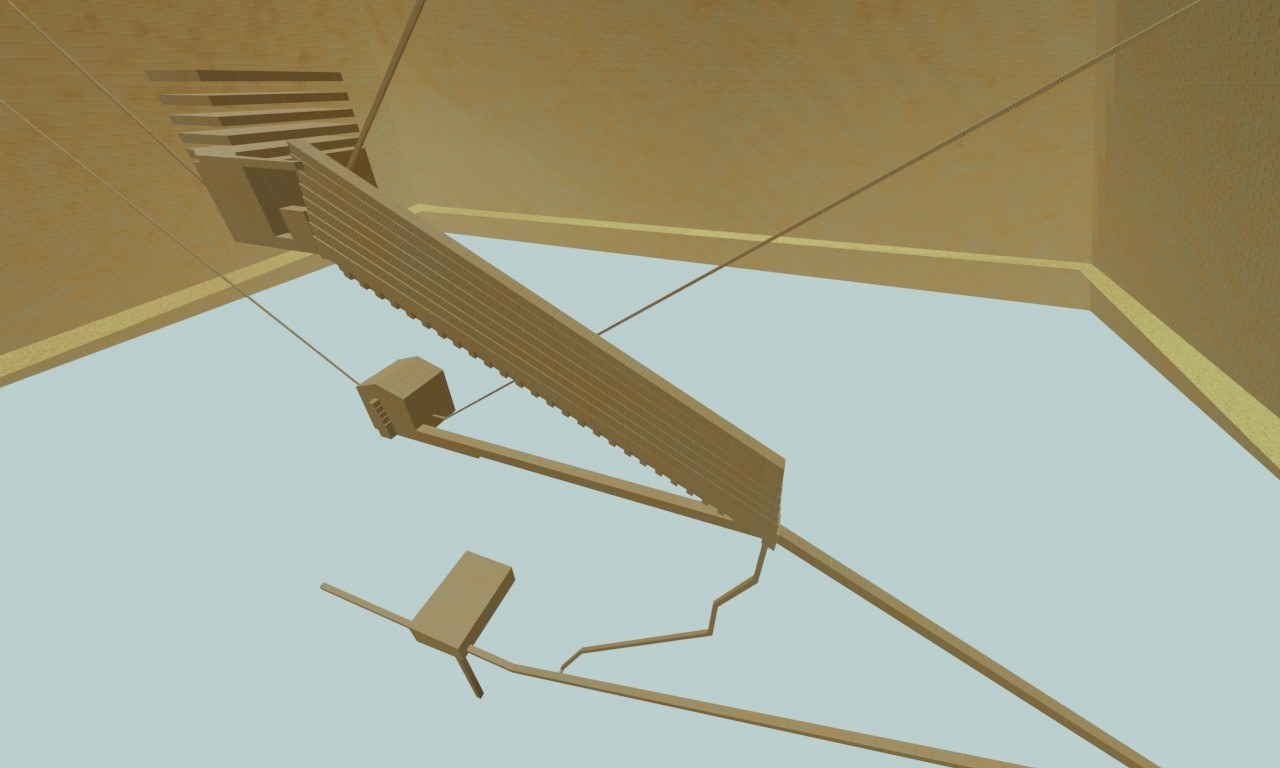 Diagram of the Great Pyramid's internal spaces: descending passage, subterranean chamber, Grand Gallery, Queen's Chamber and King's Chamber. Drummyfish.
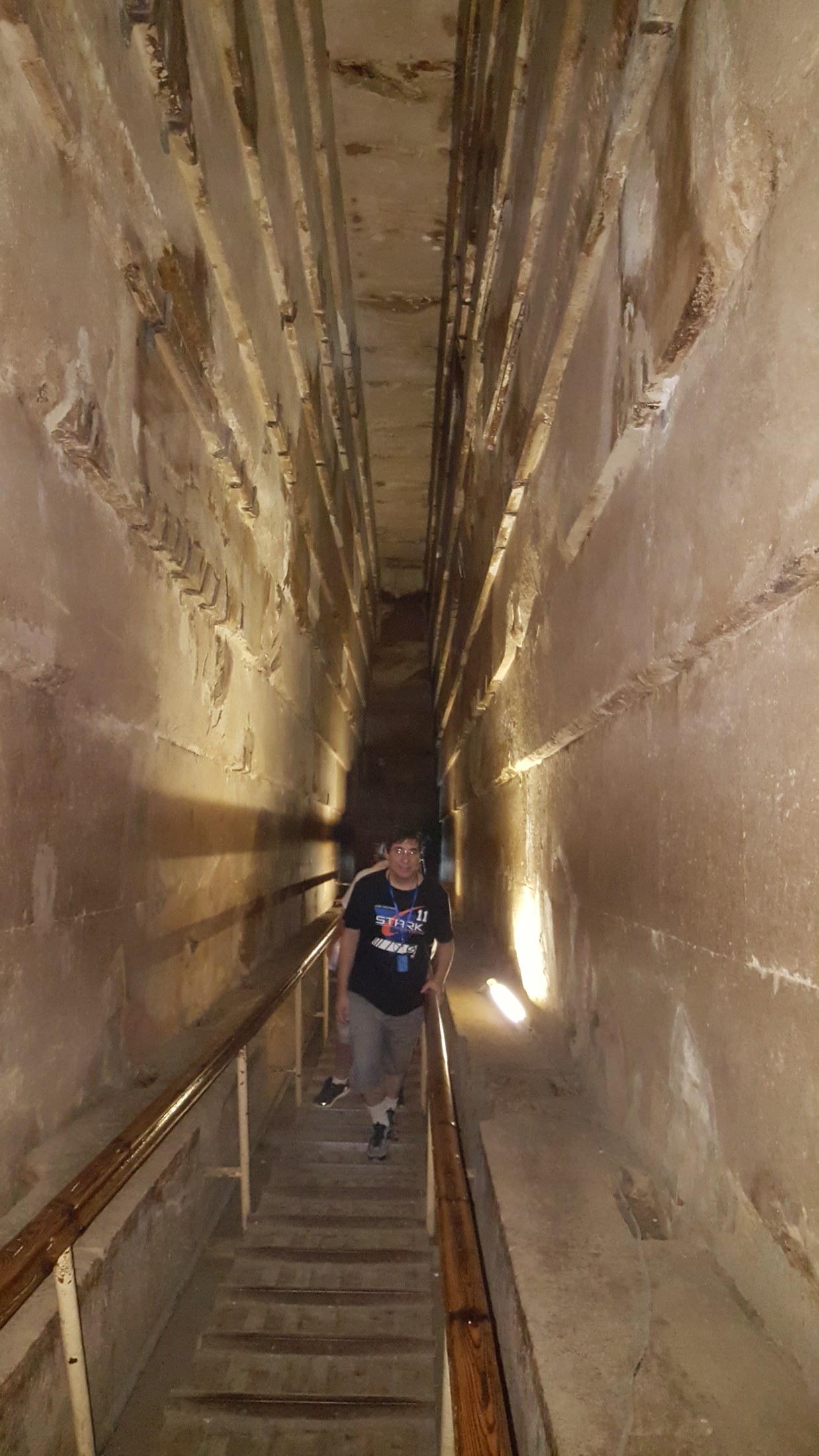 Grand Gallery inside Khufu's pyramid.
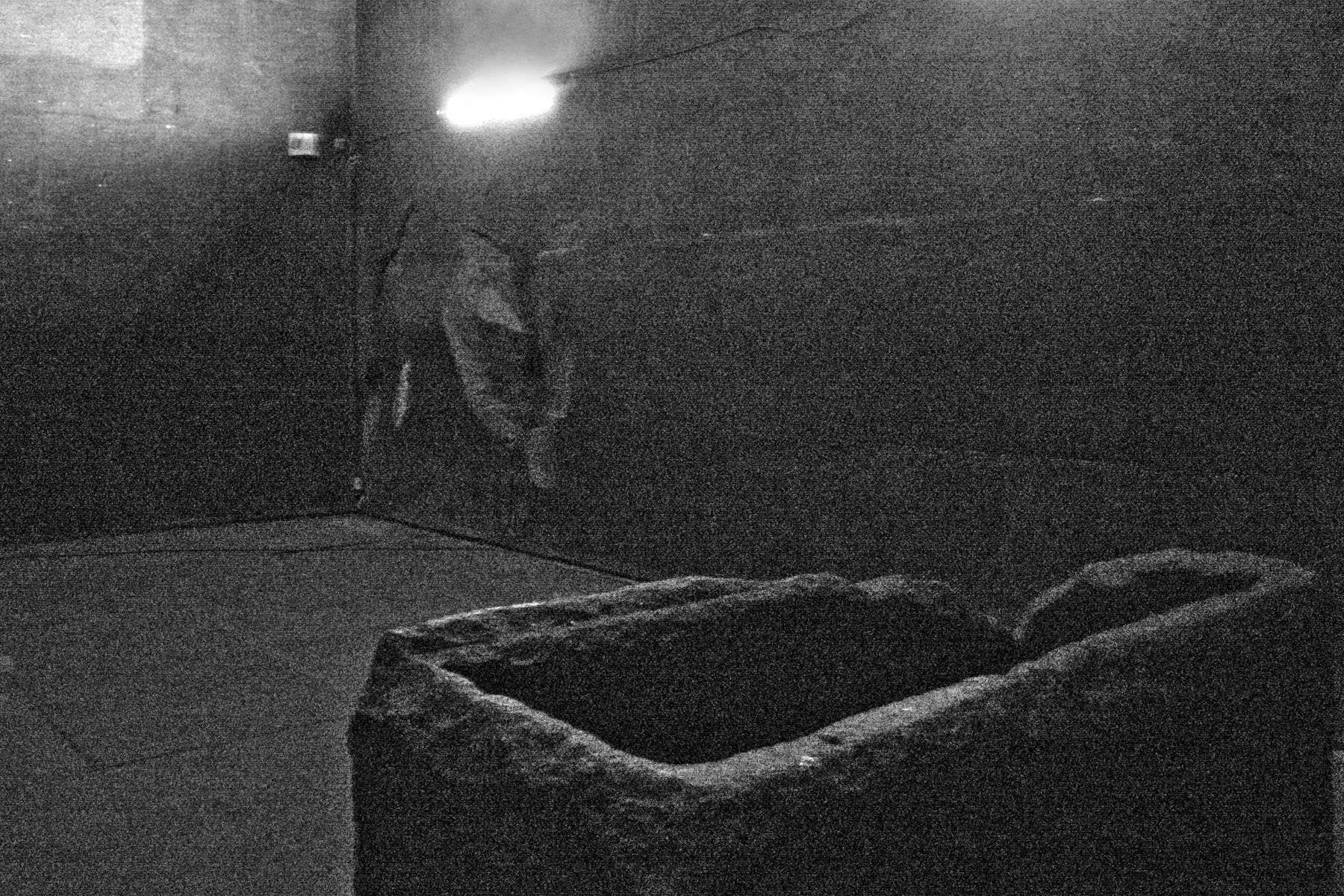 King's Chamber in Khufu's pyramid with granite masonry.
Burial Chamber
The internal passages of the Great Pyramid are narrow, steep and designed not for a grand open procession, but for controlled movement into the monument. After burial part of the system was closed with blocking stones. This distinguishes the inner route of the pyramid from the open causeways and temples outside: cult continued outside, while the king's body had to be protected inside.
The King's Chamber is built of large granite blocks. Granite is heavier and stronger than limestone and was brought from Aswan, showing the special status of the room. The sarcophagus was probably brought in before the upper parts of the pyramid were finished, because its size would have made it difficult to move through the completed narrow passages.
Modern visitors see an empty chamber, but for the ancient complex the emptiness is misleading. The chamber belonged to a closed system with the king's body, coffin, blocking stones, ritual, temple and funerary cult. The absence of a surviving mummy and grave goods is a result of the later history of the monument, not proof that the interior lacked funerary meaning.
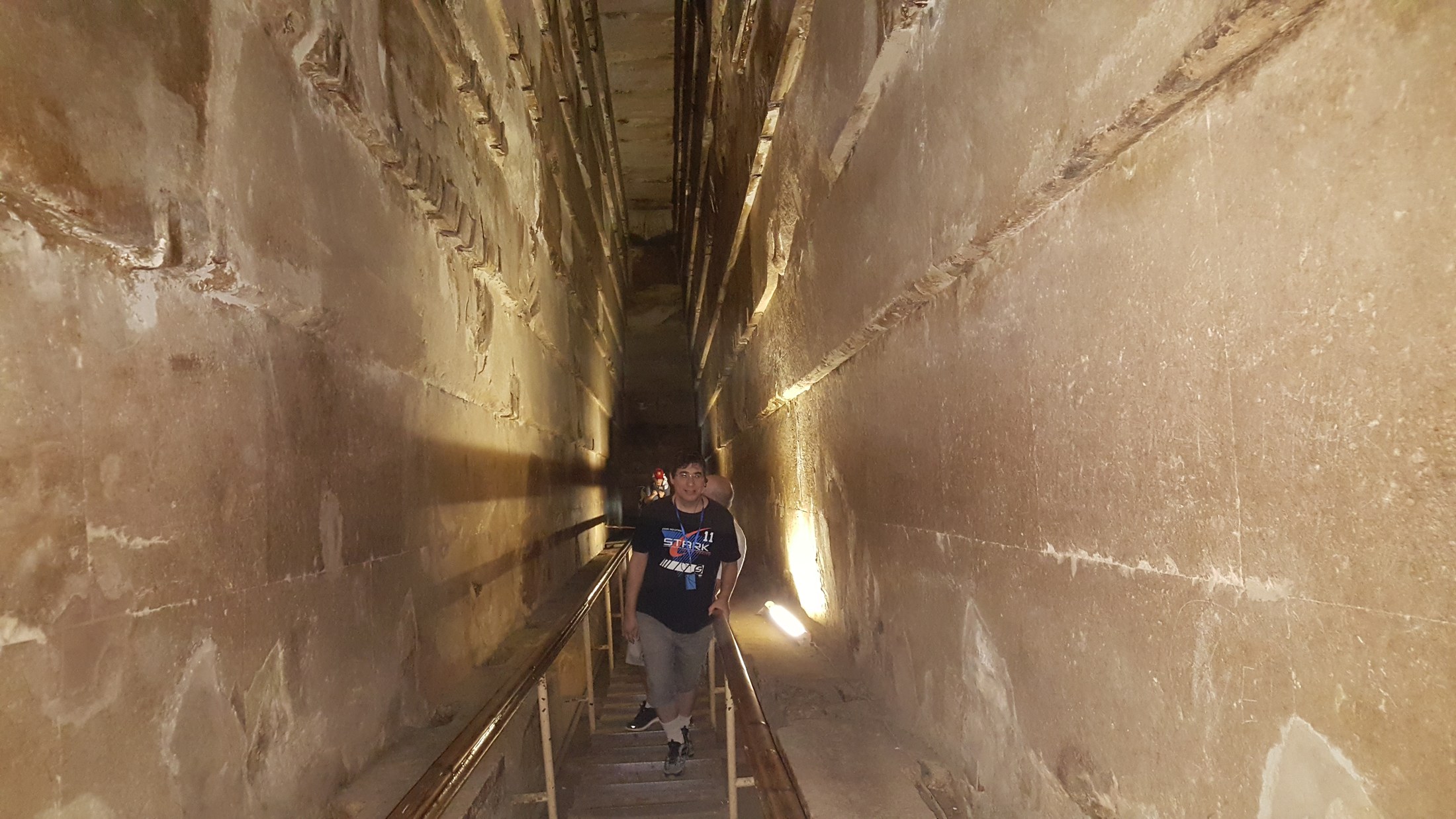 Interior passage of the Great Pyramid: narrow corridors linked entrance, gallery and chambers.
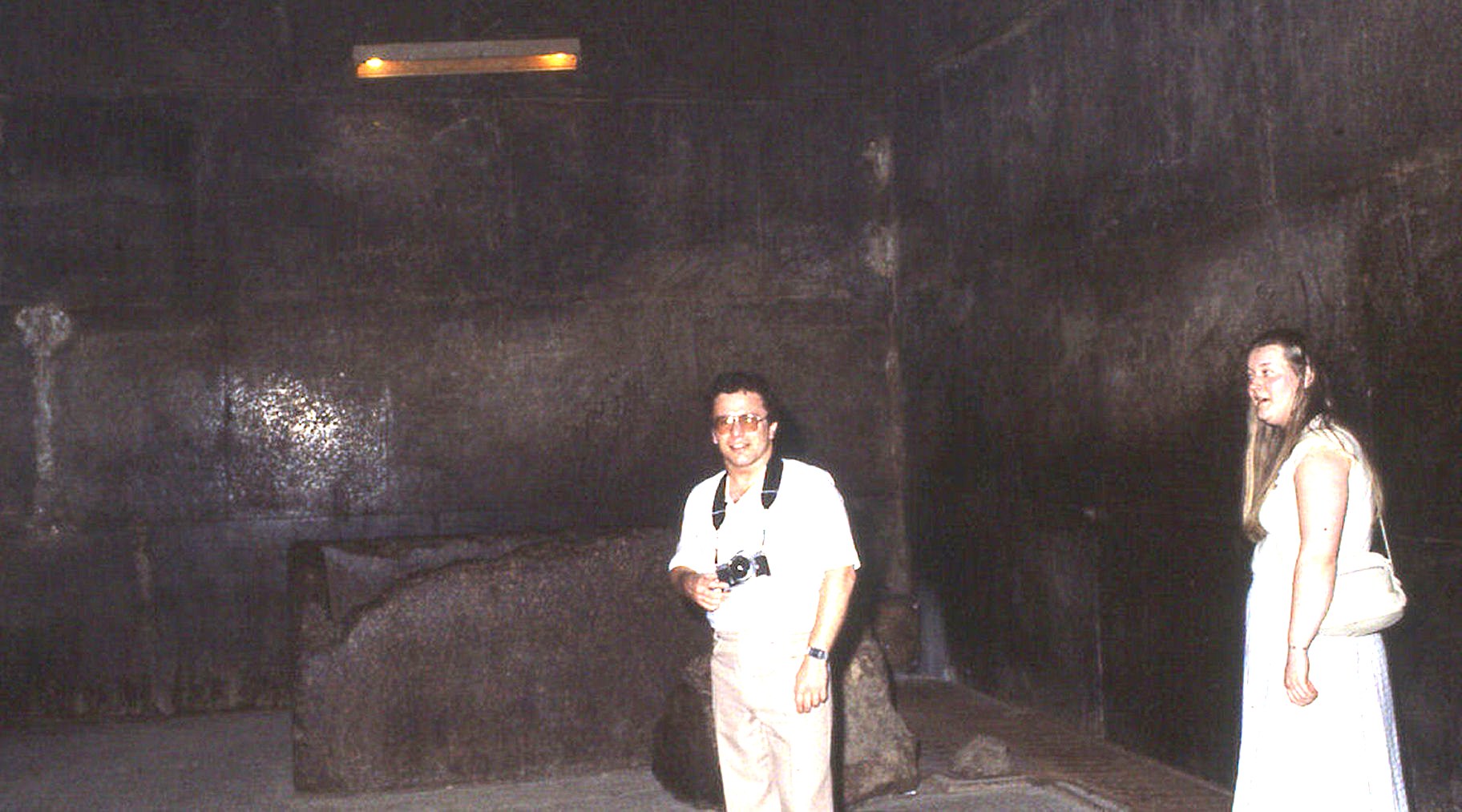 Granite sarcophagus in the King's Chamber of the Great Pyramid.
Khafre's Pyramid and the Sphinx
Khafre's pyramid appears taller than Khufu's because it stands on higher ground and preserves part of its upper casing. In fact it is slightly smaller. Its complex includes mortuary temple, causeway, valley temple and the area of the Great Sphinx. The connection between pyramid, temples and sphinx makes Khafre's complex especially coherent.
The interior of Khafre's pyramid is simpler than that of the Great Pyramid. The main chamber lies below the base level and is partly cut into the bedrock. This is a different engineering solution: instead of Khufu's complex upper system, it makes stronger use of the rock base of the plateau.
The Great Sphinx is carved from the limestone of the plateau and combines a lion's body with a human head. Its connection with Khafre is widely discussed, but within Giza it clearly participates in royal and solar symbolism of protection, horizon and power. Beside it stand the Sphinx temple and Khafre's valley temple, built of huge limestone blocks and cased with granite.
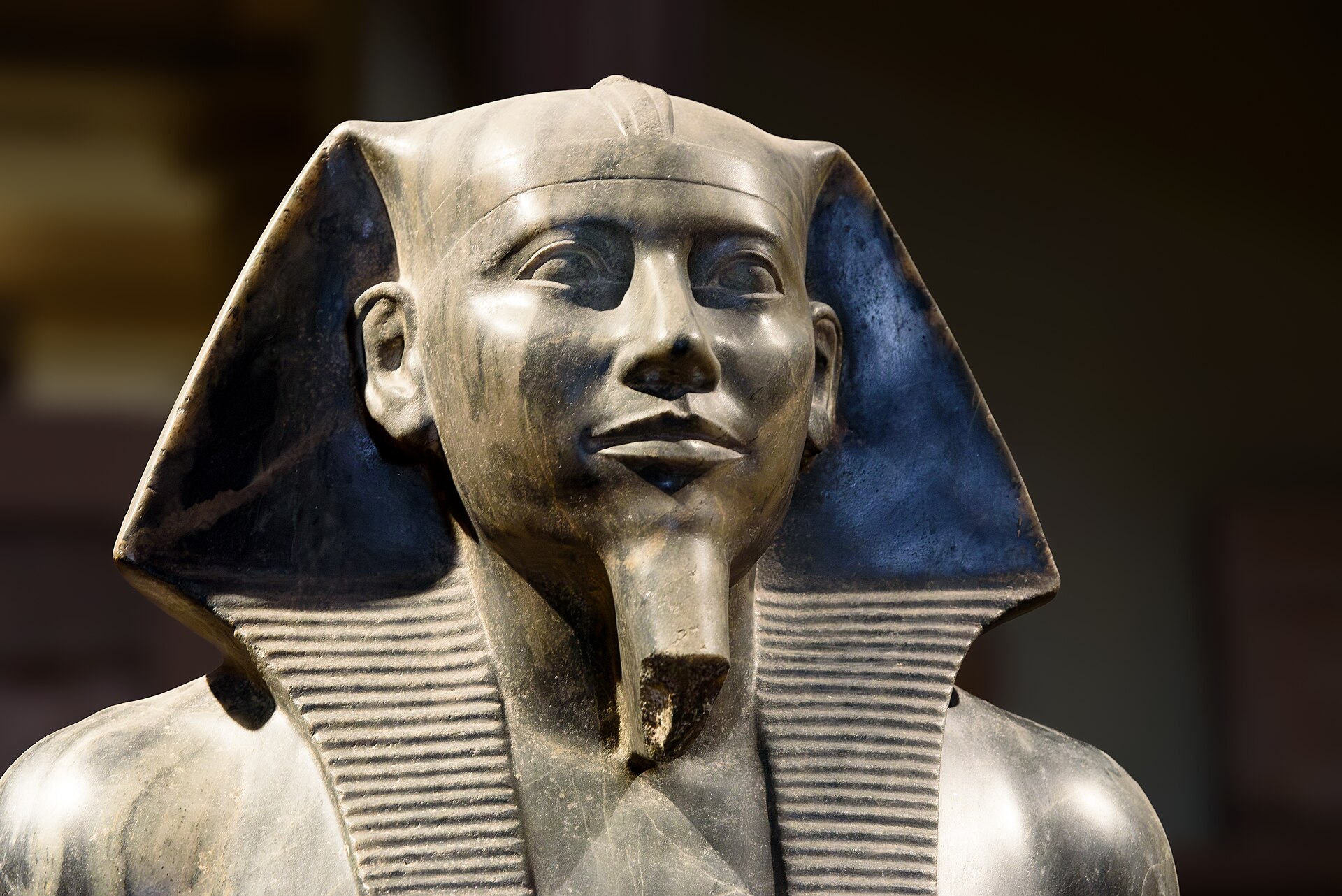 Statue of Khafre from a cache in his valley temple at Giza. Fourth Dynasty, c. 2520-2494 BC; diorite, Egyptian Museum in Cairo.
Menkaure's Pyramid and Smaller Monuments
Menkaure's pyramid is much smaller than those of Khufu and Khafre, but its complex was not secondary. The lower part of the pyramid had granite casing, and Menkaure's temples and statues show the high artistic level of the royal workshop. Reduced size does not mean the disappearance of royal cult: resources, priorities and political circumstances changed.
Inside Menkaure's pyramid are a descending passage, chambers and burial room. The famous basalt sarcophagus of Menkaure was found in the nineteenth century but was lost in a shipwreck on its way to Britain. This episode reminds us that the history of the monument includes not only the Old Kingdom, but also excavation, removal, loss and the museum age.
Near the main pyramids stand queens' pyramids and satellite structures. They are important for understanding the royal family and court: Giza was a dynastic cemetery, not only the site of three royal tombs. Mastabas of officials around the pyramids show how closeness to the king continued after death.
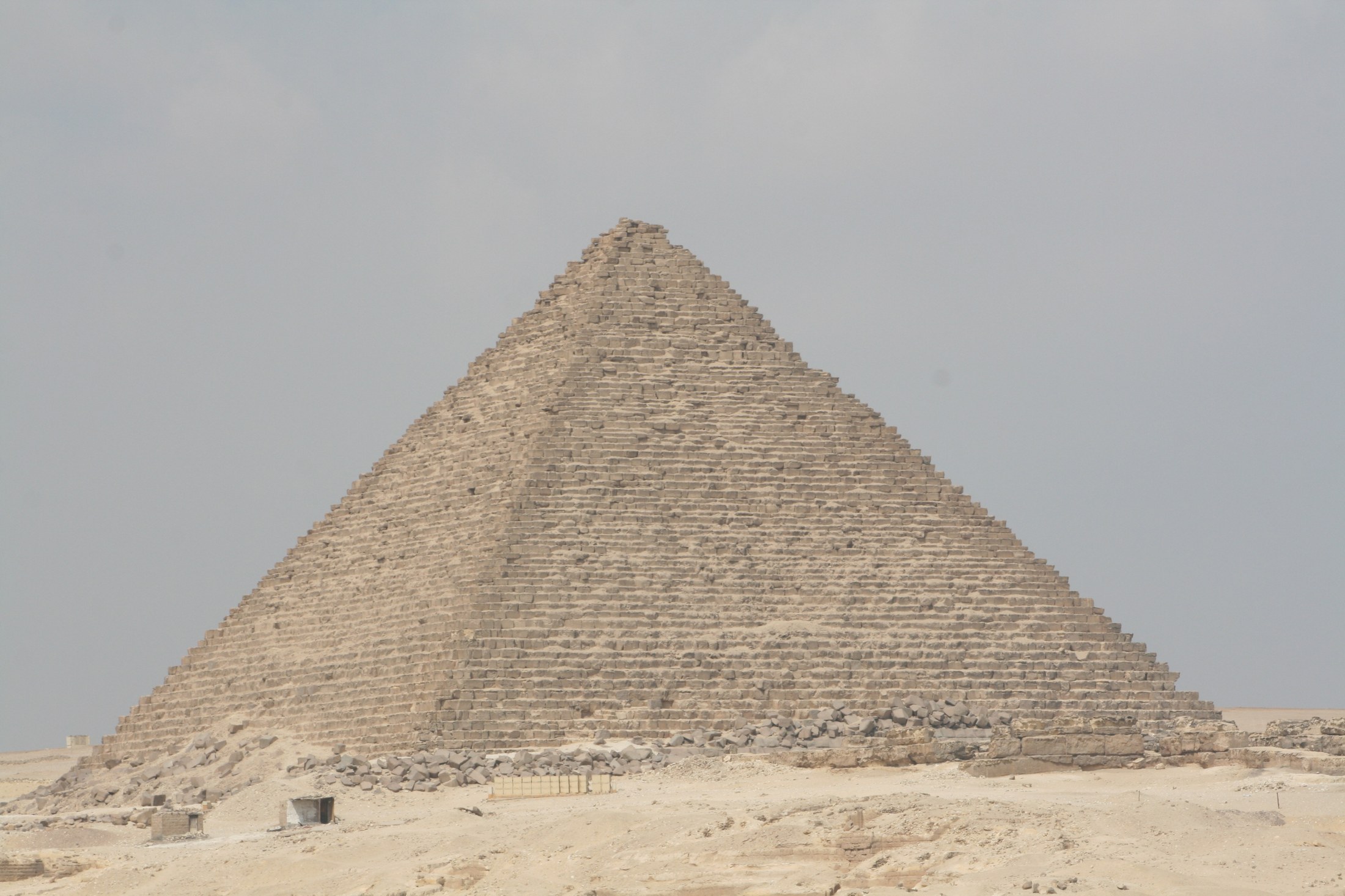 Pyramid of Menkaure at Giza, the smallest of the three main royal pyramids on the plateau.
Boats, Causeways and Funerary Cult
Boat pits were found beside Khufu's pyramid, and one boat survived disassembled. The boat may have been linked with the king's solar journey, funerary transport, ritual procession or several meanings at once. In any case it shows that the pyramid complex was imagined not only as a stone tomb but also as a space of movement.
Causeways between valley and mortuary temples directed processions and the movement of offerings. The external religious life of the complex continued after the inner chambers were closed. Priests, attendants and descendants had to maintain the cult of the dead king, bring food, recite formulae and preserve the name.
Cemeteries around the pyramids linked the king with the elite. Officials, nobles and relatives wanted burial near the royal centre because closeness to the pyramid meant participation in the order of the court and hope for well-being after death. Giza was therefore royal, administrative and familial space at the same time.
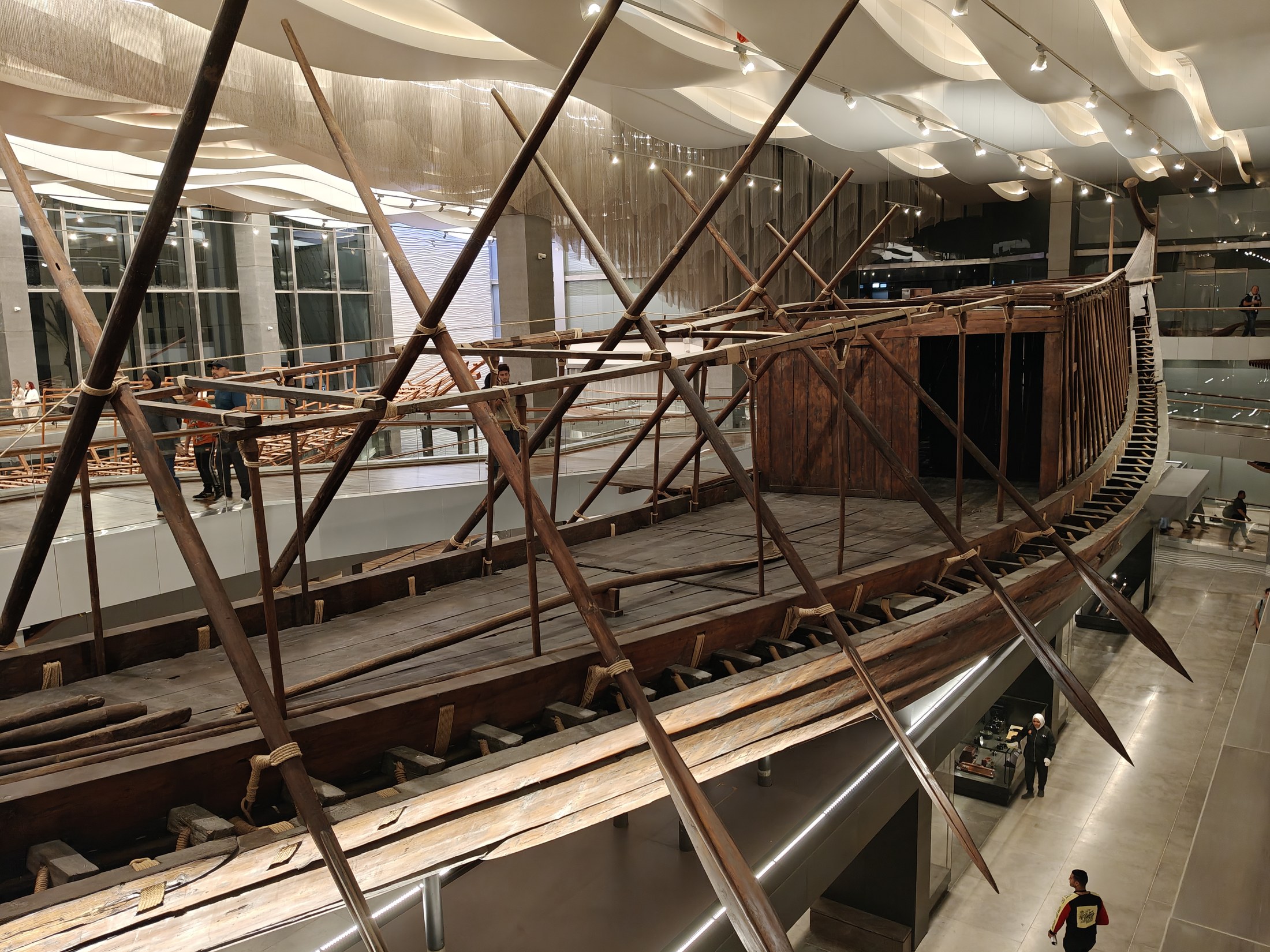 Khufu's boat, found beside the Great Pyramid and now in the Grand Egyptian Museum.
Builders and Traces of Work
Giza preserves traces not only of kings but also of builders. Workers' settlement, bakeries, workshops, cemeteries, animal bones and inscriptions naming crews show an organised labour system. The pyramids were not built by mythical nameless masses, but by managed teams with scribes, overseers, craftsmen, haulers and suppliers.
Core stone was quarried nearby, while finer materials came from farther away. The Wadi al-Jarf papyri connected with Merer's crew refer to the transport of Tura limestone to Giza during the construction of Khufu's pyramid. This is direct evidence for logistics: harbours, canals, accounting and crews were as important as the blocks themselves.
Tool marks, layout traces, blocks of different quality, repair zones and later quarrying help distinguish ancient technology from modern fantasies. Giza does not require explanation through impossible devices: its scale is explained by experience, state organisation, seasonal labour, simple mechanisms and enormous repeated work.
How Giza Is Studied Today
Modern study of Giza combines archaeology, architectural survey, geology, conservation, digital recording, old excavation diaries and laboratory methods. The plan of the plateau is refined through cemeteries, causeways, quarries, settlements, temples and interior spaces. Not only the famous pyramids matter, but also small traces that show how the complex worked.
The interiors of pyramids are studied cautiously because the monuments are fragile and heavily visited. Laser scanning, photogrammetry, endoscopy, robotic study of narrow shafts and non-destructive methods are used. New data may clarify particular voids, corridors or building decisions, but they do not cancel the basic funerary and cultic context of the pyramids.
The main mistake in reading Giza is to look only at exterior form. The plateau must be understood as a system: inner chambers, temples, causeways, sphinx, boats, cemeteries and working zones together explain why this place became the most famous necropolis of the Old Kingdom.
Chronology of the Complex
- c. 2580-2560 BC
- construction of Khufu's pyramid and formation of the largest complex at Giza.
- c. 2550 BC
- Khafre's complex links pyramid, valley temple, causeway and probably the sphere of the Great Sphinx.
- c. 2530-2500 BC
- Menkaure builds a smaller pyramid with temples and granite casing on the lower courses.
- Fifth-Sixth Dynasties
- cemeteries around the pyramids continue to be used by elites, while royal pyramid tradition develops at Saqqara and Abusir.
- New Kingdom and later
- Giza remains a place of memory, visitation, cultic reinterpretation, stone removal and later inscriptions.
- Nineteenth-Twenty-first centuries
- excavation, conservation, museums, survey and non-destructive methods gradually change knowledge of the plateau and its interior spaces.
Related Topics
- Egyptian Pyramids
- Sphinxes of Ancient Egypt
- Old Kingdom Egypt
- Pharaohs of Ancient Egypt
- Mummies of Ancient Egypt
- Ancient Egyptian Religion
Literature and sources
- Lehner M. The Complete Pyramids. London: Thames & Hudson, 1997.
- Lehner M., Hawass Z. Giza and the Pyramids. London: Thames & Hudson, 2017.
- Verner M. The Pyramids: The Mystery, Culture, and Science of Egypt's Great Monuments. New York: Grove Press, 2001.
- Arnold D. Building in Egypt: Pharaonic Stone Masonry. Oxford: Oxford University Press, 1991.
- Tallet P. Les papyrus de la mer Rouge I: Le journal de Merer. Cairo: Institut francais d'archeologie orientale, 2017.
- Excavation of the Giza workers’ settlement: AERA
Interested in Ancient Rome beyond reading? Join Legio X Fretensis or explore our reenactment directions.


