Sphinxes of Ancient Egypt
Sphinxes of Ancient Egypt are not enigmatic monsters in the Greek sense, but above all royal and sacred images of protection. The Egyptian sphinx usually combines the body of a lion with the head of a pharaoh, god or sacred animal. It stands on a boundary: between desert and valley, temple and road, necropolis and world of the living, earthly king and solar power.
In Greek tradition the sphinx became a creature of riddle and threat to the hero. In Egypt the meaning is different: the sphinx guards, marks strength, presents the king as a lion and connects the monument with the horizon of the sun. Egyptian sphinxes should therefore be read together with royal portraiture, temple roads, solar mythology and lion imagery in religion.
Mythology: Lion, King and Horizon
The main mythological basis of the sphinx is the union of human intelligence and royal name with the bodily force of the lion. In Egyptian thought the lion is linked with the desert edge, heat, danger, protection and solar power. When the pharaoh receives a lion's body, he does not become an animal; he becomes a living image of power able to lie at the boundary and keep chaos out.
The sphinx looks forward and guards space. Its stillness matters: this is not a hunting scene or a heroic episode, but the permanent presence of force. In this image the king can be seen as protector of temple, necropolis and processional road. Sphinxes therefore often stand by roads, gates, temples and funerary complexes.
The solar meaning is especially visible at Giza. The Great Sphinx faces east, toward sunrise, and in the New Kingdom was connected with Horemakhet, Horus in the Horizon. For Egyptians the horizon was not simply a line in the landscape, but the place where the sun appears and disappears, a passage between worlds and a renewal of royal force.
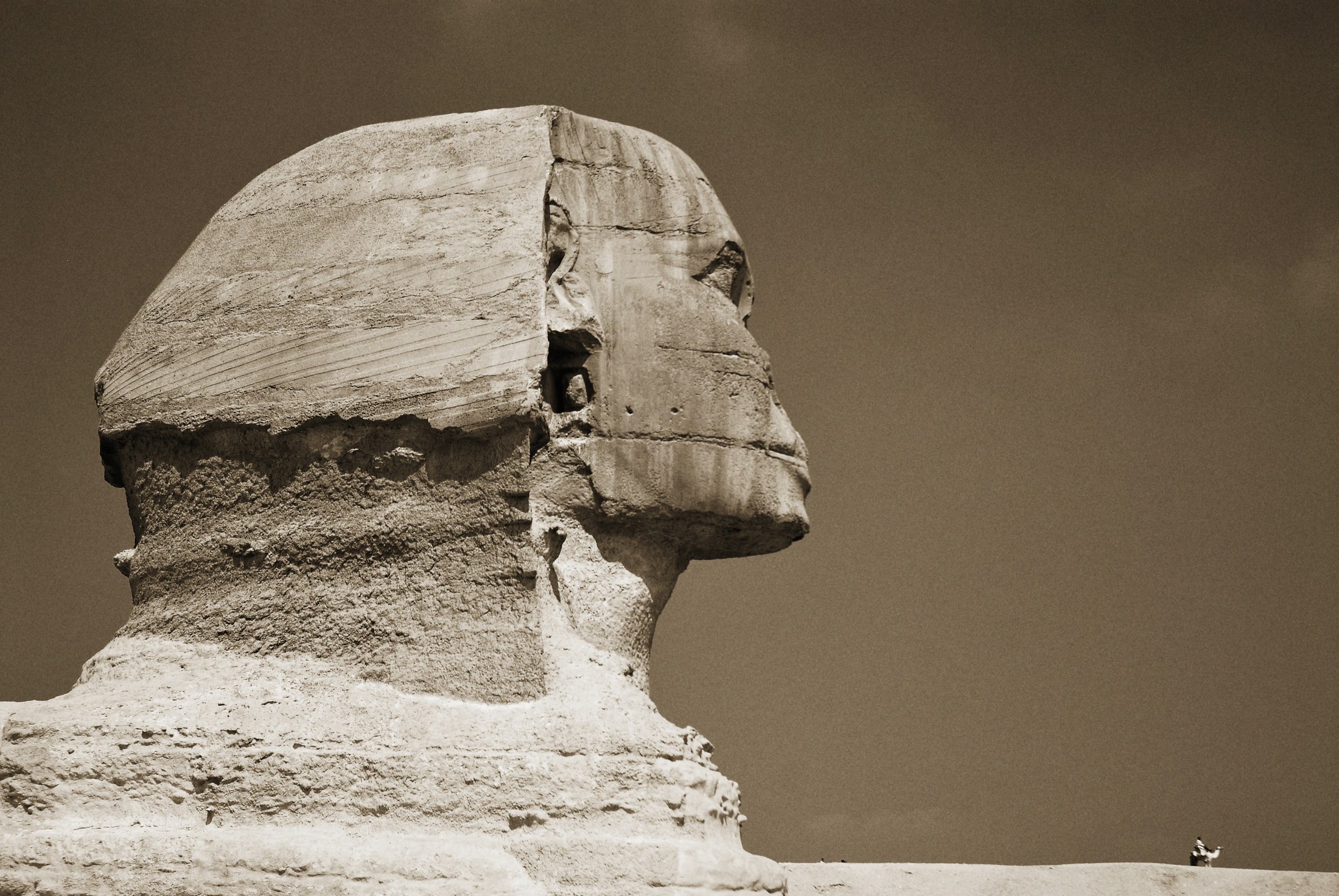 Great Sphinx at Giza: royal head and lion body as an image of guarding the necropolis and solar horizon.
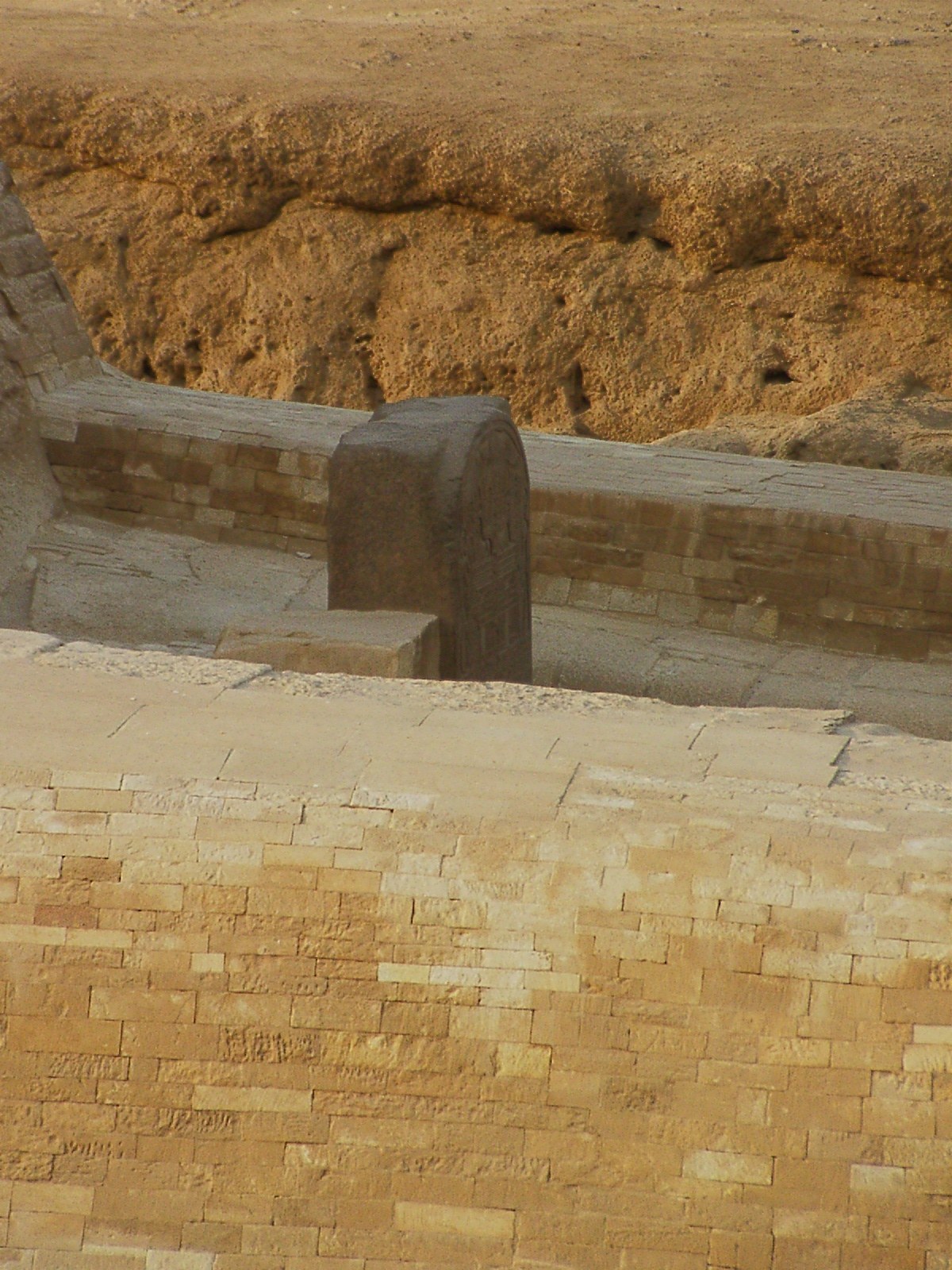 Dream Stela of Thutmose IV between the paws of the Great Sphinx.
The Great Sphinx at Giza
The best-known Egyptian sphinx stands on the Giza plateau. It was carved from limestone bedrock left during the working of the plateau and is connected with the royal complex of the Fourth Dynasty. Its face is often associated with Khafre because the sphinx lies beside the causeway and temple area of Khafre's complex, although details of dating and interpretation remain debated.
The Great Sphinx was not an isolated statue in the museum sense. It belongs to an architectural landscape: in front of it are the Sphinx temple and Khafre's valley temple, behind it rises the plateau with the pyramids. Its body was cut from living rock, and parts including paws and casing were repaired in antiquity. This was a monument that required care from the beginning.
In the New Kingdom the sphinx became an object of special veneration. The Dream Stela of Thutmose IV was set between its paws: the text tells how the young prince slept by the sphinx, received a promise of kingship and cleared the monument of sand. This story matters not as simple biography but as a myth of legitimate power revealed through an ancient solar image.
Royal Portrait and Power
The sphinx often bears the face of a particular ruler. Nemes headdress, royal beard, uraeus, calm frontality and lion body turn portrait into political formula. The pharaoh is shown not merely as a man, but as a being that joins intelligence, name, predator body and divine protection.
A female ruler could also use this image. The sphinxes of Hatshepsut from Deir el-Bahri show that royal iconography could place a female pharaoh within the traditional language of power. The lion body does not "hide" gender here; it includes Hatshepsut in the form of a legitimate king, protector of the temple and participant in solar order.
Sphinxes of Thutmose III, Amenhotep III and other kings show the same idea at different scales: from monumental sculptures to small models and temple details. Even a small sphinx need not be a toy, but a condensed sign of royal force placed in a cultic or architectural context.
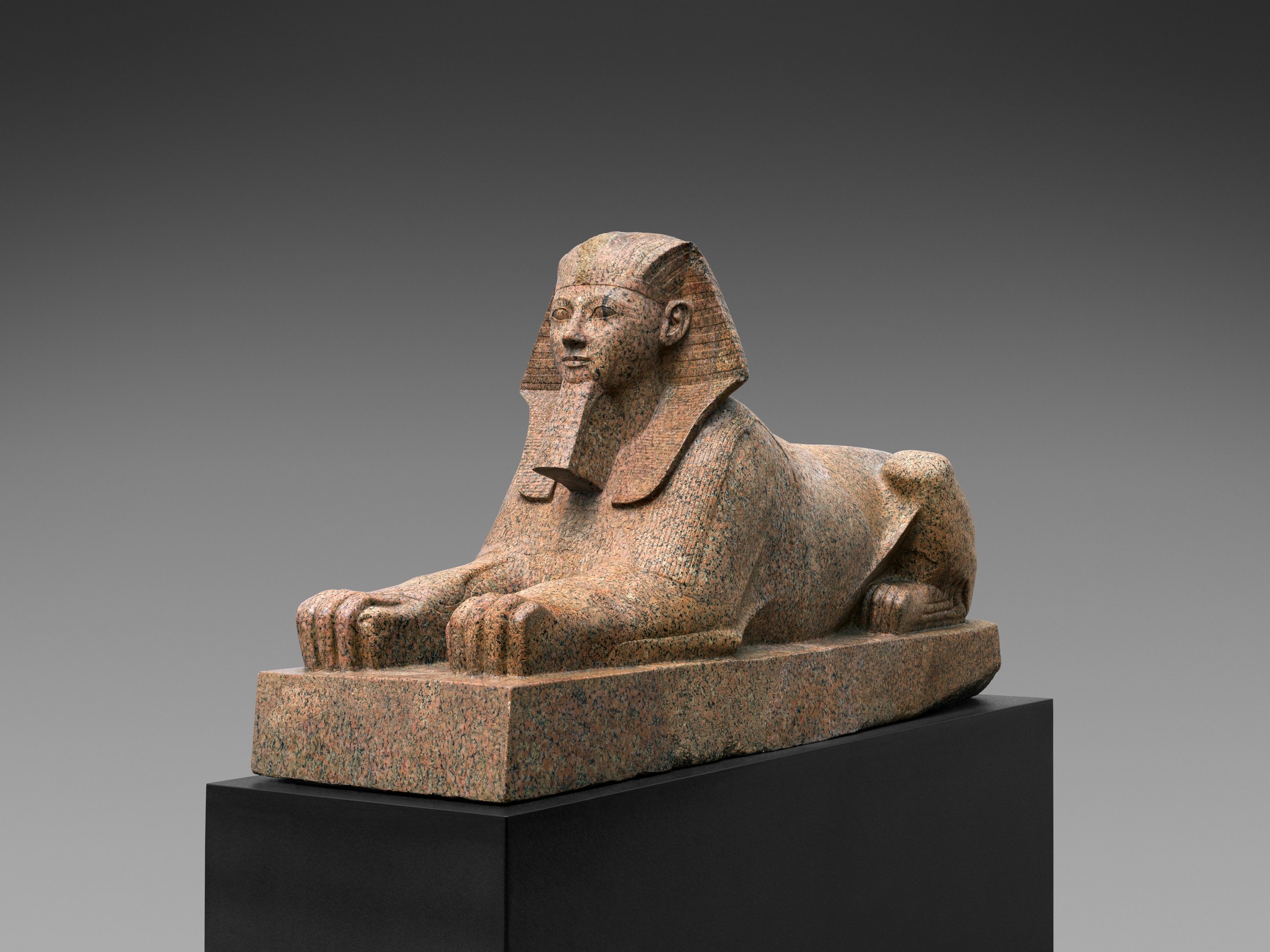 Sphinx of Hatshepsut from Deir el-Bahri. Dynasty 18, ca. 1479-1458 BC; Metropolitan Museum of Art.
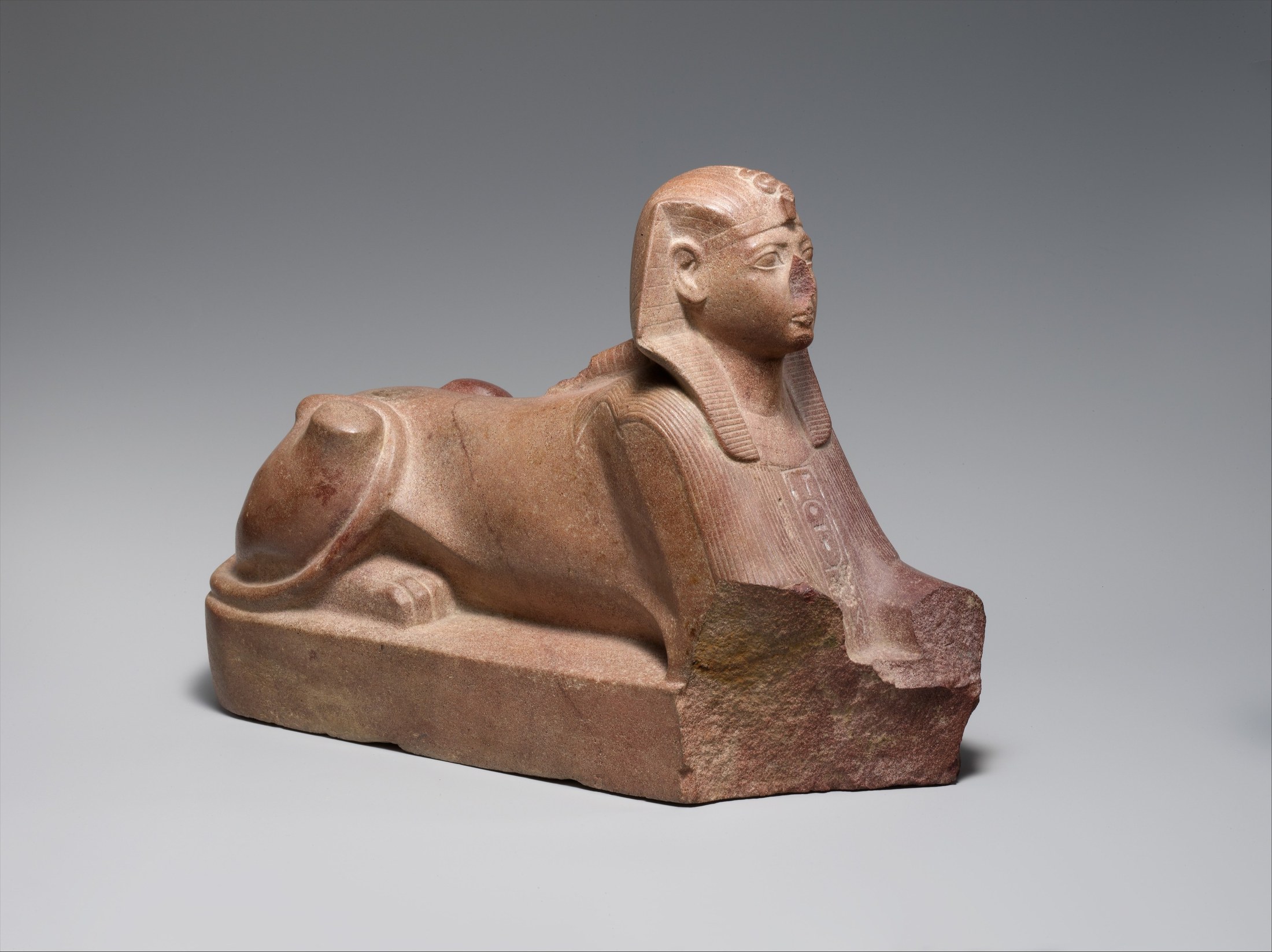 Sphinx of Thutmose III. Dynasty 18, ca. 1479-1425 BC; Metropolitan Museum of Art.
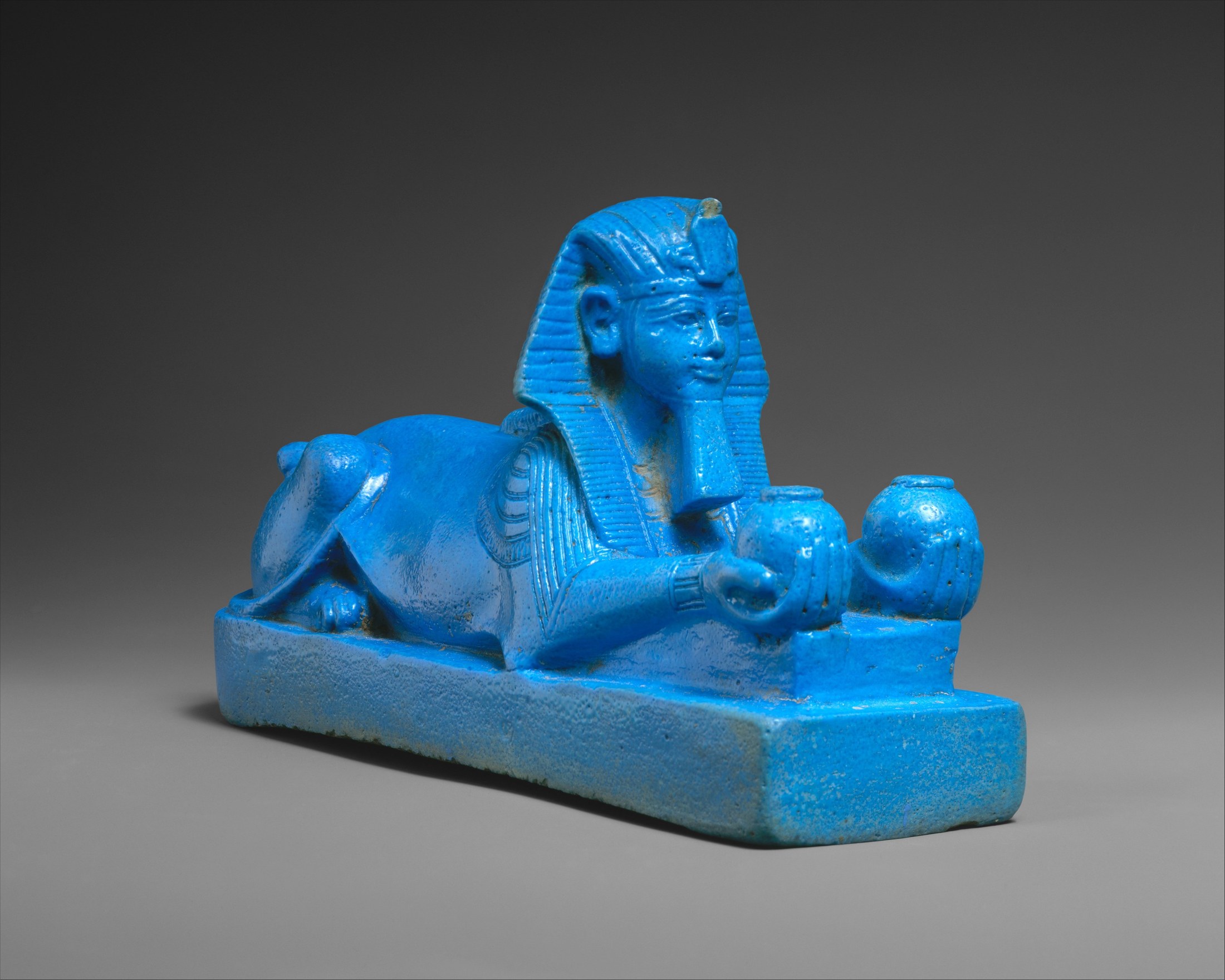 Sphinx of Amenhotep III, possibly from a model of a temple. Dynasty 18, ca. 1390-1352 BC; Metropolitan Museum of Art.
Types of Sphinxes
The human-headed sphinx is the best-known type, but not the only one. Egyptians created ram-headed sphinxes linked above all with Amun, as well as forms with falcon heads or other sacred animals. In such cases the lion body remained a sign of force, while the head specified which divine or royal energy the monument expressed.
The ram-headed sphinxes of Karnak are especially important. The ram was the animal of Amun, and an avenue of such sphinxes turned movement toward the temple into a path under the god's protection. A small figure of the king could be placed between the sphinx's paws: this showed that the ruler was under Amun's protection and at the same time participated in his cult.
Portable and small sphinxes also existed: amulets, models, decorative elements of barques, furniture and temple objects. They show that the sphinx was not only a monument like Giza, but also a sign that could be inserted into many material forms.
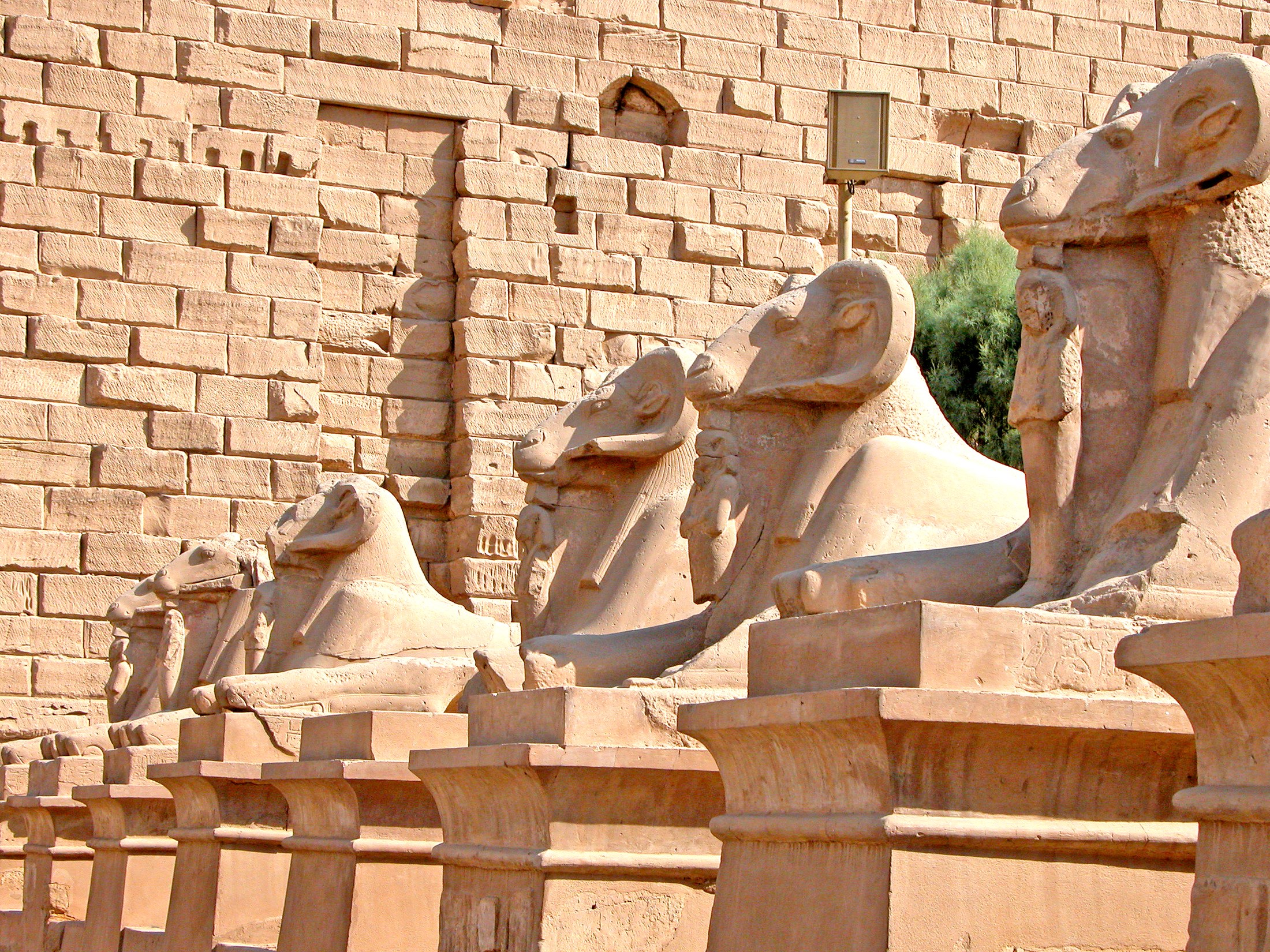 Ram-headed sphinxes at Karnak, connected with the cult of Amun.
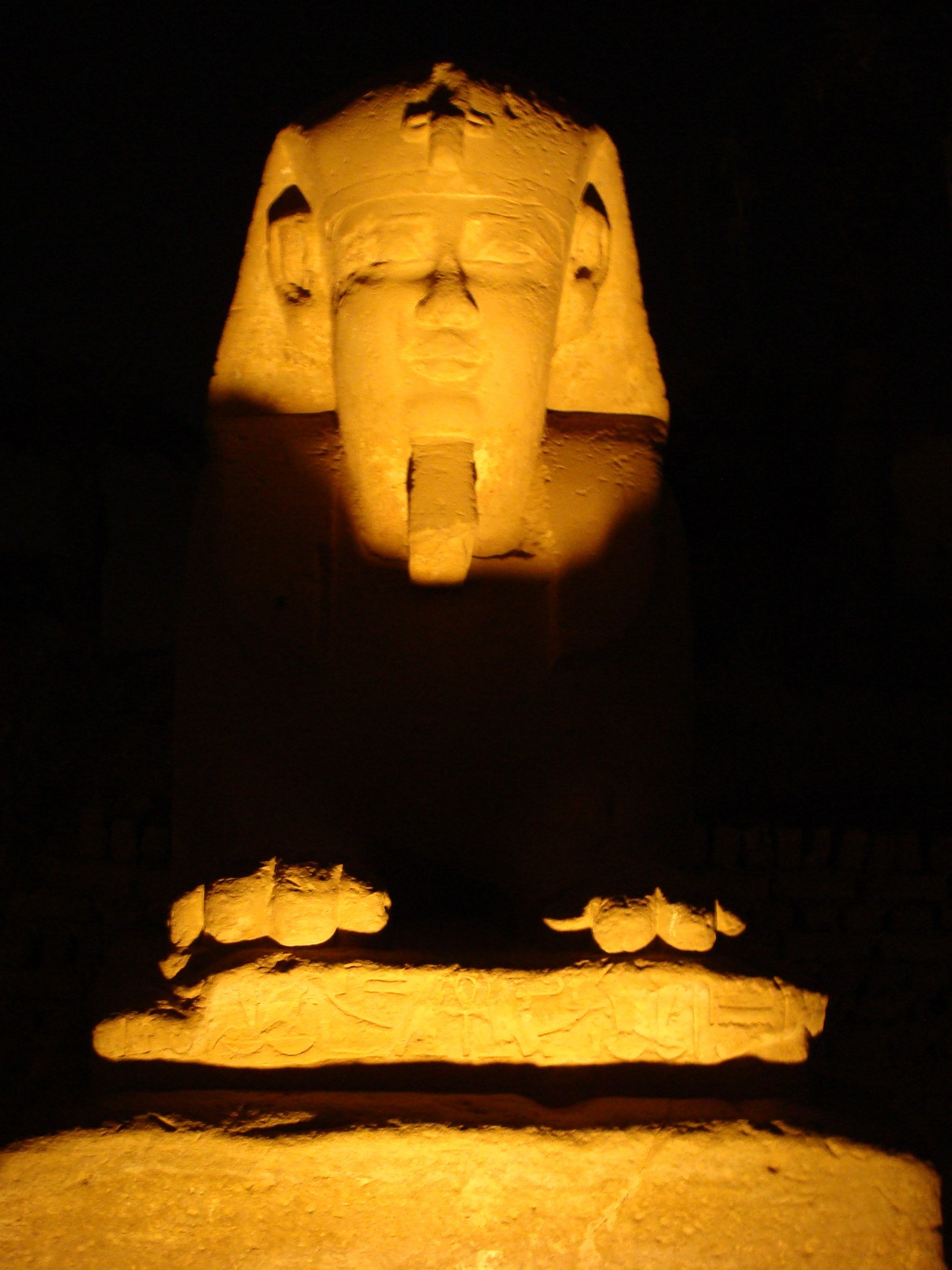 Avenue of sphinxes at Luxor Temple: sphinxes directed processions and linked sanctuaries.
Avenues, Temples and Processions
In temple architecture sphinxes often formed avenues. They did not merely decorate the road but created a sacred corridor of movement. A procession, divine bark, priests, king and festival participants passed between repeated figures as if entering a space guarded by divine and royal force.
Avenues of sphinxes are especially known at Thebes. Roads between Karnak and Luxor linked temples with festivals of Amun, Mut and Khonsu. In this context the sphinx works as architectural rhythm: repeated figures intensify the sense of order, direction and solemn approach to the sanctuary.
Sphinxes at gates and temples also protected thresholds. Egyptian religion paid great attention to boundaries: temple entrances, passages to sanctuaries, roads to necropoleis, horizons and the edge of the desert. As a boundary creature the sphinx suited such places perfectly.
Sphinxes Beyond Giza
Giza does not exhaust the history of Egyptian sphinxes. At Memphis, Tanis, Karnak, Luxor, Deir el-Bahri and other places sphinxes appeared in different scales and materials. Some stood by temples, others formed part of royal statuary, and still others were reused by later rulers and received new inscriptions.
The Great Sphinx of Tanis is especially revealing. It is connected with a long history of reuse: such monuments could carry the names of several kings because a later ruler appropriated the ancient authority of the image. This was not simply the theft of stone, but a way of inserting oneself into the memory of older royal power.
The alabaster sphinx from Memphis shows another side of the tradition: a sphinx could be connected with the old capital, Ptah, the royal court and a temple setting. Such monuments remind us that the sphinx was a pan-Egyptian image, not only the symbol of one plateau.
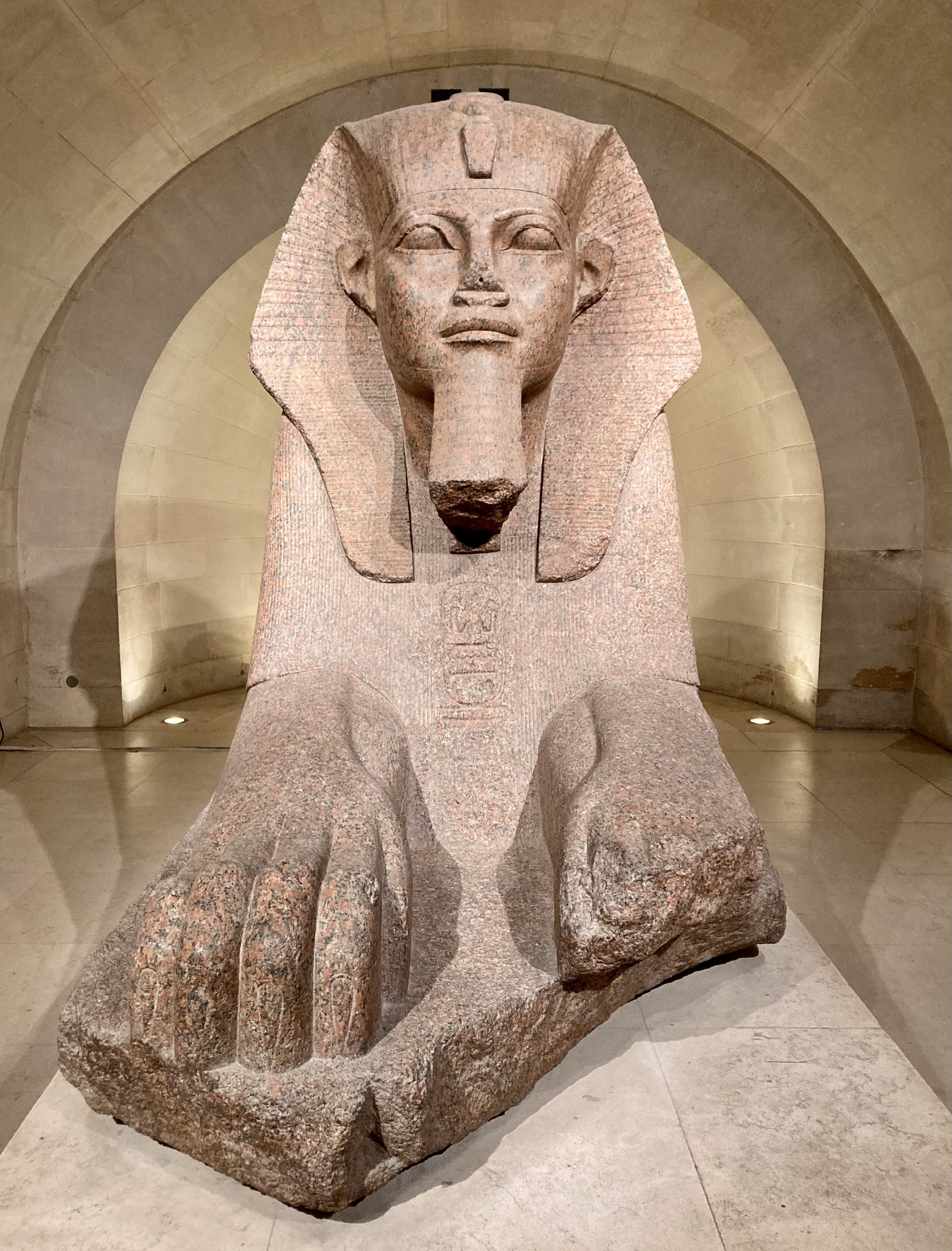 Great Sphinx of Tanis in the Louvre. The monument was reused and bears names of different pharaohs;.
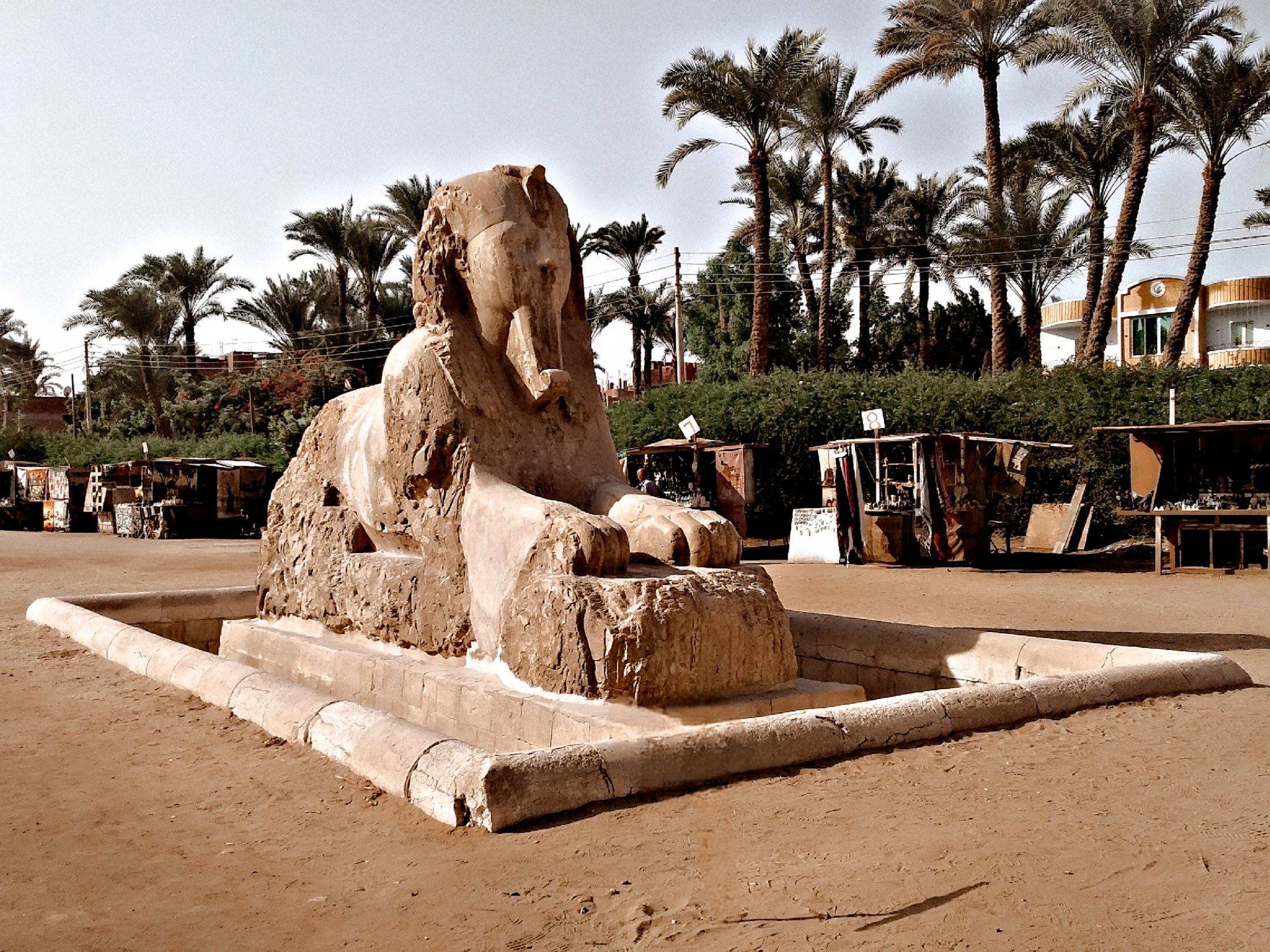 Alabaster sphinx from Memphis, probably New Kingdom or later royal tradition.
Greco-Roman Mythology
In Greek mythology the sphinx became a different image. It was no longer a calm royal guardian by a temple or necropolis, but a dangerous being at the boundary of a city and a road. The best-known story is connected with Thebes: the sphinx asked travellers the riddle of man, killed those who could not answer and was defeated by Oedipus. After the correct answer the monster dies and the hero gains power over the city. In this myth the wings, female head and lion body matter, but so does the test itself: before entry into human order stands a being that tests intelligence.
The Greek sphinx is usually female and winged. In vase-painting and relief it may sit on a column, tomb marker or rock, attack a youth or act as a boundary sign. Its image stands close to other monsters of the Greco-Roman world: like Medusa Gorgon, it combines terror with the protective power of an image; like Sirens or Centaurs, it shows the danger of a being that crosses ordinary human and animal boundaries. In Greek art the sphinx is often not merely a character in a story, but an independent sign of death, riddle, protection and transition.
The Romans inherited both layers. Roman art used Greek mythological sphinxes, decorative sphinxes on furniture, frescoes, mosaics and sarcophagi, and, after the conquest of Egypt, Egyptian or Egyptianising sphinxes in gardens, sanctuaries of Isis and imperial decorative settings. The Greco-Roman sphinx should therefore not be read automatically as a continuation of one Egyptian type. In Egypt it more often expresses royal and temple protection; in Greek myth it means riddle, danger and heroic victory; in the Roman world both meanings could stand together as part of a wider taste for Egyptian imagery.
How Sphinxes Are Studied
Sphinxes are studied through archaeological context, style, inscriptions, traces of repair, stone geology and position in architecture. For the Great Sphinx, the limestone layers of the plateau, ancient repairs, sand burial, the Dream Stela and connection with the temple zone matter. For museum sphinxes, findspot, royal name, material and history of reuse are essential.
The difficulty is that many sphinxes were moved. Some stand in museums, others lost their original location, and still others received later inscriptions or restorations. A photograph without caption can therefore mislead: date, material, ruler's name and original architectural context are needed.
Good study of a sphinx joins mythology and practice. Lion and horizon explain the meaning, but stone, erosion, repair, road, temple and inscription show how that meaning worked in a particular place.
Chronology
- Old Kingdom
- the Great Sphinx at Giza forms the major image of the royal sphinx in the Fourth Dynasty necropolis.
- Middle Kingdom
- royal sphinxes become an important form of portrait and power, especially in the statuary tradition of the Twelfth Dynasty.
- New Kingdom
- the sphinx receives new cults and interpretations; the Dream Stela of Thutmose IV links Giza with legitimate kingship.
- Eighteenth Dynasty
- Hatshepsut, Thutmose III and Amenhotep III use the sphinx image in temple and royal iconography.
- Later periods
- sphinx avenues, ram-headed forms and reuse of older monuments show the long life of the image.
- Greco-Roman world
- the sphinx motif spreads more widely around the Mediterranean, but receives different stories, including the Greek account of Oedipus.
Related Topics
- Pyramids of Giza
- Egyptian Pyramids
- Pharaohs of Ancient Egypt
- Ancient Egyptian Religion
- Gods of Ancient Egypt
- Temples of Ancient Egypt
- Greek Mythology
Literature and sources
- Lehner M. The Complete Pyramids.
- Lehner M., Hawass Z. Giza and the Pyramids.
- Wilkinson R. H. The Complete Temples of Ancient Egypt.
- Wilkinson R. H. The Complete Gods and Goddesses of Ancient Egypt.
- Assmann J. The Search for God in Ancient Egypt.
- Metropolitan Museum of Art collection: Sphinx of Hatshepsut, Sphinx of Thutmose III, Sphinx of Amenhotep III.
- Wikimedia Commons: Great Sphinx close view, Dream Stela, ram-headed sphinxes at Karnak, Avenue of Sphinxes at Luxor, Great Sphinx of Tanis, Alabaster Sphinx of Memphis.
Interested in Ancient Rome beyond reading? Join Legio X Fretensis or explore our reenactment directions.


