Ancient Egyptian religion
The religion of ancient Egypt was a system of local cults, royal rituals, myths about the gods and ideas about the fate of the dead. Egyptians did not have a single sacred book: the traditions of Heliopolis, Memphis, Thebes, Abydos, Dendera, Edfu and other centres could explain creation and divine kinship in different ways. What held them together was the need to maintain maat, the proper order of gods, king, people and nature.
Religious life was visible not only in temples. It shaped royal ideology, funerary rites, amulets, calendrical festivals, domestic appeals to the gods and everyday care for the dead. Egyptian religion is therefore best understood as a practice that connected the state, the family, the economy, writing and art.
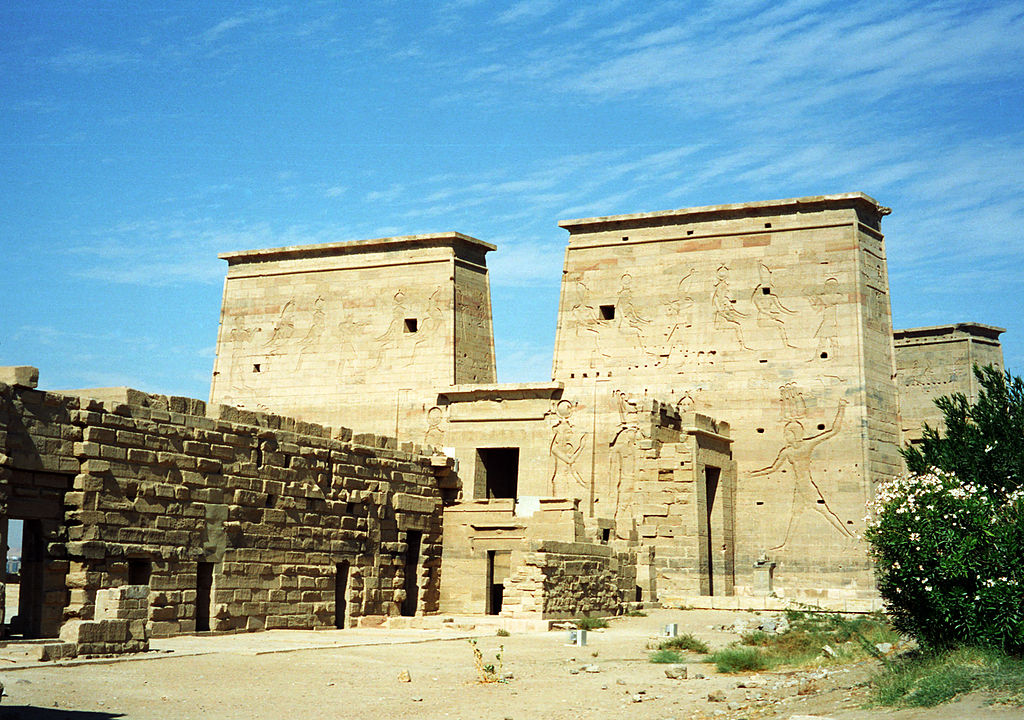 The Philae temple complex, chiefly the sanctuary of Isis. Its Late Egyptian, Ptolemaic and Roman phases show the continuation of temple tradition after the pharaonic period.
Gods and Local Cults
The Egyptian pantheon included gods with different fields of action: Ra was linked with the sun and kingship, Osiris with the dead and rebirth, Isis with protection and motherhood, Horus with the king and victory, Anubis with funerary ritual, Amun with Thebes and later with empire-wide power, Ptah with Memphis and creative craftsmanship, Thoth with writing, counting and knowledge, and Hathor with joy, music, love and the western mountain of the necropolis. The individual gods are discussed in more detail in Egyptian gods.
A god could have several forms and names. The sun god could appear as Ra, Atum, Khepri or Amun-Ra; a goddess could combine the roles of mother, wife, protector and dangerous power. This was not treated as a contradiction: mythological language allowed one deity to act in different states of the world.
Temples, Priests and Daily Ritual
A temple was not a congregation hall in the modern sense but the house of a god. Its inner rooms held the cult statue, approached by the king and priests. The daily ritual involved opening the shrine, washing and dressing the statue, presenting offerings, reciting formulas and closing the sanctuary for the night. Outer courts, processions and festivals connected the temple with the town and its countryside.
Priests did not form a wholly separate caste. Many served in rotating teams and then returned to economic or administrative duties. Large temples employed scribes, musicians, singers, craftsmen, storekeepers and staff responsible for fields, herds and workshops. The priests of ancient Egypt were therefore part of a large temple economy.
Maat, Pharaoh and Power
The pharaoh was regarded as the chief mediator between people and gods. Ideally he offered gifts to the gods, defeated chaos and restored maat to the land. In practice most rituals were performed by priests in the king's name, but temple reliefs continued to show the pharaoh as the principal actor. Religion supported the image of power, while power supplied temples with land, produce and labour.
This relationship changed over time. In the Old Kingdom the royal cult and pyramid complex stand out; in the New Kingdom the Theban Amun became a major political god; in later periods temples preserved local traditions under Persian, Macedonian, Ptolemaic and Roman rule. In Hellenistic Egypt older cults continued, but the language of power and imagery became more mixed.
Death, Osiris and the Afterlife
Funerary religion was one of the most enduring parts of Egyptian culture. Death was not imagined as simple disappearance: a person needed to preserve the body, name, image, family memory and the ability to receive food. Tombs, coffins, statues, false doors, stelae, amulets, offering formulas and funerary texts all helped the dead pass through a dangerous journey.
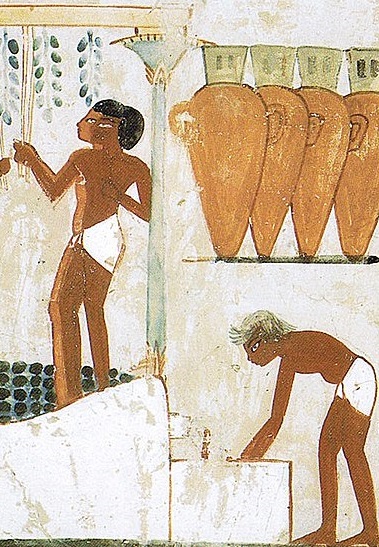 Scene with amphorae from the Theban tomb of Nakht. Dynasty 18, 15th century BC; Metropolitan Museum of Art.
Osiris became the central figure of the afterlife. The myth of his death, dismemberment, restoration by Isis and the birth of Horus offered a model for victory over destruction. In later tradition the dead sought vindication before Osiris: the heart was weighed before Maat, while text and image fixed the hope for a blessed existence after death. The practical side of this ritual is connected with Egyptian mummies and funerary objects.
Magic, Amulets and Personal Piety
Magic in Egypt was not opposed to religion. Heka was the force by which a god created and protected the world, and by which a person could appeal to gods, names, images and formulas. Amulets in the form of a scarab, the wedjat eye, the djed pillar, the knot of Isis or a divine figure protected the body, house, child, pregnant woman, sick person and dead person.
Alongside state cults there were personal appeals to gods. People left stelae, figurines and inscriptions of thanks, asking for healing, protection or justice. In the New Kingdom appeals to Amun as a god who hears the poor are especially visible, but similar forms of piety are known in other cults as well.
Festivals and Sacred Time
The calendar connected religion with the Nile flood, the agricultural year and mythic memory. During major festivals the statue of a god could leave the inner shrine in a portable bark. Processions allowed townspeople to see divine presence, ask questions through an oracle, take part in feasts and renew the relationship between temple, king and community.
Brief Chronology
- Predynastic and Early Dynastic periods: local cults, royal symbolism, burial complexes and early written names take shape.
- Old Kingdom: pyramid complexes and the Pyramid Texts reveal royal funerary cult and early cosmological ideas.
- Middle Kingdom: Coffin Texts extend funerary formulas beyond the royal family; Osiris becomes increasingly important.
- New Kingdom: Theban Amun gains empire-wide importance, the Valley of the Kings receives rich tombs, the Book of the Dead develops, and Akhenaten's reform gives the Aten cult exceptional prominence.
- Late, Ptolemaic and Roman Egypt: the temples of Edfu, Dendera and Philae preserve older rituals and myths under new political conditions.
Related Topics
- Ancient Egypt
- Egyptian gods
- Temples of ancient Egypt
- Priests of ancient Egypt
- Pharaohs of ancient Egypt
- Egyptian mummies
- Egyptian pyramids
Literature and sources
- Assmann J. The Search for God in Ancient Egypt.
- Assmann J. Death and Salvation in Ancient Egypt.
- Hornung E. Conceptions of God in Ancient Egypt: The One and the Many.
- Wilkinson R. H. The Complete Gods and Goddesses of Ancient Egypt.
- Pinch G. Magic in Ancient Egypt.
- Teeter E. Religion and Ritual in Ancient Egypt.
- Quirke S. Ancient Egyptian Religion.
Interested in Ancient Rome beyond reading? Join Legio X Fretensis or explore our reenactment directions.


