Temples of Ancient Egypt
A temple in Ancient Egypt was the earthly house of a deity, a place of daily cult, a large economic institution and a visible part of royal power. Through the temple the pharaoh showed that he maintained Ma'at: the correct order of the world, the bond between people and gods, and the stability of the country. An Egyptian temple was therefore not simply a place for prayer. It joined architecture, ritual, inscriptions, workshops, storehouses, festival routes and political memory.
Temples changed throughout Egyptian history. Early sanctuaries could be small and partly wooden; in the Old Kingdom mortuary temples developed beside pyramids; in the New Kingdom the great Theban complexes became one of the main languages of royal ideology. Late temples at Edfu, Dendera and Philae preserved Egyptian forms under Hellenistic and Roman rulers.
Layout and Symbolism
The classic temple was arranged as a sequence of increasingly restricted spaces. A visitor moved from the pylon and open court to the hypostyle hall, inner rooms and sanctuary, where the divine image or sacred bark was kept. The deeper a room lay inside the temple, the fewer people could enter it. For most inhabitants the temple was encountered mainly from outside: through pylons, obelisks, festivals and open courts.
Architecture worked as a model of the world. The pylon could evoke the horizon where the sun rises; the columned hall became a stone forest of papyrus stems; ceilings were often covered with stars; the floor could rise slightly toward the sanctuary, while the light became dimmer. The route marked a transition from ordinary space to the place where the god was especially present.
Reliefs and inscriptions were not mere decoration. Temple walls repeated scenes of offering, purification, coronation, victory over enemies and the king meeting the gods. Their function was to affirm order continuously: the king gives food, wine, incense and Ma'at to the gods, and the gods in return grant life, authority and fertility to Egypt.
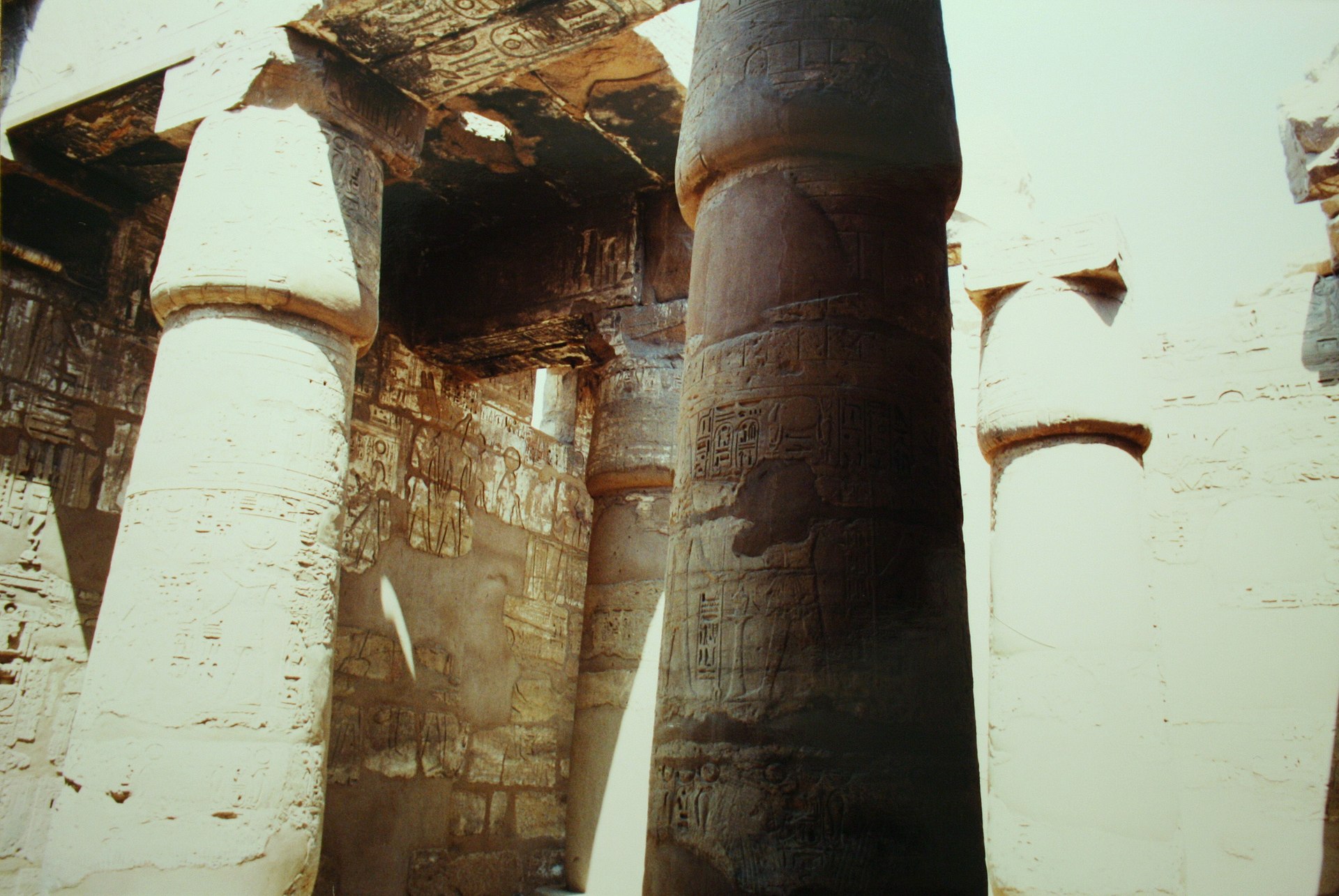 Great Hypostyle Hall of the Temple of Amun-Re at Karnak, Thebes. New Kingdom, chiefly built under Seti I and Ramesses II;.
Cult and Festivals
The daily ritual centred on the divine image hidden in the inner sanctuary. In the morning it was symbolically awakened, purified, clothed, anointed with oils, censed and presented with food. Formally the king was the chief ritual actor, but in practice the rites were performed by priests serving in rotating groups. After the ritual the offerings returned to human use and were distributed among temple personnel as consecrated food.
Festivals opened the temple more widely. The statue of the god or the sacred bark was carried out from the sanctuary, and the deity left the closed inner space. At Thebes the Opet festival linked Karnak and Luxor; elsewhere processions moved between the temple, necropolis, quay or a related shrine. For ordinary people this was the moment when temple religion became urban and public: they saw the procession, addressed petitions to the god and took part in the festival, even if they could not enter the sanctuary.
The temple calendar combined daily actions, seasonal festivals, royal jubilees and local cults. A single complex could therefore be the house of a god, a stage for royal ritual, a memorial to a dead ruler and a centre of civic identity at the same time.
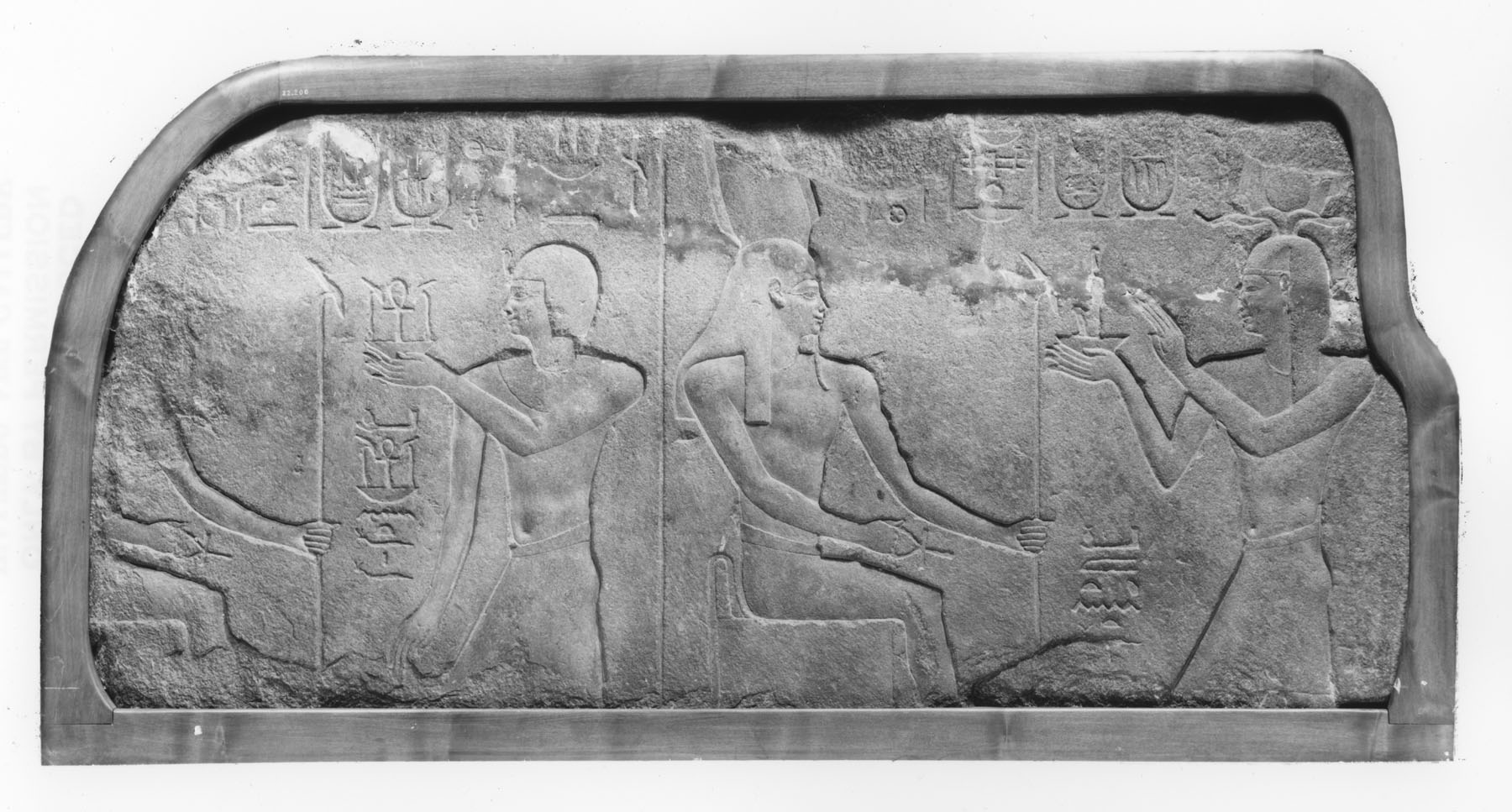 Temple relief fragment: Ptolemy II offering to Osiris and another god. Behbeit el-Hagar, 285-246 BC; granite, Walters Art Museum, 22.200.
Economy and Power
A major temple was not only a cult building. It owned fields, gardens, herds, boats, granaries and workshops; received gifts from the king and private donors; and maintained scribes, craftsmen, porters, singers, musicians, guards and labourers. Temple storerooms accounted for grain, textiles, oil, wine, metal and finished goods. This made the temple an important part of the economy, especially in provincial centres and in the great Theban cults.
Temple power could grow with the wealth of a particular deity. In the New Kingdom the cult of Amun at Thebes acquired vast resources and political weight, and the priestly elite became a group that kings had to take into account. At the same time temples depended on the state: building projects, high priestly appointments, major endowments and war booty remained tied to royal power.
Mortuary temples had a special function. They maintained the cult of a dead king, received offerings, preserved his name and inserted his memory into the sacred landscape. In such complexes royal ideology joined funerary cult and an economic mechanism intended to continue long after the king's death.
Building and Historical Change
An Egyptian temple rarely appeared as a finished project of one ruler. It was enlarged, rebuilt, extended and re-inscribed. One king built a pylon, another added a court, a third erected an obelisk or decorated walls with new scenes. Large complexes, especially Karnak, can therefore be read as a stone history of several centuries, where sections of different dynasties, political programmes and artistic styles stand side by side.
Materials and techniques depended on period and function. Stone was used for the lasting parts of the sanctuary, columns, pylons and reliefs; mudbrick remained important for enclosure walls, service zones and auxiliary buildings. Large projects required quarries, river transport, work teams, scribal accounting and skilled craftsmen. The completed temple was not only a religious monument but also evidence that power could organise people, materials and time.
Late temples show the durability of Egyptian tradition. Ptolemies and Roman emperors represented themselves in the familiar pharaonic role, offering to the gods and leaving hieroglyphic texts. At Edfu and Dendera many inscriptions are especially detailed, helping us understand ritual, mythological texts, festival organisation and the learned culture of the temple.
Major Complexes
Karnak was the chief centre of Amun-Re at Thebes and one of Egypt's largest temple ensembles. Its importance lies not only in scale: it shows the links between royal power, priesthood, the Opet festival, military memory and centuries of building. Luxor Temple complemented the Theban system and shows the ritual side of kingship especially clearly.
Hatshepsut's temple at Deir el-Bahari stands at the edge of desert and necropolis. It joins mortuary cult, the worship of Amun, the image of a female pharaoh and narratives of royal achievement, including the expedition to Punt. The Abydos temple of Seti I is important for its reliefs, divine chapels and king list; Medinet Habu shows how the temple of Ramesses III combined cult, war memory and a fortified setting.
Edfu, Dendera and Philae belong to the later tradition, but they are especially valuable because they preserve large bodies of temple texts and architecture. They help us understand not only Late Egypt, but also the way old models continued to function under new political conditions.
Archaeological Evidence
Temples are studied through several kinds of evidence. Architecture shows routes of movement, limits of access and technical solutions. Reliefs and inscriptions record the ideal side of cult: what the king was meant to do before the gods, which festivals were celebrated and which myths were tied to a particular place. Ostraca, papyri, accounts and service areas show another side: labour, supplies, workshops and the everyday maintenance of the complex.
Date and findspot matter. A New Kingdom relief from Thebes, a Ptolemaic inscription from Edfu and a Roman building at Philae belong to one long tradition, but they answer different historical questions. Temple images are therefore useful not as random attractive views, but as sources for architecture, ritual, royal ideology, local cult and economy.
Related Topics
- Gods of Ancient Egypt
- Ancient Egyptian religion
- Priests of Ancient Egypt
- New Kingdom Egypt
- Pharaohs of Ancient Egypt
Literature and sources
- Wilkinson R. H. The Complete Temples of Ancient Egypt. London: Thames & Hudson, 2000.
- Arnold D. Temples of the Last Pharaohs. Oxford: Oxford University Press, 1999.
- Shafer B. E., ed. Temples of Ancient Egypt. Ithaca: Cornell University Press, 1997.
- Kemp B. J. Ancient Egypt: Anatomy of a Civilization. 2nd ed. London: Routledge, 2006.
- Assmann J. The Search for God in Ancient Egypt. Ithaca: Cornell University Press, 2001.


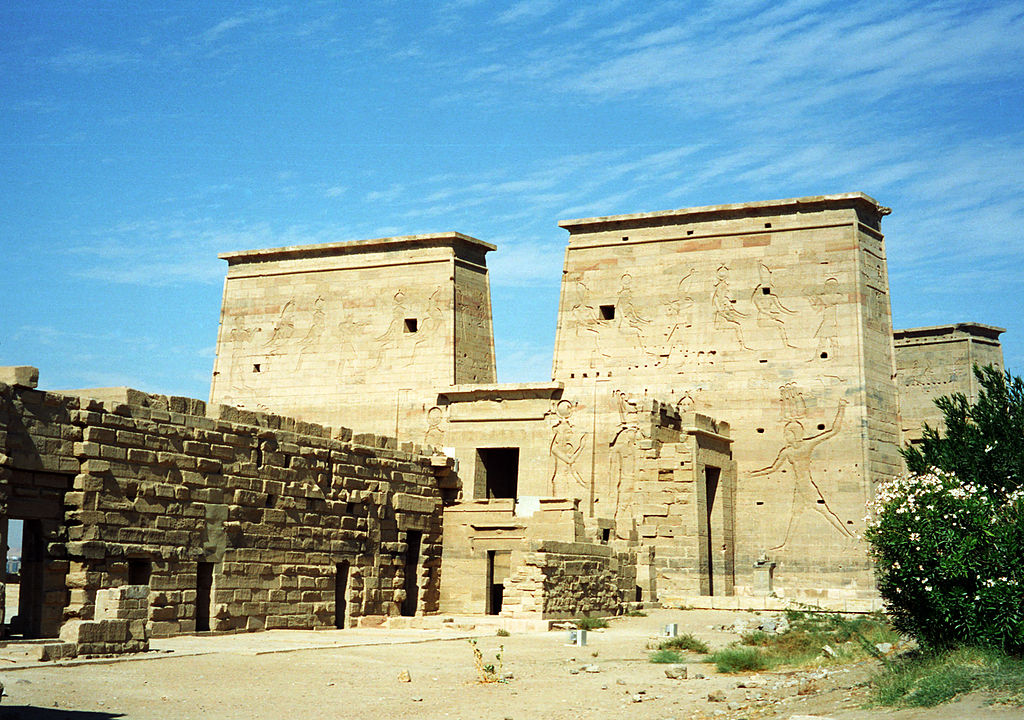 The Philae temple complex, chiefly the sanctuary of Isis. Its Late Egyptian, Ptolemaic and Roman phases show the continuation of temple tradition after the pharaonic period.
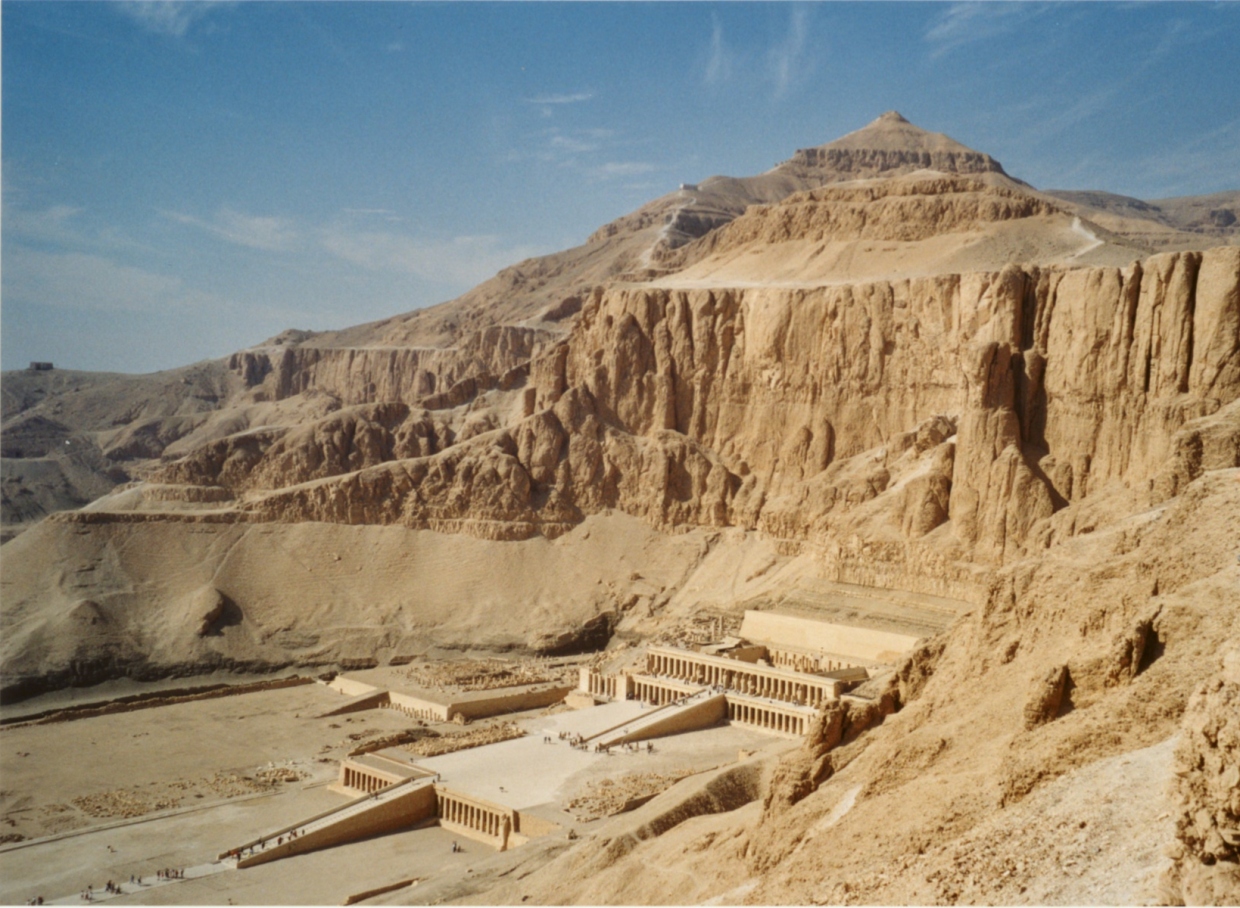 Deir el-Bahari: Hatshepsut's temple, the temple of Thutmose III and the temple of Mentuhotep II on the west bank of Thebes.
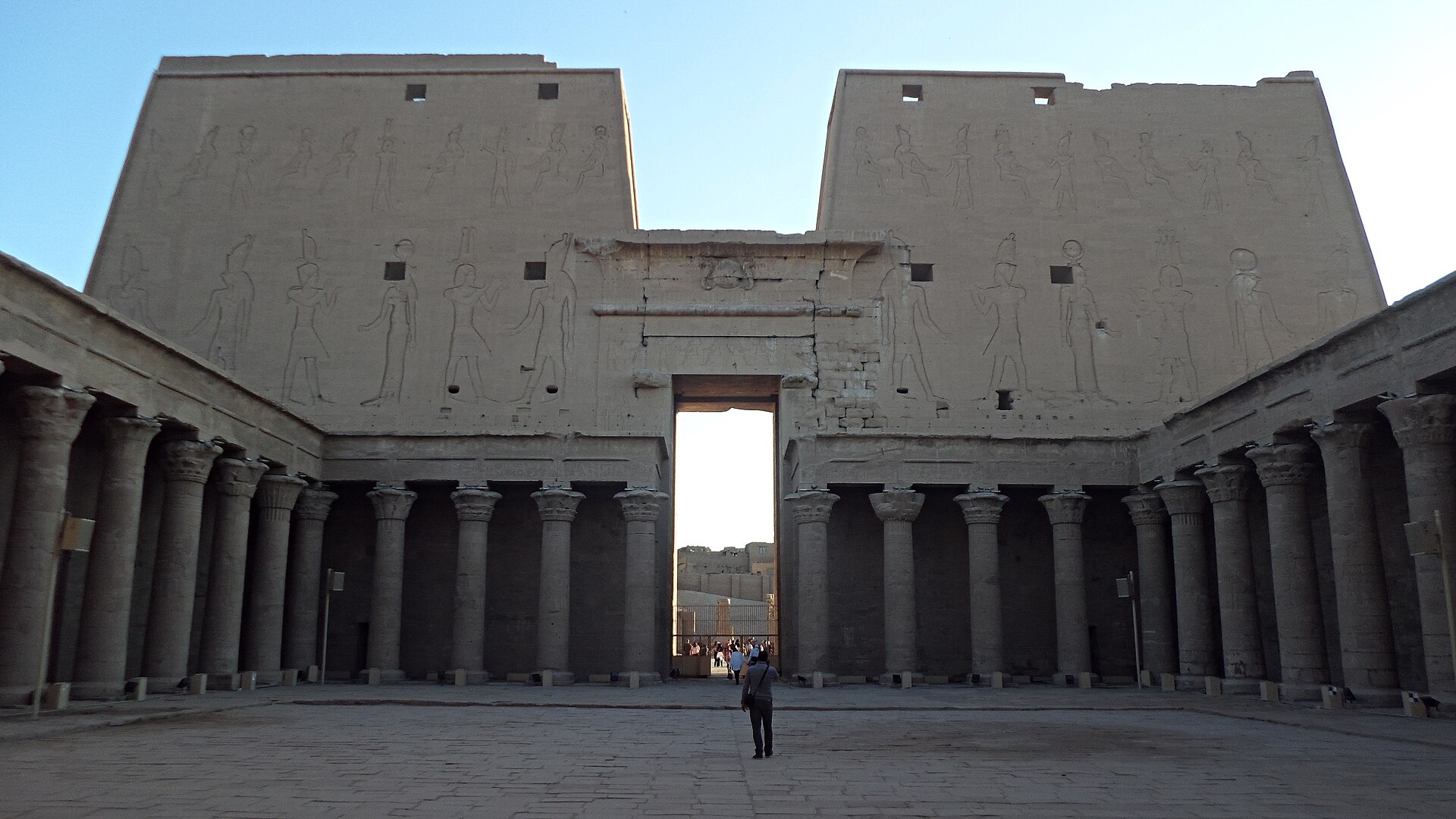 Courtyard of the Temple of Horus at Edfu looking toward the pylon. Ptolemaic period;.
Interested in Ancient Rome beyond reading? Join Legio X Fretensis or explore our reenactment directions.


