Egyptian pyramids
Egyptian pyramids are royal and elite funerary monuments connected above all with the Old Kingdom and the Middle Kingdom. They grew out of the mastaba tradition but became a distinct architectural form in which tomb, temple, processional causeway, royal cult, solar symbolism and state organisation worked together. A pyramid was not merely a large mass of stone: it was the centre of a necropolis and a sign that royal power continued after death.
Different pyramids look similar only at first glance. The Step Pyramid of Djoser, Sneferu's experiments at Meidum and Dahshur, the pyramids of Giza, Pyramid Texts of the Fifth and Sixth Dynasties and mudbrick pyramids of the Middle Kingdom show changes in technology, religion and administration. The history of pyramids should therefore be read not as a single building mystery, but as a long series of decisions: how to lay out the base, quarry stone, move blocks, raise them, case the surface and maintain the cult of the dead king.
From Mastaba to Step Pyramid
The early royal tomb had the form of a mastaba: a low rectangular structure above burial chamber and underground rooms. At Saqqara, under Djoser and his architect Imhotep, this tradition was radically enlarged. Several diminishing stages formed the Step Pyramid, and around it appeared a vast stone complex with courts, dummy buildings, enclosure wall and ritual spaces.
The Step Pyramid is important not only for its size. It shows the transition from brick and mixed architecture to monumental stone building. Stone in Djoser's complex imitates forms of wood, reed and brick, yet already allows durable royal architecture. This was a technical and ideological leap: the tomb became not a single building, but a model of the royal world.
After Djoser builders continued to seek a stable form. Pyramids of the Third Dynasty and early experiments of the Fourth show that the smooth-sided pyramid did not appear at once. Builders had to understand slope, core stability, mass distribution and the connection between burial chamber and superstructure.
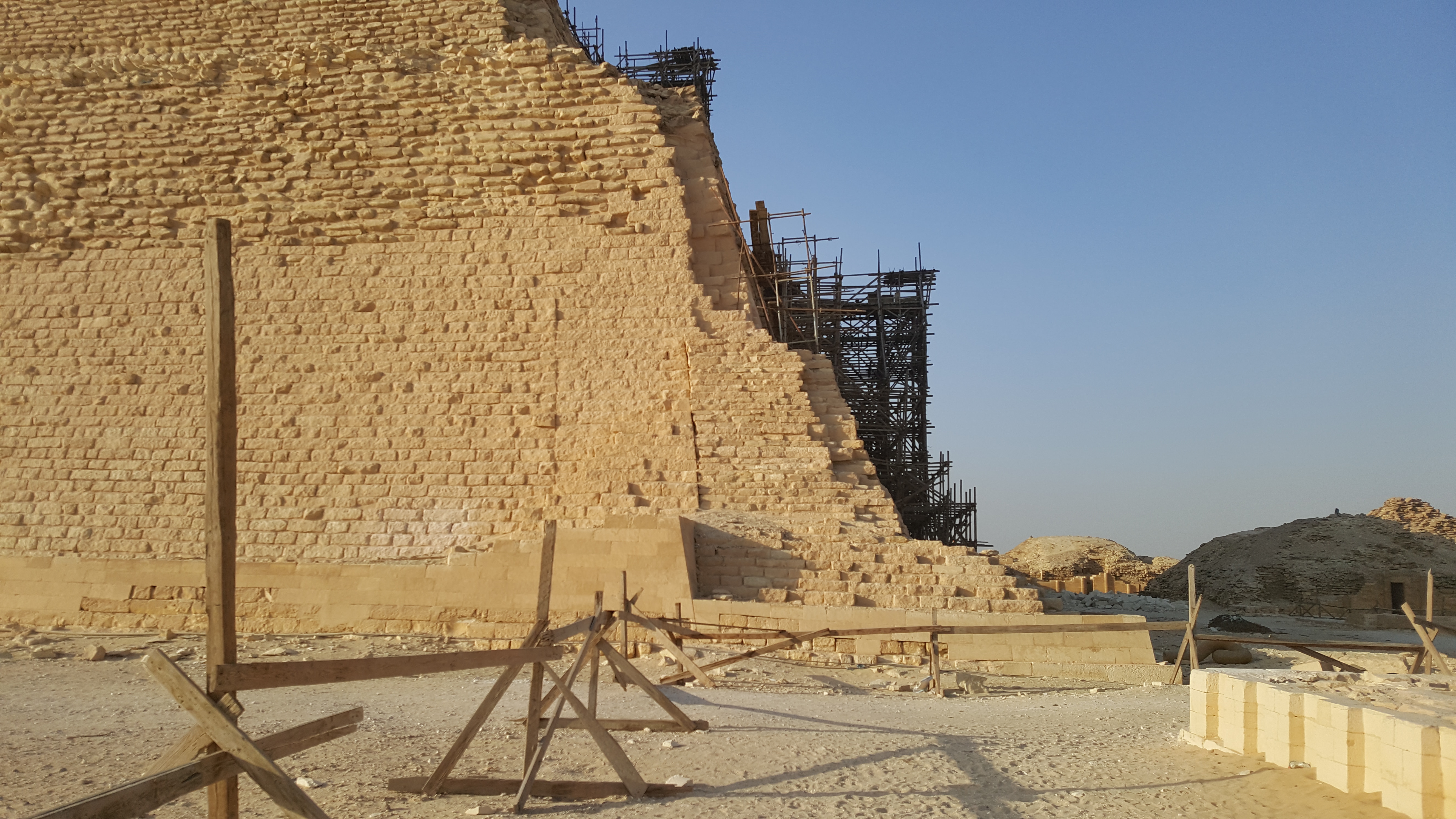 Step Pyramid of Djoser at Saqqara. Dynasty 3, ca. 27th century BC.
Sneferu and the Search for the Smooth Pyramid
Sneferu's reign was a time of major building experiment. Meidum, the Bent Pyramid and the Red Pyramid are connected with different answers to one question: how to move from a stepped form to a stable smooth-sided pyramid. The Meidum pyramid survives as a massive tower with collapsed outer parts, and its state clearly shows the risk of early solutions.
The Bent Pyramid at Dahshur is especially important for understanding technology. Its lower part has a steeper angle, its upper part a shallower one. The change of slope is usually linked with stability problems, construction speed or the desire to reduce load. Even if the exact reason remains debated, the form itself shows that builders observed the behaviour of the structure and could alter the design during work.
The Red Pyramid at Dahshur became one of the first successful large smooth-sided pyramids. Its slope is lower than in earlier ambitious projects, but that is what made the form stable. Sneferu's experience prepared the building of Giza: without these trials and errors, Khufu's pyramid is hard to understand as an engineering result.
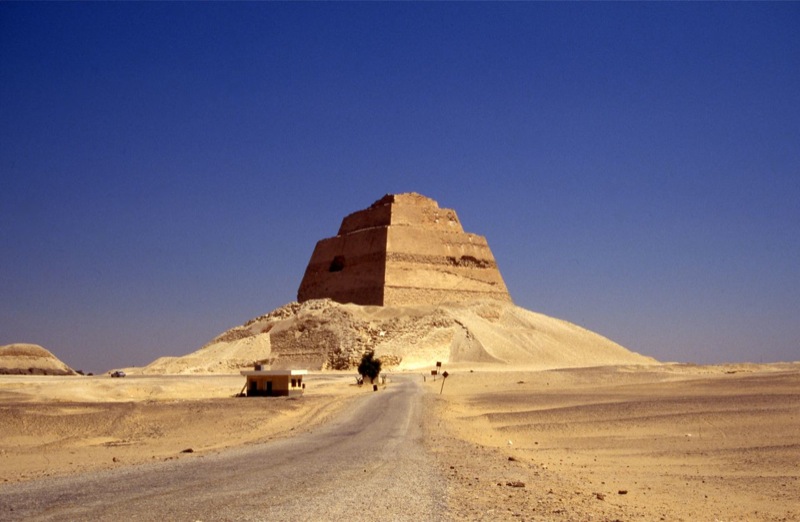 Pyramid at Meidum, associated with Sneferu.
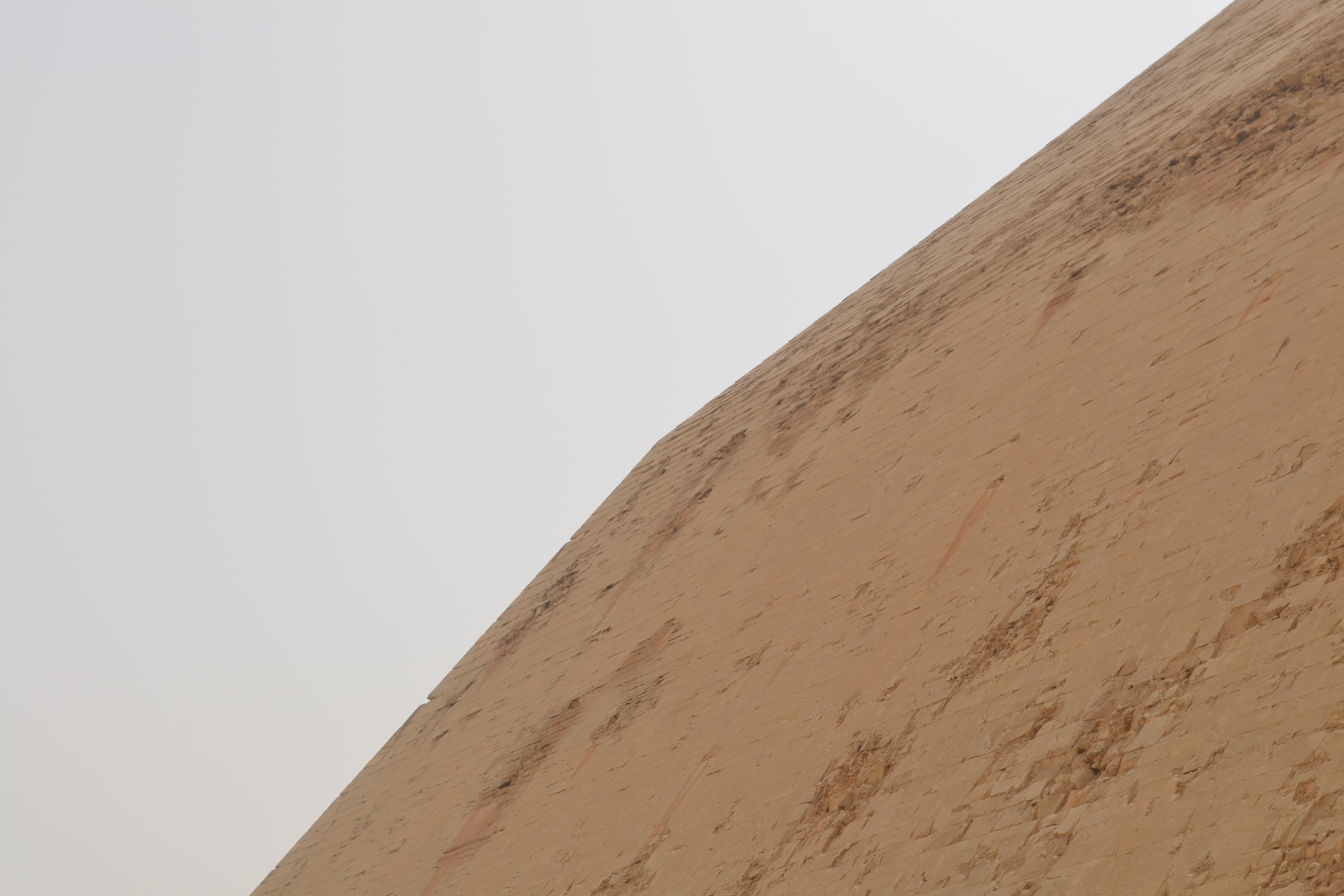 Bent Pyramid of Sneferu at Dahshur: the change of slope is clearly visible.
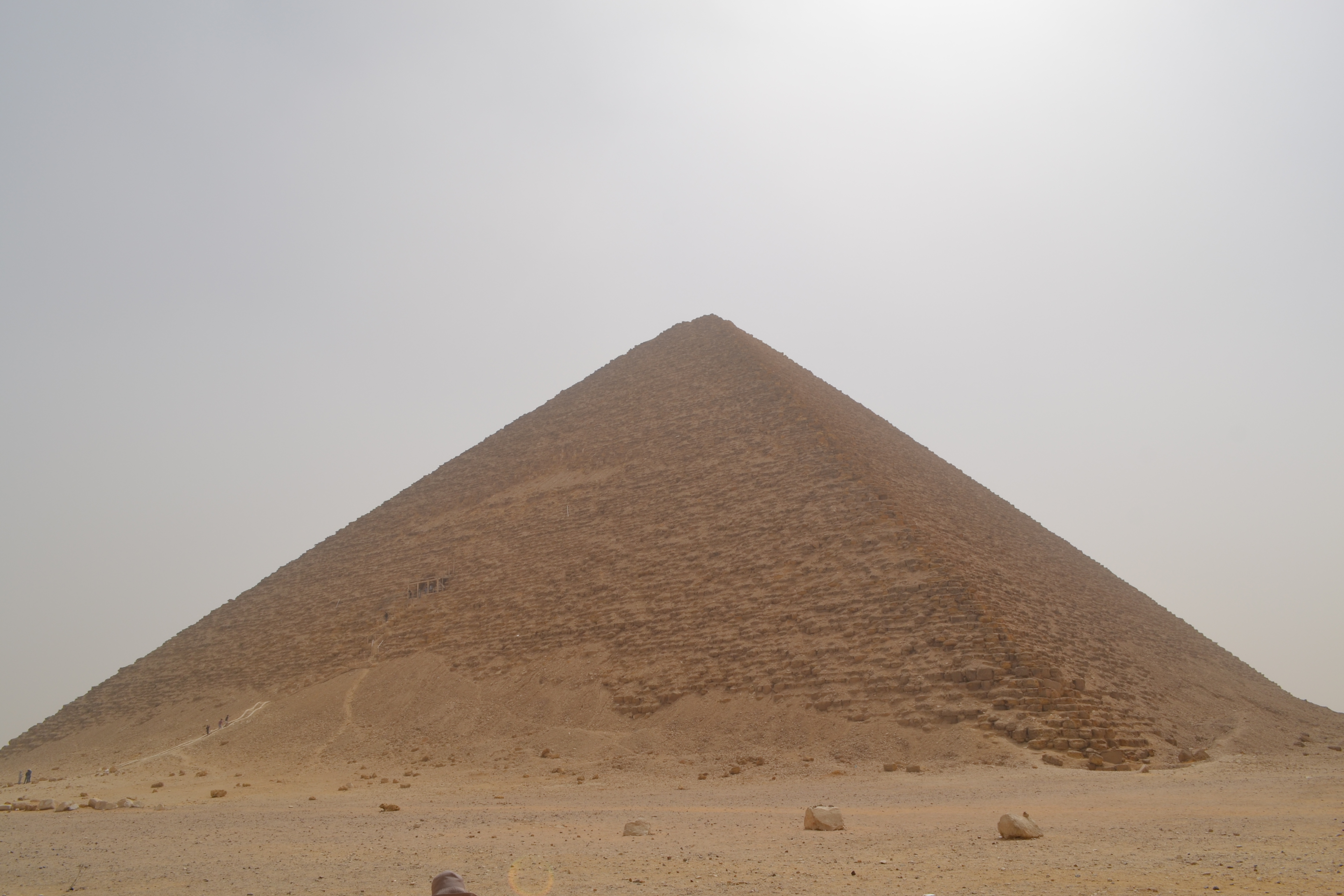 Red Pyramid of Sneferu at Dahshur, one of the early successful smooth-sided pyramids.
Giza and the Classic Pyramid Complex
Giza became the most famous expression of Fourth Dynasty pyramid architecture. The pyramids of Khufu, Khafre and Menkaure did not stand in isolation. Each belonged to a complex: valley temple, covered causeway, mortuary temple, pyramid, satellite pyramids, boat pits, elite cemeteries and working infrastructure formed a single system.
Khufu's pyramid is remarkable for its base accuracy and cardinal orientation. Yet its success is explained not by one secret technology, but by the combination of surveying, labour control, quarries, water transport, storerooms, accounting, worker provisioning and experience accumulated under Sneferu. Giza shows the state in action: the building project gathered people, materials and symbols of power.
Khafre's pyramid preserves part of the upper casing and appears taller because it stands on higher ground. Menkaure's complex is smaller but no less important: it shows that scale and resources changed even within one dynasty. Giza was not a static picture, but a developing necropolis.
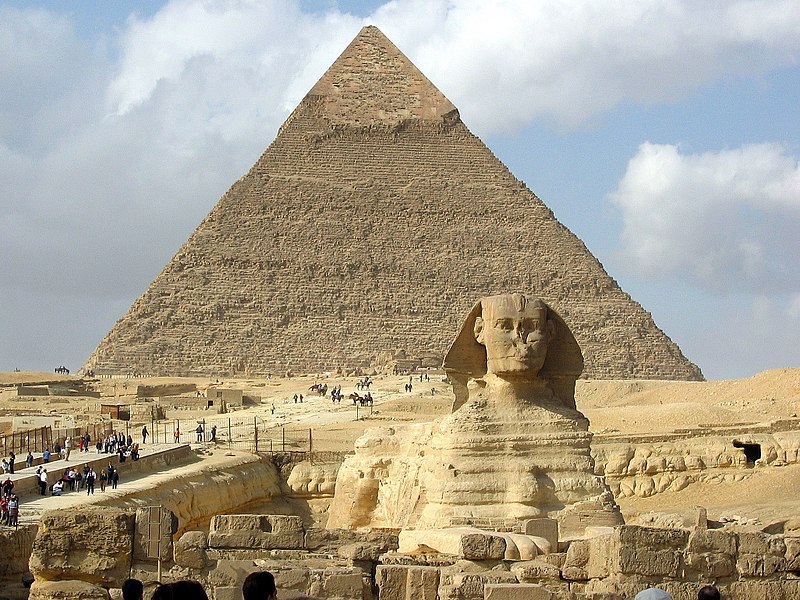 Pyramids of Giza and the Great Sphinx. Fourth Dynasty necropolis, Old Kingdom.
Layout, Orientation and Measurement
Before building, a site had to be chosen, the base levelled and the sides laid out. Egyptians used cubits, cords, sighting, levelling and observations of the sky. The accurate cardinal orientation of pyramids shows a high level of practical geometry, though the exact astronomical methods are debated: circumpolar stars, shadows, solar observations and combinations of these methods may have been used.
The slope was defined not in modern degrees but by the horizontal offset per unit of vertical rise, the seked. This allowed workers and overseers to maintain a single incline over large areas. The layout had to join exterior form with internal structure: entrance, descending corridor, chambers, relieving spaces and blocking stones required planned geometry.
Mistakes were dangerous. A small deviation at the base became a large problem at height, and too steep a slope could increase stress on the core. Pyramid technology therefore began not with lifting blocks, but with design, site testing and constant control of dimensions.
Stone, Quarries and Transport
Most core stone was often quarried near the building site. At Giza, the core of Khufu's pyramid consists mainly of local limestone, reducing transport. Higher-quality white limestone for casing came from Tura on the east bank of the Nile, granite for internal chambers and beams from Aswan, and basalt, gypsum and other materials were used for temples, floors and details.
Transport was as important as quarrying. Blocks could be dragged on wooden sledges, moved along prepared roads, taken down to water and carried by Nile and canal. Later images of statue transport show sledges and the wetting of sand before the runners; this is not a direct instruction for every pyramid, but it explains the principle of reducing friction.
The Wadi al-Jarf papyri connected with Merer's crew under Khufu are especially important for supply organisation. They refer to moving limestone from Tura to Giza and show that construction relied on accounting, crews, harbours, canals and regular logistics. A pyramid was not only masonry, but also a transport system.
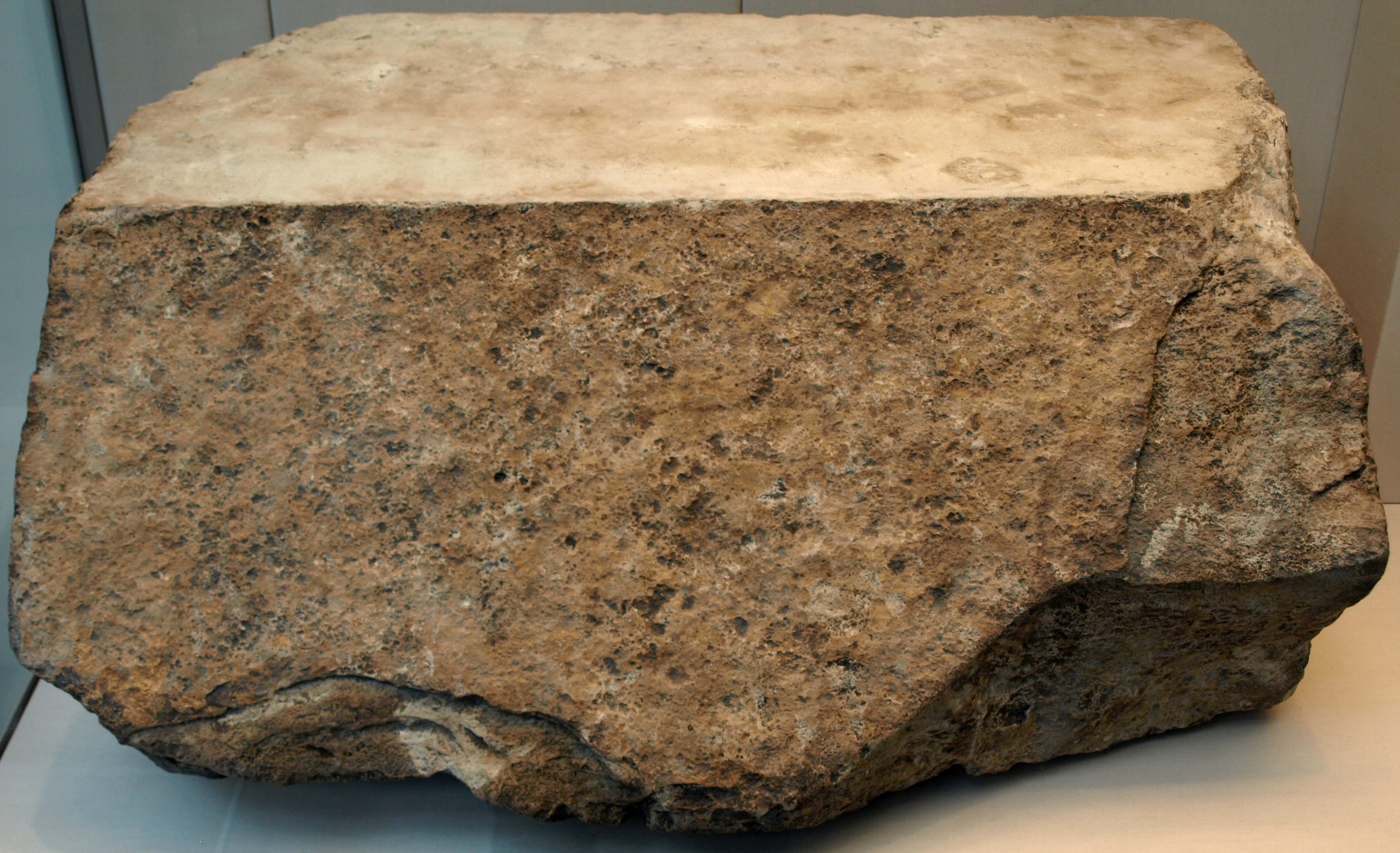 Casing stone from the pyramid of Khufu in the British Museum.
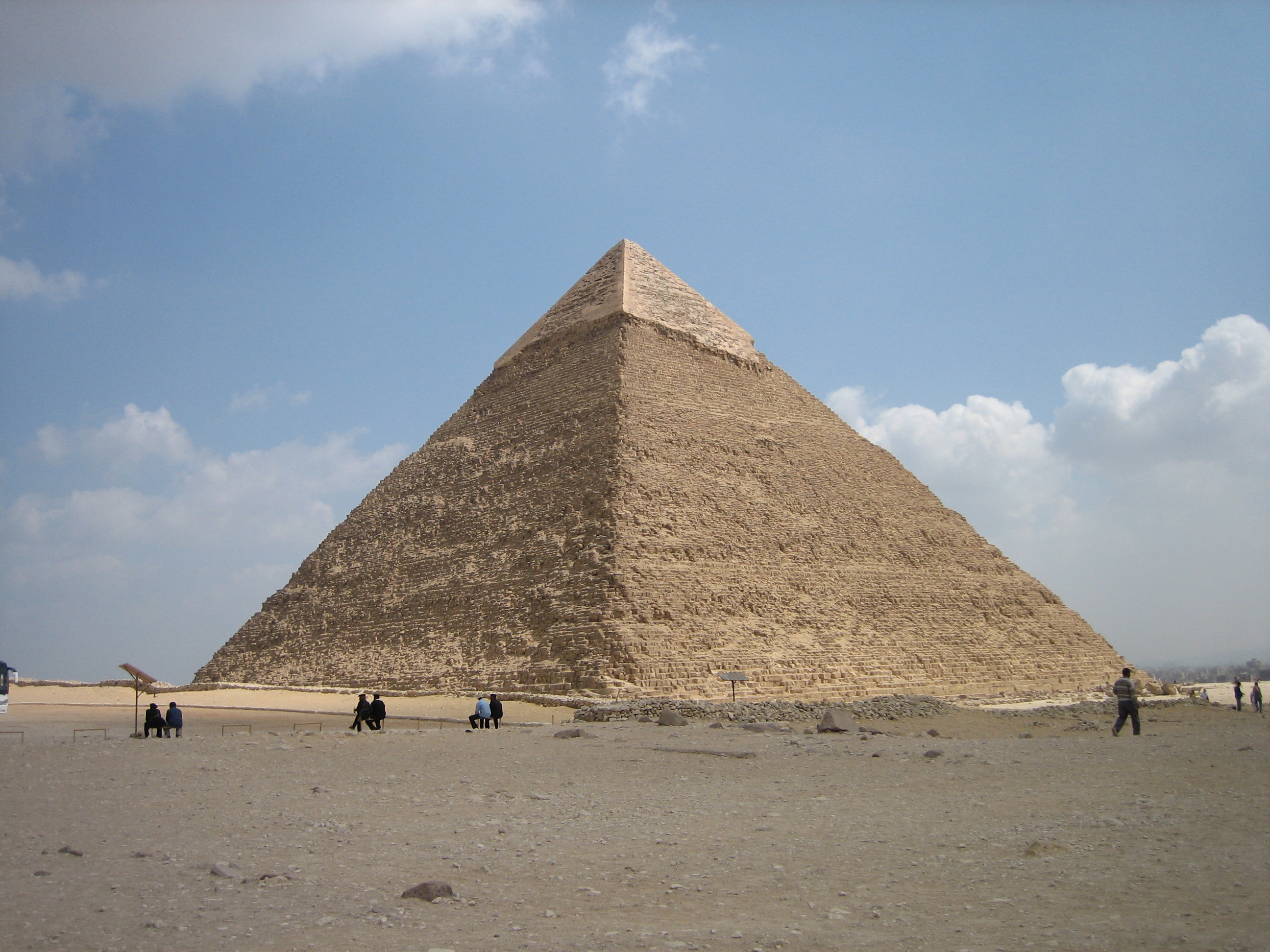 South-west corner of Khafre's pyramid: masonry courses and the preserved core mass are visible.
How Blocks Were Raised
The raising of blocks is often turned into a single riddle, but archaeologically several solutions are more likely. Earth and stone embankments, working roads, ramps, levers, wooden sledges, turning platforms and the gradual filling of construction levels were used. One universal scheme for every pyramid is unlikely: size, period, site and building stage required different methods.
Ramps could be straight, side ramps, zigzag, spiral or combined. A straight ramp is useful in early stages but becomes enormous at great height; side and wrapping solutions save volume but are harder to lay out. Traces of ancient ramps are known at various monuments and quarries, but the complete scheme for the Great Pyramid has not survived.
Blocks were not necessarily uniform. The inner core could consist of roughly dressed stones of different sizes with packing and mortar, while casing required accurate fitting. Blocks on upper levels were generally smaller. Raising was not a miracle but a repeated process: prepare the path, haul the block, set it, adjust it, fill gaps and move to the next level.
Workers, Settlements and Administration
Archaeology at Giza does not support the popular image of pyramids built by a mass of nameless slaves. Construction relied on organised crews, seasonal labour obligations, specialists, craftsmen, overseers, scribes, bakers, brewers, doctors and suppliers. Workers received food, housing, accounting and medical care, although the labour remained hard.
Settlements, workers' cemeteries, bakeries, workshops and animal bones show the scale of provisioning. People had to be fed with bread, beer, meat, fish and vegetables; tools had to be repaired; crews had to be assigned to work areas. Inscriptions naming crews show the corporate identity of work groups, sometimes with humorous or royal names.
The pyramid was a project in which religion and economy were not separate. Building gave the king an eternal monument, but also linked provinces, redistributed produce, trained specialists and displayed the court's ability to govern the land. This organisation, rather than fantastic technology, explains the scale of the pyramids.
Casing, Interior Spaces and Cult
Many pyramids originally looked different from today. White limestone casing created a smooth shining surface, and the summit could be finished with a pyramidion. Much of the casing was later removed or collapsed, so the stepped surfaces now visible often show the core rather than the intended exterior.
Inside pyramids were corridors, chambers, shafts, blocking stones and relieving structures. In Khufu's pyramid the descending corridor, Grand Gallery, King's Chamber, Queen's Chamber and relieving chambers above the burial chamber are known. These elements show that builders thought not only about exterior form, but also about weight, access, protection and ritual route.
The pyramid was linked with the cult of the dead king. Rites were performed in the mortuary temple, the causeway connected it with the valley temple, and burials of relatives and elites were placed around it. In the Fifth and Sixth Dynasties the Pyramid Texts appear inside pyramids: religious formulae helping the king pass to gods and stars.
Later Pyramids and Changing Tradition
After the Fourth Dynasty pyramids became smaller but religiously more complex. Under Unas at Saqqara the Pyramid Texts appear, and the pyramid itself becomes the carrier of a large body of funerary formulae. Exterior scale decreases, while text, temple, causeway and ritual setting gain importance.
In the Middle Kingdom the kings of the Twelfth Dynasty again built pyramids, but often used mudbrick cores, stone casing and more complex internal protection systems. Such pyramids are less well preserved because brick and removed casing decayed faster than the large stone cores of the Old Kingdom. Hawara and Lahun show a different technological tradition linked with the Faiyum.
Later the pyramid form did not disappear entirely. Small pyramids were built in private tombs of the New Kingdom, and in Nubia an independent tradition of steep pyramids developed for the kings of Kush. But the centre of Egyptian royal funerary architecture shifted: rock-cut tombs in the Valley of the Kings and temple complexes became more important than the giant above-ground pyramid.
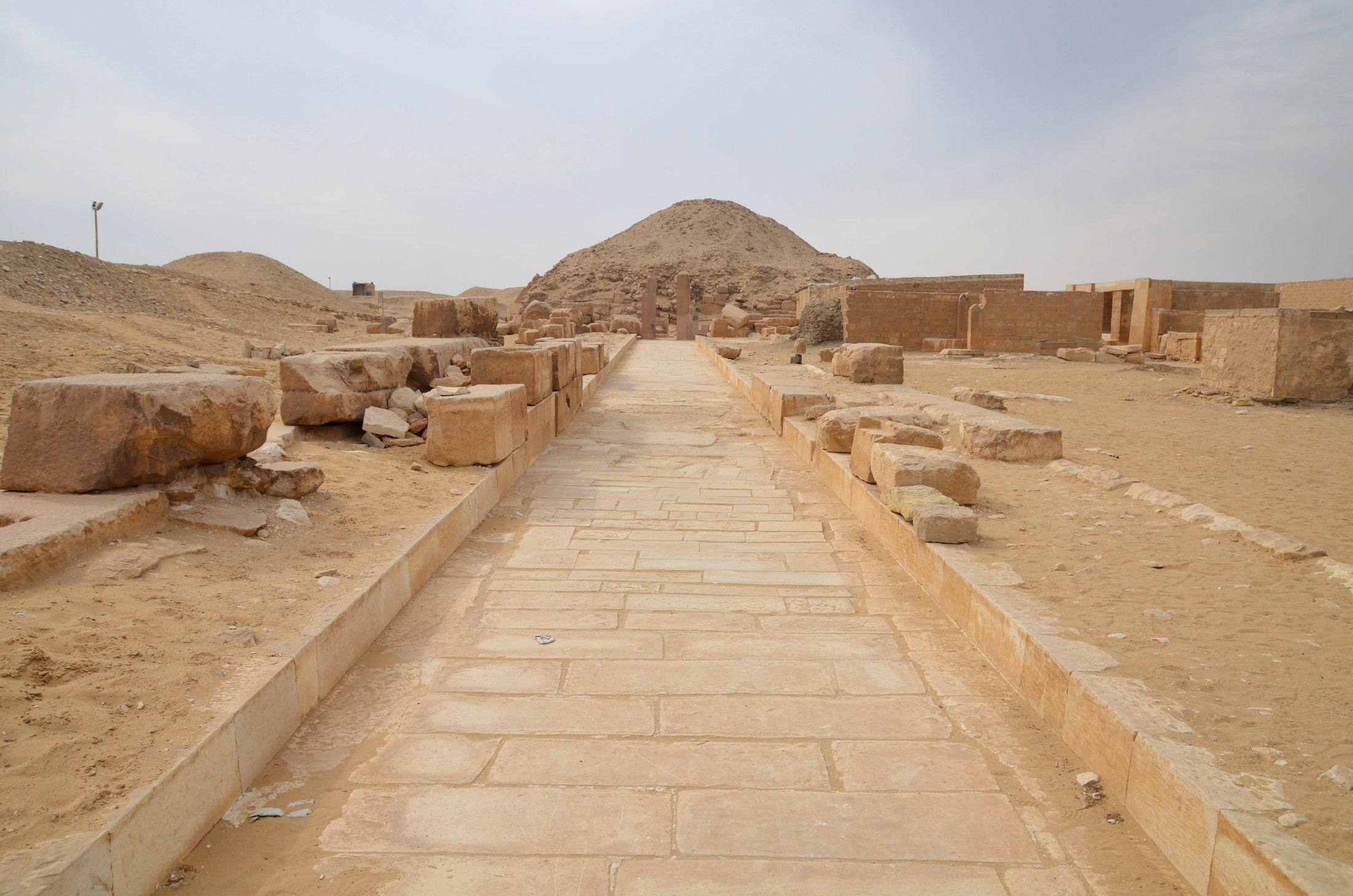 Causeway leading to the pyramid of Unas at Saqqara. Dynasty 5;.
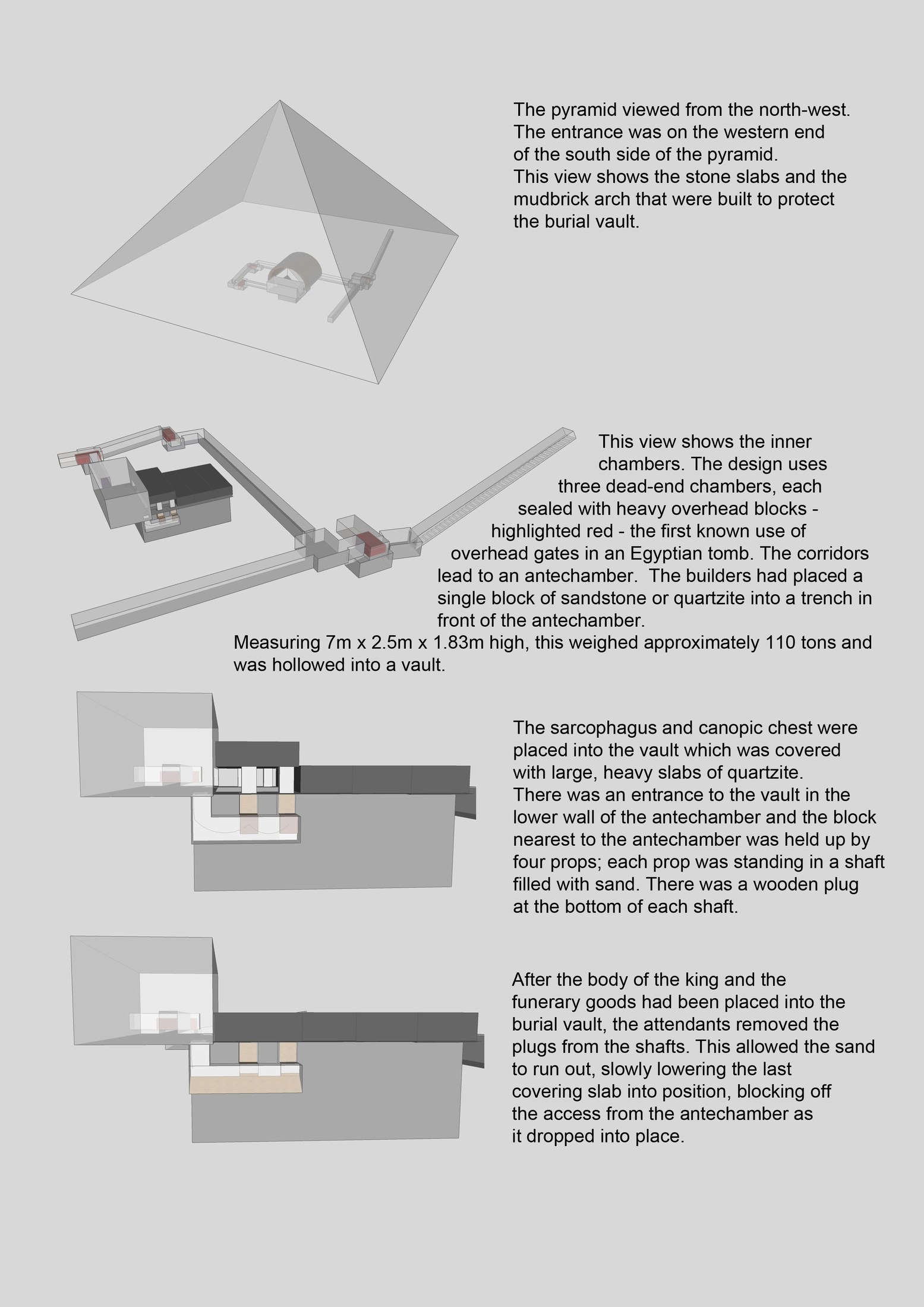 Pyramid of Amenemhat III at Hawara. Middle Kingdom;.
Chronology
- Third Dynasty
- the Step Pyramid of Djoser at Saqqara creates the first great stone pyramid complex.
- Early Fourth Dynasty
- under Sneferu experiments at Meidum and Dahshur take place; the Bent and Red Pyramids show the search for a stable smooth-sided form.
- Fourth Dynasty
- Giza becomes the peak of large stone pyramid construction under Khufu, Khafre and Menkaure.
- Fifth-Sixth Dynasties
- pyramids become smaller, while temples, causeways and Pyramid Texts grow in importance.
- Middle Kingdom
- Twelfth Dynasty pyramids use new internal systems, mudbrick cores and stone casing.
- New Kingdom and later
- royal funerary architecture shifts toward rock-cut tombs, but small pyramid forms continue in private and regional traditions.
Related Topics
- Pyramids of Giza
- Sphinxes of Ancient Egypt
- Old Kingdom Egypt
- Middle Kingdom Egypt
- Pharaohs of Ancient Egypt
- Mummies of Ancient Egypt
- Ancient Egyptian Religion
Literature and sources
- Lehner M. The Complete Pyramids.
- Verner M. The Pyramids.
- Arnold D. Building in Egypt: Pharaonic Stone Masonry.
- Kemp B. Ancient Egypt: Anatomy of a Civilization.
- Tallet P. Les papyrus de la mer Rouge I: Le journal de Merer.
- Romer J. The Great Pyramid: Ancient Egypt Revisited.
- Wikimedia Commons: Step Pyramid of Djoser, Meidum Pyramid, Bent Pyramid, Red Pyramid, Khufu casing stone, Pyramid of Khafre corner, causeway of Unas, pyramid of Amenemhat III at Hawara.
- Mathematics of the Rhind Papyrus: British Museum
Interested in Ancient Rome beyond reading? Join Legio X Fretensis or explore our reenactment directions.


