Inchtuthil
Inchtuthil was a Roman legionary fortress in Caledonia, on a plateau above the north bank of the River Tay in modern Scotland. It is usually connected with the Flavian advance north after the campaigns of Gnaeus Julius Agricola and with an attempt to secure Roman power beyond the line of the later Hadrian's Wall. The site is especially important because the fortress did not have time to become a long-lived garrison centre: it was founded in the AD 80s, partly built, then dismantled and abandoned.
For the history of the Roman army Inchtuthil is valuable as a stopped construction project. It shows not only ramparts and ditches, but also the planned spatial order of a legion: headquarters, barracks, tribunes' houses, granaries, hospital, workshops and prepared areas that were not always completed. Its most famous find, the enormous hoard of iron nails, shows how material and labour-intensive Roman military infrastructure was.
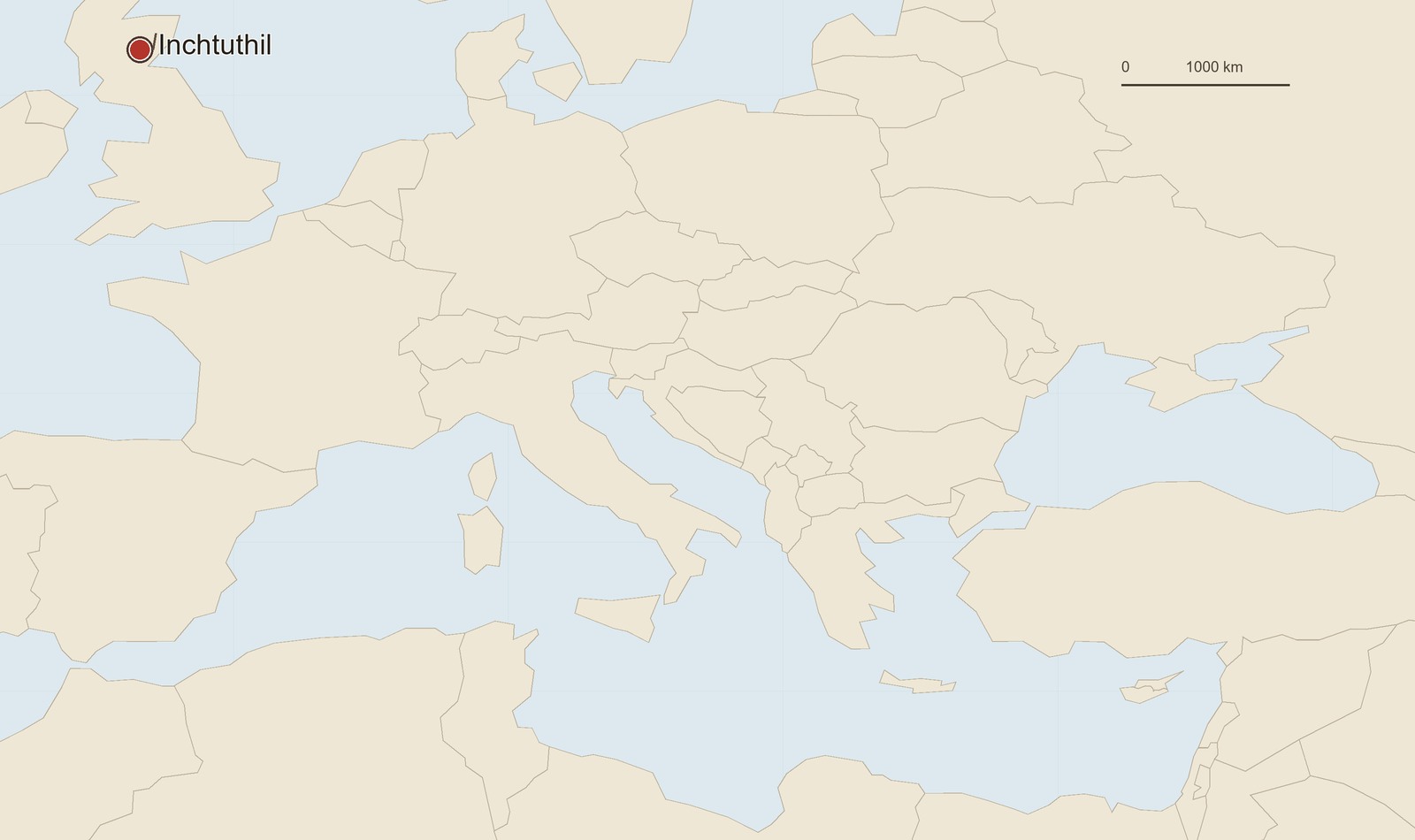 Location map: Inchtuthil. The marker shows the ancient site or main archaeological complex.
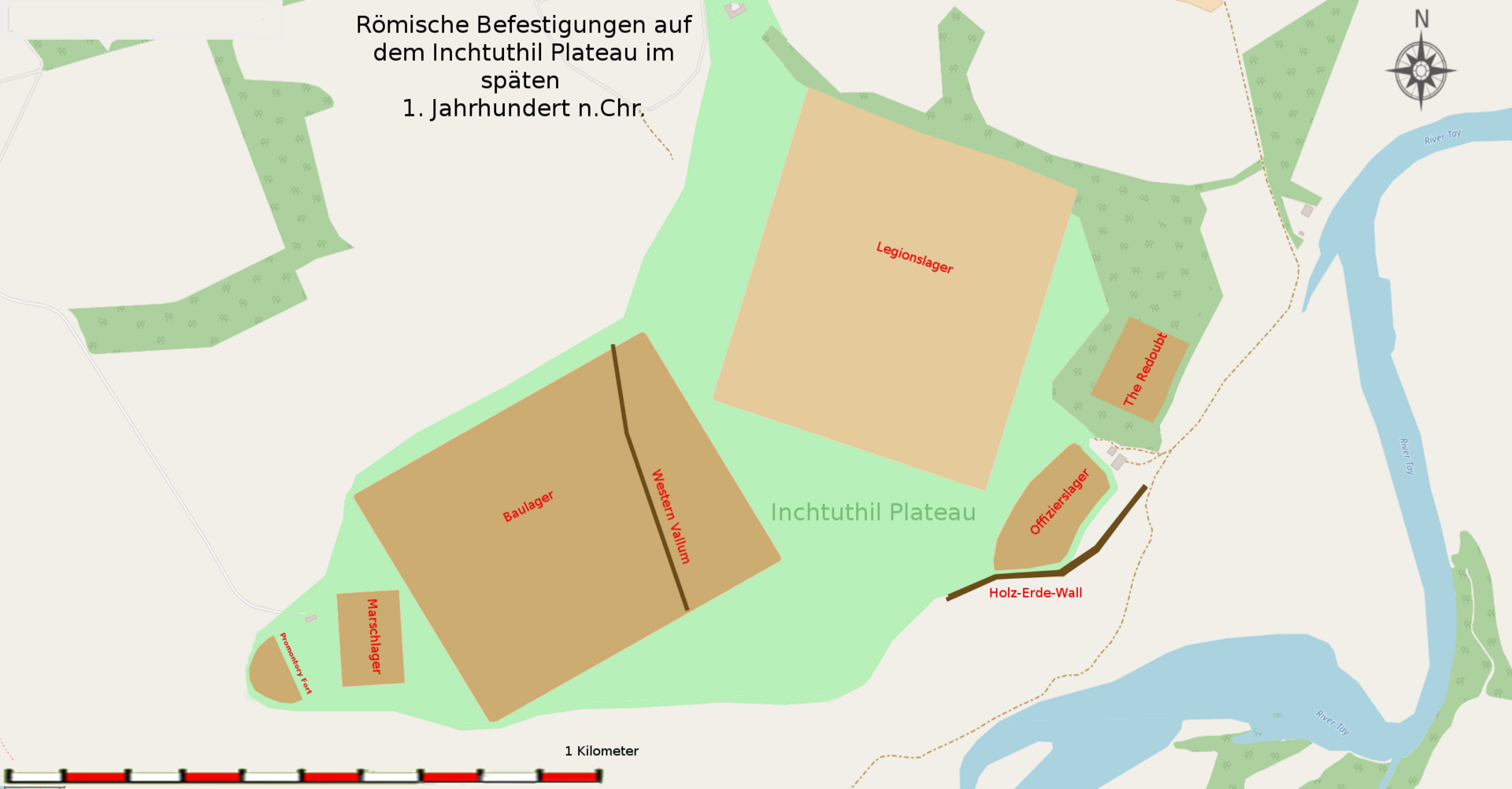 Plan of the Roman fortifications on the Inchtuthil plateau, late first century AD. Plan by Veleius after Pitts and St Joseph;.
Campaign and Northern Frontier
Inchtuthil belongs to the Roman operations in northern Britain under the Flavians. After Agricola's victory over northern peoples, associated by ancient tradition with Mons Graupius, Roman commanders tried to control the passes, valleys and communications of Caledonia. The fortress on the Tay was intended not as an isolated camp, but as the centre of a network of roads, forts and temporary camps designed to hold the northern zone.
Such a project required permanent supply. A legionary fortress needed timber, stone, iron, grain, fodder, animals, carts, workshops, forges and labour. The Roman north was not an empty strip on a map: local communities, routes, farming zones and pasture existed around it. Inchtuthil was therefore both a military installation and a point where Roman logistics met the Caledonian landscape.
The decision to abandon the fortress shows how strongly the frontier depended on wider imperial politics. Soon after work began, troops were redistributed to other theatres, and the northern line in Scotland did not become a stable system. Later Roman frontier control settled farther south: first through forts and roads, then through Hadrian's Wall, and for a shorter period through the Antonine Wall.
Fortress Plan
The plan of Inchtuthil is unusually well known for a legionary fortress. Excavations in 1952-1965 made it possible to reconstruct the general layout: a rectilinear street system, a central area with the principia, barracks, officers' houses, granaries, workshops and hospital. The fortress covered about 53 acres, roughly 21 hectares, and was planned for a full legion with its support structures.
The unfinished and prepared areas are especially important. The commander's praetorium was not built, although its site had been prepared. This separates Inchtuthil from towns that grew out of long-lived legionary bases: the archaeology here shows planning and withdrawal rather than mature urban life. At this stage the decisions of military engineers become visible: how barracks were distributed, where grain was stored, which buildings required large areas and which zones remained in reserve.
The hospital and workshops matter as much as the barracks. The valetudinarium shows that a large base was planned from the start as a place of long-term occupation and medical care, while the fabrica connects the fortress with the repair, manufacture and storage of equipment. The military archaeology of Inchtuthil is therefore not limited to defensive ditches: it reveals the internal economy of a legion.
Construction and Supply
Building a legionary fortress required an enormous number of repeated operations. Timber had to be cut, transported, shaped and built into walls, towers, gates, barracks and storehouses. Iron had to be distributed between forges, carpenters and repair groups. Clay, stone, turf, water, food and draught power connected the camp both with the surrounding countryside and with distant supply bases.
Inchtuthil shows the difference between the ceremonial image of the Roman army and its real material basis. The legion was not only building a fortification, but also creating a temporary industrial node: forges, workshops, storehouses and roads made the transition from marching camp to permanent base possible. Such a site depended not on a few spectacular objects, but on thousands of repeated parts: boards, clamps, nails, hinges, fittings, tools and packing.
When the fortress was abandoned, the Romans apparently dismantled everything that could be removed or destroyed. This distorts the archaeological picture: many materials are absent not because they never existed, but because they were taken down, burned, carried away or hidden. Inchtuthil must therefore be read through traces of action: prepared plots, pits, ditches, workshop remains, fittings and the exceptional nail hoard.
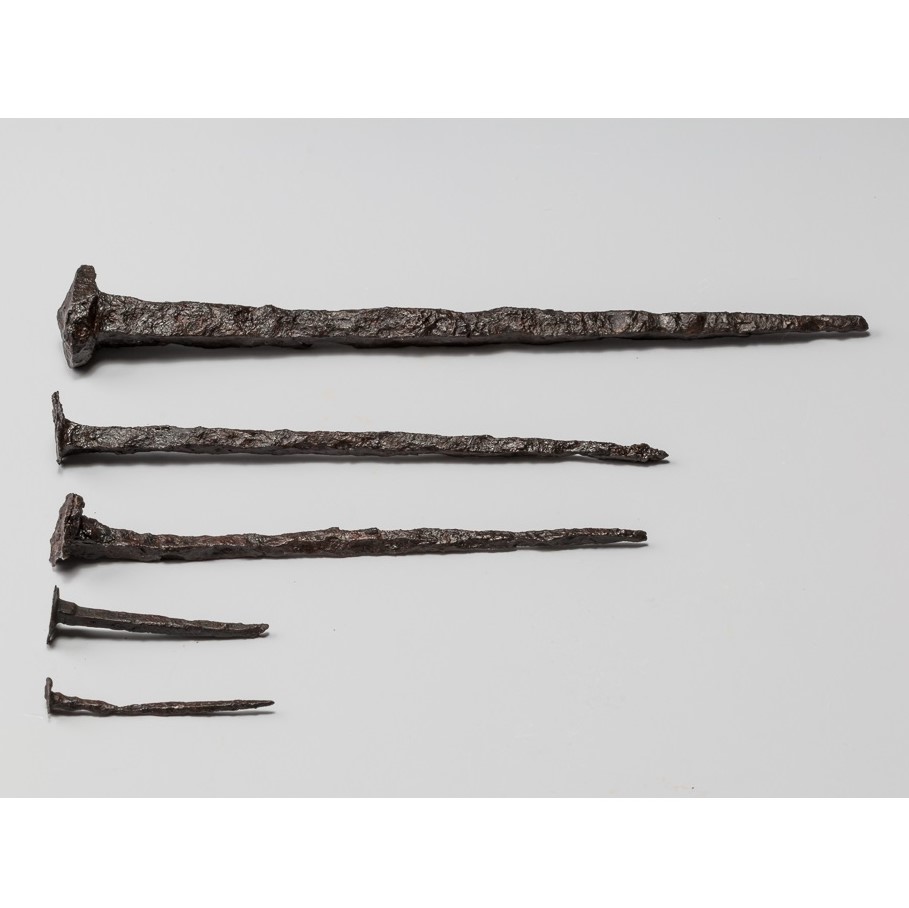 Five iron nails from the Inchtuthil hoard. Roman Imperial period, AD 83-90; ANU Classics Museum, inv. 2012.14.
The Nail Hoard
The most famous find from Inchtuthil is the hoard of iron nails discovered in 1960 in the workshop area. The pit contained hundreds of thousands of nails of different sizes and other iron fittings; the total mass of iron is usually estimated at about ten tonnes. The figure of 875,400 nails is often given in publications for the counted complete examples.
The concealment of the hoard is usually explained by the withdrawal of the garrison. Iron was too valuable a resource to leave to local opponents: it could be turned into weapons, tools and fittings. The stock was therefore not simply abandoned, but hidden deep in a pit, covered and masked by the demolition of the workshop. The operation itself suggests both haste and discipline: moving ten tonnes of iron was difficult, but leaving it visible was dangerous.
The nails matter not as a curiosity but as quantitative evidence. They show the scale of carpentry, standardisation of sizes, forge work and the cost of timber military architecture. Most Roman nails at other sites disappeared during dismantling or after fires, when iron was collected again. At Inchtuthil the stockpile was preserved by the decision to hide it, and an ordinary construction detail became the main archaeological witness.
After excavation the nails were dispersed to museums, research collections and private presentation sets. Some of the material was used to study iron corrosion, including as an ancient analogue for the long-term behaviour of metal in the ground. The post-excavation history of the hoard gives the objects a second life: scientific material, museum display, souvenir and technical research sample.
Archaeological Value
Inchtuthil should not be used as a normal picture of a long-lived Roman town. It offers little evidence for late urban daily life, a trading quarter or a stable civilian settlement. Its strength lies elsewhere: the site shows how a legionary base was planned, built, supplied and then shut down.
At the level of planning, Inchtuthil helps compare legionary fortresses in Britain and Europe: the position of the principia, barracks, granaries, hospital and workshops, the operation of the street grid, and the adaptation of a standard plan to terrain. At the level of objects, it shows how much unobtrusive material stood behind Roman military architecture. At the level of frontier history, it reminds us that Rome's northern plans in Scotland were real, expensive and short-lived.
The best sources for Inchtuthil are therefore not isolated dramatic reconstructions, but excavation publications, plans, catalogues of finds, metallurgical studies and museum records for the nails. Together they show the fortress as an unfinished military project rather than an empty point on the map of northern Britain.
Related topics
Literature and sources
- Pitts L. F., St Joseph J. K. Inchtuthil: The Roman Legionary Fortress Excavations 1952-1965. Britannia Monograph Series 6. Society for the Promotion of Roman Studies, 1985.
- Shirley E. A. M. The Building of the Legionary Fortress at Inchtuthil. Britannia 27, 1996.
- Shirley E. A. M. The Construction of the Roman Legionary Fortress at Inchtuthil. BAR British Series 298. Archaeopress, 2000.
- Angus N. S., Brown G. T., Cleere H. F. The iron nails from the Roman legionary fortress at Inchtuthil, Perthshire. Journal of the Iron and Steel Institute 200, 1962.
- Woolliscroft D. J., Hoffmann B. Rome's First Frontier: The Flavian Occupation of Northern Scotland. Tempus, 2006.
- ANU Classics Museum Catalogue: Five Roman Nails, acquisition number 2012.14.


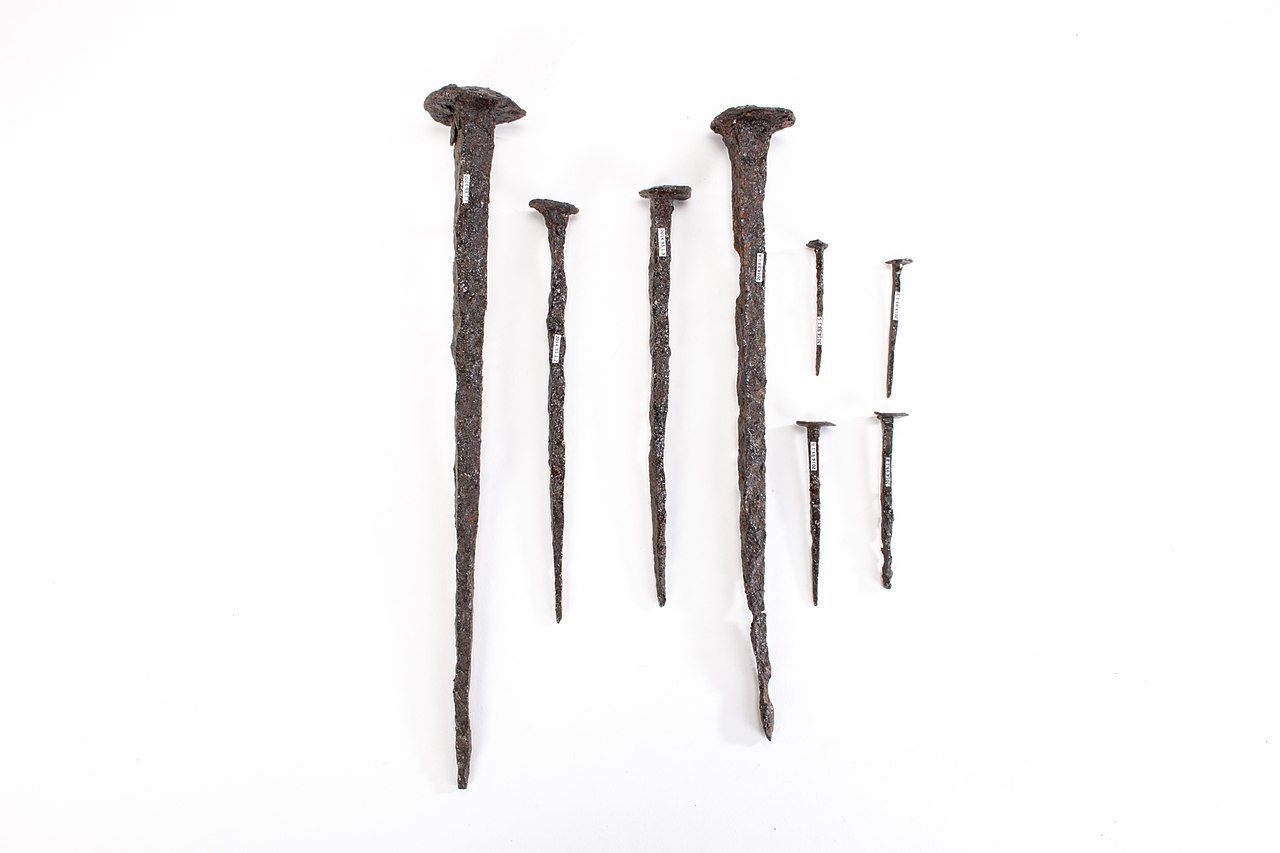 Inchtuthil: Nails (AM 2014.93.1-2); archaeological view, find or museum context connected with the site, Roman period or local archaeological context.
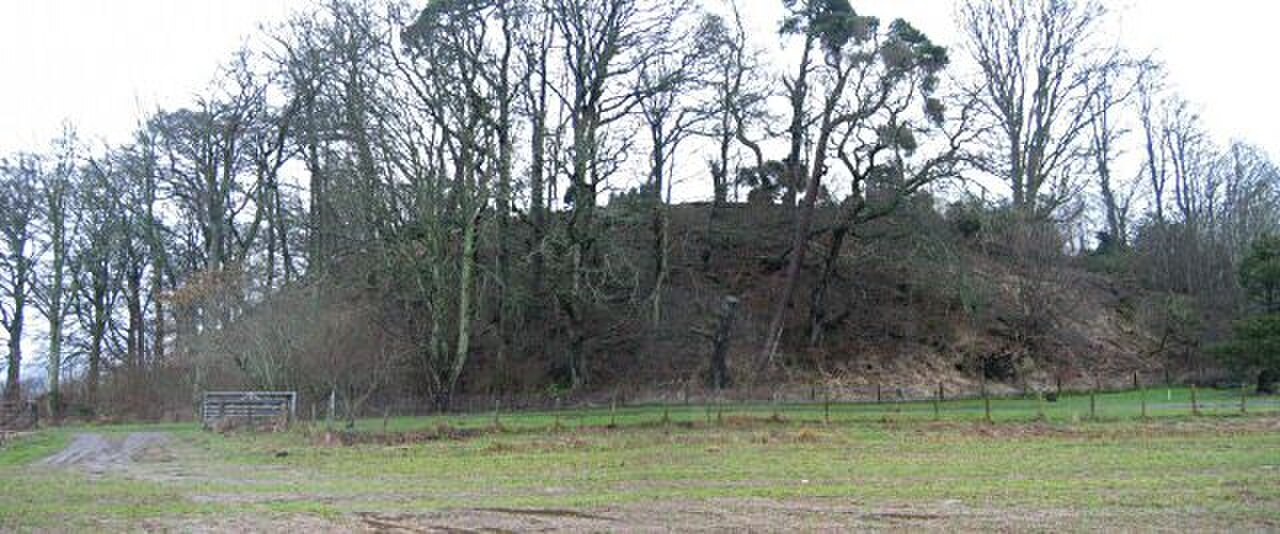 Inchtuthil: Fort by Inchtuthil Cottage - geograph.org.uk - 336367; archaeological view, find or museum context connected with the site, Roman period or local archaeological context.
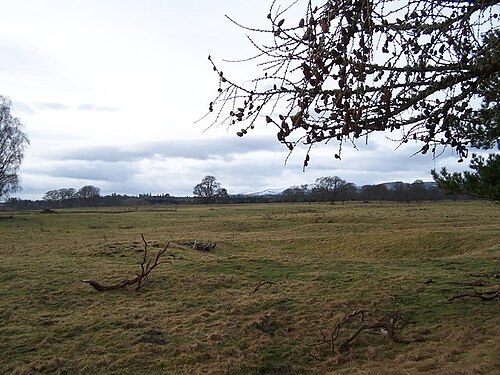 Inchtuthil: Roman Fortress Inchtuthil - geograph.org.uk - 662961; archaeological view, find or museum context connected with the site, Roman period or local archaeological context.
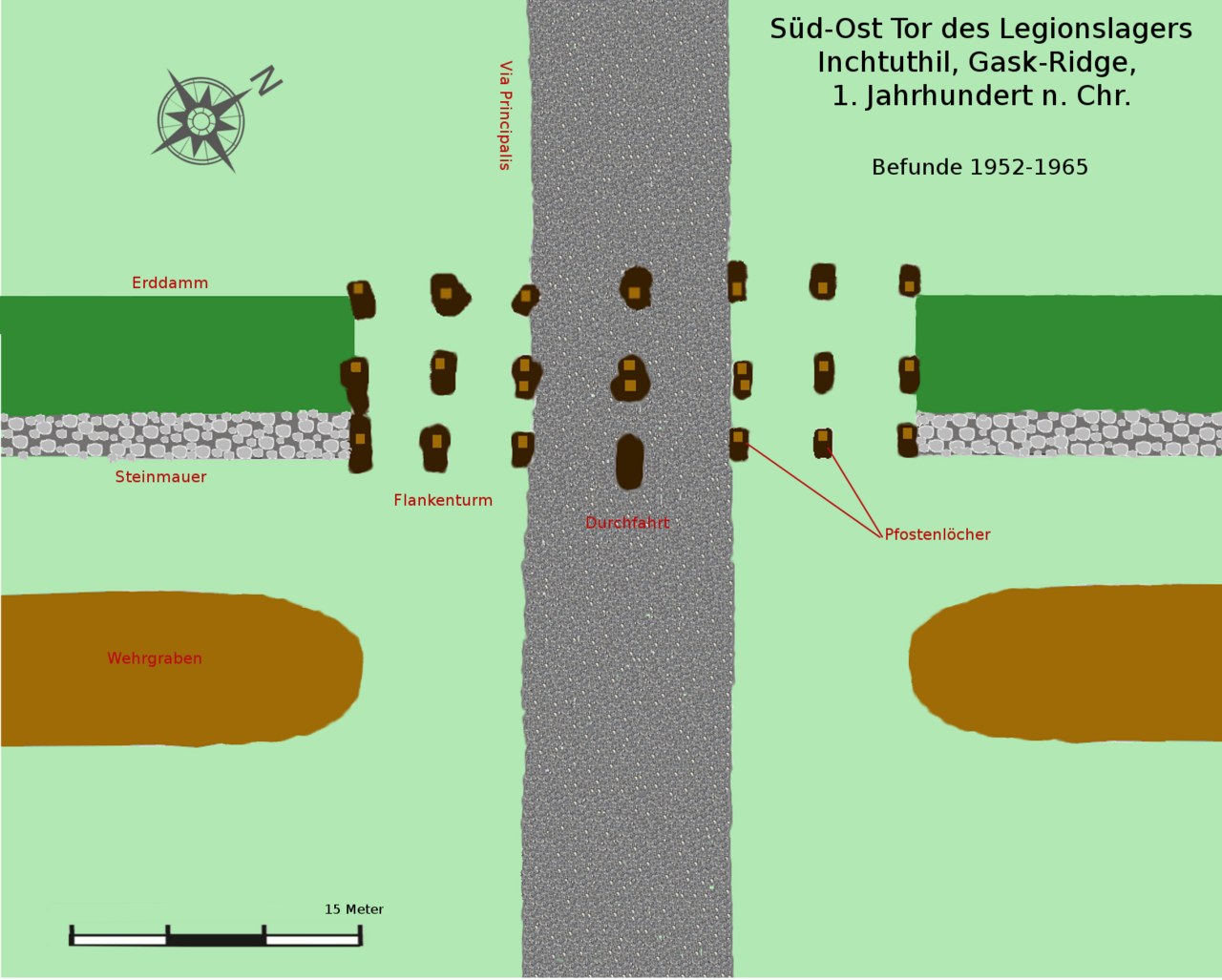 Inchtuthil: BS Inchtuthil Osttor; archaeological view, find or museum context connected with the site, Roman period or local archaeological context.
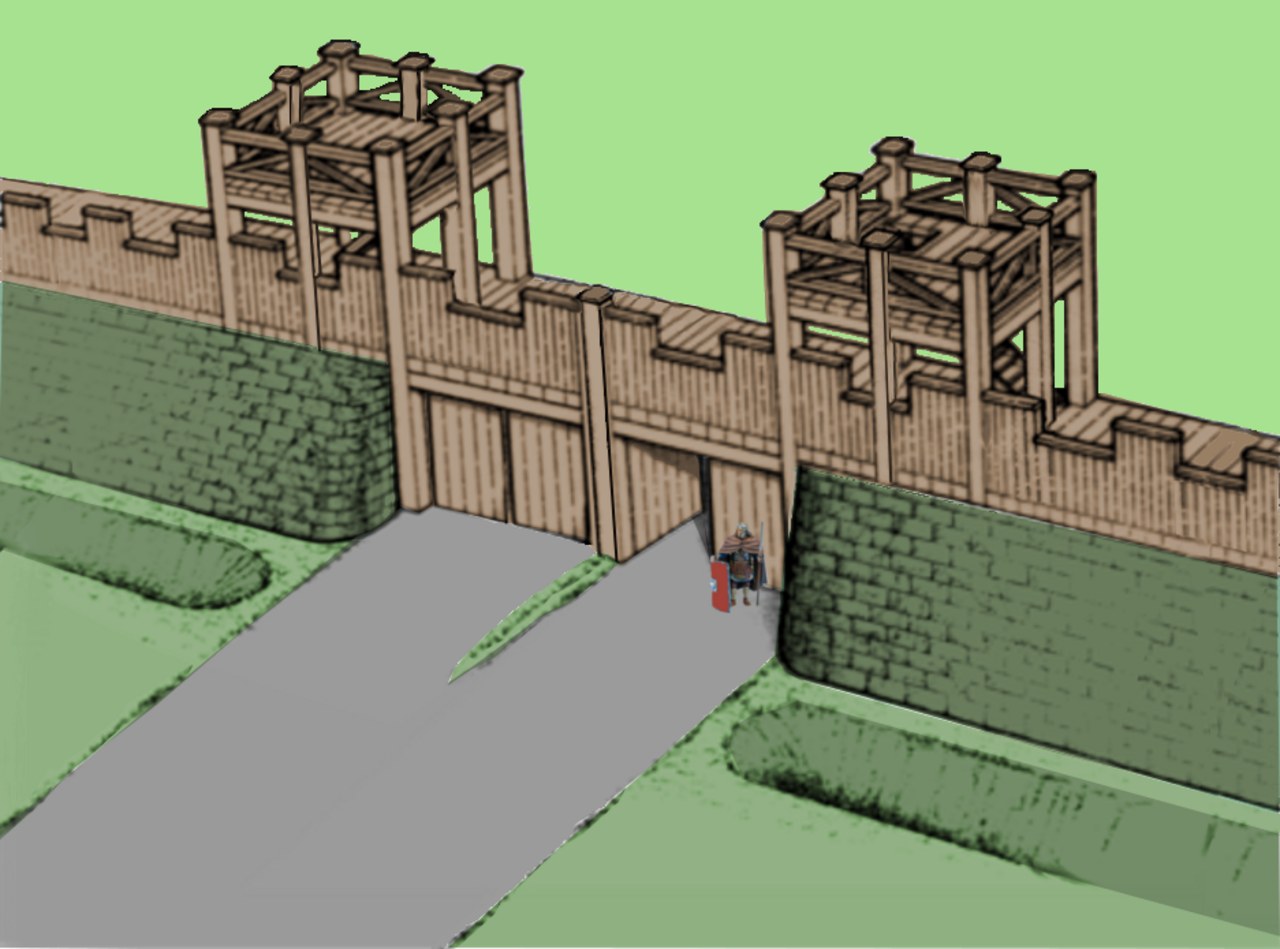 Inchtuthil: Lagertor Inchtuthil; archaeological view, find or museum context connected with the site, Roman period or local archaeological context.
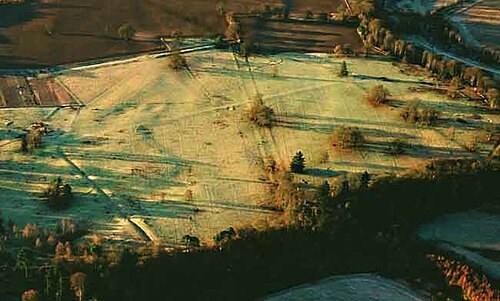 Inchtuthil: Den arkeologiske lämningen av fortet Inchtuthill med kant och upphöjt läge, floden Tay...; archaeological view, find or museum context connected with the site, Roman period or local archaeological context.
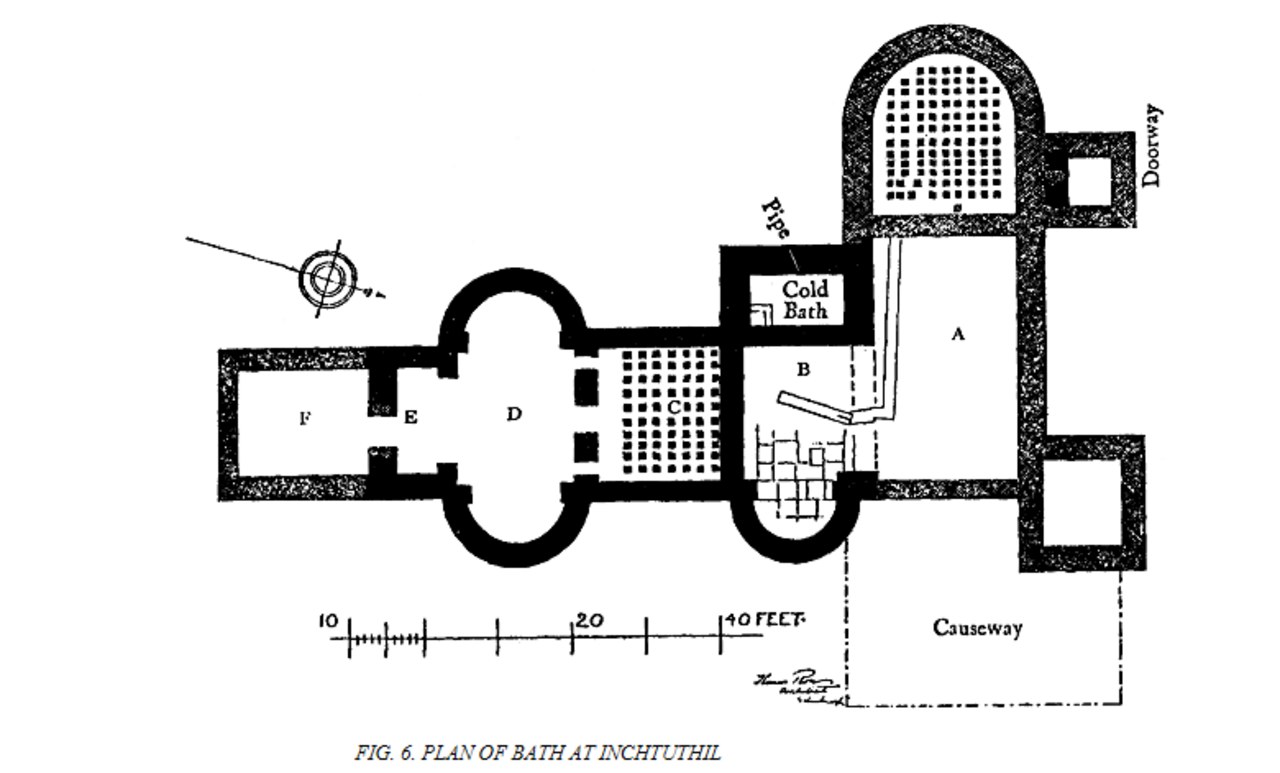 Inchtuthil: Balineum Inchtuthil; archaeological view, find or museum context connected with the site, Roman period or local archaeological context.
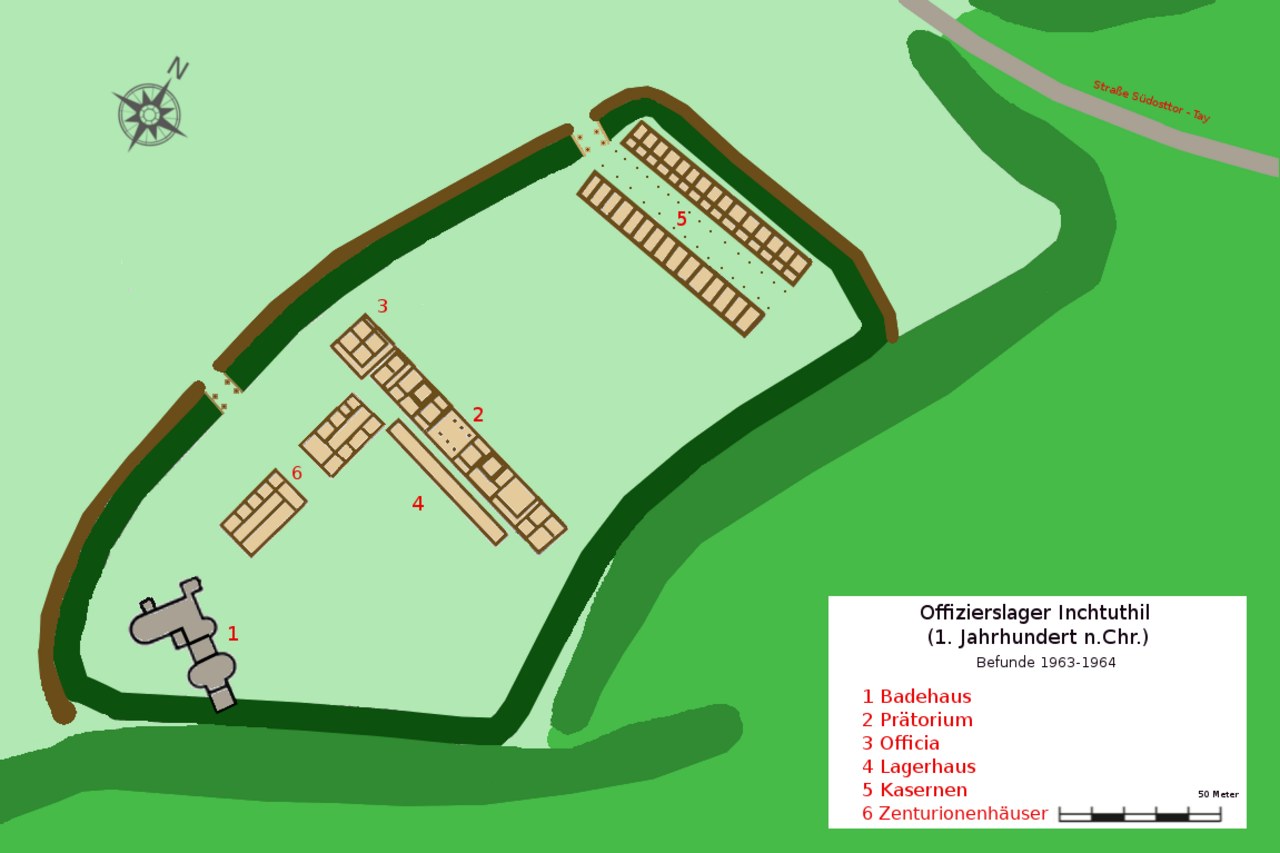 Inchtuthil: Befundskizze Offizierslager Inchtuthil; archaeological view, find or museum context connected with the site, Roman period or local archaeological context.
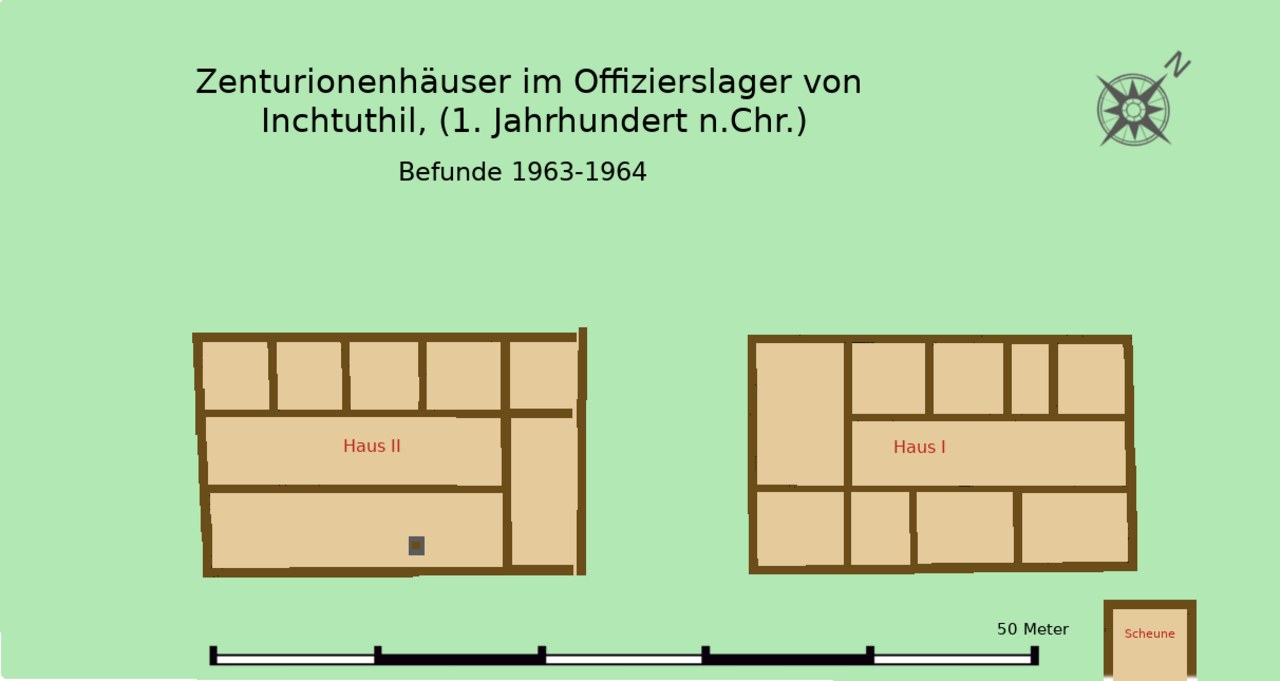 Inchtuthil: Befundskizze Zenturionenhäuser im Offizierslager von Inchtuthil; archaeological view, find or museum context connected with the site, Roman period or local archaeological context.
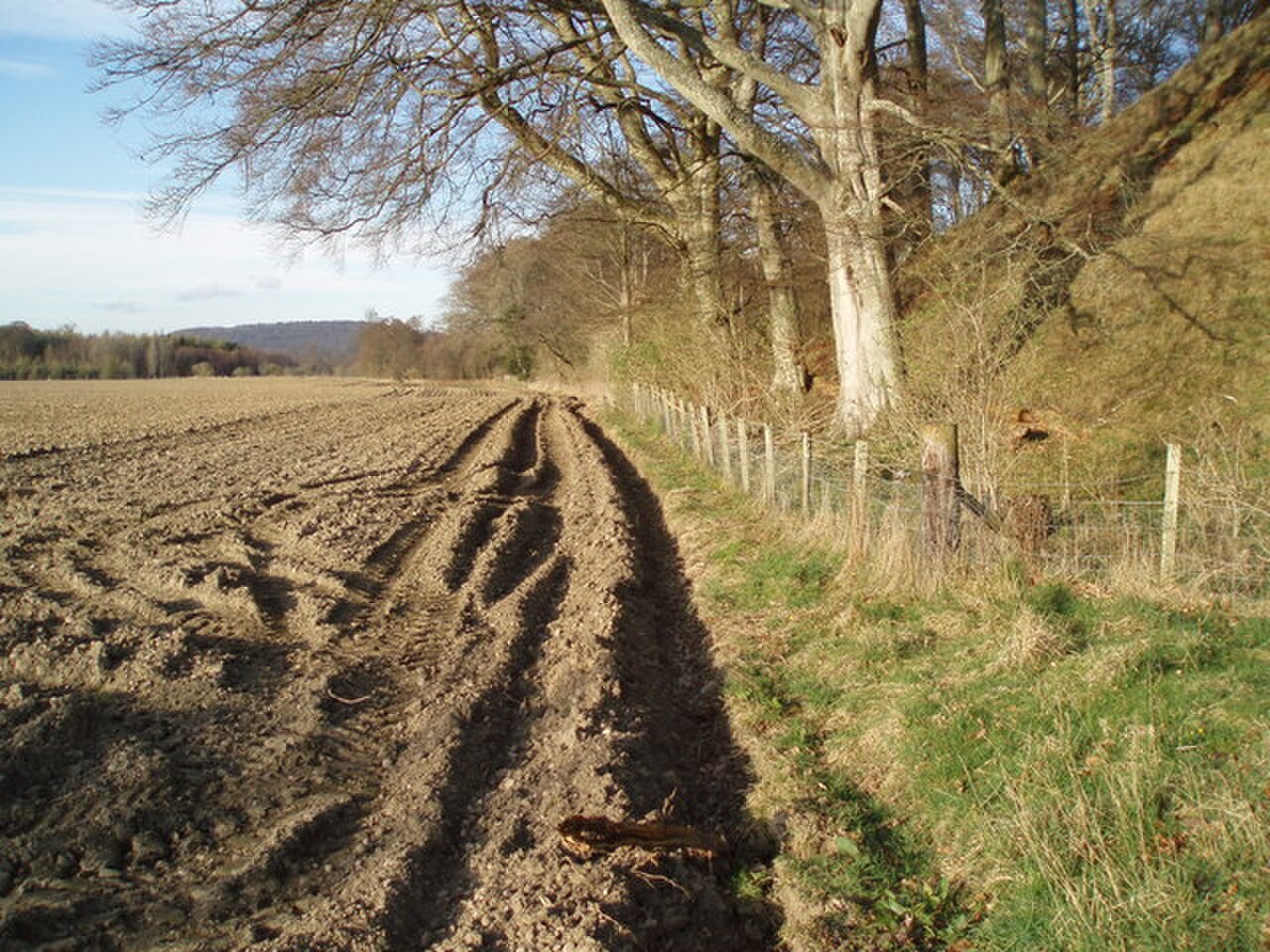 Inchtuthil: Boundary alongside old fort, Inchtuthil - geograph.org.uk - 390273; archaeological view, find or museum context connected with the site, Roman period or local archaeological context.
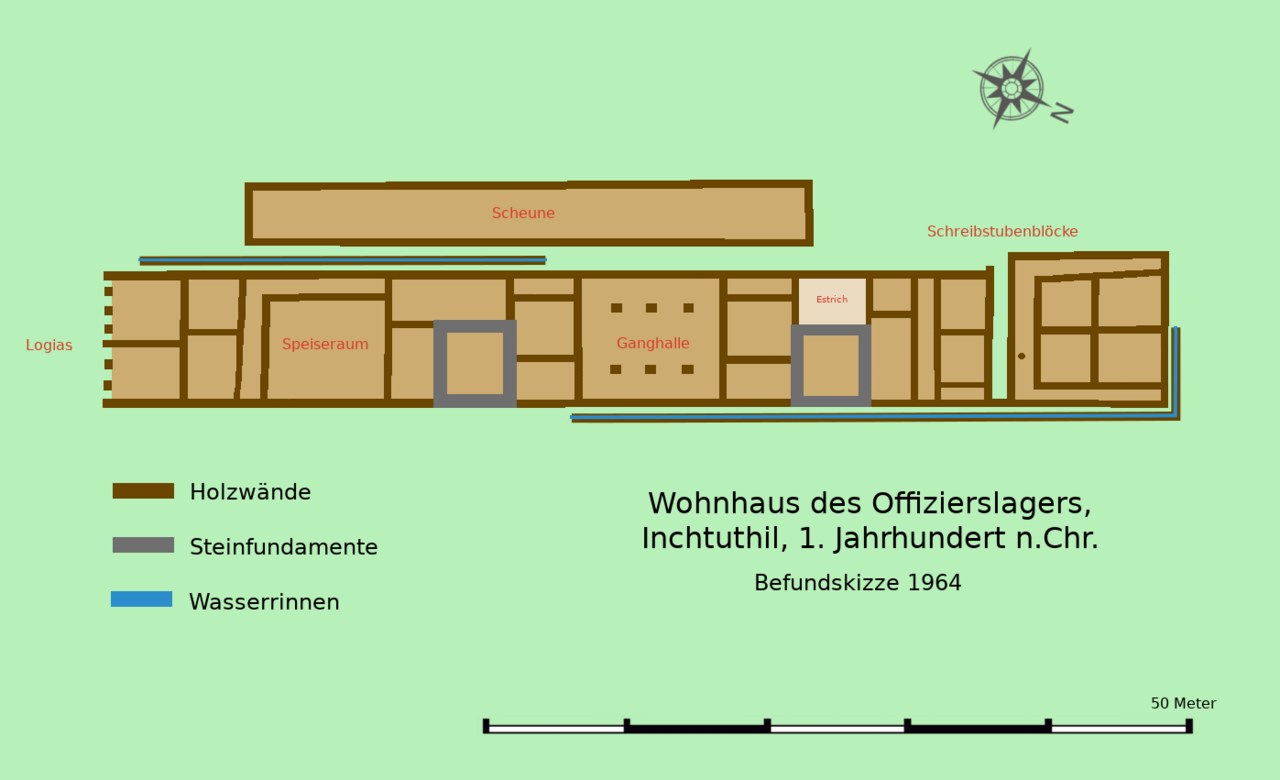 Inchtuthil: BS 1964, Wohnhaus Offizierslager; archaeological view, find or museum context connected with the site, Roman period or local archaeological context.
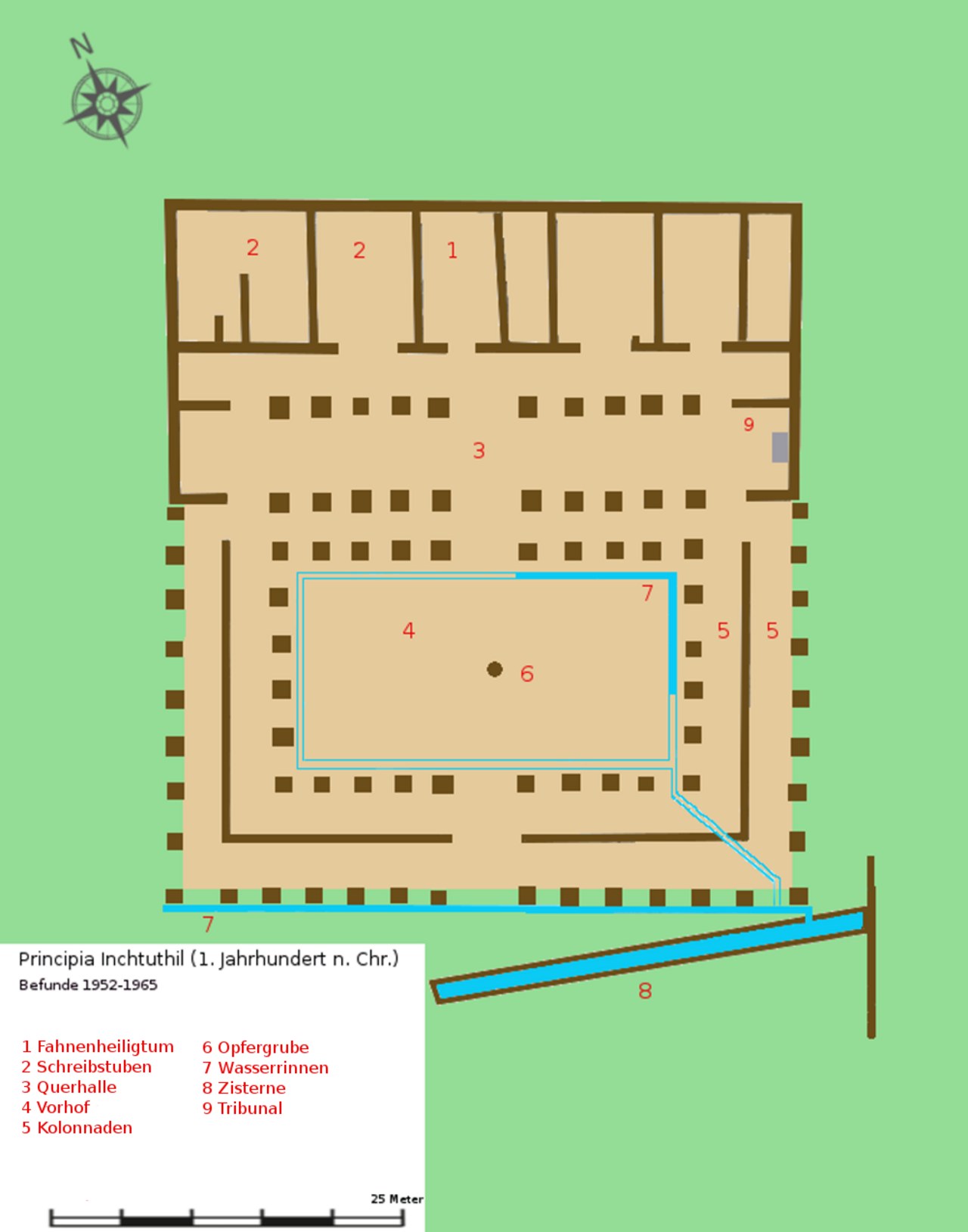 Inchtuthil: Befundskizze Principia Inchtuthil; archaeological view, find or museum context connected with the site, Roman period or local archaeological context.
Interested in Ancient Rome beyond reading? Join Legio X Fretensis or explore our reenactment directions.


