Mogontiacum / Mainz
Mogontiacum, Roman Mainz, was one of the main Roman centres on the Rhine. Its importance grew out of military geography: the Rhine, roads toward Gaul, routes into Germanic territory and the administrative interests of Upper Germany met here. Mogontiacum therefore cannot be described only as a camp or only as a city. It was a legionary base, headquarters and supply node, a place of military memory, a provincial town, a religious centre and a major archaeological complex.
For the history of the Roman army Mainz is especially important for early imperial material: gladii, belts, pugiones, horse harness, reliefs, tombstones and legionary stamps show the garrison through objects and names rather than in the abstract. Urban archaeology broadens the picture: the theatre, aqueduct, sanctuary of Isis and Mater Magna, streets, craft areas and inscriptions show how a stable Roman centre grew around the army.
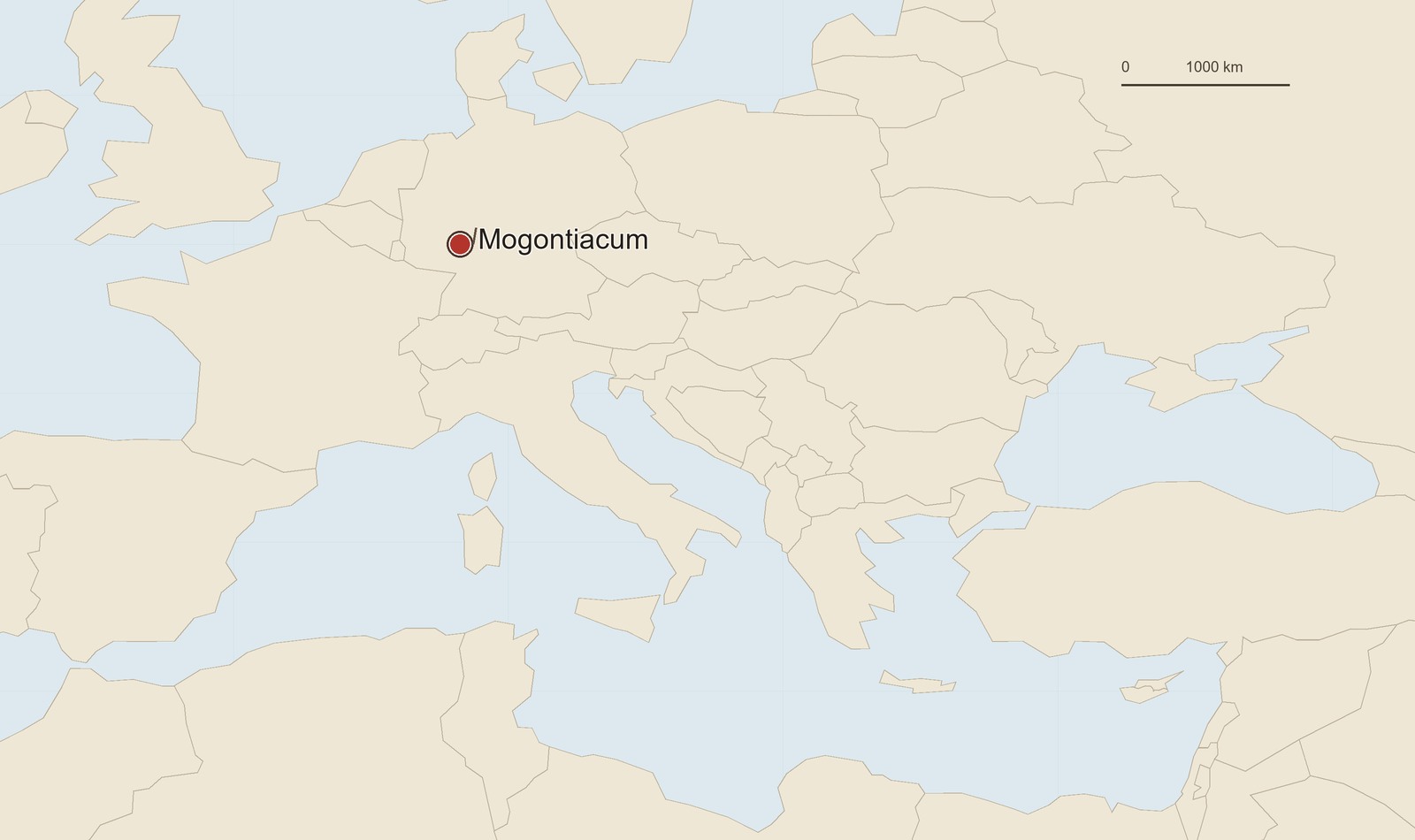 Location map: Mogontiacum / Mainz. The marker shows the ancient site or main archaeological complex.
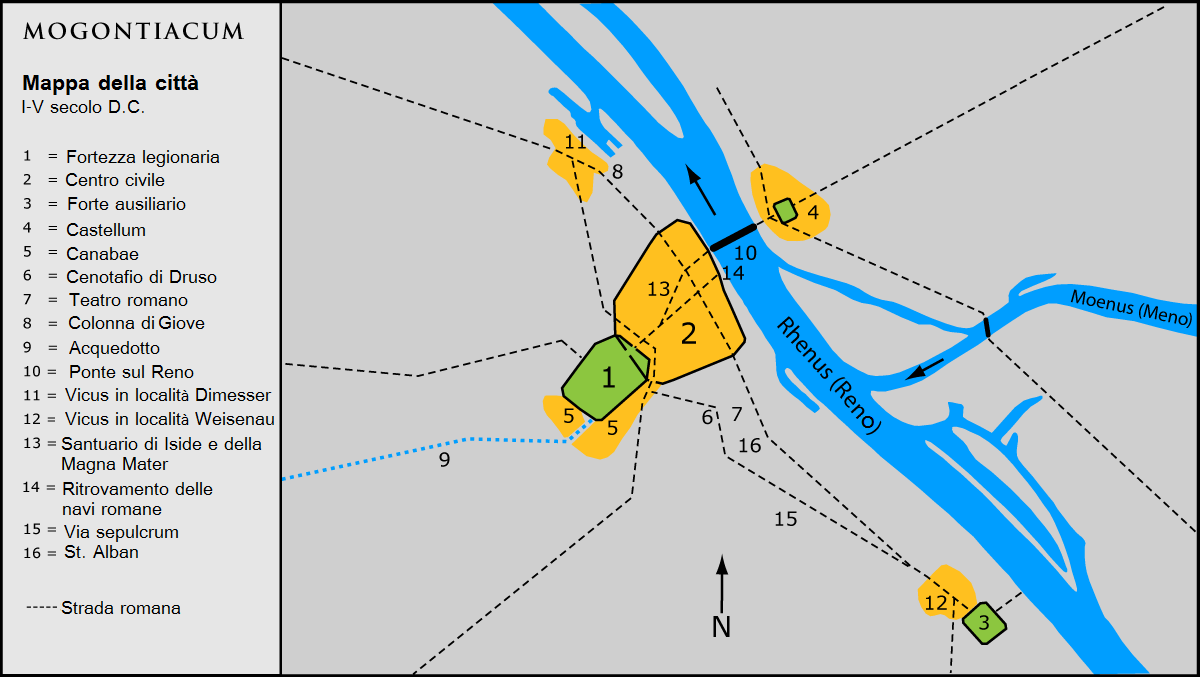 Plan of Roman Mogontiacum: the legionary fortress, the Rhine, civilian zones and the main monuments of ancient Mainz.
Foundation and the Rhine Frontier
Roman presence near the future Mainz is connected with the Augustan period and the campaigns of Drusus beyond the Rhine. The site was well placed for controlling a crossing, river movement and operations on the east bank. In its early phase Mogontiacum was above all a military base: troops could be supplied from here, units assembled, reconnaissance organised, roads built and communication with the Gallic rear maintained.
The memory of Drusus became part of the local military landscape. The Drususstein, preserved in the area of the Mainz citadel, is usually connected with the cenotaph raised by troops for the dead commander. For Mogontiacum this is an important sign: the city began not as an ordinary civilian settlement, but as a place where the army created lasting memory of its campaigns and commanders.
After the frontier stabilized, Mogontiacum did not lose its military significance. The Rhine remained a transport artery and line of defence, while the city served units, stores, workshops, crossings and administrative control. Even when urban life became more visible, the military layer continued to shape its archaeological character.
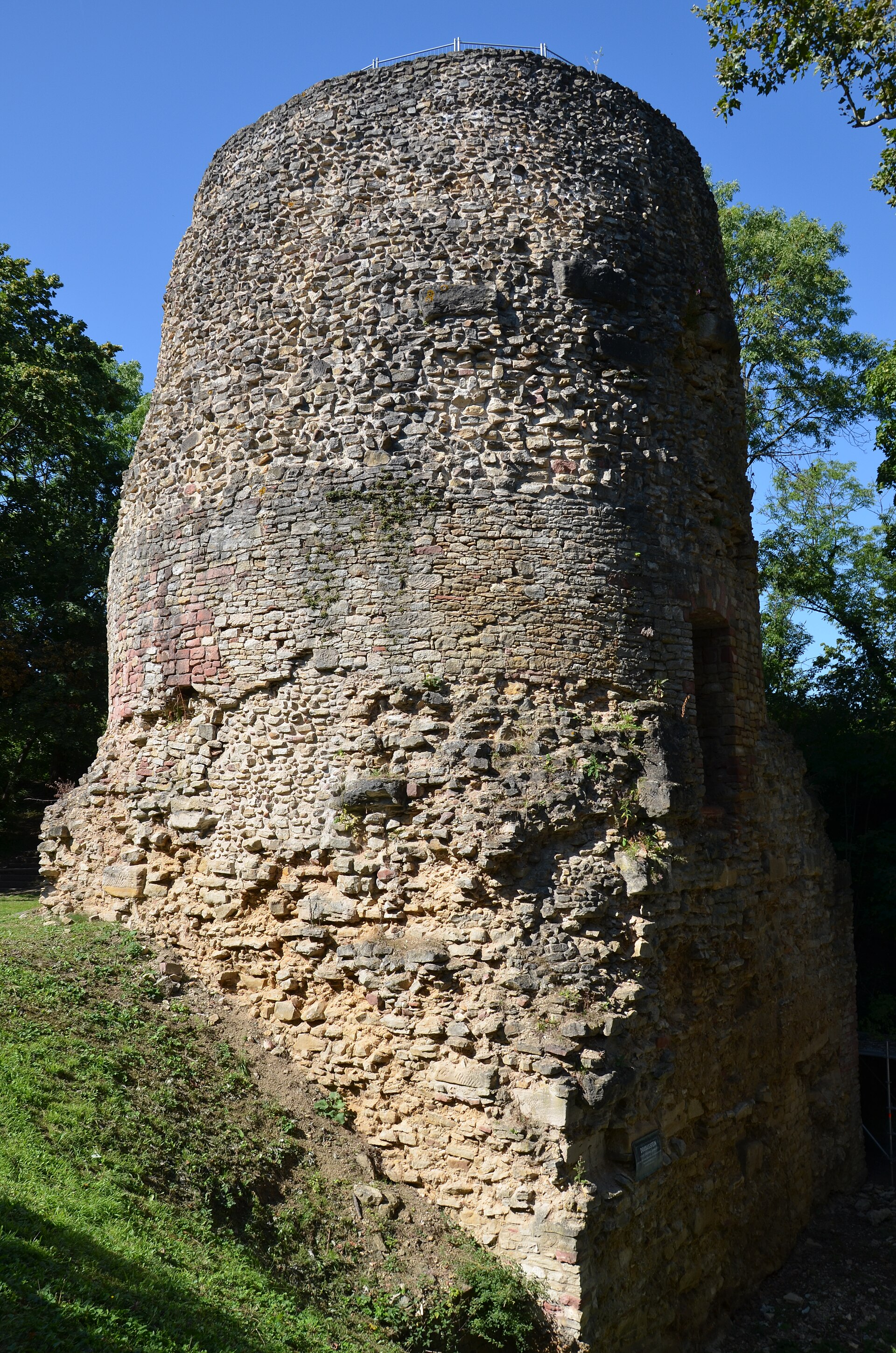 The Drususstein, the remains of the Roman cenotaph of Drusus at Mogontiacum. The monument connects early Mainz with the Augustan army and campaigns beyond the Rhine.
Legions and Military Setting
Different units were stationed or active at Mogontiacum, among them Legio XIV Gemina, Legio XVI Gallica, Legio IIII Macedonica and later Legio XXII Primigenia. The composition of the garrison changed, but Mainz retained its role as a node where legions, auxiliary units, headquarters administration, workshops and supply worked together. Canabae developed beside the fortress, settlements connected with military needs, trade, craft and the families of people attached to the garrison.
Material finds show this setting clearly. The Mainz-type gladius became one of the recognizable early imperial sword forms, but it should not obscure the rest of the evidence. Belt sets, scabbards, pugiones, rings, tile stamps and horse harness show not a single attractive object, but a system: a soldier wore equipment, workshops repaired it, stores recorded supplies, and the urban economy served the garrison.
Reliefs and tombstones complement the artefacts. They show clothing, gesture, weapons, age, name, unit and sometimes origin. Unlike a museum object without context, an inscription connects the image with a specific social memory: who served, in which legion, how he was to be remembered and which formulas were meaningful to people in the Rhine garrison.
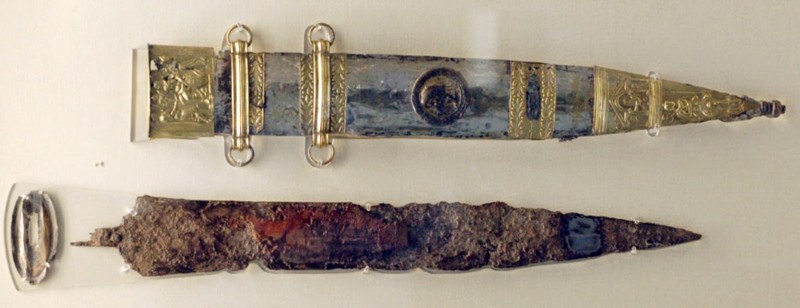 Mainz-type gladius found in the Rhine. Early first century AD; British Museum, London.
 Belt set with pugio from Mainz. First century AD; the object connects personal equipment with the Rhine garrison.
Urban Life
Mogontiacum developed into an urban environment in which a military base stood beside civilian architecture. The theatre, roads, water supply, workshops, trade and cult places show that the Rhine centre was not only a camp. The population included soldiers, veterans, craftsmen, traders, women and children of the garrison environment, migrants, local inhabitants and people from different provinces.
The Roman theatre of Mainz shows the scale of this urban side. Its position and size connect Mogontiacum with familiar forms of Roman public life: spectacles, gatherings, civic prestige and memory of authority. The aqueduct and other engineering remains speak to practical infrastructure: water had to be brought, distributed and maintained in a city that long lived beside a large garrison.
Cult life was also varied. The sanctuary of Isis and Mater Magna, discovered in the modern centre of Mainz, shows eastern cults in a Rhine city. Such monuments are important because they move Mogontiacum beyond a narrowly military subject: the city was a place where army, trade, religion and daily life intersected.
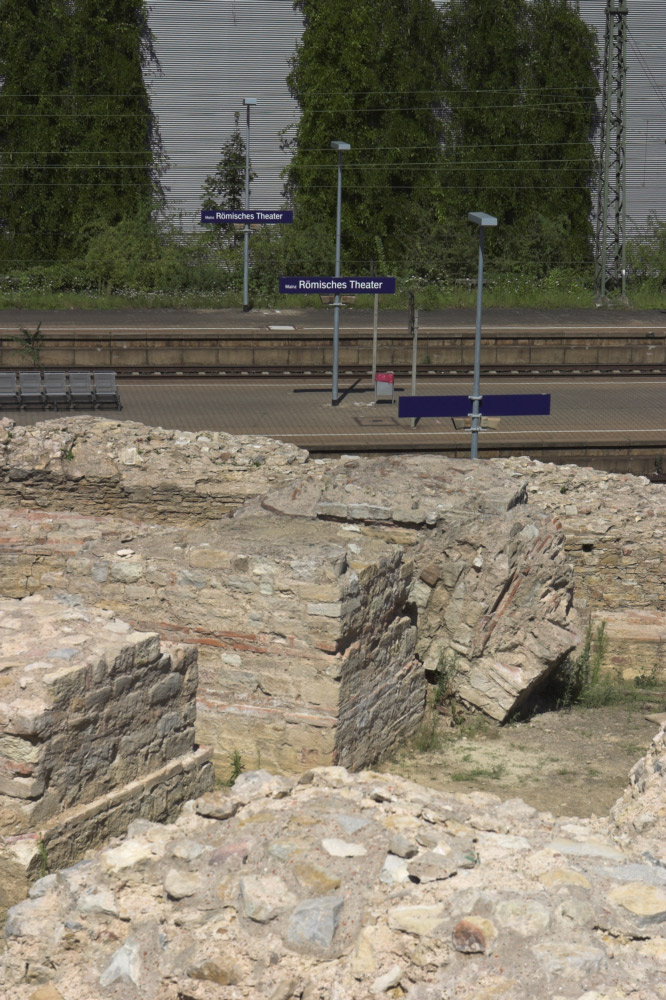 Ruins of the Roman theatre of Mogontiacum in Mainz. The theatre shows the urban side of the military capital of Upper Germany.
Stone, Inscriptions and Garrison Memory
The stone monuments from Mainz are especially valuable where image and text meet. Reliefs of soldiers from column pedestals in the headquarters area show how the military environment shaped public space. Tombstones name legionaries and their units, while stamps on building ceramics show the role of legions in economic and construction work.
This material is best read in layers. A relief speaks about the image of a soldier, but does not always record an exact campaign set. A tombstone gives name, unit and age, but follows the language of commemoration. A tile stamp does not show a person, but ties a legion to production and building. Together these sources give a more reliable picture of Mogontiacum than a single spectacular object without the city around it.
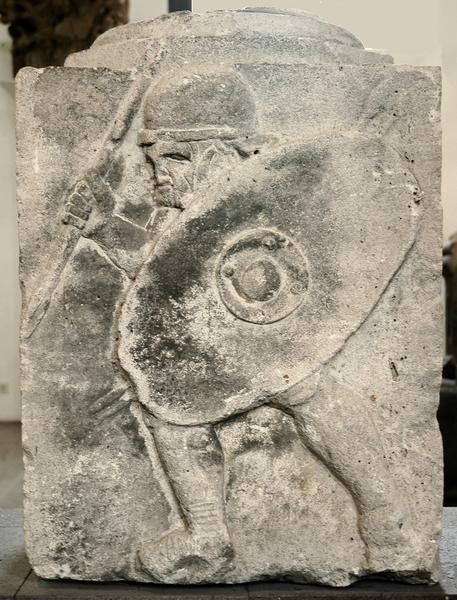 Relief of a Roman auxiliary armed with spear and javelins. Column pedestal from the principia area of Mogontiacum, second half of the first century AD; Landesmuseum Mainz.
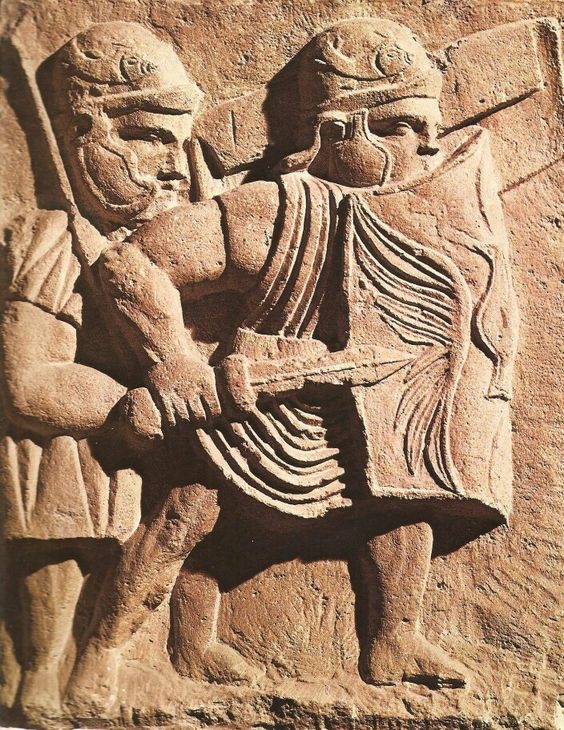 Relief of a soldier from the column-pedestal group of Mogontiacum. Second half of the first century AD; Landesmuseum Mainz.
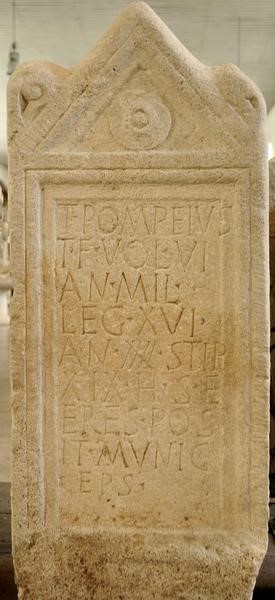 Tombstone of Titus Pompeius, a legionary of Legio XVI Gallica. Mainz, first century AD.
Chronology
- Late first century BC - the Mainz area becomes an important base for Augustan operations on the Rhine.
- 9 BC - death of Drusus; the cenotaph known through the remains of the Drususstein is connected with his memory.
- First century AD - Mogontiacum develops as a major legionary centre, around which canabae, workshops and an urban environment grow.
- AD 69-70 - the crisis of the Year of the Four Emperors and the Batavian Revolt affect the Rhine garrisons.
- Late first-second century AD - Mainz becomes the capital of Upper Germany and retains importance as a military and administrative centre.
- Second-third centuries AD - urban life, cults, theatre, inscriptions and craft show the stable development of Mogontiacum within the Rhine provincial system.
Archaeological Sources
The main sources for Mogontiacum are the fortress and urban topography, military equipment, horse harness, tombstones, legionary stamps, cult complexes and building remains. They need to be kept together: weapons explain the garrison, inscriptions return names to people, the theatre and aqueduct show the city, and the sanctuary shows the religious environment.
Mainz is useful precisely because it cannot be reduced to one class of finds. It allows object, image, text and place to be compared. If a gladius or belt set is considered apart from the Rhine base, it becomes a generic image of "Roman weapons." In the context of Mogontiacum it becomes part of a specific military and urban history.
Related Topics
- Archaeology and museums
- Roman Empire
- Roman Army
- Gladius
- Cingulum
- Pugio
- Nijmegen / Noviomagus
- Antiquity museums in Mainz
Literature and sources
- Boppert W. Römische Steindenkmäler aus Mainz.
- Carroll M. Spirits of the Dead: Roman Funerary Commemoration in Western Europe.
- Feugère M. Weapons of the Romans.
- Bishop M. C., Coulston J. C. N. Roman Military Equipment.
- Derks T., Roymans N. Ethnic Constructs in Antiquity.
- CIL XIII: inscriptions of Upper Germany and the Rhine provinces.
- Wikimedia Commons: Mogontiacum plan, Drususstein, Roman theatre of Mainz, sanctuary of Isis and Mater Magna, Roman aqueduct remains.


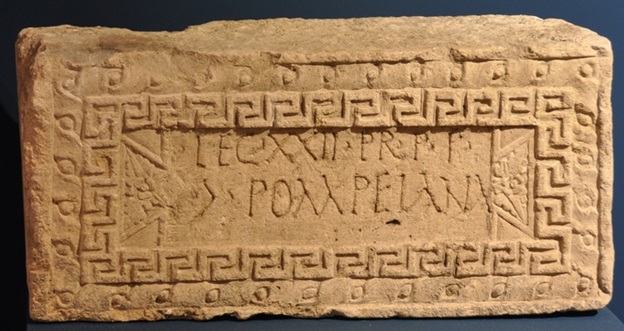 Inscription mentioning Legio XXII Primigenia Pia Fidelis. Mainz, Roman period.
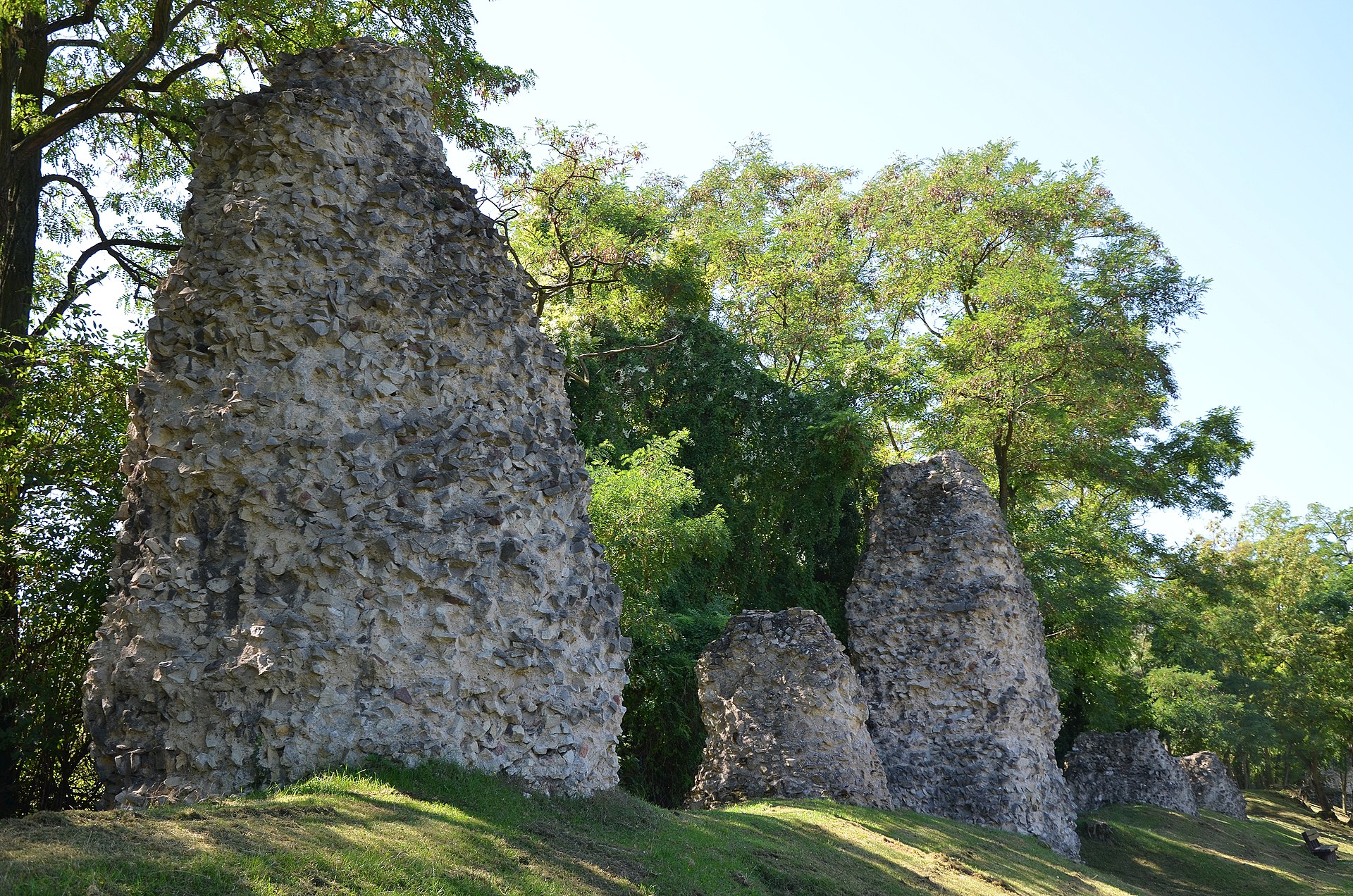 Remains of the Roman aqueduct of Mogontiacum. Water supply formed part of the urban infrastructure that grew around the legionary centre.
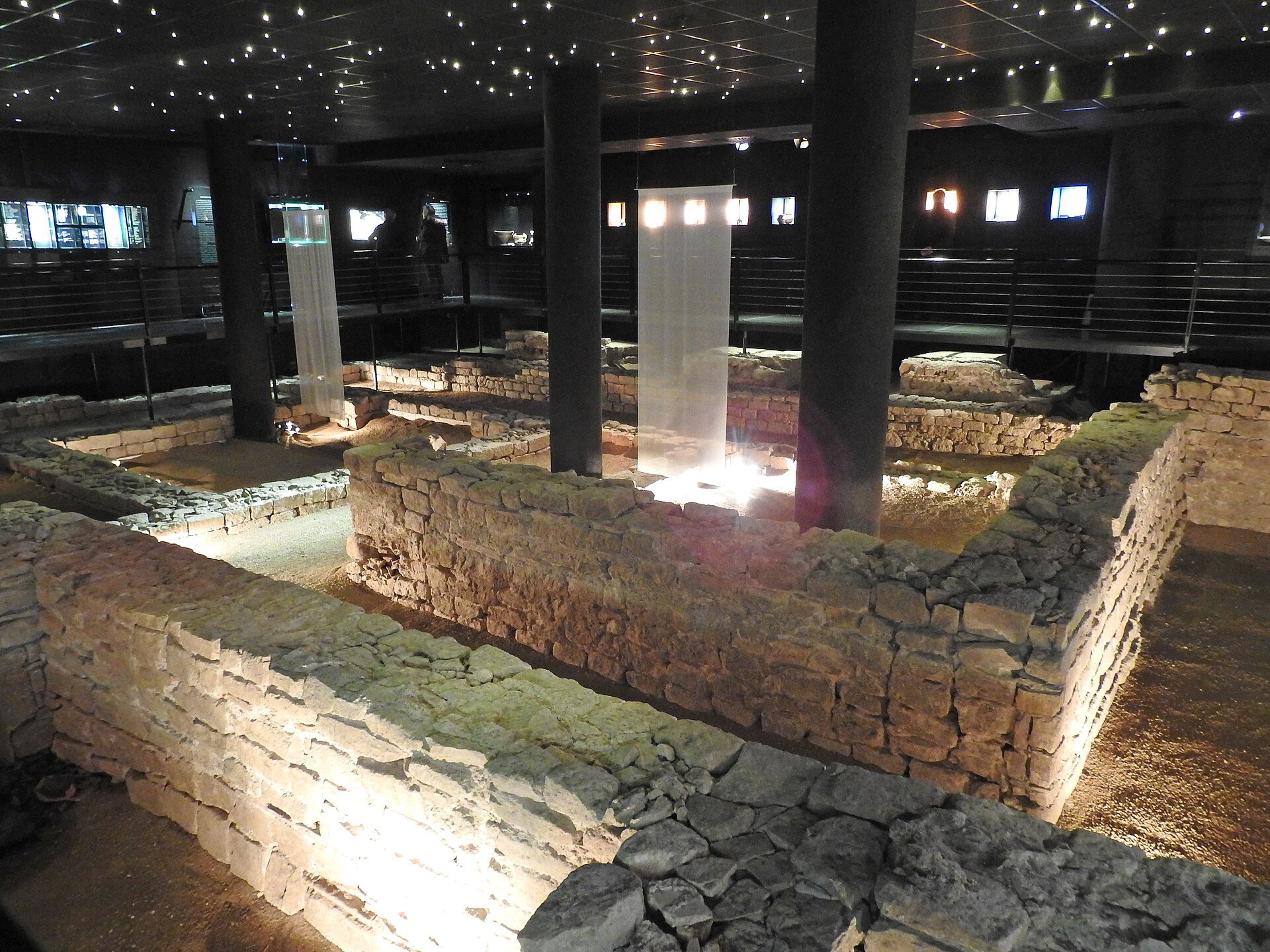 The sanctuary of Isis and Mater Magna in Mainz. Discovered in 1999, the complex belongs to the urban religious environment of Mogontiacum.
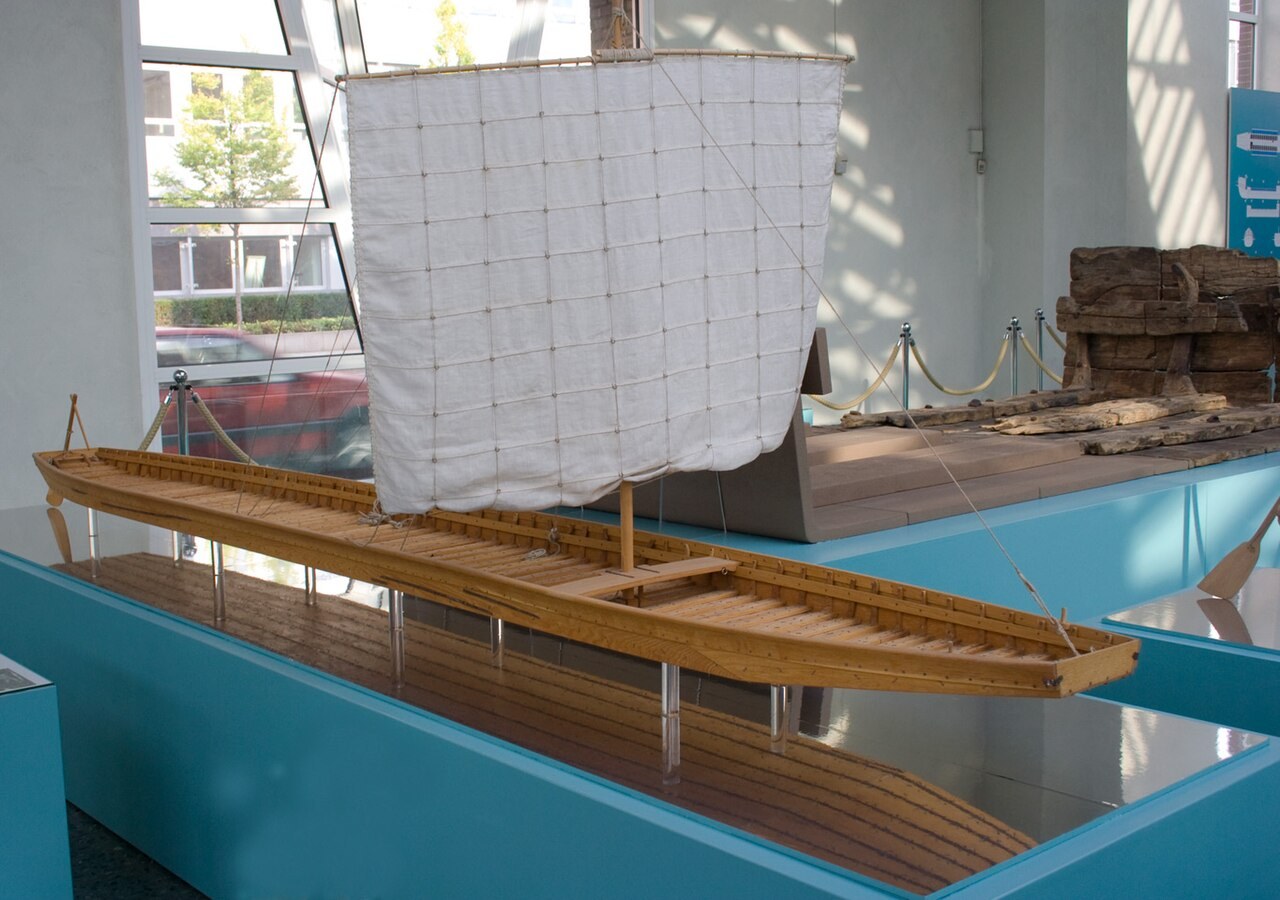 Mogontiacum / Mainz: Roemische-Prahm Mogontiacum; archaeological view, find or museum context connected with the site, Roman period or local archaeological context.
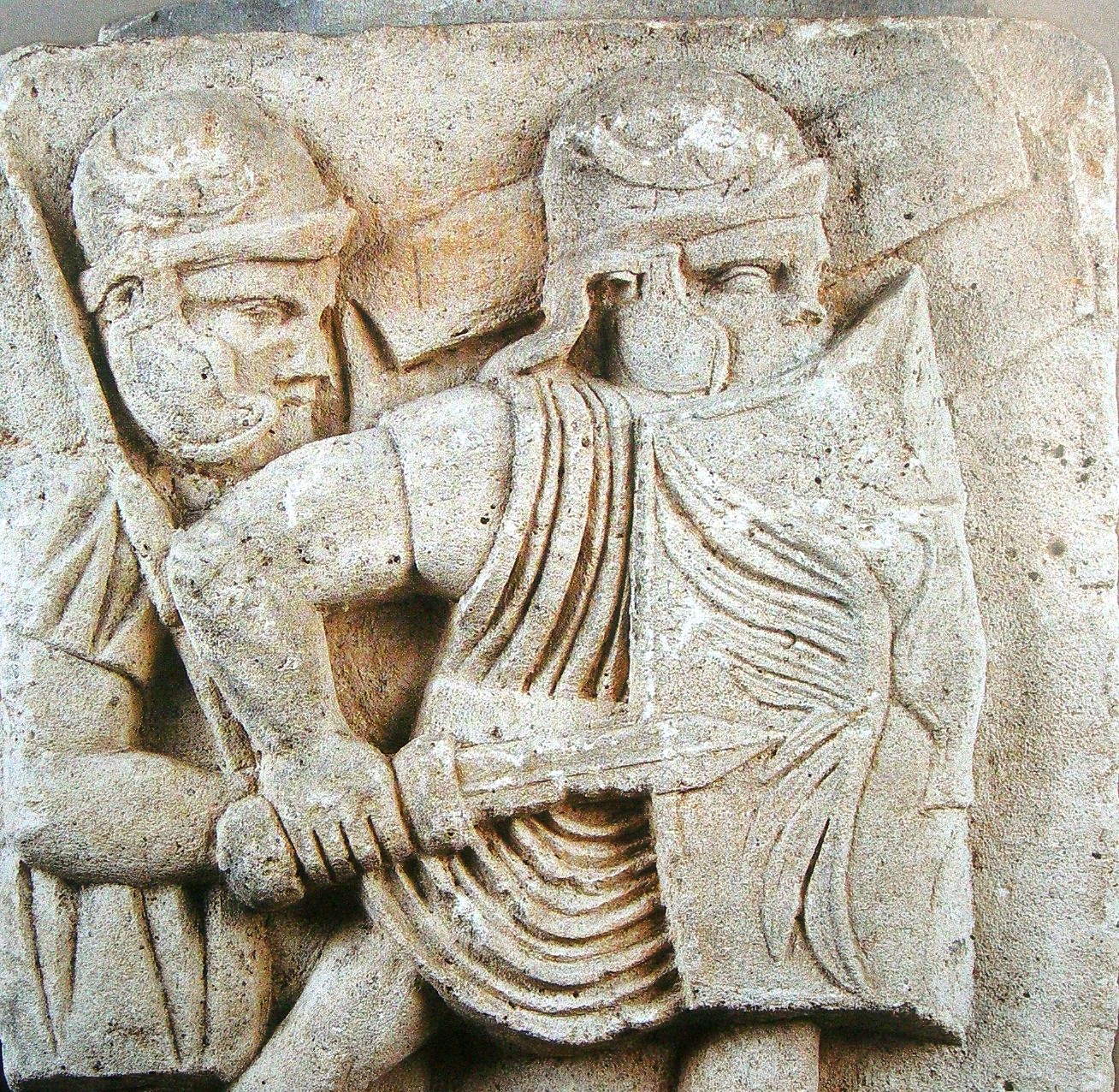 Relief fragment from Mogontiacum with a military scene. Images of this kind complement the artefactual evidence for weapons and belts.
 Tile stamped by Legio IIII Macedonica. Mainz, ca. AD 41-69.
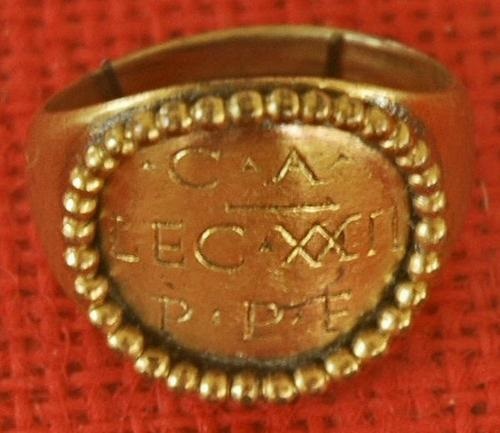 Ring of a soldier of Legio XXII Primigenia. Mainz, first century AD.
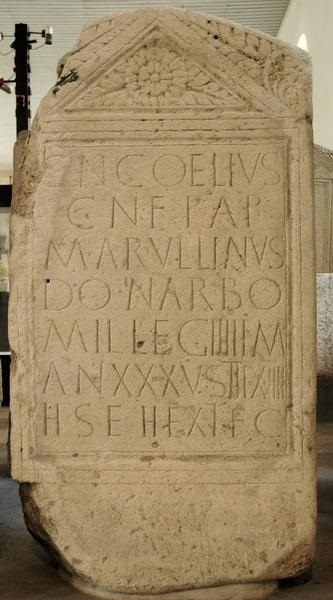 Tombstone of Gnaeus Caelius of Legio IIII Macedonica. Mainz, first century AD.
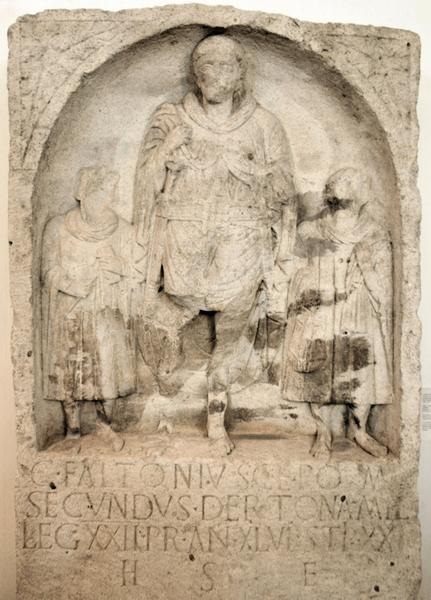 Tombstone of Gaius Falconius Secundus, soldier of Legio XXII Primigenia. Mainz, first century AD.
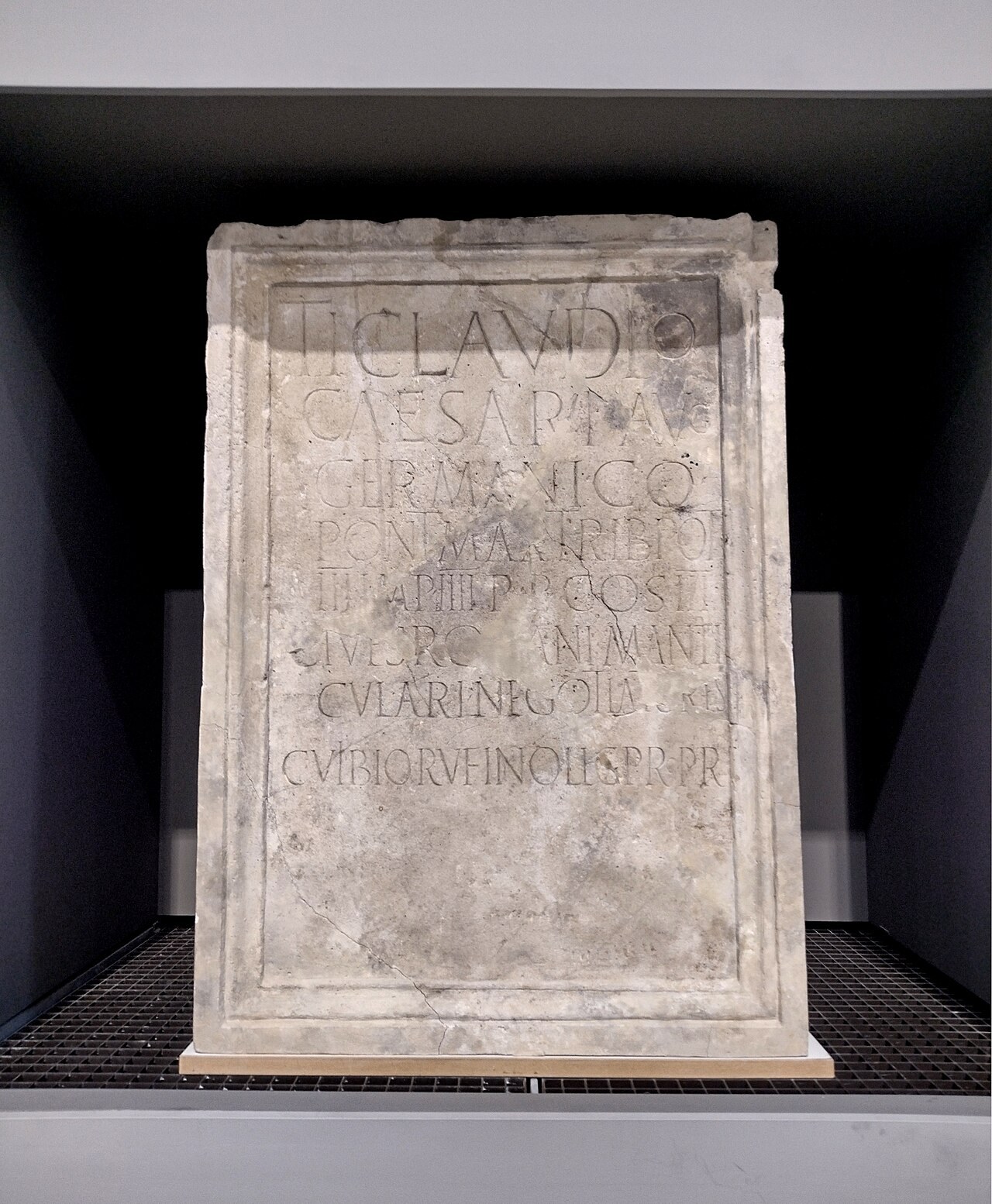 Mogontiacum / Mainz: Mainz, Ehreninschrift für Kaiser Claudius; archaeological view, find or museum context connected with the site, Roman period or local archaeological context.
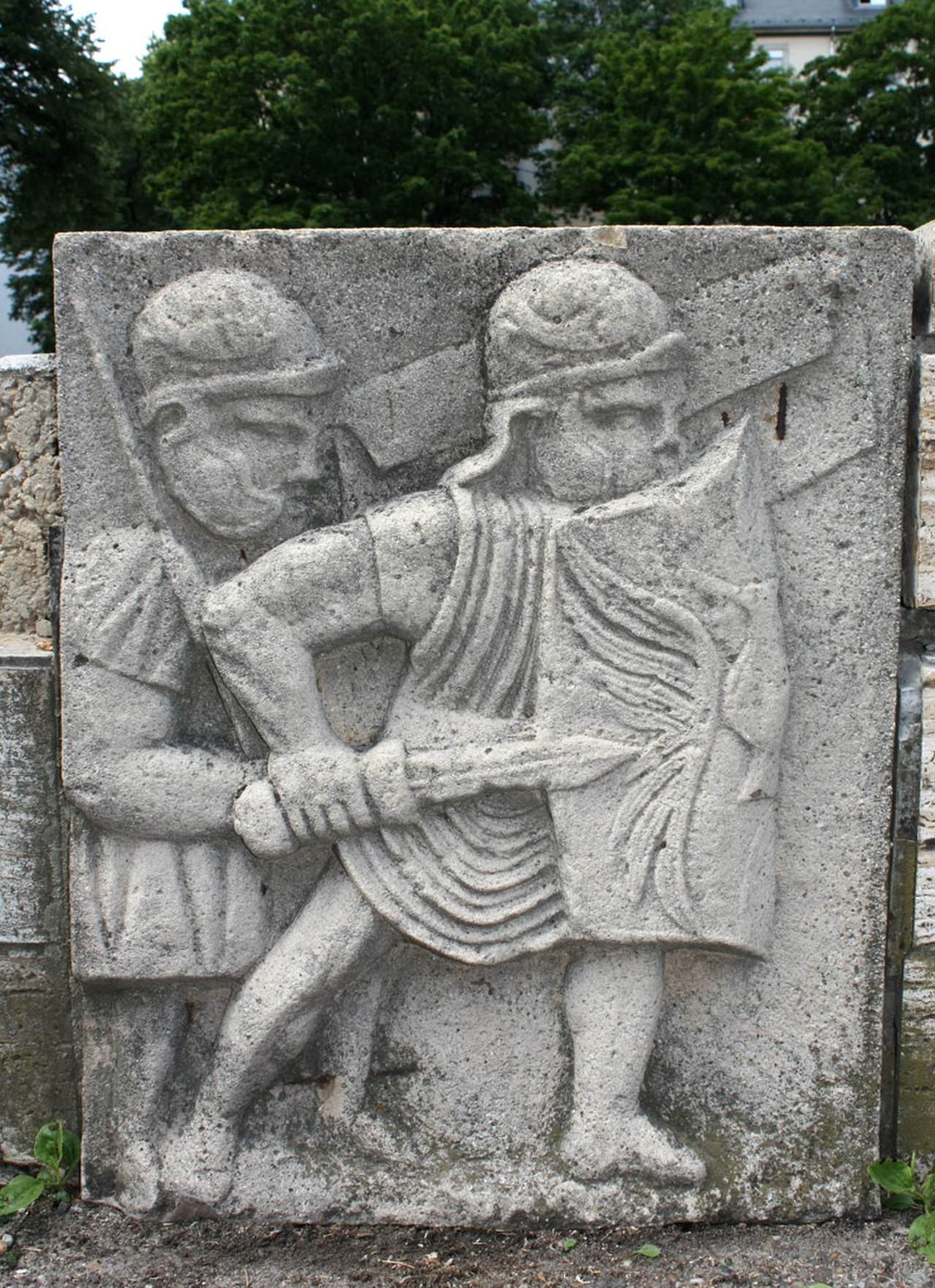 Mogontiacum / Mainz: Säulensockel2 Mogontiacum; archaeological view, find or museum context connected with the site, Roman period or local archaeological context.
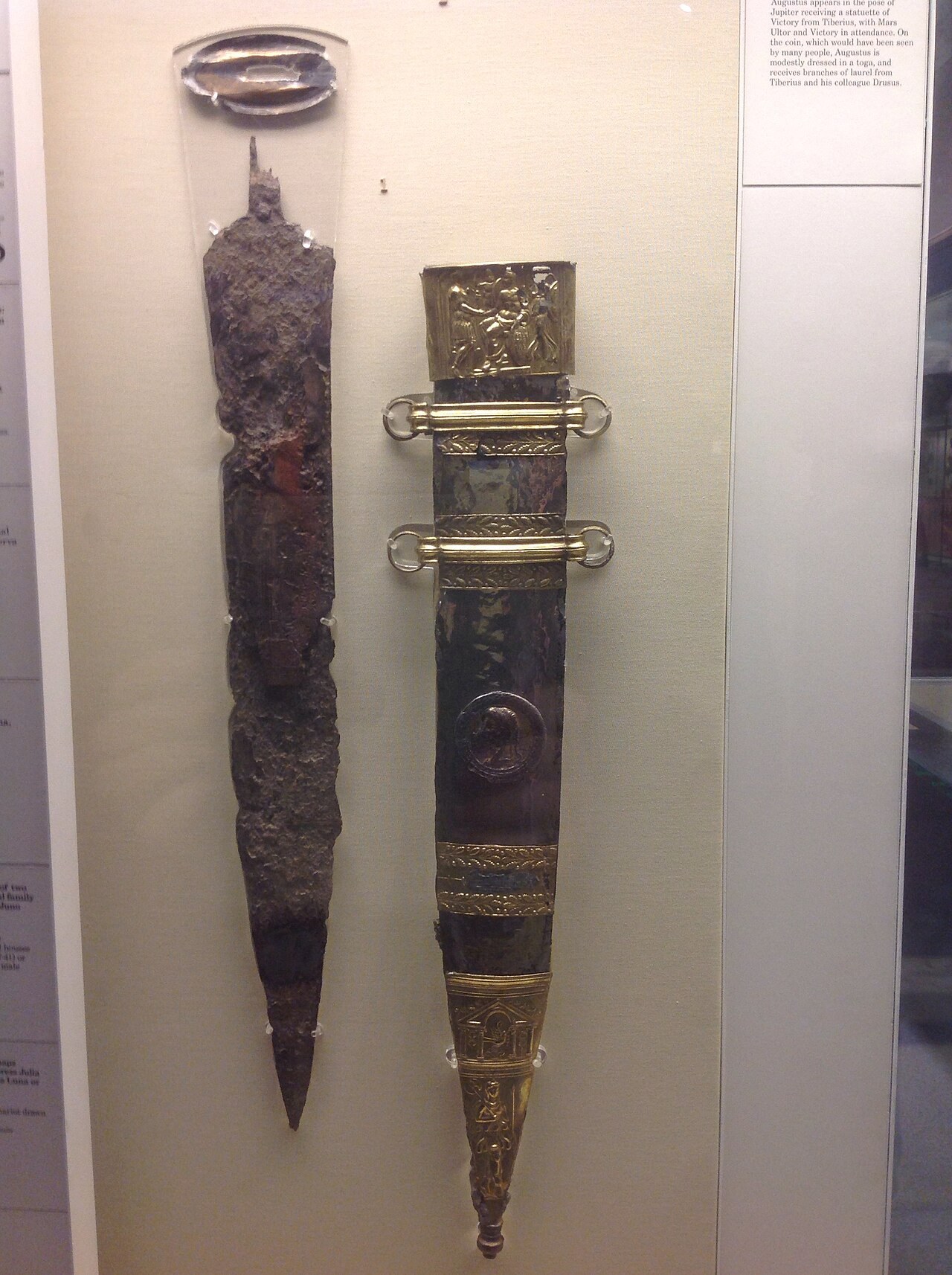 Mogontiacum / Mainz: Mainz sword; material-culture object or museum find connected with the site, Roman period or local archaeological context.
Interested in Ancient Rome beyond reading? Join Legio X Fretensis or explore our reenactment directions.


