Plato
Plato (c. 427-347 BC) was an ancient Greek philosopher, a student of Socrates and the founder of the Academy in Athens. His dialogues became one of the main vehicles of ancient philosophy. In brief: - city: Athens; - school: the Academy; - key themes: soul, knowledge, justice, state and Forms; - significance: one of the central authors of the European philosophical tradition.
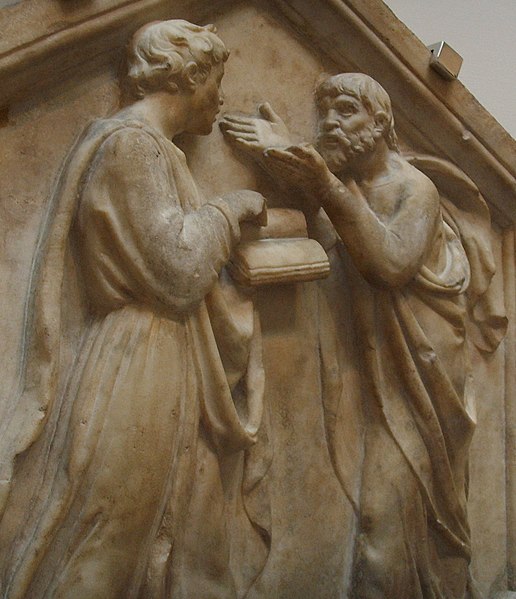 "Plato and Aristotle,or Philosophy",Luca Della Robbia. Bas-relief of the 15th century.
Life and the Circle of Socrates
Plato came from an aristocratic Athenian family and lived through political upheaval: defeat in the Peloponnesian War, the rule of the Thirty Tyrants and democratic restoration. The trial of Socrates became a decisive event for him. In the early dialogues Socrates is usually the central speaker. Through his figure Plato discusses virtue, knowledge, education and the limits of human certainty.
Dialogue as Form
Plato did not write treatises in the modern sense, but dialogues. This form allowed him to show philosophy as a movement of thought: question, answer, objection, clarification and sometimes open-endedness. The dialogues do not always present doctrine in a simple form. Often the path by which speakers reach or fail to reach a conclusion matters as much as the conclusion itself.
Forms, Soul and Knowledge
The doctrine of Forms holds a special place in Platonic philosophy. It explains why the sensible world changes while knowledge requires stable objects of thought. This is connected with discussions of the soul, recollection, mathematics and education. Plato saw philosophy as a turning of the soul away from opinions toward more secure knowledge.
State and Politics
In the Republic, Statesman and Laws Plato examined the order of the community, education of citizens and the dangers of flawed regimes. His political philosophy grew out of the crisis of Athenian politics and the experience of Socrates. The Platonic project should not be read simply as a literal political program. It is a philosophical model in which justice in the city is connected with justice in the soul.
The Academy and Influence
Plato's Academy became a long-lasting center of philosophical education. Its members included Aristotle, who later built his own system and criticized several Platonic positions. Plato influenced ancient metaphysics, ethics, political thought and later Neoplatonism. His texts continued to be read in the Roman period, Byzantium, Arabic scholarship and Europe.
Related topics
Literature and sources
1. Plato. Dialogues. 2. Aristotle. Metaphysics; Nicomachean Ethics. 3. Diogenes Laertius. Lives and Opinions of Eminent Philosophers. 4. Plutarch. Parallel Lives. 5. Cicero. On the Republic; Tusculan Disputations.
Interested in Ancient Rome beyond reading? Join Legio X Fretensis or explore our reenactment directions.


