SPQR: the Senate and Roman People
SPQR abbreviates the Latin formula Senatus Populusque Romanus, "the Senate and Roman People". It expresses the Roman civic community through two political components: Senate and people. It is not an emperor's name, the designation of a particular legion or an abbreviation of "Roman Empire".
Reading the abbreviation
S stands for Senatus, P for Populus, Q represents the attached conjunction -que, meaning "and", and R stands for Romanus. The expanded form is therefore Populusque, not an independent word Que. Romanus agrees grammatically with populus.
Stone inscriptions may read SENATVS POPVLVSQVE ROMANVS, using V where a modern edition prints U. Word dividers and abbreviation marks vary. A lack of modern spacing does not make the wording a different formula.
What Senate and people meant
In the Roman Republic, the Senate was a council in which former magistrates played a major role. The people acted politically through assemblies of citizens. Populus Romanus was not equivalent to every inhabitant of Roman territory: women, slaves and non-citizens did not possess the same political rights as voting male citizens. Even citizens' participation depended on assembly procedures and their ability to travel to Rome.
The formula articulates a civic community, but does not by itself describe the actual distribution of power in a particular year. It is neither evidence of modern political equality nor a written constitution.
Why the formula survived the Republic
Imperial rule did not immediately abolish all republican institutions or forms of public expression. The Senate survived, and a dedication in the name of Senate and people retained prestige. A well-known example is the Arch of Titus in Rome, built after his death in 81 CE. Its ancient dedicatory inscription on the side facing the Colosseum begins with the expanded formula Senatus Populusque Romanus.
SPQR, or its expanded wording, therefore does not automatically date an object to the Republic. A ruler's name, titulature, archaeological context and the inscription itself must also be considered.
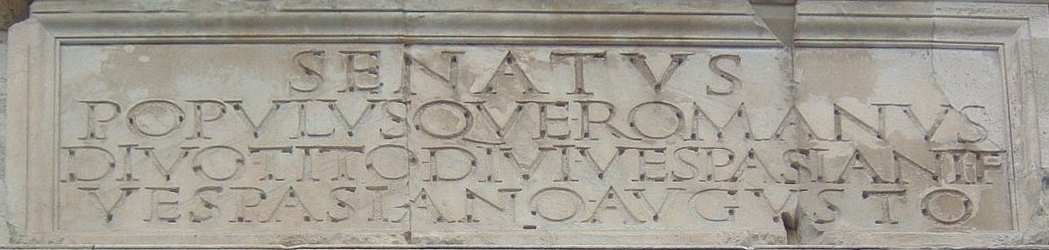 Ancient dedicatory inscription on the Arch of Titus, Rome, after 81 CE. The opening lines read SENATVS POPVLVSQVE ROMANVS, followed by the dedication to the deified Titus. CIL VI 945. Photograph: Vincent Ramos, Wikimedia Commons version; CC BY-SA 3.0.
SPQR and military reconstruction
Modern images often place SPQR on shields, standards and equipment. The familiarity of the formula does not establish a single universal decorative scheme for the Roman army. A reconstruction should distinguish the civic formula, a unit's name and a particular standard, using a dated image or object as evidence.
Modern souvenirs and civic emblems belong to the later reception of Rome, not to the ancient evidence itself. A modern composition combining eagle, wreath and letters should not be presented as an exact copy of an ancient object without a documented prototype.
Related topics
Literature and sources
- Arch of Titus: inscription CIL VI, 945. Parco archeologico del Colosseo.
- Andrew Lintott. The Constitution of the Roman Republic. Oxford University Press, 1999.
- Alison E. Cooley. The Cambridge Manual of Latin Epigraphy. Cambridge University Press, 2012.
Illustration: file page and attribution; CC BY-SA 3.0.
Interested in Ancient Rome beyond reading? Join Legio X Fretensis or explore our reenactment directions.


