Roman Numerals
Roman numerals are a non-positional way of writing numbers that developed in ancient Italy and used the signs I, V, X, L, C, D and M. The modern school form emerged through long standardisation: ancient monuments preserve different sign shapes, additive forms such as IIII, and abbreviations whose meaning becomes clear only within the complete inscription.
The complete 1–100 chart and converter use modern normalised notation. Archaeological examples show actual practice—entrance numbers, calendar tables, epitaphs and small objects. The three opening images belong to different periods: LII on the Colosseum is ancient, Freigius's table was printed in 1582, and the clock face represents a modern tradition.
The principal values are I = 1, V = 5, X = 10, L = 50, C = 100, D = 500 and M = 1000. A smaller sign after a larger one is usually added; in modern notation a smaller sign before a larger one can be subtracted. Ordinary Roman numeral notation has no separate zero sign.
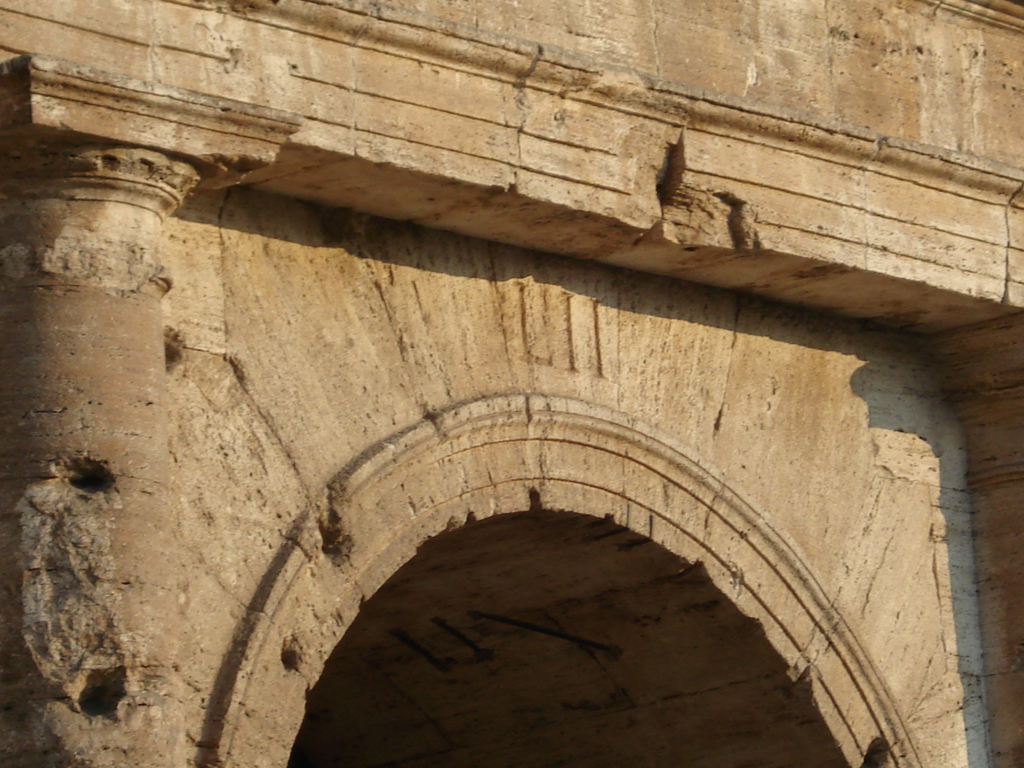 Number LII above an entrance of the Colosseum in Rome. Numbered arches and passageways directed spectators to sectors of the amphitheatre; travertine, late 1st century CE. Photo by WarpFlyght, Wikimedia Commons, CC BY-SA 3.0.
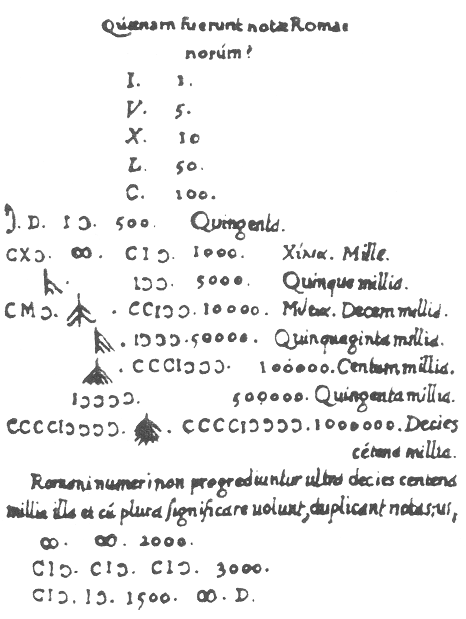 Table of Roman numerals in a work by Johann Thomas Freigius, published in 1582. This is an early modern, not an ancient, source. Scan: u3001 / Wikimedia Commons; public domain.
 Modern clock face with Roman numerals I–XII: an example of later reception, not an ancient source. Photo: Notwist, Wikimedia Commons; public domain.
Roman numerals chart from 1 to 100
The complete chart below gives Roman numerals from 1 to 100. It uses modern normalised notation: 4 = IV, 9 = IX, 40 = XL and 90 = XC. Ancient inscriptions can use variants such as IIII instead of IV, but the chart gives the standard form for learning, conversion and modern dates.
| Number | Roman numeral |
|---|---|
|
1 |
I |
|
2 |
II |
|
3 |
III |
|
4 |
IV |
|
5 |
V |
|
6 |
VI |
|
7 |
VII |
|
8 |
VIII |
|
9 |
IX |
|
10 |
X |
|
11 |
XI |
|
12 |
XII |
|
13 |
XIII |
|
14 |
XIV |
|
15 |
XV |
|
16 |
XVI |
|
17 |
XVII |
|
18 |
XVIII |
|
19 |
XIX |
|
20 |
XX |
|
21 |
XXI |
|
22 |
XXII |
|
23 |
XXIII |
|
24 |
XXIV |
|
25 |
XXV |
|
26 |
XXVI |
|
27 |
XXVII |
|
28 |
XXVIII |
|
29 |
XXIX |
|
30 |
XXX |
|
31 |
XXXI |
|
32 |
XXXII |
|
33 |
XXXIII |
|
34 |
XXXIV |
|
35 |
XXXV |
|
36 |
XXXVI |
|
37 |
XXXVII |
|
38 |
XXXVIII |
|
39 |
XXXIX |
|
40 |
XL |
|
41 |
XLI |
|
42 |
XLII |
|
43 |
XLIII |
|
44 |
XLIV |
|
45 |
XLV |
|
46 |
XLVI |
|
47 |
XLVII |
|
48 |
XLVIII |
|
49 |
XLIX |
|
50 |
L |
|
51 |
LI |
|
52 |
LII |
|
53 |
LIII |
|
54 |
LIV |
|
55 |
LV |
|
56 |
LVI |
|
57 |
LVII |
|
58 |
LVIII |
|
59 |
LIX |
|
60 |
LX |
|
61 |
LXI |
|
62 |
LXII |
|
63 |
LXIII |
|
64 |
LXIV |
|
65 |
LXV |
|
66 |
LXVI |
|
67 |
LXVII |
|
68 |
LXVIII |
|
69 |
LXIX |
|
70 |
LXX |
|
71 |
LXXI |
|
72 |
LXXII |
|
73 |
LXXIII |
|
74 |
LXXIV |
|
75 |
LXXV |
|
76 |
LXXVI |
|
77 |
LXXVII |
|
78 |
LXXVIII |
|
79 |
LXXIX |
|
80 |
LXXX |
|
81 |
LXXXI |
|
82 |
LXXXII |
|
83 |
LXXXIII |
|
84 |
LXXXIV |
|
85 |
LXXXV |
|
86 |
LXXXVI |
|
87 |
LXXXVII |
|
88 |
LXXXVIII |
|
89 |
LXXXIX |
|
90 |
XC |
|
91 |
XCI |
|
92 |
XCII |
|
93 |
XCIII |
|
94 |
XCIV |
|
95 |
XCV |
|
96 |
XCVI |
|
97 |
XCVII |
|
98 |
XCVIII |
|
99 |
XCIX |
|
100 |
C |
Converting Roman numerals to Arabic and back
Arabic to Roman. Repeatedly take the largest possible value from M, CM, D, CD, C, XC, L, XL, X, IX, V, IV and I, writing each chosen sign from left to right.
Examples: 2026 = 2000 + 20 + 6 = MMXXVI; 1999 = 1000 + 900 + 90 + 9 = MCMXCIX; 944 = 900 + 40 + 4 = CMXLIV; 49 = 40 + 9 = XLIX. The normalised converter covers 1–3999; this is a convenient modern limit, not the historical boundary of the Roman system.
Roman to Arabic. Assign each sign its value and read from left to right: add a sign when the next is not larger, and subtract it when a larger sign follows. XIV = 10 + (5 − 1) = 14; XL = 50 − 10 = 40; MCMXCIX = 1000 + 900 + 90 + 9 = 1999.
After calculating, check the form: IV is valid in the modern standard, while IIV and VX are not. An ancient inscription must not be corrected automatically from a school chart: preserve its actual spelling first, then interpret it in context.
Quick answers. IV = 4, IX = 9 and XL = 40. A year writes the number itself: 2026 = MMXXVI, 1999 = MCMXCIX and 476 = CDLXXVI. A century is the ordinal number of a hundred-year period: the 21st century covers 2001–2100, the 4th century 301–400 and the 9th century 801–900. MMXXVI is therefore a year, while XXI is a century number.
| Notation | Answer |
|---|---|
|
IV |
4 |
|
XL |
40 |
|
CDLXXVI |
year 476 |
|
MMXXVI |
year 2026 |
|
4th century |
years 301–400 |
|
IX |
9 |
|
XLIV |
44 |
|
MCMXCIX |
year 1999 |
|
21st century |
years 2001–2100 |
|
9th century |
years 801–900 |
Origins of the signs and writing rules
Early numeral signs are connected with the traditions of ancient Italy, especially the Etruscan system. Their exact development remains debated: scholars compare the forms with tally marks and grouped notches, and with the reshaping of Italic signs after their incorporation into Latin writing. I readily reads as one stroke; V and X mark groups of five and ten, but the explanation of V as a picture of a hand remains a hypothesis. Signs for 50, 500 and 1,000 long had forms unlike familiar L, D and M. Forms such as CIƆ represented one thousand; M could also abbreviate mille or milia. The resemblance of C to centum and M to mille is a useful mnemonic, but not a complete history of the signs.
Modern normalised notation combines addition with limited subtraction. VI = 6, XV = 15 and LX = 60 are added; in IV = 4, IX = 9, XL = 40, XC = 90, CD = 400 and CM = 900 the smaller sign is subtracted. I, X, C and M are normally repeated no more than three times, while V, L and D are not doubled; 49 is therefore XLIX, not IL.
Ancient practice was more flexible. IIII instead of IV, VIIII instead of IX and XIIII instead of XIV are normal additive variants, not automatic evidence of a mason's mistake. Additive and subtractive forms could coexist. An epigrapher first records an inscription sign by sign, including losses and separators, and only then supplies a normalised value.
On the bone tessera lusoria, text and numeral appear on different faces, so the two photographs form a single source. The purpose of such tokens is debated, but the arrangement shows that a number could identify a series, a move in a game or an accounting value rather than function as a free-standing textbook example.
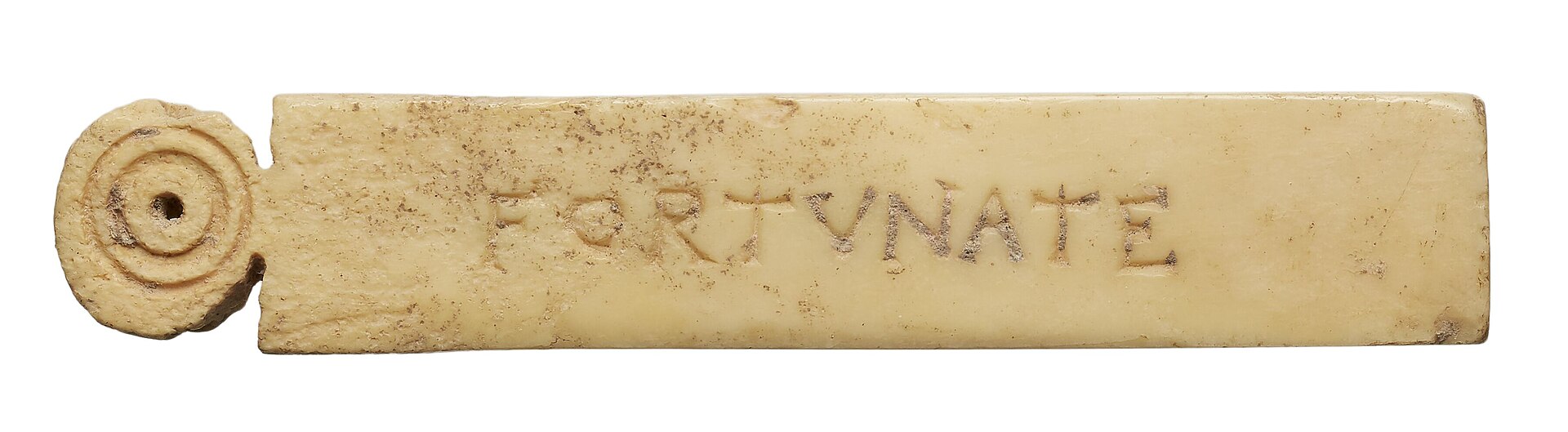 Bone tessera lusoria with inscription and numeral: obverse. BnF/Gallica, public domain.
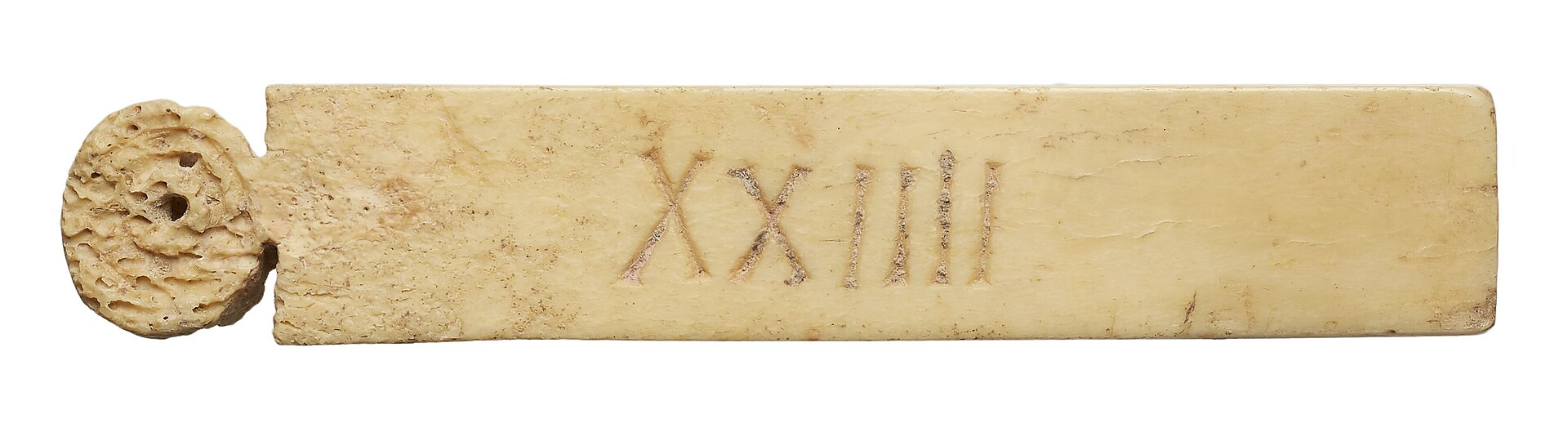 The same bone tessera lusoria: reverse. Such objects are usually linked with gaming or counting, but their function is debated.
Years, calendars and numerals in inscriptions
A modern year is decomposed by the ordinary rules: MMXXVI = 2026, MCMXCIX = 1999 and CDLXXVI = 476. A century is the ordinal number of a hundred-year period; traditional historical chronology has no year zero between 1 BC and AD 1.
Ancient Romans did not usually identify a year with a long sequence of numerals. Documents were dated by the names of consuls, numbered imperial powers, days before the Kalends, Nones or Ides, and less often by years from the foundation of the city. Formulas such as TR P XII or COS III belong to titulature and help date a monument, but do not mean “year XII” in the modern sense.
Stone and painted calendars connected the count of days with religious and civic life. The Fasti Antiates Maiores preserve a late Republican calendar from before Caesar's reform; the Fasti Praenestini of Verrius Flaccus belong to the Augustan age. Month name, festival date, nundinal letter and legal status of the day form a table in which an isolated sign is read only within its row and column.
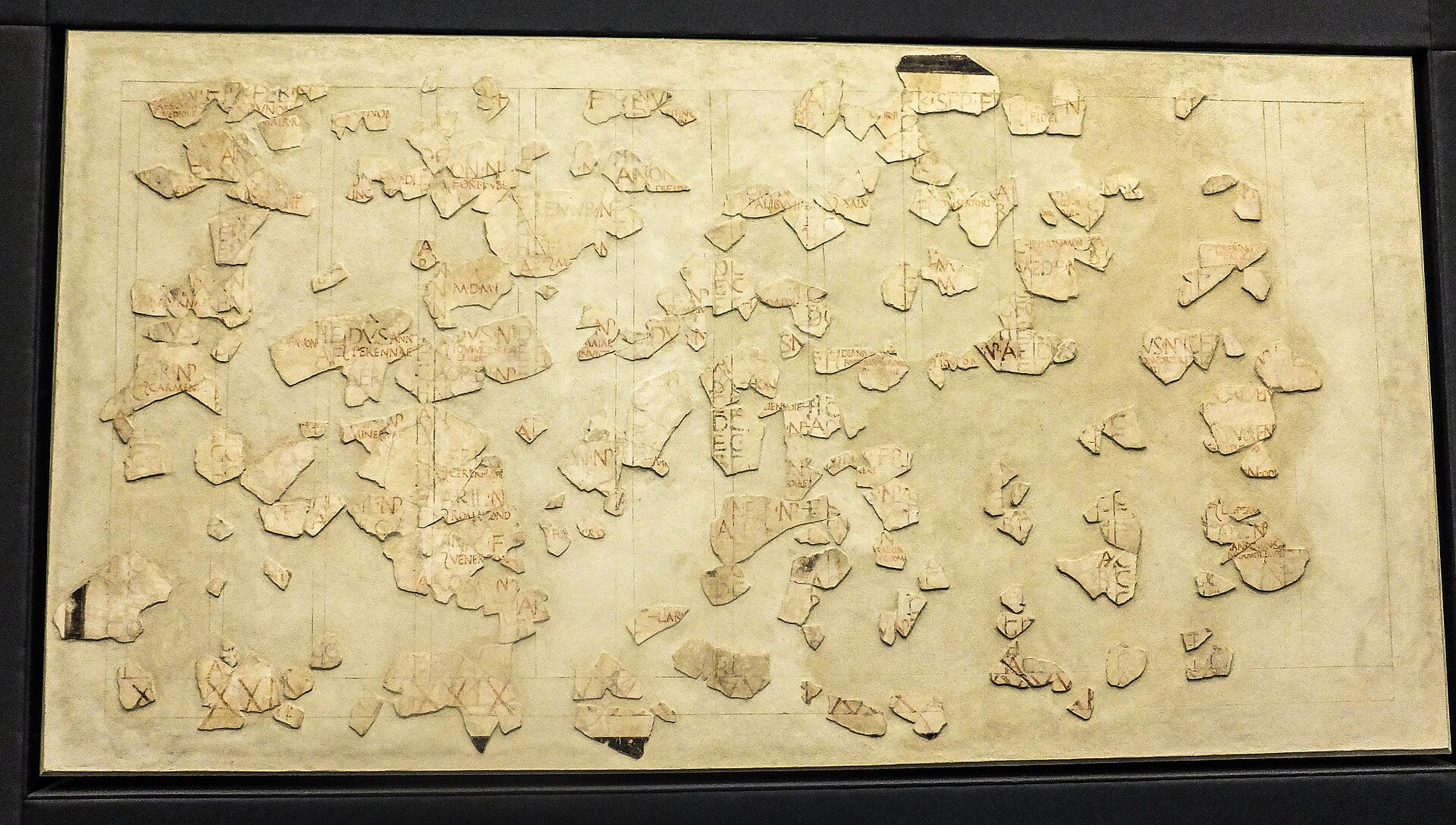 Fasti Antiates Maiores: fragments of a pre-Julian Roman calendar from Antium, first half of the first century BC; Museo Nazionale Romano, Palazzo Massimo. Photo: Carole Raddato / Wikimedia Commons, CC BY-SA 2.0.
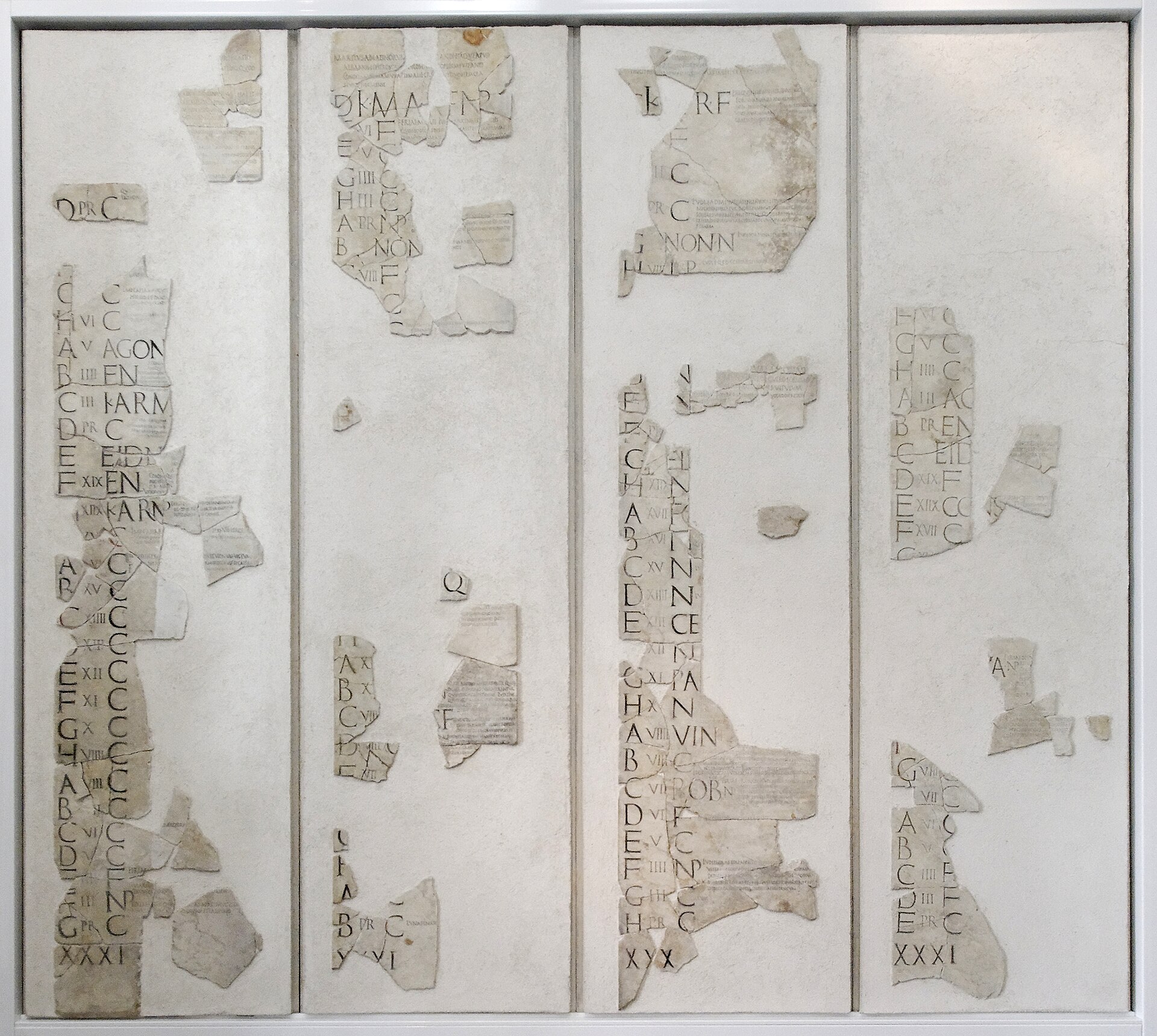 Fasti Praenestini, the calendar of Verrius Flaccus with festivals, commemorations and legal markings of days, AD 6–9; Museo Nazionale Romano, Palazzo Massimo. Photo: Jastrow / Wikimedia Commons; public domain.
Read an inscription from its formula towards its numeral. First separate names, dedications and abbreviations; then preserve the ancient numeral form and determine the word it governs. ANN or AN expands to annorum, “years”; STIP to stipendiorum, “years of service”; and M P to milia passuum, “thousands of paces”. The same X can mean ten, occur within a name, or form part of an abbreviation.
On Regina's tombstone from Arbeia, the Latin line AN XXX gives her age as 30; a Palmyrene Aramaic commemoration appears below. The number belongs to a history of family, migration and a bilingual community. For comparison, the tombstone of Gnaeus Musius has ANN XXXII, STIP XV and LEG XIIII GEM: 32 years of age, 15 years of service and a unit number within its name. Three numeral groups on one monument perform three different functions.
The sequence for reading a date or epitaph is the same: identify the monument type, expand abbreviations, preserve the actual numeral form and only then convert its value. This prevents a common mistake—treating every group of Roman signs as a construction year or a military unit number.
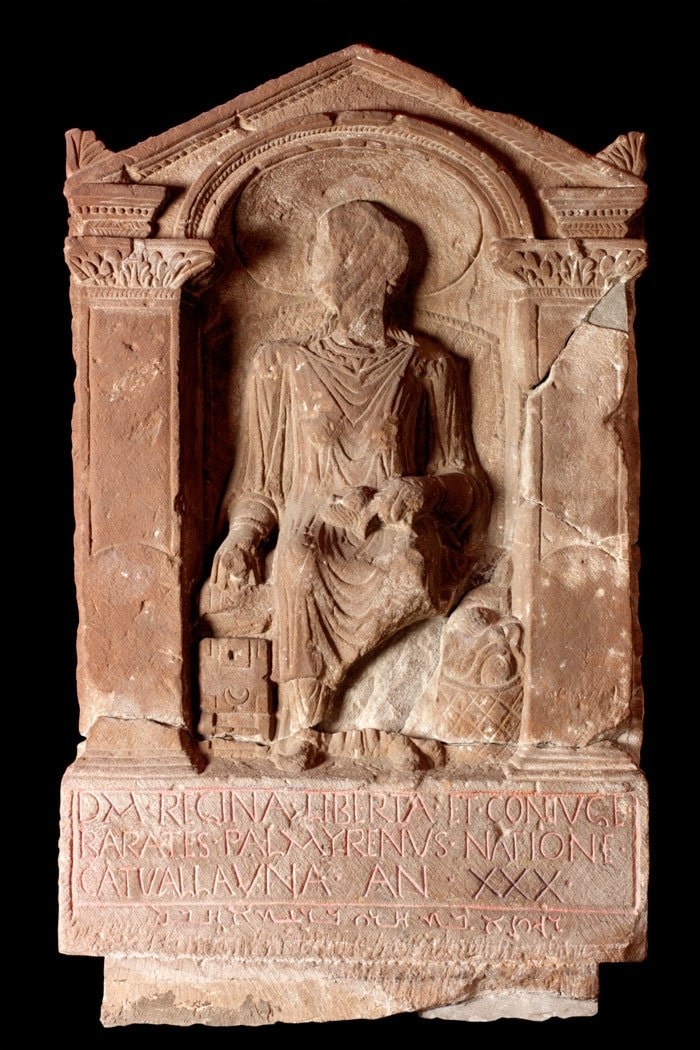 Tombstone of Regina from Arbeia: AN XXX in the Latin epitaph gives her age as 30; a Palmyrene Aramaic inscription appears below. Buff sandstone, second century AD; Arbeia Roman Fort and Museum, South Shields, inv. TWCMS: T765. RIB 1065.
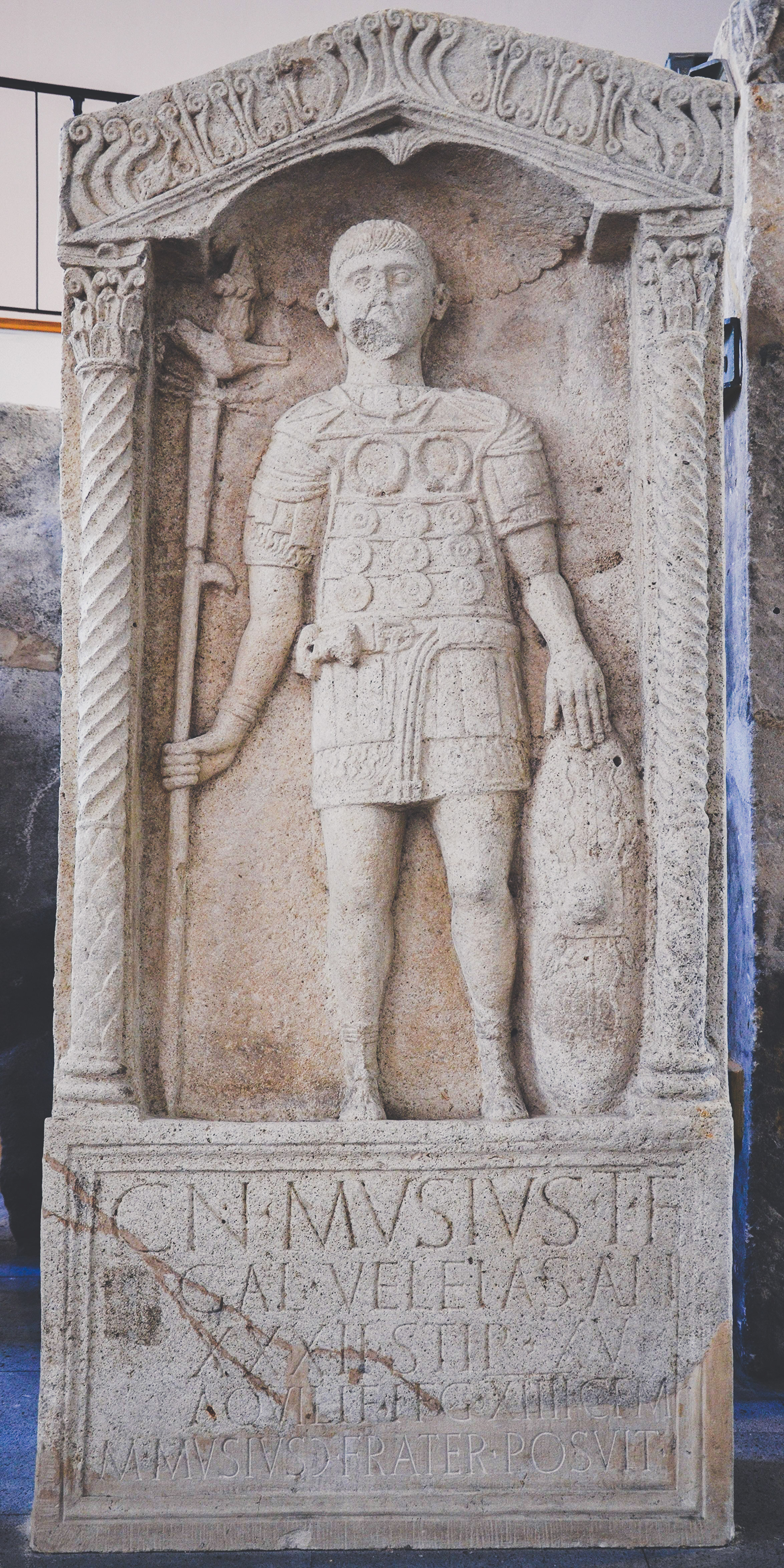 Tombstone of Gnaeus Musius, aquilifer of Legio XIIII Gemina. Mogontiacum / Mainz; limestone, first half of the 1st century CE. Landesmuseum Mainz. EDCS-11000956. Photo: Carole Raddato / Wikimedia Commons, CC BY-SA 2.0.
Where Romans used numerical notation
Roman numerals were primarily a practical way to record quantity, order and distance. They were cut into stone and metal, written on wooden tablets and marked on pottery. Ancient notation did not always match the modern school standard: IIII and XVIIII could appear instead of IV and XIX.
In the army, numerals formed part of legion and unit names: Legio X Fretensis, Legio IX Hispana, Legio XX Valeria Victrix and cohors VIII. A number distinguished a unit, but it was not unique: more than one legion could bear the same number, so the honorific name remained essential. Legion numbers occur not only in formal inscriptions but also on tiles, ingots, sealings and other products. See also Legion and the List of Roman legions.
Milestones used numerals for distance. M P LIII meant milia passuum quinquaginta tria, or 53 Roman miles. Building and official inscriptions also numbered completed work, cohorts and repeated tenures of office; COS III, for example, indicated a third consulship.
Commercial and household records used numerals for prices, weights, capacities and quantities. An amphora from Carlisle preserves VI and XI for six modii and eleven sextarii. Wax tablets recorded prices in denarii, while weights carried their stated mass.
Numerals also occur on bone tokens and tesserae. These objects could serve as counters on an abacus, board-game pieces, gambling tokens or markers of value. Ordinary Roman dice, however, usually marked their faces with pips rather than the letters I–VI. Dice and games therefore attest numerical reckoning, but not always Roman numeral notation itself.
The Roman numerals of modern clock faces should not be projected directly back into antiquity. Roman sundials divided daylight into twelve unequal hours, but surviving examples normally preserve hour lines rather than the familiar circular I–XII dial. The popular claim that hopscotch originated in Roman times is likewise unsupported: no secure ancient evidence for the game is currently known.
Mathematics and calculation in Ancient Rome
Roman numerals were a way of recording a number, not the only instrument of calculation. Small sums can be handled directly with the signs: combine XVII and VIII, regroup five I as V and two V as X, and obtain XXV. Long multiplication, division and fractions, however, are easier on a counting device or with memorised tables than on a line of letters.
Everyday algorithms are less well documented than the written numbers themselves. No complete ancient manual survives to explain an accountant's ordinary procedure step by step. Methods are reconstructed from references to small stones called calculi, portable bronze abaci, school exercises and figures in business records. A proposed procedure for division or rounding is therefore often a reasoned reconstruction rather than a verbatim ancient instruction.
On a counting board, lines or columns represented units, tens, hundreds and larger places; separate positions could represent fives. Moving counters allowed addition and subtraction with regrouping between places. Multiplication could use repeated addition, doubling and memorised tables; division could use partition, repeated subtraction or the selection of multiples. An Imperial Roman portable abacus was small enough to form part of the equipment of traders and money-changers. An empty column represented the absence of units in a place, so the device did not require a separate written zero.
Practical numeracy training included memorised tables and operations with coins and shares. Horace mentions school exercises involving division into hundredths. A duodecimal fraction system was particularly important: as could mean the whole, semis one half, uncia one twelfth, triens one third, quadrans one quarter and sextans one sixth. S commonly marked a half, while dots and special signs represented twelfths. In the second century AD the jurist Volusius Maecianus described fractions down to the scriptulum, 1/288 of a whole, connecting them with the division of inheritances, money and property.
The images below have different evidential status, and that distinction matters. The relief from Portus is an ancient representation of tabularii recording and inventorying cargo; the bronze weight from Nîmes is an archaeological object with a weight inscription. The counting board with calculi, by contrast, is a modern explanatory diagram. Wooden and sand surfaces rarely survive, and no ancient manual for operating such a board is extant. The diagram illustrates a possible place-value principle, not a photographed Roman device.
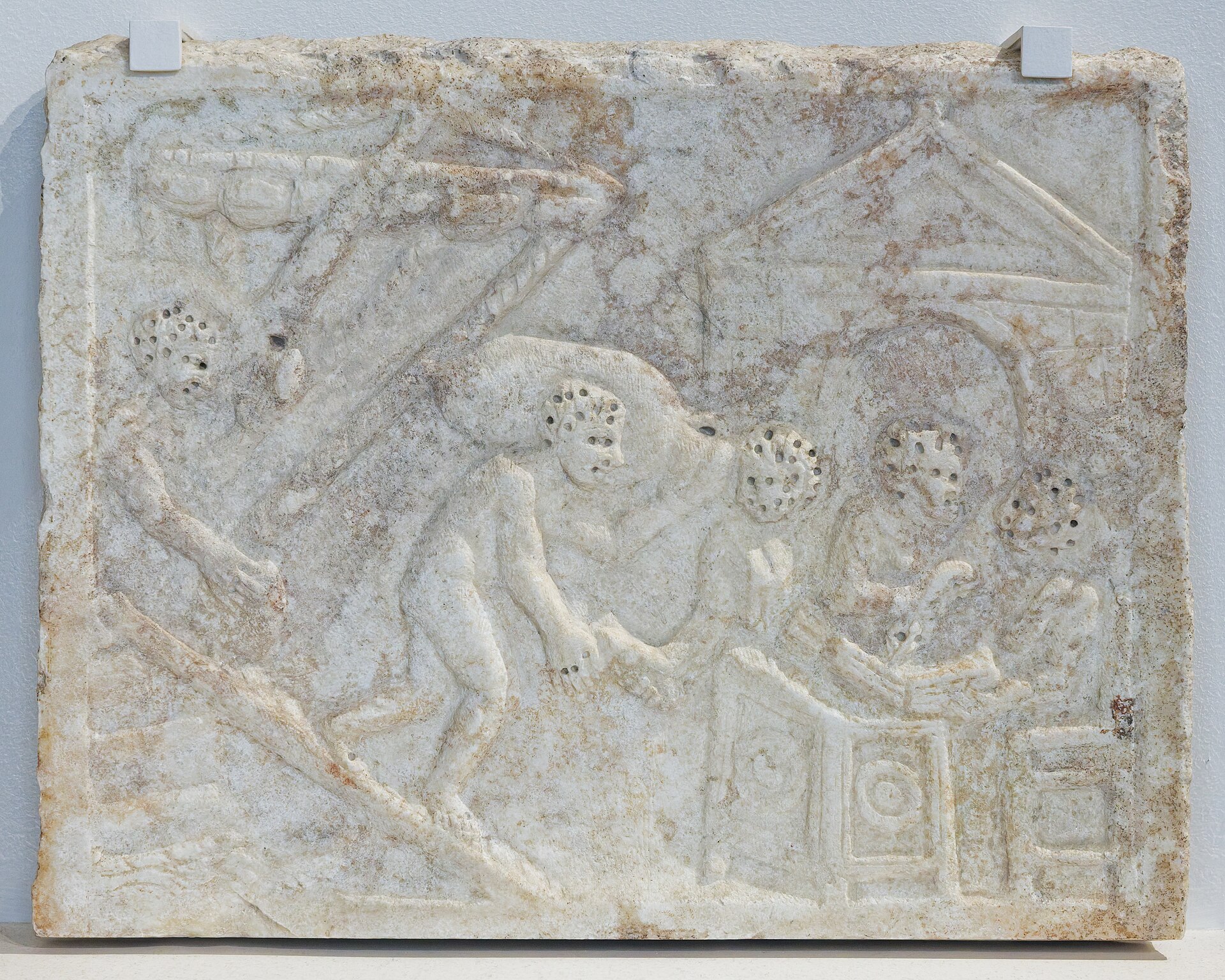 Amphorae being unloaded beside three tabularii, officers who record and inventory the cargo. Roman marble relief from Portus, mid-third century AD; Collezione Torlonia, MT 428. Photo by Marie-Lan Taÿ Pamart / Wikimedia Commons, CC BY 4.0.
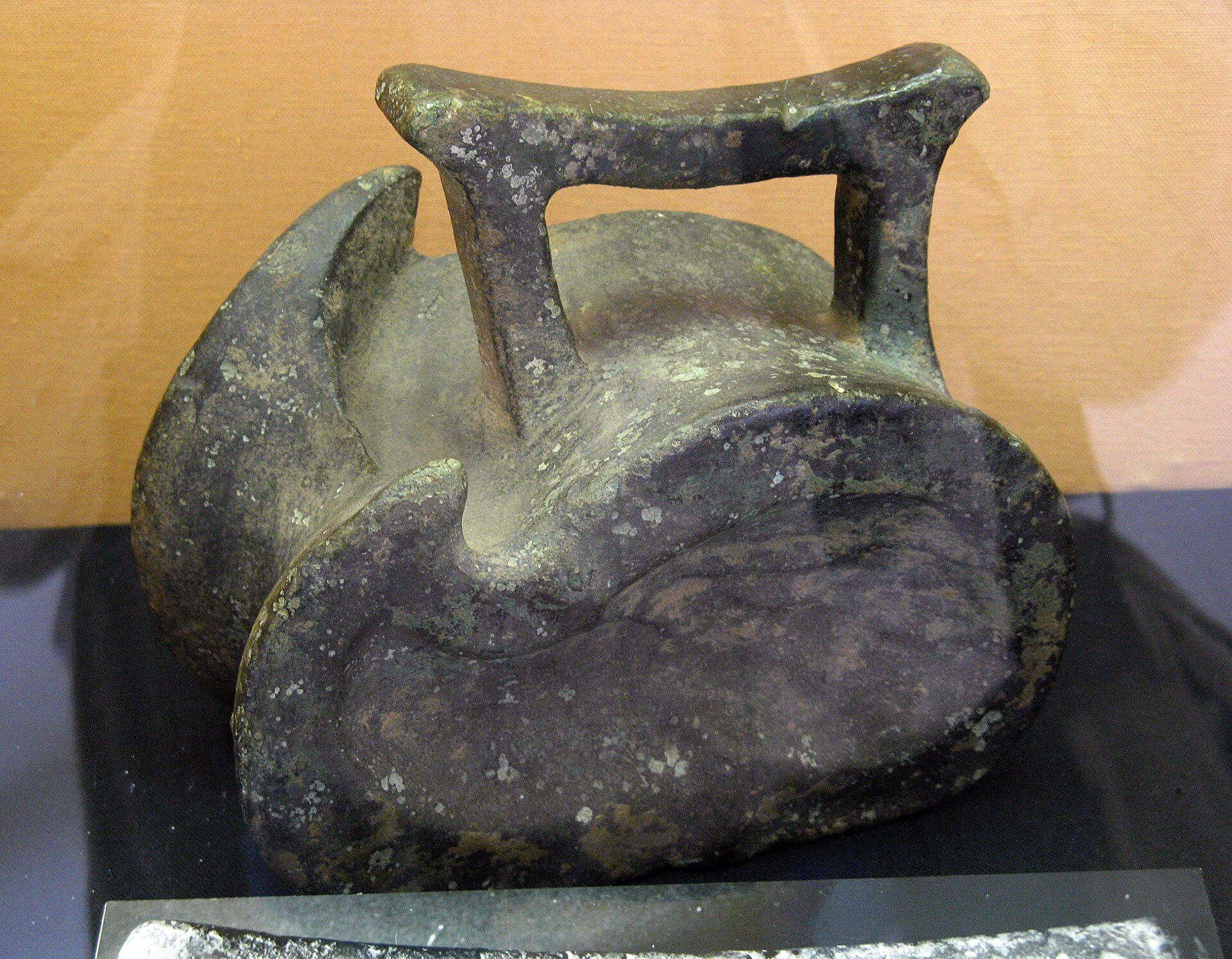 A Roman bronze weight in the form of a knucklebone. The inscription CAST XXX gives a weight of 30 Roman pounds by standards associated with the Temple of Castor; found at Nîmes, Musée de la Romanité. Photo by Mark Landon / Wikimedia Commons, CC BY 4.0.
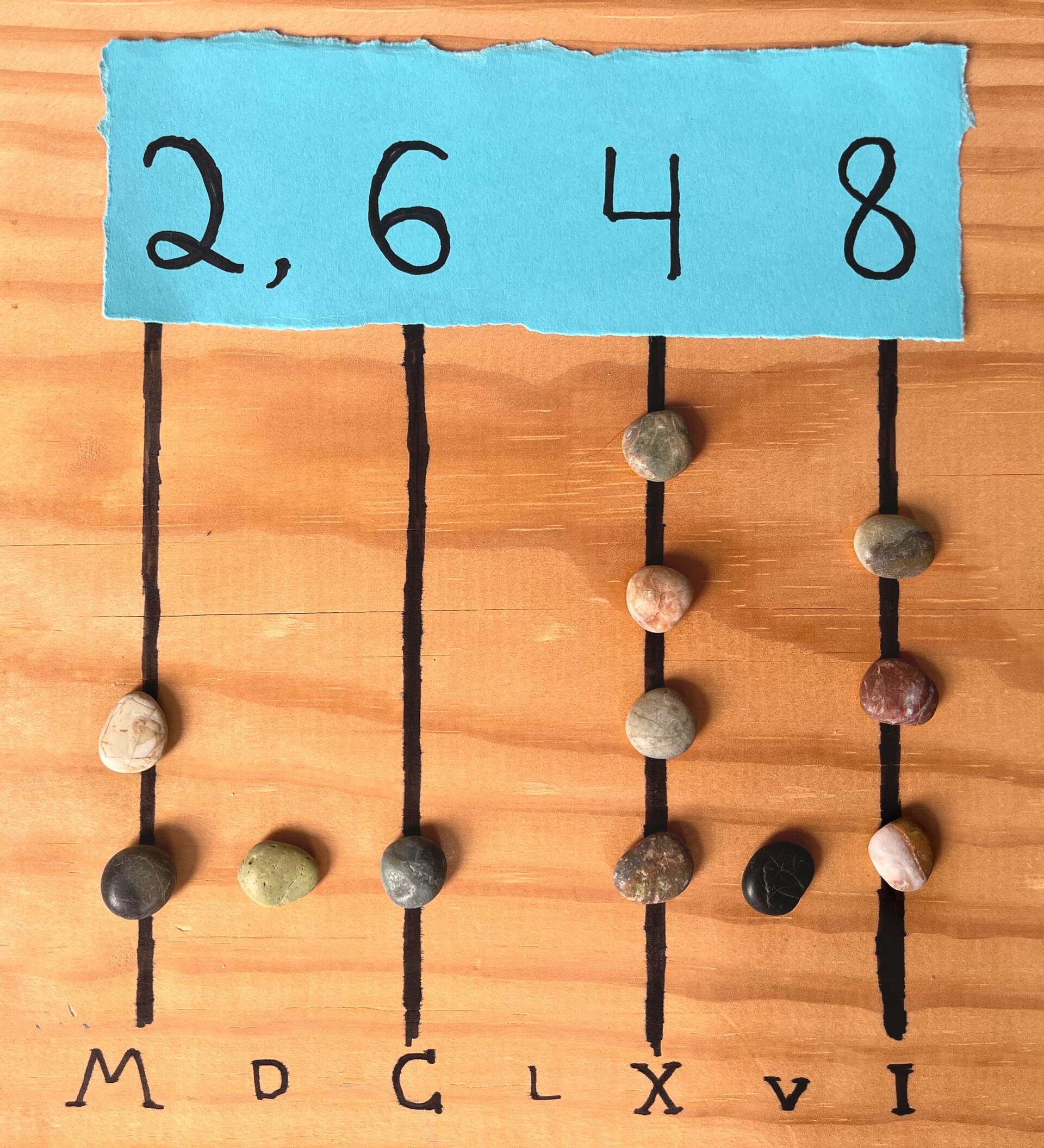 A modern hypothetical diagram of a counting board with pebble calculi. It demonstrates place-value operation, but does not reproduce a particular ancient find or prove a single Roman algorithm. By Jacobolus / Wikimedia Commons, CC BY-SA 4.0.
Commerce required calculations of prices, interest, debts and coin exchange. The Tabula Alimentaria of Veleia preserves dozens of Trajanic loan and property-valuation figures; their consistency reveals sophisticated calculations with fractional rates, although the exact algorithm remains debated. A Roman accountant could work with hundreds of thousands of sesterces without positional written notation because place value was supplied by the device and procedure, while Roman numerals recorded inputs and results.
The two documents below represent different scales of financial record-keeping. The Tabula Alimentaria of Veleia is not an abstract 'debt table' but a monumental bronze register: its rows and columns connect landowners, estates, property valuations, loan sums and payments due. The Pompeian wax tablet from the archive of the banker Lucius Caecilius Iucundus belongs to everyday practice: its AD 59 entry certifies a completed monetary settlement. In both cases numerals record legally significant inputs and outcomes; the accountant's intermediate operations were normally not written on the document.
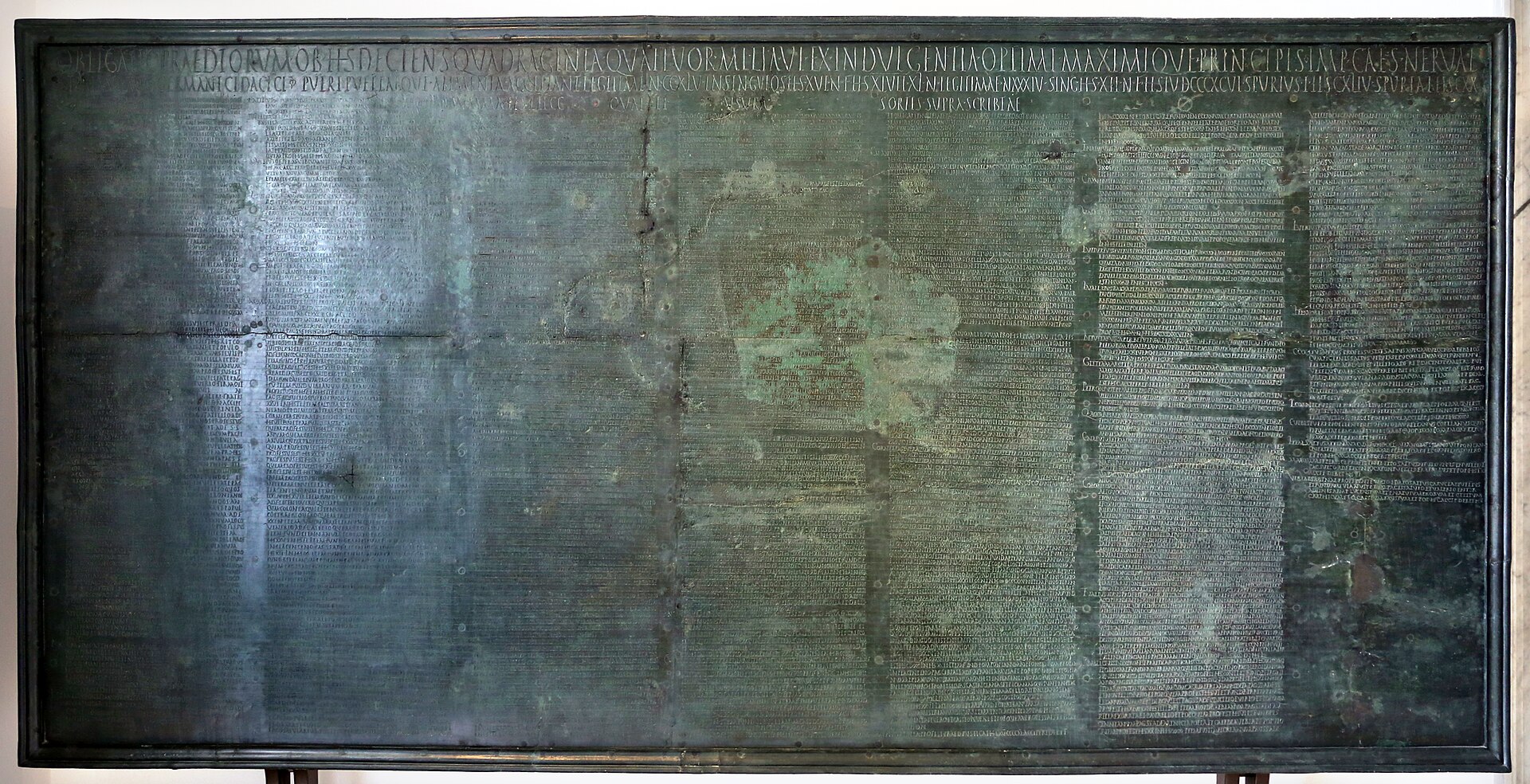 The Tabula Alimentaria from Veleia (CIL XI 1147), a bronze table recording landed securities, loans and payments under Trajan's alimenta programme, about AD 102; Museo Archeologico Nazionale di Parma. Photo by Sailko / Wikimedia Commons, CC BY-SA 4.0.
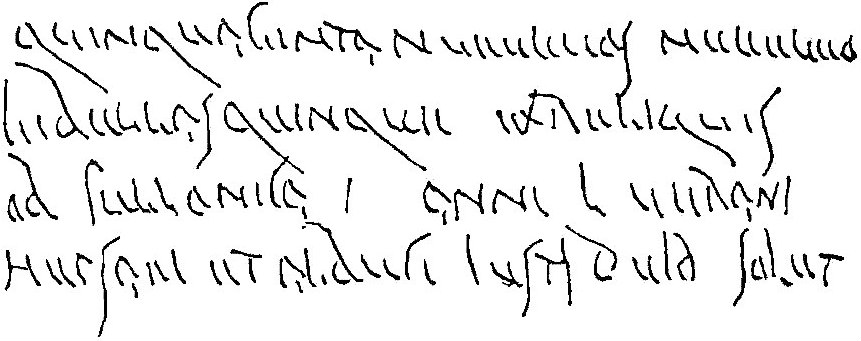 A wax accounting tablet from the archive of the Pompeian banker Lucius Caecilius Iucundus, AD 59, CIL IV 3340, 143: the text certifies a monetary settlement. A 1911 reproduction of the ancient original / Wikimedia Commons, public domain.
Weights, lengths, areas and capacities connected arithmetic to material standards. The inscription CAST XXX on the Nîmes weight denotes thirty Roman pounds and refers to standards associated with the Temple of Castor. Checking a weight or measure was both a computational and a legal procedure: the correct number had to correspond to an accepted physical standard.
Practical mathematics was essential to the land surveyors, or agrimensores. They established boundaries, divided land, calculated the area of irregular plots and laid out colonies, roads and camps. Their educational tradition preserves problems in arithmetic and geometry. Architects and engineers used measurement, proportion and geometry to set out buildings, estimate materials, construct roads and maintain aqueduct gradients. Taxation, supply, pay and ration distribution likewise required regular calculation.
The learned mathematical and astronomical tradition of the Roman Empire continued to develop largely in Greek, while Latin texts are especially informative about land surveying, architecture, legal metrology and everyday arithmetic. It is misleading to contrast “awkward Roman numerals” with Roman engineering: numeral notation and computational technique performed different tasks.
Large numbers were not confined to the range of a modern converter. Thousands could be expressed by repeating M, by words and by special signs such as CIƆ. An overbar multiplying a value by one thousand is chiefly familiar from later manuscript and typographic traditions and should not automatically be projected onto every ancient inscription. Publish the actual ancient form and supply its numerical value separately.
Roman numerals after antiquity
After antiquity, Roman notation continued in manuscripts, printed books, building dates, and the numbering of rulers, popes, volumes and sections. Freigius's table of 1582 is a learned printed systematisation, important for the history of knowledge but not evidence for the form of a first-century inscription.
Clock faces often use IIII rather than IV. Several explanations have been proposed for this durable tradition, from visual balance to workshop practice, but no single cause has been demonstrated. Modern forms such as “21st century”, Henry VIII or MMXXVI continue the Roman system within their own genres.
Ancient objects explain ancient practice, while early modern and modern images document reception and standardisation. These levels must not be confused, but together they show why the system outlived the Roman Empire.
Related topics
I. Writing, reckoning and dates
II. Objects and inscriptions
III. Calendar and society
Literature and sources
Studies:
- Campbell, Brian. The Writings of the Roman Land Surveyors: Introduction, Text, Translation and Commentary. Journal of Roman Studies Monograph 9, 2000.
- Cuomo, Serafina. Ancient Mathematics. London and New York: Routledge, 2001.
- Dilke, O. A. W. The Roman Land Surveyors: An Introduction to the Agrimensores. Newton Abbot, 1971.
- Gordon, Arthur E. Illustrated Introduction to Latin Epigraphy. Berkeley, 1983.
- Ifrah, Georges. The Universal History of Numbers. London, 1998.
- Keyser, Paul. “The Origin of the Latin Numerals 1 to 1000.” American Journal of Archaeology 92.4, 1988, 529–546.
- Maher, David W.; Makowski, John F. “Literary Evidence for Roman Arithmetic with Fractions.” Classical Philology 96.4, 2001, 376–399.
- Menninger, Karl. Number Words and Number Symbols. Cambridge, MA, 1969.
- Stewart, Charles. “Fractional Arithmetic in the Tabula Alimentaria of Veleia.” Journal of Roman Studies 109, 2019, 89–102.
- AgRoMa: The Agrimensores and Roman Mathematics. Newcastle University research project.
Epigraphic and museum sources:
- RIB 1065. Funerary inscription for Regina. Roman Inscriptions of Britain Online.
- CIL XIII 6901; EDCS-11000956. Tombstone of Gnaeus Musius, Mogontiacum.
- Bibliothèque nationale de France, Gallica, btv1b11358348d. Bone tessera lusoria.
- Museo Nazionale Romano, inv. 65054. Portable bronze Roman abacus of the Imperial period.
- CIL XI 1147. The Tabula Alimentaria from Veleia: landed securities, loans and payments under Trajan's alimenta programme; Museo Archeologico Nazionale di Parma.
- CIL IV 3340, 143. Wax accounting tablet from the archive of Lucius Caecilius Iucundus, Pompeii, AD 59.
- Collezione Torlonia, MT 428. Relief of amphora unloading with three tabularii, Portus, mid-third century AD.
- Luciani, L.; Lucchelli, T. M. Pondera exacta ad Castoris // Instrumenta inscripta VI. Trieste, 2016. P. 265–289.
- RIB 2283. Milestone inscribed M P LIII, or 53 Roman miles. Roman Inscriptions of Britain Online.
- Brit. 28.15. Amphora marked with a capacity of six modii and eleven sextarii. Roman Inscriptions of Britain Online.
- Brit. 54.15. Wax tablet listing auctioned objects and prices in denarii. Roman Inscriptions of Britain Online.
- RIB 2440. Bone roundels bearing numerals and possibly used for calculation, board games or stakes. Roman Inscriptions of Britain Online.
- Schädler, Ulrich. “Some Misconceptions About Ancient Roman Games.” Board Game Studies Journal 15.1, 2021, 79–97.
- Museo Nacional de Arte Romano, Mérida. Roman sundial with hour lines and seasonal arcs.
Interested in Ancient Rome beyond reading? Join Legio X Fretensis or explore our reenactment directions.


