Christianity in Antiquity
Christianity in antiquity is the history of the emergence, spread, and institutional formation of Christian communities within the late Hellenistic and Roman world. The subject is connected with the conflict between traditional cults and the new religion, but it is not limited to that conflict: Christianity developed as a communal, theological, social, and political force that gradually changed Late Antique society.
The article focuses on the independent history of Christianity: its Jewish origins, early communities, legal position, church organization, councils, and the Christianization of the late Empire. Conflict and coexistence with traditional cults remained an important part of this history; that side is treated in more detail in Paganism and Christianity.
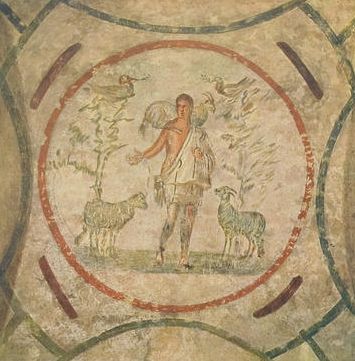 The Good Shepherd in the Catacomb of Priscilla, second half of the 3rd century. Published by Joseph Wilpert, 1903; Wikimedia Commons, public domain.
Jewish Context
Christianity emerged within the Jewish environment of the first century AD. Its earliest followers understood themselves in relation to biblical tradition, messianic expectation, prophetic heritage, and the religious life of Judaea. The Jerusalem Temple, synagogue communities, knowledge of Scripture, and debates over law, purity, resurrection, and the fate of Israel were all important.
After the destruction of the Jerusalem Temple in AD 70, the Jewish and Christian worlds gradually moved apart. This was a long process: many early Christian communities preserved Jewish forms of worship, while increasingly addressing Gentiles in the Graeco-Roman world.
Early Communities
The earliest Christian communities formed around preaching, common prayer, meals, baptism, charity, and the memory of the life, death, and resurrection of Christ. They existed in cities of the eastern Mediterranean, Asia Minor, Syria, Egypt, Greece, and Italy, using the roads, maritime trade, and urban networks of the Roman Empire.
For ancient society these communities were unusual: they brought together people of different origins, statuses, and genders around a shared faith and discipline. This did not erase social distinctions, but it created a new kind of religious solidarity, different from traditional civic and household cults.
Christianity in the Roman Empire
The Roman Empire gave Christianity room to spread: shared communications, cities, Greek and Latin languages, legal forms, and the relative unity of the Mediterranean. Yet the same imperial system demanded public loyalty, participation in civic cult, and reverence for authority, creating tension between Christians and the traditional order.
Christians could be perceived as a closed group that avoided sacrifices and civic cults. For Romans this was not only a religious question, but also a problem of public cohesion, because sacrifices and festivals maintained the bond between the community and the gods.
Persecutions and Legal Status
Before the third century, persecutions were more often local or sporadic. Their causes depended on circumstances: suspicion, denunciation, refusal to sacrifice, urban conflicts, or official reactions to crises. Christianity gradually became a visible force, and the question of its legality gained empire-wide importance.
In the third and fourth centuries pressure increased. The age of Diocletian is especially important, when the largest persecutions of Christians began. They were connected with an attempt to strengthen the unity of the state, traditional cult, and imperial authority in the context of late Roman reforms.
Constantine and the Edict of Milan
A turning point came under Constantine the Great. After victory in the struggle for power, Constantine supported Christianity and, together with Licinius, confirmed a policy of religious toleration traditionally associated with the Edict of Milan in AD 313. Christians gained the ability to profess their faith openly, recover community property, and build church institutions with imperial support.
Constantine did not make the Empire instantly Christian, but he changed Christianity's status. It ceased to be a persecuted religion and became an important partner of imperial power, urban building, charity, and public ideology.
The Council of Nicaea
In AD 325 Constantine convened the Council of Nicaea. Its aim was to strengthen the unity of the Church and the Empire, above all in the dispute over the teaching of Arius. The council became an important step toward empire-wide discussion of doctrinal questions and showed that the Christian Church was becoming an institution able to act across the Roman state.
The Council of Nicaea did not end theological disputes, but it established a model: imperial power could support church assemblies, and church decisions gained political significance. This became one of the characteristic features of Late Antiquity.
Christianization of the Late Empire
In the fourth and fifth centuries Christianity entered imperial life more deeply. New basilicas appeared, episcopal authority developed, and the roles of church charity, monasticism, and theological literature increased. Cities of the late Empire preserved the ancient heritage, but gradually changed their sacred center.
These processes are closely connected with the structure of late Roman power described in the articles Dominate and Late Roman Empire. Christianization was uneven: faster in some regions and social groups, slower in others.
Conflict and Coexistence
Christianity's relationship with traditional cults cannot be reduced to simple replacement. In some cases there were open conflicts over temples, sacrifices, civic festivals, and the status of old elites. In others, coexistence continued through the reinterpretation of ancient education, the use of classical rhetoric, and the preservation of urban culture.
Even after Christianity became stronger, ancient culture did not disappear at once. It changed form: part of the old religious language was rejected, part of the educated tradition was preserved, and the memory of Rome became important for Christian authors. These changes accompanied the crises and transformations connected with the Fall of the Western Roman Empire.
Related Topics
- Paganism and Christianity
- Diocletian
- Constantine the Great
- Dominate
- Late Roman Empire
- Fall of the Western Roman Empire
- Religion in Antiquity
Literature and sources
- Brown P. The Rise of Western Christendom. Wiley-Blackwell, 2013.
- Frend W. H. C. The Rise of Christianity. Fortress Press, 1984.
- MacMullen R. Christianizing the Roman Empire. Yale University Press, 1984.
- Rives J. B. Religion in the Roman Empire. Wiley-Blackwell, 2006.
- Bolotov V. V. Lectures on the History of the Ancient Church. Saint Petersburg, 1907.
- Image: Good Shepherd Catacomb of Priscilla.jpg. Wikimedia Commons; Joseph Wilpert, 1903; Public Domain.
Interested in Ancient Rome beyond reading? Join Legio X Fretensis or explore our reenactment directions.


