Religion in Antiquity
Religion in antiquity was the body of cults, mythological ideas, and ritual practices of the ancient Mediterranean and neighboring regions. It united the worship of gods, ancestor cults, sacrifice, divination, temple life, and public ceremonies through which communities explained the world and maintained a bond between people, the state, and sacred order.
Ancient religion was rarely separated from everyday life. The polis, city, family line, household, army, and imperial power all had their own forms of worship. Religion was therefore not only a matter of personal belief, but also part of law, politics, the calendar, family ritual, and military discipline.
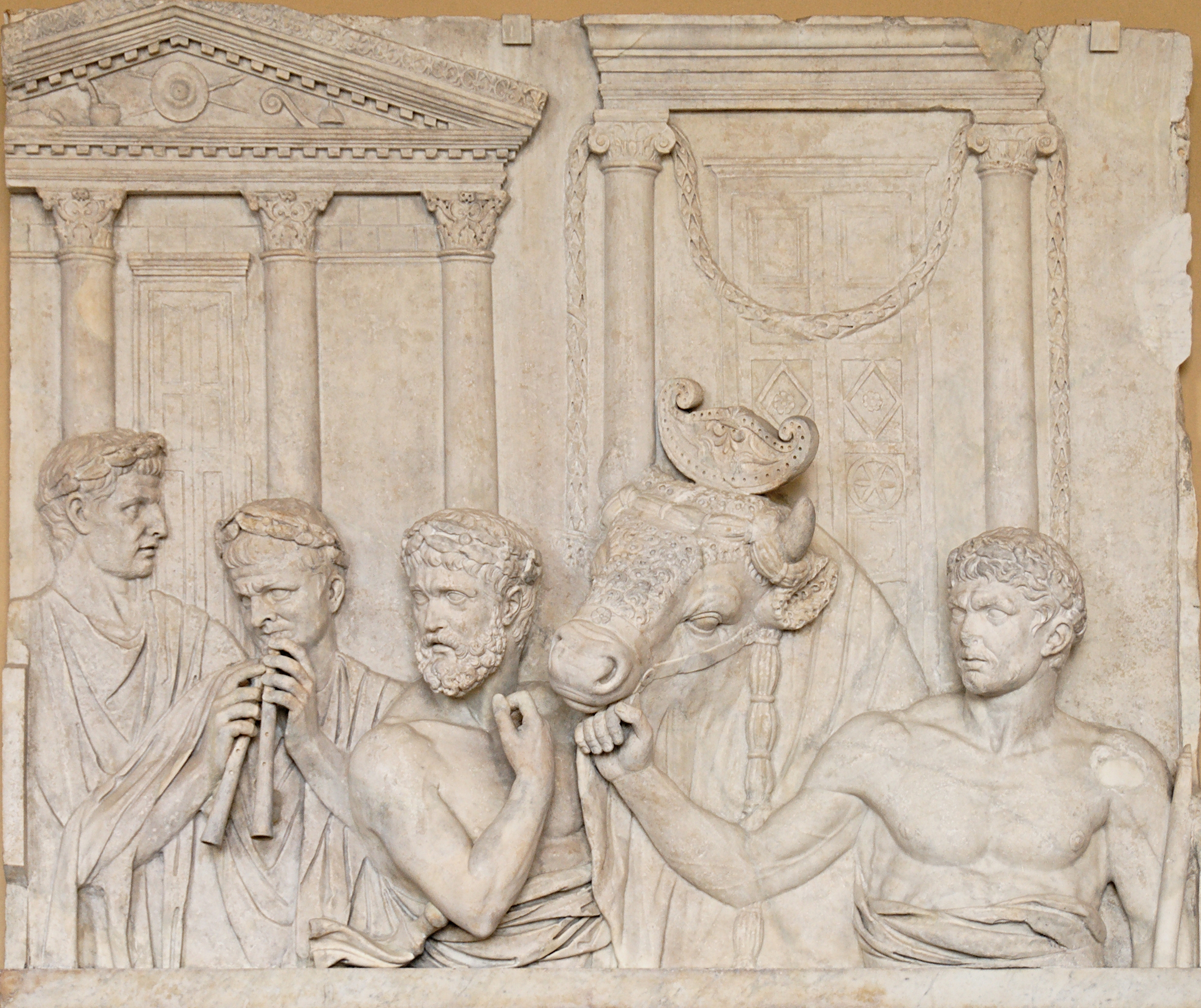 Preparation of a Roman sacrifice. Marble relief, Rome, first quarter of the 2nd century AD; Louvre, Ma 992.
Cult and Ritual
The basis of ancient religion was cult: the proper performance of ritual, observance of festivals, presentation of gifts and sacrifices, and appeals to the gods before important public and private acts. In Rome this aspect is especially visible in the work of the pontifices, augurs, flamines, and Vestals.
Ritual precision was understood as a way to preserve divine favor. An error in words, gestures, or the choice of day could require the ceremony to be repeated. Priesthoods were therefore not only religious bodies, but also public and political institutions.
Mythology and the Worldview
Mythology explained the origins of gods, humans, cities, royal lines, and customs. In the Greek world, myths about gods and heroes were connected with poetry, theater, sanctuaries, and local traditions. In Roman culture, mythological narratives were joined to ancestral memory, foundation legends, and the idea of Rome's special destiny.
Myth was not simply a tale. It provided the language in which ancient societies spoke about power, excellence, transgression, kinship with gods, and punishment for impiety. Through myth, communities explained the origins of cities and lineages, justified hero cults, connected festivals with memories of the past, and turned local tradition into part of the wider Greek or Roman world.
Religion and the State
In ancient societies religion supported political order. Civic cults united citizens, sacrifices accompanied assemblies and wars, and victories were marked by temples, vows, and triumphs. In Rome, state religion was built into magistracies, the calendar, and public memory.
Under the Empire, the imperial cult and the veneration of the ruler's genius became especially important. This tradition did not abolish older cults, but added a new language of loyalty. It connects with the topics of genius, the Roman emperors, the Principate, and the Dominate.
Syncretism
The ancient world constantly compared and combined the gods of different peoples. Greeks identified foreign deities with their own, Romans incorporated local cults into the imperial sphere, and Hellenistic monarchies joined Greek, Egyptian, Eastern, and royal forms of worship.
This process is especially visible in Hellenistic Egypt, where the cult of Alexander, pharaonic traditions, and Graeco-Egyptian forms of worship acted as a language of legitimacy. Syncretism connects the Graeco-Roman world with Egypt, Persia, Asia Minor, and provincial cults.
Christianity and Late Antiquity
In Late Antiquity traditional cults coexisted and competed with Christianity. Christian communities emerged within the Jewish and Roman world, experienced periods of persecution, and later received imperial support. This transition was not immediate: it affected law, urban life, the army, education, and memory of the past.
Key articles for this topic are Paganism and Christianity, Diocletian, Constantine the Great, and the Late Roman Empire.
Topic Sections
I. Overview of ancient religion.
Religion of Ancient Greece and Ancient Rome
II. Priesthood, cult, and Roman sacred practice.
III. Christianity and Late Antiquity.
IV. Eastern and northern religious traditions.
Religion of the Celts and Germans
Related Topics
- Antiquity
- Ancient Greece
- Ancient Egypt
- Hellenistic Egypt
- Pontifex
- Augur
- Flamen
- Vestal
- Sacrifice in Ancient Rome
- Roman temples
- Paganism and Christianity
- Celts
- Germans
- Greco-Persian Wars
Literature and sources
- Beard M., North J., Price S. Religions of Rome. Vol. 1: A History. Cambridge University Press, 1998.
- Burkert W. Greek Religion. Harvard University Press, 1985.
- Rives J. B. Religion in the Roman Empire. Wiley-Blackwell, 2006.
- Zelinsky F. F. History of Ancient Religions. Saint Petersburg, 1914.
- Image: Roman sacrifice Louvre Ma992.jpg. Wikimedia Commons; photo by Jastrow; Public Domain.
Interested in Ancient Rome beyond reading? Join Legio X Fretensis or explore our reenactment directions.


