Religion of Ancient Greece and Ancient Rome
The religion of Ancient Greece and Ancient Rome was a network of public, household and personal cults through which people addressed gods, heroes, ancestors and powers of place. It was not a single church and had no common sacred book. Ritual, calendar, sacrifice, vow, festival, sanctuary, ancestral authority and the accepted tradition of the city mattered more.
Greek and Roman religious systems were close, but they cannot be reduced to a simple table of equivalents. Greek tradition was more strongly tied to the polis, poetry, sanctuaries and heroic myth. Roman tradition placed particular weight on exact ritual, sacred law, the connection between cult and state, and family memory. Both belonged to the wider world of ancient religiosity, where different cults could exist side by side without requiring exclusive membership.
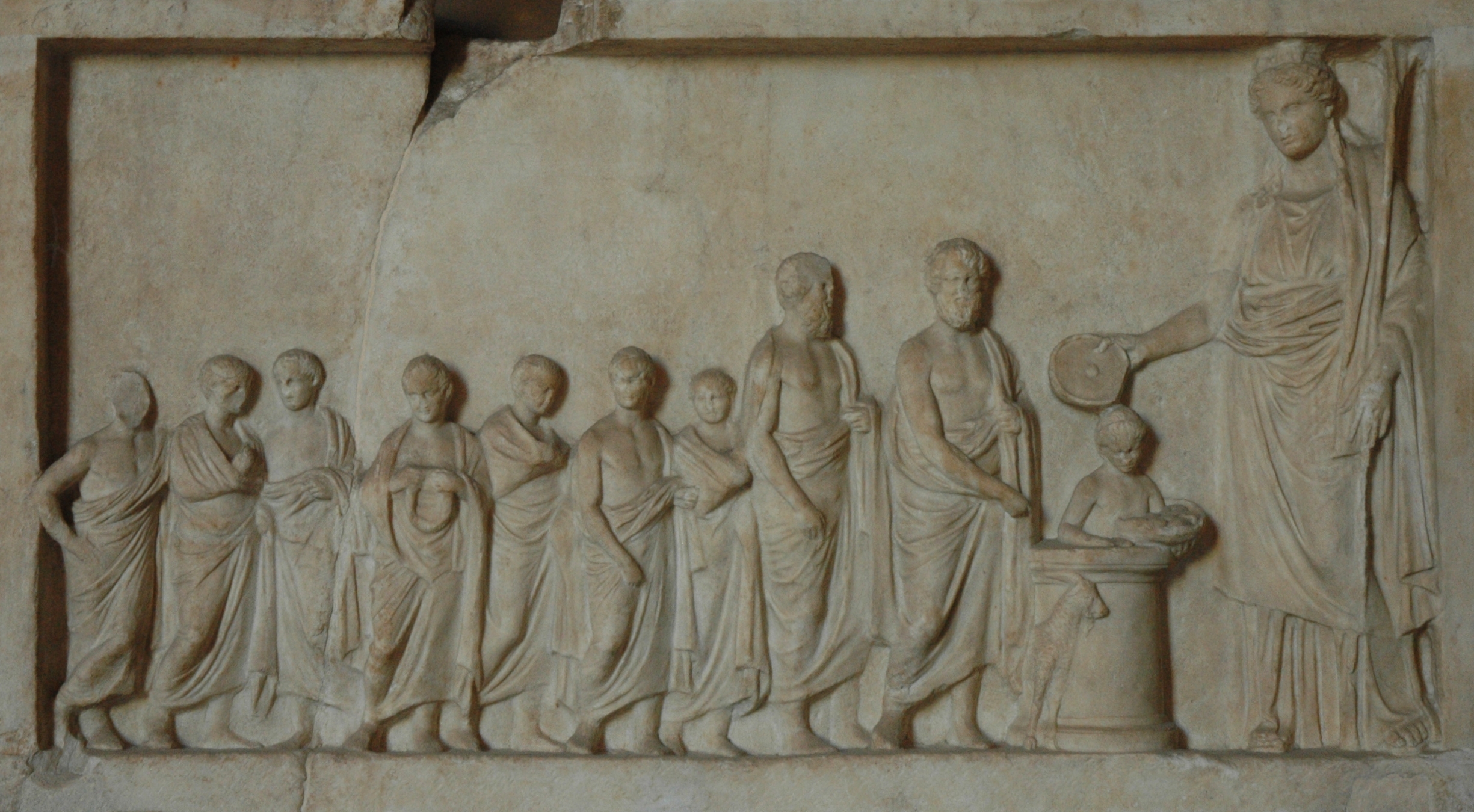 Votive relief with the sacrifice of a goat, c. 340-320 BC; Louvre, Ma 756.
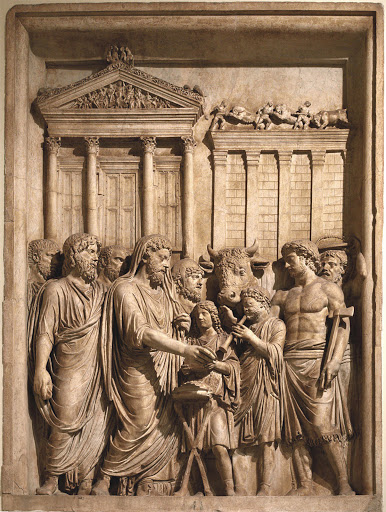 Sacrifice to Jupiter Capitolinus; relief panel from the Arch of Marcus Aurelius, AD 176-180; marble.
Greek Tradition
In the Greek world religion formed part of polis life. Each city had its patron gods, local divine epithets, sacred precincts, priestly offices and festival calendar. Athens connected its civic identity with Athena, Delphi with Apollo and the oracle, Olympia with Zeus and the Panhellenic games, and Eleusis with Demeter and Kore. The same god could therefore have different cultic faces: Athena Polias at Athens, Apollo Pythios at Delphi or Zeus Olympios at Olympia.
Mythology was important, but cult was not merely a set of stories. Texts connected with Homer, Hesiod, tragedy and hymns provided a language of images: divine genealogies, conflicts, heroic journeys and the intervention of fate. In practice, religion was held together by altars, processions, votive offerings, civic decrees and the memory of a particular sanctuary. A Greek temple, vase, relief or inscription can therefore tell as much about living religion as a literary myth.
Hero cults and the cults of local founders had a special place. A hero might be a figure of epic, an ancestor of a family, a protector of a city or a dead person whose tomb became a sacred centre. Such cults tied inhabitants to territory and past: during a festival the hero received honours, the city recalled its origins, and rivals could dispute possession of the bones or memory of a famous protector. In mystery cults, especially at Eleusis, religious experience became more personal, but it remained tied to place, ritual and initiation.
 Apollo painted inside a kylix from Delphi; Delphi Archaeological Museum, Greece.
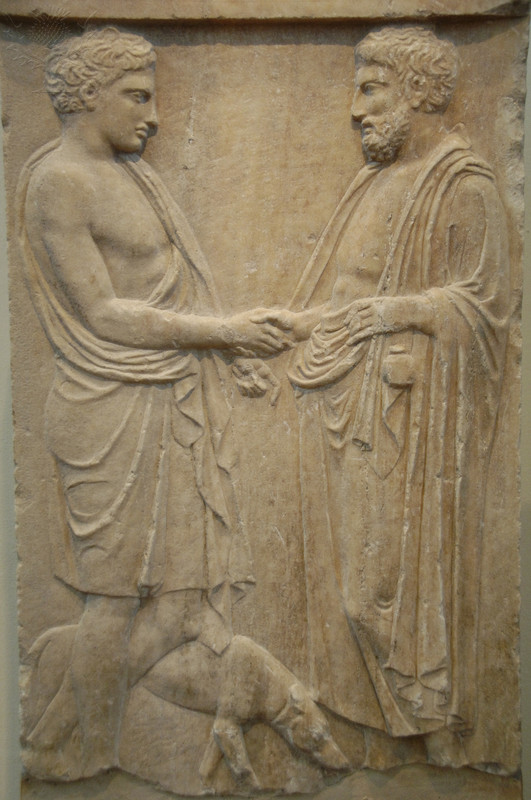 Greek marble relief found in Athens, around 400 BC; National Archaeological Museum, Athens.
Roman Tradition
Roman religion was built around correct action and the preservation of pax deorum, the agreement between community and gods. What mattered was not only the deity's name, but also the formula of prayer, place, time, order of gestures and status of the person performing the rite. An error in words or sequence could require the sacrifice to be repeated, because religion was understood as part of public order and an agreement with divine powers.
This side of Roman religion was maintained by priestly colleges. The pontifices supervised sacred law and the calendar, the augurs interpreted signs for public action, the flamines were attached to individual gods, and the Vestal Virgins guarded Vesta's fire and held an exceptional public status. Priests did not form a separate clerical estate: many offices were held by members of the elite, for whom religious duty was part of a political and civic career.
Rome also constantly borrowed and reinterpreted foreign cults. Latin, Sabine, Etruscan and Greek elements entered the city's tradition from early periods. In times of crisis the Senate could consult the Sibylline Books and introduce new forms of worship, as happened with the cult of the Great Mother during the Second Punic War. This openness did not destroy older Roman forms: new deities and rituals received a place within Roman order, calendar and the language of public power.
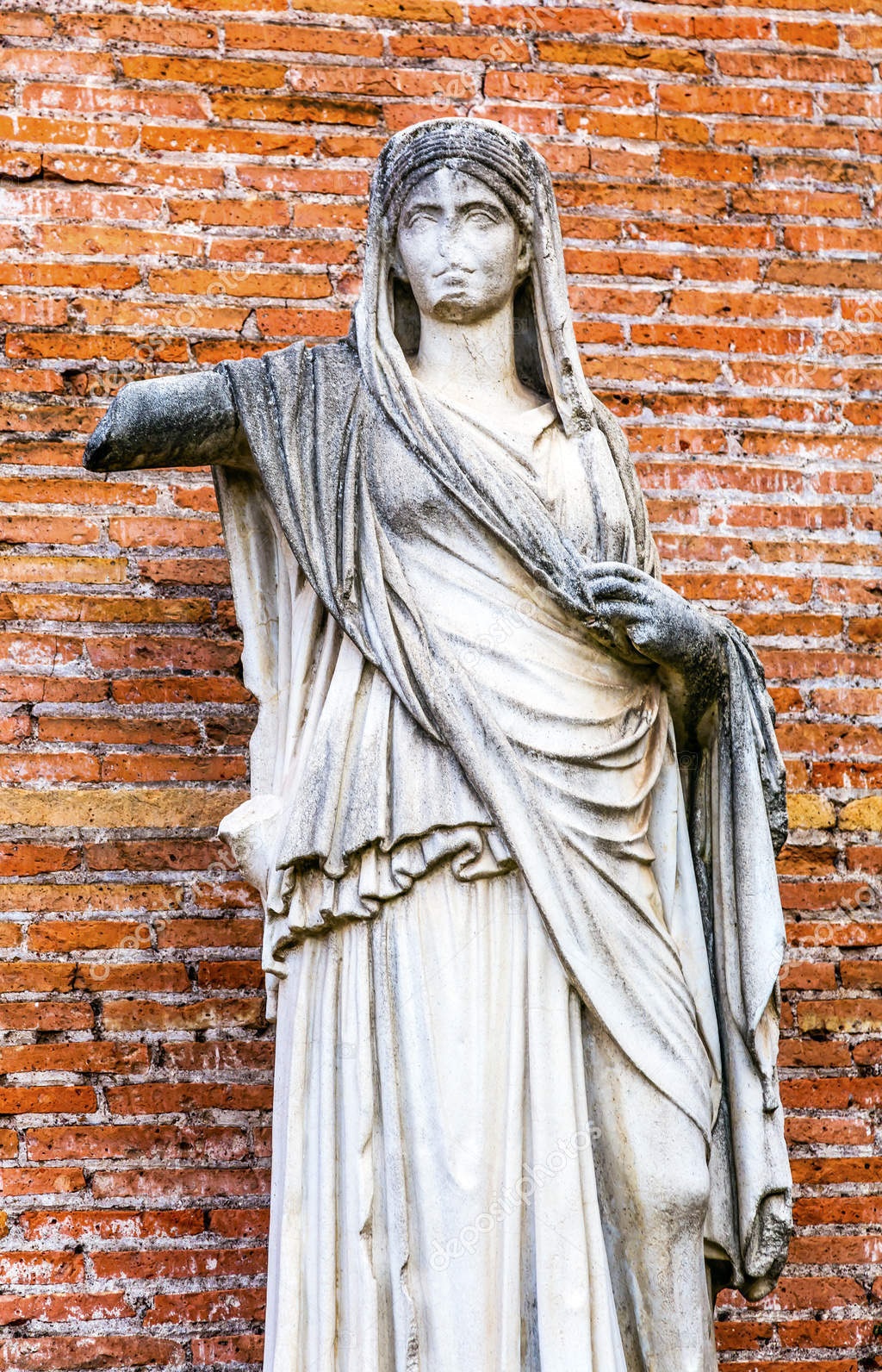 Statue of a Vestal from the Temple of Antoninus and Faustina in Rome, 2nd century AD.
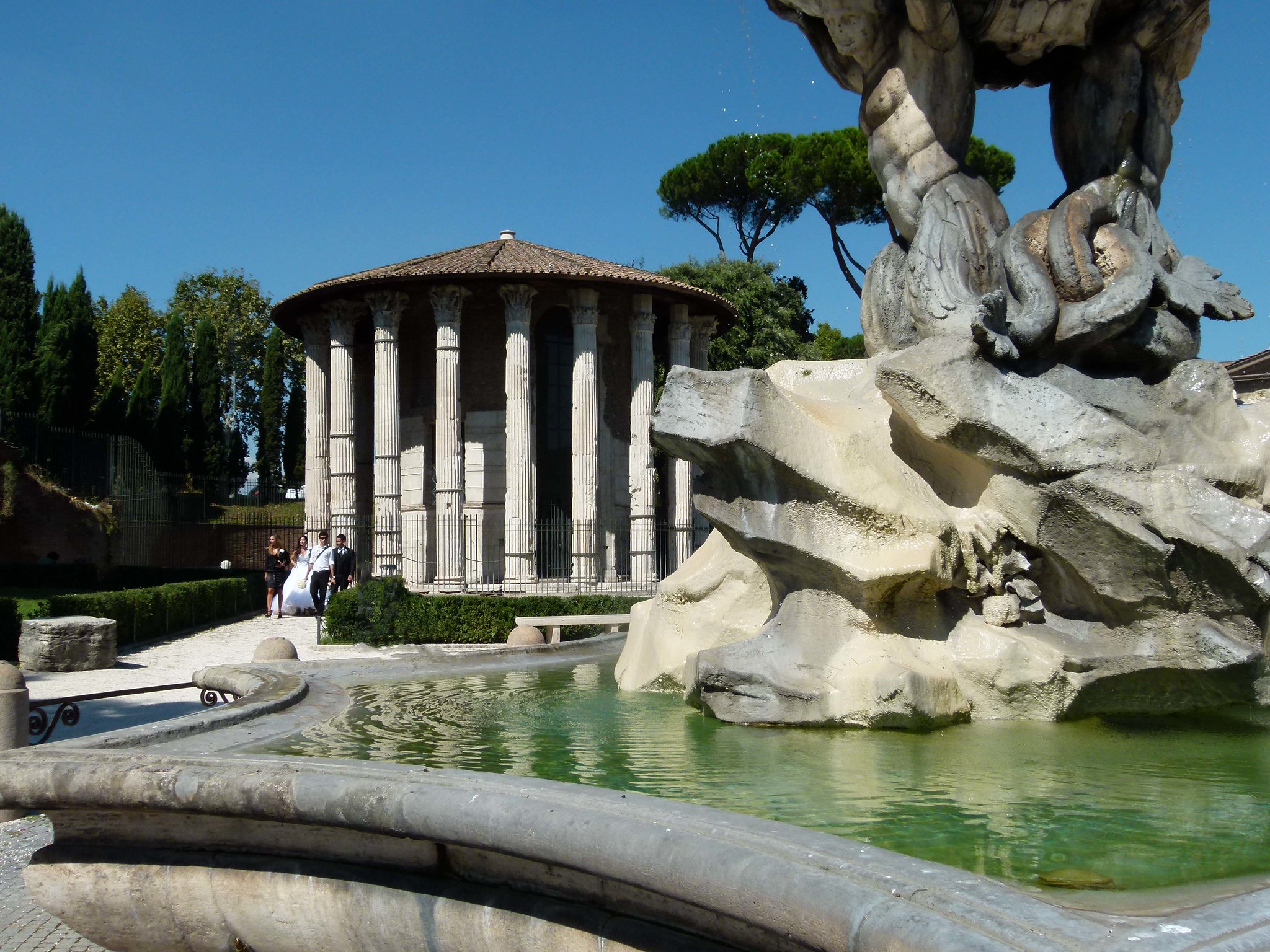 Temple of Vesta in the Roman Forum; the public sacred fire was understood as the hearth of the Roman people.
Differences between the Traditions
Greek and Roman religion should not be opposed as simply "mythological" and "practical": both knew myth, cult, vow, sacrifice, divination, household rites and local sanctuaries. The difference lies more in scale and emphasis. Greek material is often clearest through the polis, local epithet, heroic memory, Panhellenic sanctuary and poetic tradition. Roman material especially shows the link between ritual and magistrate, Senate, calendar, priestly college, military victory, household and law.
In a Greek city one deity could have several local faces: Athena Polias at Athens, Apollo Pythios at Delphi, Artemis of Ephesus in Asia Minor. At Rome the same local principle was joined to public procedure: a temple could fulfil a vow, a festival could belong to the state calendar, and a sacrifice could be performed by a magistrate on behalf of the people. Comparison therefore requires more than divine names. It must ask where the rite took place: an altar in the agora, a boundary sanctuary, the forum, a military camp, a household lararium or a provincial temple.
Material evidence shows this difference well. A Greek vase may preserve a mythological moment meaningful in symposium or burial; a Roman altar more often names the dedicator, deity and fulfilled vow. Greek hero cult ties a community to a tomb and its past; Roman cult of ancestors and household gods ties family to house, food stores and lineage memory. These distinctions do not cancel a shared ancient polytheism, but they prevent Greek and Roman cults from becoming one featureless system.
Pantheons and Equivalences
The Greek and Roman pantheons were often compared: Zeus and Jupiter, Hera and Juno, Athena and Minerva, Ares and Mars, Aphrodite and Venus, Hermes and Mercury. These pairs are useful for orientation, but they do not mean full identity. Mars at Rome was not only a god of war, but also a protector of the Roman community, linked with the father of Romulus and the agricultural calendar. Venus acquired special political importance through the idea that the Julian family descended from Aeneas and the goddess.
Equivalences became especially visible after Rome's contacts with the Greek world intensified. Romans adopted Greek statues, myths, literary plots and philosophical interpretations, while keeping their own ritual habits. The topic of Greek and Roman gods therefore requires not only a list of names, but also a comparison of functions, cults, festivals and political meanings. This is also the difference between living religion and the later literary retelling of Greco-Roman mythology.
Ritual, Sacrifice and Divination
Sacrifice was the chief public language of communication with the gods. It could accompany a festival, military campaign, election, treaty, family event, funeral or fulfilment of a vow. In Greek practice the altar, the division of meat among participants, the smoke and scent of the offering, and the gift left in the sanctuary all mattered. At Rome the formulas of prayer, inspection of the animal, order of the procession, musical accompaniment and legal precision of the rite are especially visible; this topic is treated separately in the article on sacrifices in Ancient Rome.
Divination helped determine whether the moment was favourable for action. Greeks consulted the oracles of Delphi and Dodona, dreams in healing sanctuaries and signs interpreted by seers. Romans gave public importance to auspices, the flight of birds, the behaviour of sacred chickens, unusual natural phenomena and the inspection of sacrificial entrails. Haruspices, connected with Etruscan tradition, could give an opinion on the meaning of a sign, but the final political decision remained with Roman magistrates and the Senate.
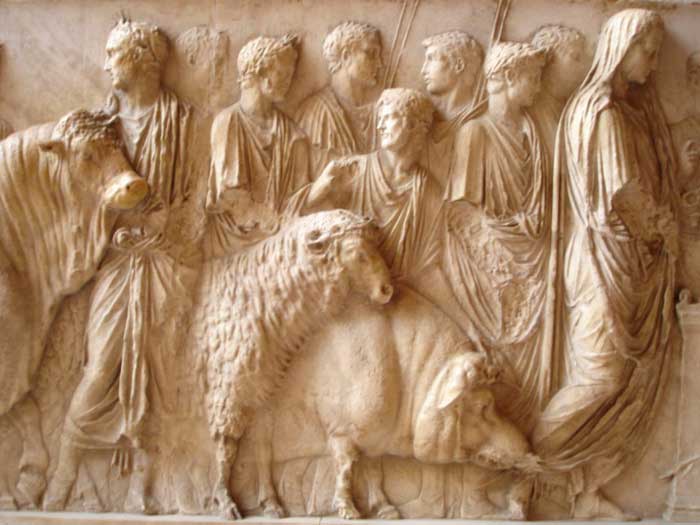 Sacrifice to Mars: suovetaurilia on a marble relief from the Louvre, first half of the 1st century AD.
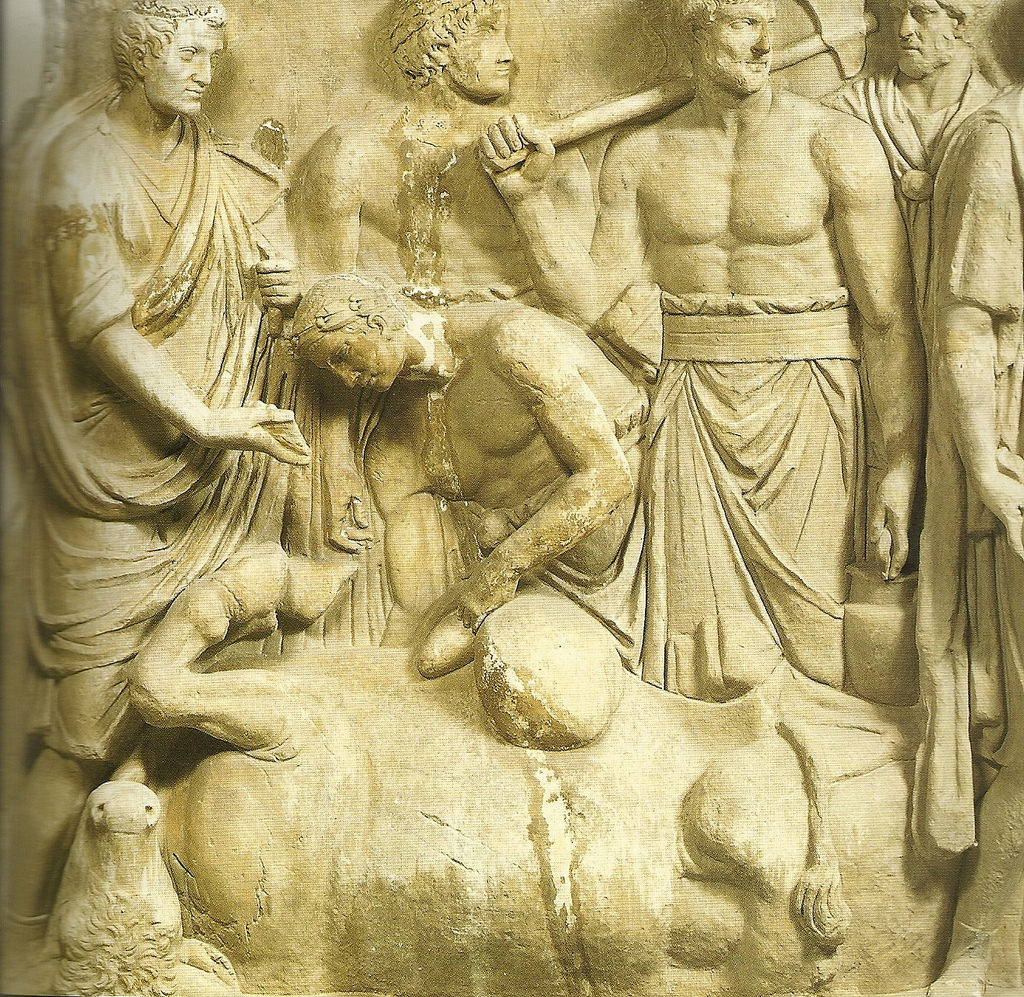 Roman relief from the Louvre showing a haruspex awaiting inspection of a sacrificial animal's entrails.
Temples, Festivals and Public Life
A temple was not simply a building for a congregation. In a Greek sanctuary the main centre often remained the open-air altar, while the temple housed the divine image and valuable dedications. A sacred precinct could include treasuries, stoas, theatrical spaces, a stadium, spring, processional road and archive of inscriptions. Delphi, Olympia or Epidaurus were therefore not only religious places, but also centres of memory, competition, diplomacy and gift exchange.
At Rome a temple often arose as the fulfilment of a vow after victory, a political promise or a senatorial decision. It became a visible sign of the bond between deity, city and power. Festivals included sacrifices, banquets, theatrical performances, races, processions and appearances by magistrates. Roman temples, forums and circuses show that religion was built into urban architecture: sacred, political and spectacular space constantly overlapped.
Household Cult and Ancestors
Public cults existed alongside the religion of the household. In the Greek oikos the hearth, family gods, ancestors and protective powers of the house were honoured; major transitions of life, such as birth, marriage and death, were accompanied by rites that tied the family to city and lineage. At Rome household religion is especially visible in the lararia of Pompeii and Herculaneum: small shrines with frescoes, figurines and a place for offerings stood inside domestic space rather than in a separate temple.
The Roman family addressed the Lares, Penates, Manes and the genius of the head of the household. A lararium might show a guardian snake, a genius holding a patera, dancing Lares or a sacrificial scene. These images matter because they record the everyday level of religion: concern for food, prosperity, the memory of the dead and the stability of the house. This side is treated in more detail in the article on household cult in Ancient Rome.
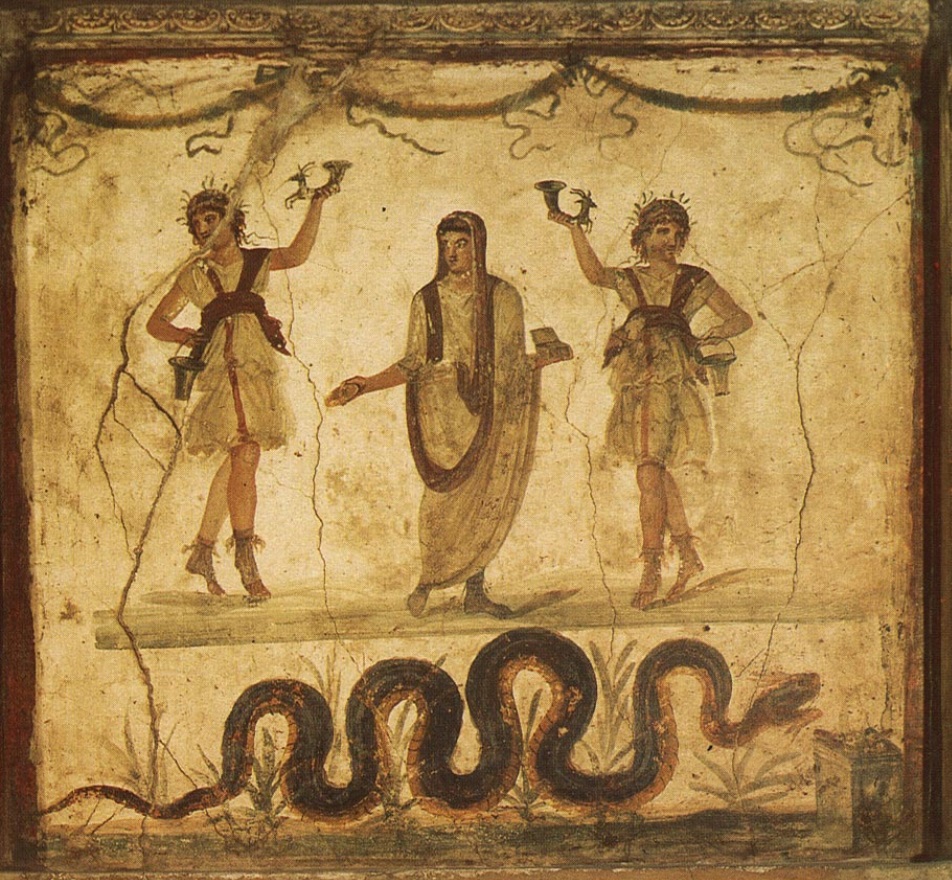 Lararium of the House of the Vettii in Pompeii (VI.15.1), kitchen area: the household genius between Lares, with serpent and altar; AD 60-79.
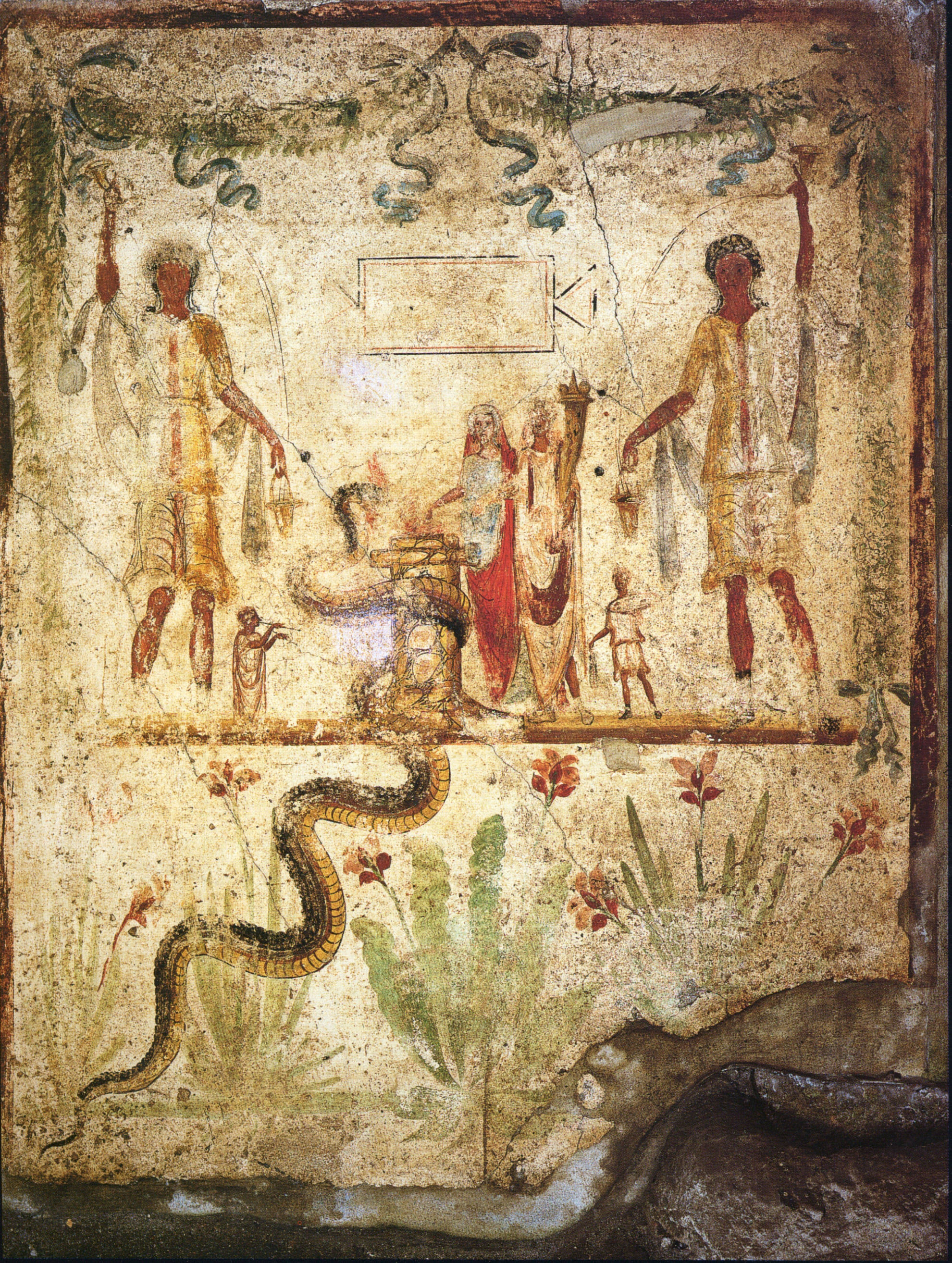 Fresco from the lararium of the House of Julius Polybius in Pompeii, 1st century AD; a household shrine with Lares, genius, serpents and altar.
Priests, Status and Participation
Ancient priesthood did not resemble a later church hierarchy. In Greek cities a priestly office might belong to a particular family, be sold, or be assigned by the city for a fixed term. Women held important positions: priestesses of Athena, Demeter, Artemis or Hera could manage temple property, participate in processions and represent the cult before the community. Alongside official priests stood seers, interpreters of dreams, sanctuary attendants, hymn-singers and specialists in purification.
At Rome religious status closely overlapped with civic status. A magistrate could sacrifice on behalf of the people, a commander could vow a temple for victory, the head of a household could perform a domestic rite, and a priestly college could preserve rules, calendar and memory of precedents. Ordinary people participated through festivals, vows, funerary rites, dedications on altars and small offerings. Religion was therefore at once a matter of elites, community, family and individual.
Imperial Cult and Late Antiquity
The imperial cult did not arise from nothing. In the Greek East Hellenistic kings had already received honours as benefactors of cities, and Romans already knew the cult of deified ancestors and victors. After the assassination of Gaius Julius Caesar his posthumous deification became an important precedent, and Octavian Augustus turned the link between power, peace and religion into a stable language of the principate. In the provinces the cult of Roma and Augustus expressed loyalty to the empire, but it usually did not abolish local cults.
In Late Antiquity traditional cults existed alongside mystery communities, philosophical schools, eastern cults and growing Christianity. Tension became especially visible under Diocletian, when the state tried to restore the unity of traditional cult, and under Constantine, when Christianity received imperial support. The change of the fourth century was not an instant disappearance of older religion: temples, festivals, images and local customs continued, but their legal and social status gradually changed. This transition is discussed in the article on Christianity in Antiquity.
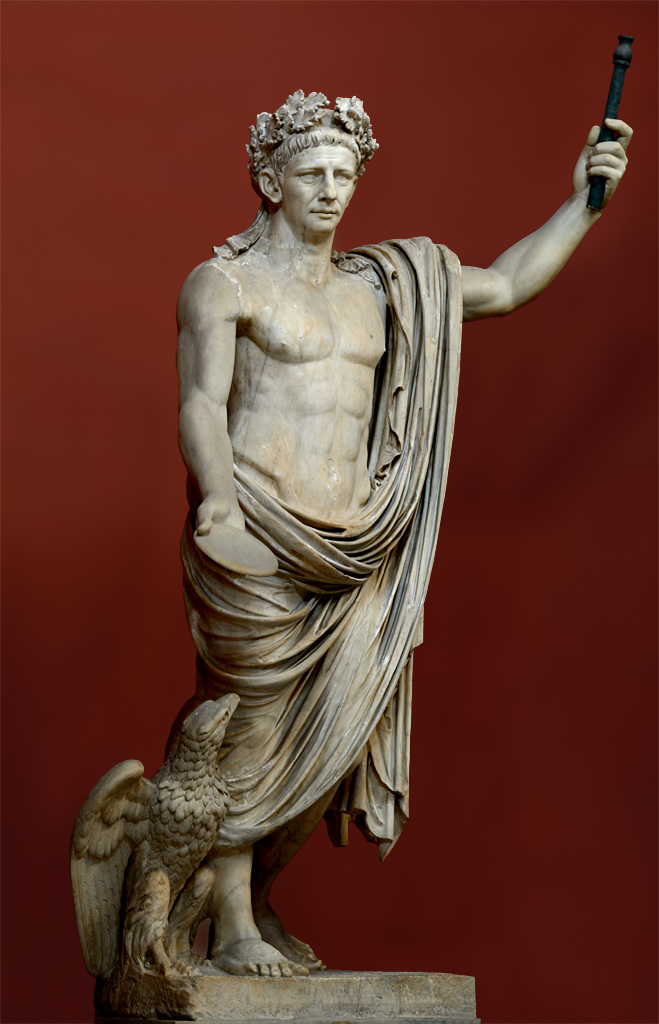 Emperor Claudius represented as Jupiter. Marble, 1st century AD; Vatican Museums.
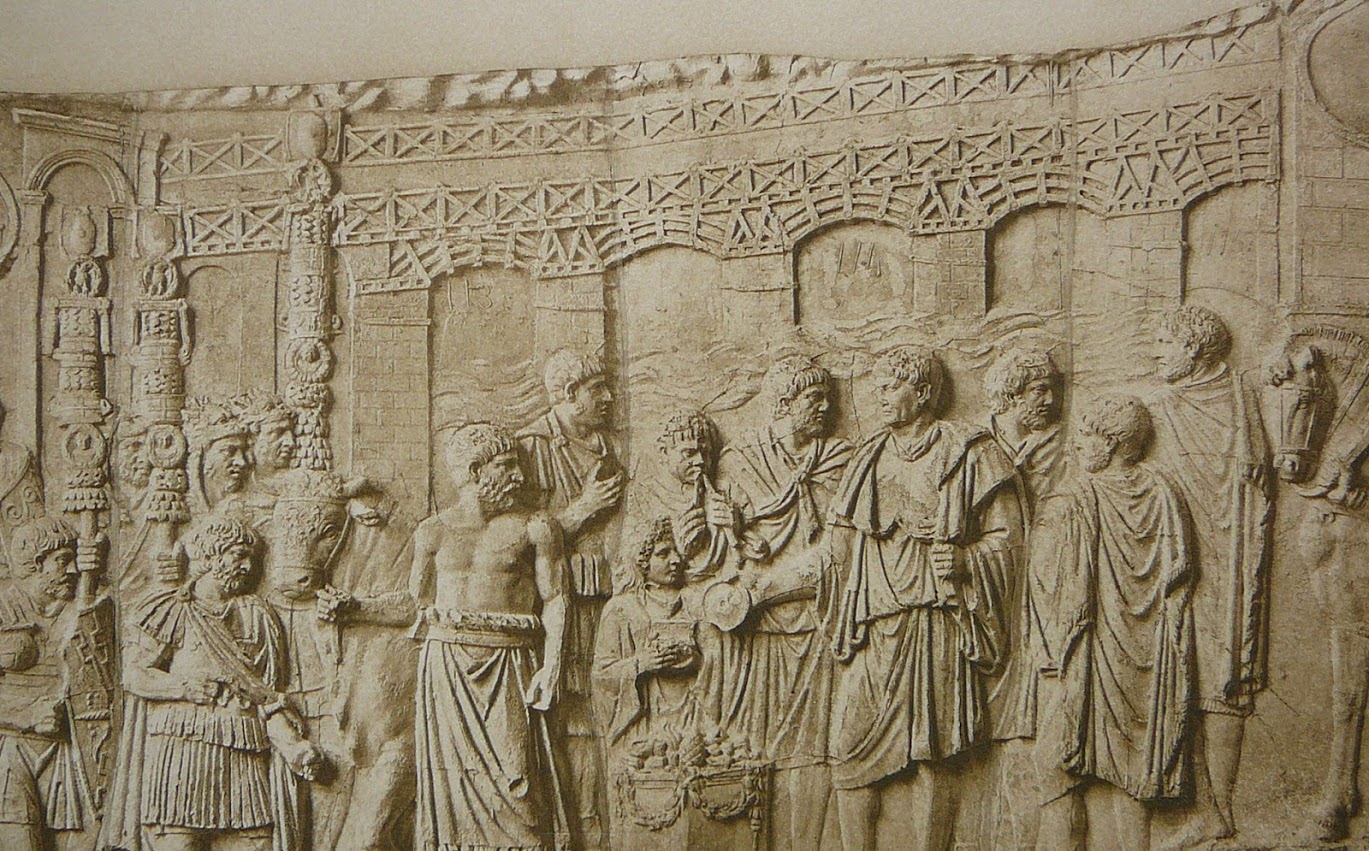 Trajan offering sacrifice to the gods; relief on Trajan's Column, early 2nd century AD.
Short Chronology
- 8th-7th centuries BC - formation of polis religion, early epic tradition, growth of public sanctuaries and hero cults.
- 6th-5th centuries BC - flourishing of Panhellenic centres, the Delphic oracle, the Olympic Games, Athenian festivals and temple building.
- 4th-3rd centuries BC - Hellenistic kingdoms spread Greek cults, forms of royal honour and new mixed religious practices.
- 3rd-2nd centuries BC - Rome intensifies contact with the Greek world, introduces new cults and links religious decisions with senatorial politics.
- 1st century BC - civil wars, the cult of Venus, Caesar's posthumous deification and Augustus' religious programme alter the language of Roman power.
- 1st-3rd centuries AD - imperial cult, provincial altars, local sanctuaries and household cults coexist within imperial religion.
- 4th century AD - Christianity receives imperial support, while traditional cults gradually lose their former official status.
Written and Archaeological Evidence
Greek and Roman religion is studied through different kinds of evidence, each showing a different side of practice. Literary texts preserve myths, hymns, philosophical reflections and accounts of festivals. Inscriptions record dedications, priestly offices, temple finances, calendar rules and thanks for a fulfilled vow. Reliefs show the posture of the dedicator, processions, animals, altar, musical accompaniment and ritual objects. Architecture helps reconstruct the movement of people through a sanctuary, the place of the altar and the connection between temple, forum, theatre, stadium or house.
Objects found in a clear context are especially important: an altar with the name of the deity and dedicator, a household lararium, a vessel with a cult scene, a statue from a sanctuary, a votive tablet or a festival calendar. Such finds do not merely illustrate the narrative; they clarify who performed the rite, where it took place, which words or images were considered appropriate, and how religion joined city, army, family and personal hope.
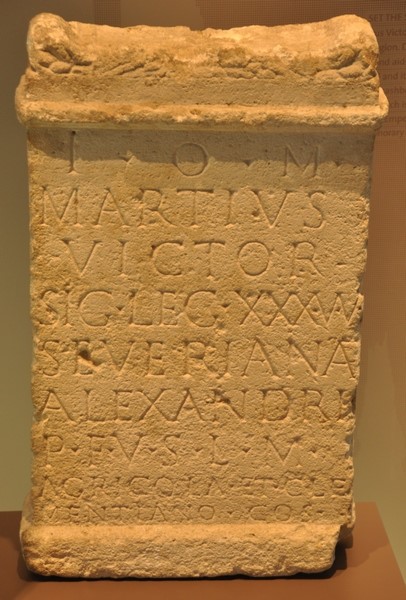 Altar dedicated to Jupiter by Legio XXX Ulpia Victrix. Xanten, AD 230; LVR-RömerMuseum, Xanten Archaeological Park.
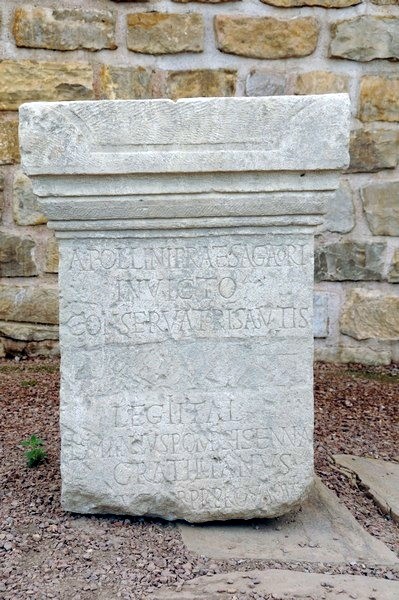 Altar dedicated to Apollo by Legio I Italica; Svishtov City Museum, Bulgaria, 1st century AD.
Related Topics
- Religion in Antiquity
- Ancient Greece
- Ancient Rome
- Greek Gods
- Roman Gods
- Greek and Roman Gods
- Roman Religion
- Roman Temples
- Household Cult in Ancient Rome
- Lares
- Lararium
- Penates
- Pontifex
- Augur
- Flamen
- Vestal Virgin
- Sacrifices in Ancient Rome
- Greco-Roman Mythology
- Christianity in Antiquity
Literature
- Beard M., North J., Price S. Religions of Rome. Vol. 1: A History. Cambridge University Press, 1998.
- Beard M., North J., Price S. Religions of Rome. Vol. 2: A Sourcebook. Cambridge University Press, 1998.
- Burkert W. Greek Religion. Harvard University Press, 1985.
- Parker R. On Greek Religion. Cornell University Press, 2011.
- Rives J. B. Religion in the Roman Empire. Wiley-Blackwell, 2006.
- Rüpke J. Religion of the Romans. Polity Press, 2007.
- Scheid J. An Introduction to Roman Religion. Indiana University Press, 2003.


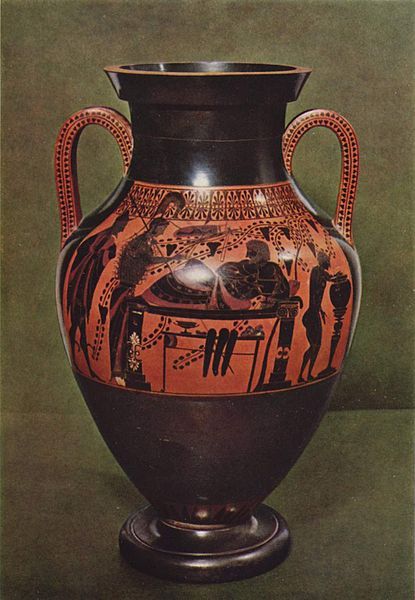 Athena beside Heracles on an Attic black-figure amphora, 520-510 BC; vase painting as evidence for myth.
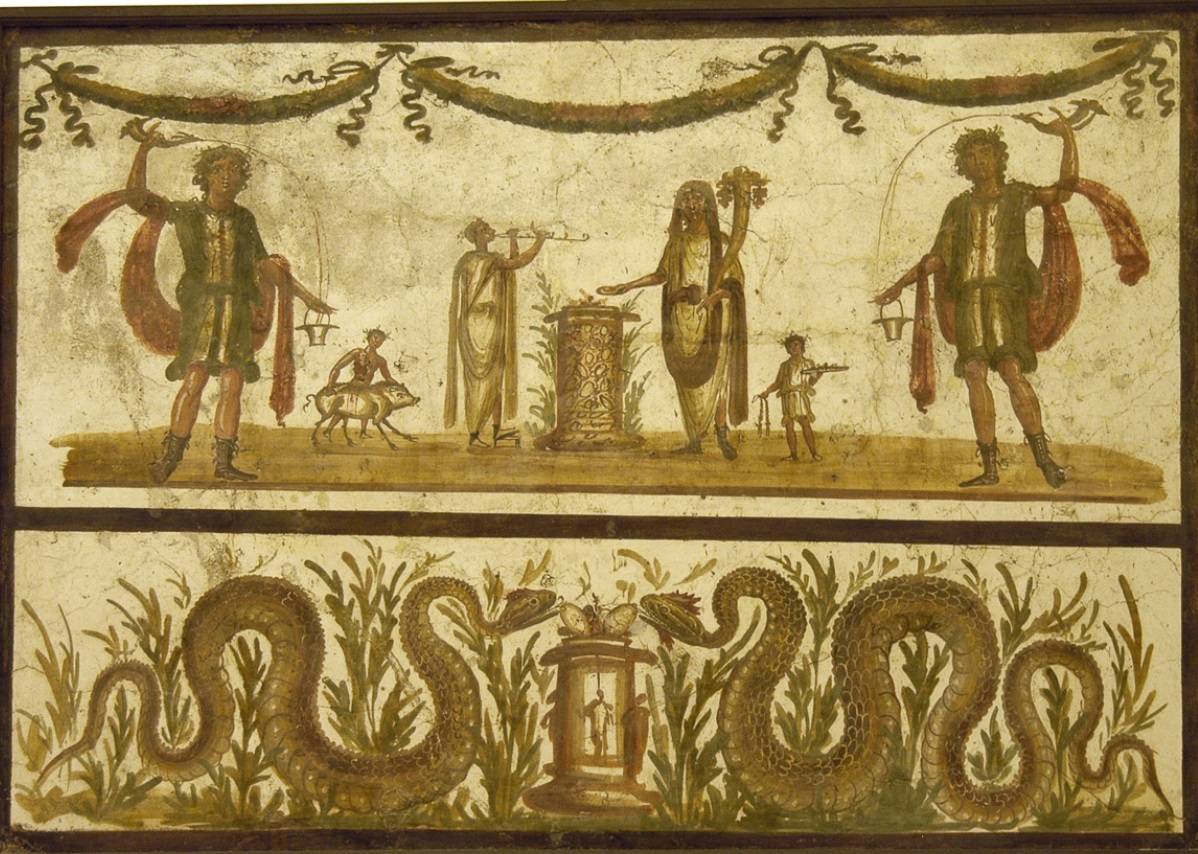 Lares, genius and serpents on a fresco from a Pompeian lararium, Insula VIII.2; Naples, National Archaeological Museum, inv. 8905, AD 69-79.
Interested in Ancient Rome beyond reading? Join Legio X Fretensis or explore our reenactment directions.


