Persian Religion
Persian religion in antiquity was a body of Iranian religious traditions, royal ideology, and cult practice most visible to the Graeco-Roman world through the Achaemenid Empire, the Hellenistic East, and later ideas about Mithra. For ancient history this topic is important as a bridge between Greek sources, eastern imperial policy, and Roman perceptions of 'Persian' religious heritage.
Unlike Greek civic cults or Roman state religion, Persian religious history is known through diverse sources: royal inscriptions, Avestan tradition, Greek narratives, archaeology, and later testimony. It therefore has to be treated carefully, separating the Iranian context itself from external interpretations.
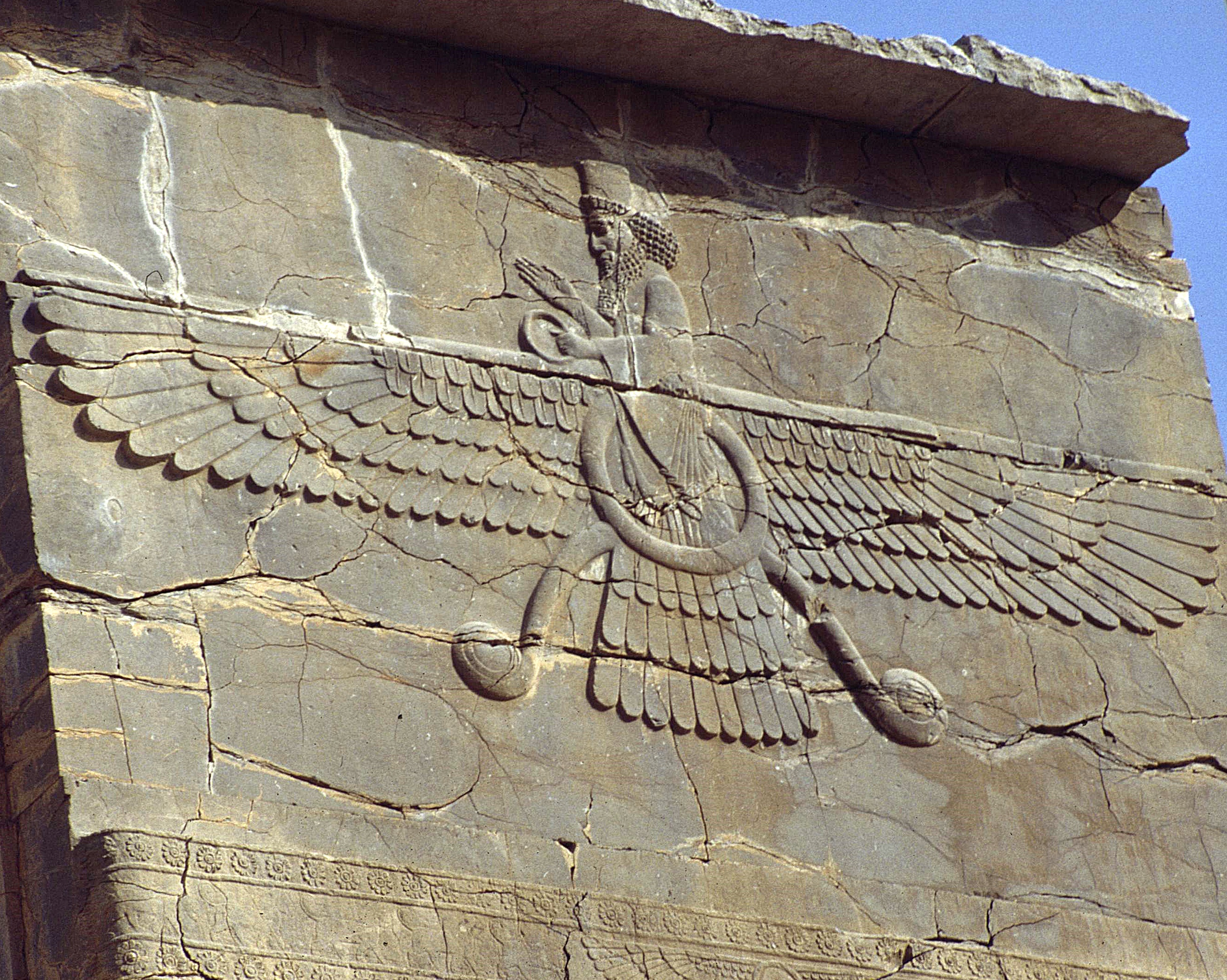 Relief of Ahura Mazda at Persepolis. Photo: Ziegler175, Wikimedia Commons, CC BY-SA 3.0.
Achaemenid Religious Policy
The Achaemenid Empire united many peoples, languages, and cults. Its religious policy was usually based not on uniformity, but on recognition of local traditions under the condition of political loyalty. Persian kings could support the temples and sanctuaries of subject peoples when this strengthened imperial order.
This approach helped govern a vast empire from Asia Minor to Egypt and Central Asia. In Greek history the Achaemenids are especially visible through the conflict with the poleis described in Greco-Persian Wars and Xerxes' Campaign, but within the empire religious policy was more complex than a simple 'Persia versus Greece' scheme.
Zoroastrianism, Ahura Mazda, and Asha
Zoroastrianism is connected with the name of Zarathustra and the worship of Ahura Mazda, the Wise Lord and supreme deity. A central concept was Asha: truth, order, rightness, and cosmic law. The opposite of Asha was lie and chaos, which disrupted the structure of the world.
In Achaemenid inscriptions Ahura Mazda appears as the source of royal authority and protector of rightful order. At the same time, the question of how far the religion of all Achaemenids was already fully formed Zoroastrianism in the later sense remains complex: royal ideology, Iranian tradition, and local cults did not always coincide completely.
Dualism and the Struggle of Order Against the Lie
Iranian religious thought is often described through dualism: the opposition of the good, truthful, and ordered principle to the forces of lie, destruction, and chaos. In later Zoroastrian tradition this picture takes the developed form of the struggle between Ahura Mazda and Angra Mainyu.
For political ideology this had direct significance. The king was represented not merely as ruler, but as guardian of truth and order. Rebellion, false oath, and breach of loyalty could be described as religious and moral evil, while royal victory appeared as the restoration of cosmic balance.
Royal Ideology
The Achaemenid king relied on the image of lawful authority granted by Ahura Mazda. Royal inscriptions emphasized the ruler's election, just rule, suppression of the Lie, and protection of order. This ideology linked religion, law, war, and the governance of a multiethnic empire.
Unlike the Egyptian pharaoh, the Persian king was usually not presented as a god in a direct sense. His sacrality was expressed through his connection with Ahura Mazda, royal charisma, victory over rebellion, and ability to maintain Asha within the empire.
Persian Religion in Greek Perception
Greek authors perceived Persian religion through their own categories. They noted the Magi, fire, sacrifices, the absence of familiar Greek divine statues, and royal ceremonies. Some information is valuable, but some reflects Greek stereotypes about the East, luxury, despotism, and 'barbarian' customs.
After the campaigns of Alexander the Great Greek knowledge of the East became broader, but not fully neutral. Persia remained for the Hellenistic world at once a historical enemy, a source of royal models, and a space of cultural mixture.
The Hellenistic East
After the conquests of Alexander the Great and the breakup of his empire, Iranian lands entered the system of Hellenistic monarchies. The most important successor in the East was the Seleucid Empire, where Greek political culture coexisted with local Iranian, Babylonian, Anatolian, and Syrian traditions.
In this period Persian religion was not simply replaced by Greek religion. Rather, there were interactions, local compromises, translations of royal imagery, and the gradual formation of new regional cultures. Later, similar mixed traditions are visible in Pontus and other regions connected with Mithridates Eupator.
Mithra and Roman Mithraism
The Iranian Mithra was an ancient deity of covenant, oath, light, and supervision of proper order. His figure existed in the Iranian religious world long before Roman Mithraism appeared. It is therefore not correct to identify Mithra of Zoroastrian and Iranian tradition directly with the Roman Mithras without qualification.
The Roman cult of Mithras, widespread from the first to fourth centuries AD, was a mystery cult with its own rites, underground mithraea, initiations, and the characteristic scene of bull-slaying. It used an eastern and 'Persian' image, but developed within the Roman Empire and differed from ancient Iranian veneration of Mithra.
Importance for Ancient History
Persian religion helps us see antiquity not only as the history of Greece and Rome, but also as a space of interaction with the East. Through the Achaemenids, Hellenistic monarchies, Iranian cults, and Roman interest in Mithras, we can see a long chain of contacts, conflicts, and mutual interpretations.
For this reason the Persian religious theme connects the Greco-Persian Wars, Alexander's campaigns, the Hellenistic East, and later Roman religious practices into a single historical line.
Related Topics
- Greco-Persian Wars
- Xerxes' Campaign
- Seleucid Empire
- Alexander the Great
- Campaigns of Alexander the Great
- Mithridates Eupator
- Religion in Antiquity
Literature and sources
- Boyce M. Zoroastrians: Their Religious Beliefs and Practices. Routledge, 2001.
- Briant P. From Cyrus to Alexander: A History of the Persian Empire. Eisenbrauns, 2002.
- de Jong A. Traditions of the Magi: Zoroastrianism in Greek and Latin Literature. Brill, 1997.
- Beck R. The Religion of the Mithras Cult in the Roman Empire. Oxford University Press, 2006.
- Image: AhuraMazda-Relief.jpg. Wikimedia Commons; photo by Ziegler175; CC BY-SA 3.0.
Interested in Ancient Rome beyond reading? Join Legio X Fretensis or explore our reenactment directions.


