Druids
Druids belonged to the religious and intellectual elites of Celtic societies in Gaul and Britain. Ancient authors describe them as priests, teachers of the nobility, keepers of sacred knowledge, judges and mediators in disputes. They were not a single "church" with one hierarchy for all Celts; similar functions could take local forms in different communities.
Druids are known mainly from external Greek and Roman texts. No druidic books survive. Every literary account must therefore be read alongside archaeology: sanctuaries, cult objects, burials, inscriptions, coins and images from Celtic religious contexts.
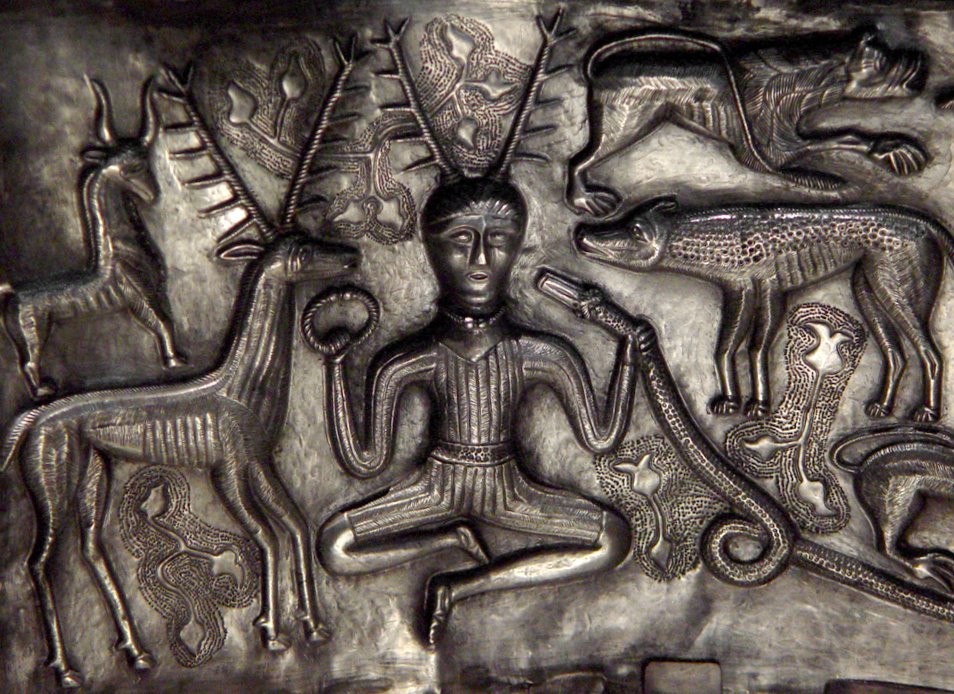 Detail of the Gundestrup cauldron with an antlered figure, torc and serpent. Silver, Late Iron Age; National Museum of Denmark. This is Celtic religious iconography, not a direct image of a druid.
Ancient Evidence
The best-known description comes from Gaius Julius Caesar in book six of the Gallic War. Caesar says that druids dealt with divine matters, offered sacrifices, judged private and public disputes, taught the young and held great authority. His account is essential, but it was written by a Roman commander during the conquest of Gaul, and it carries the perspective of conquest.
Strabo, Diodorus Siculus and Pomponius Mela placed druids alongside other groups of learned Celtic specialists: bards and seers. Tacitus linked druids with resistance on Mona in Britain. Pliny the Elder preserves the famous story of oak and mistletoe. These texts do not form a simple handbook: every author wrote in a particular genre and for a particular purpose.
Social Functions
In Roman descriptions a druid could be priest, teacher, judge and political mediator. Caesar emphasizes that their decisions concerned inheritance, boundaries, crimes and penalties, and that refusal to obey could lead to exclusion from sacrifices. Religious authority thus appears as part of social order.
Druidic education, according to ancient authors, was long and oral. Students memorised large bodies of verse and teaching, while writing down sacred knowledge was discouraged. This helps explain why archaeology gives no "druidic books", even though Celtic societies knew writing and used Greek or Latin letters in practical and public contexts.
Druids, Bards and Seers
Ancient authors did not always divide Celtic specialists in the same way. Some place bards beside druids, responsible for memory, fame and poetic speech; others mention seers connected with divination and prophecy. This division was not necessarily the same in every region of Gaul or Britain. It shows that knowledge in Celtic societies could be distributed among several groups.
The bard preserved memory of origins, deeds and status. The seer interpreted signs, lots and sacrificial practices. The druid in Roman description stood at a higher level, connected with teaching, judgment, ritual and general authority. In practice these functions could overlap, especially in smaller communities where one person might hold several roles.
Teaching on Soul, Nature and Time
Caesar and other authors connect druids with belief in the immortality of the soul. The Roman explains this as a teaching that made warriors braver because death was not considered final disappearance. It is impossible to test how precisely he rendered Celtic thought, but the motif is significant: druids appear not only as ritual performers, but also as bearers of a complex worldview.
The texts also mention knowledge of stars, nature, gods and the size of the world. To an ancient reader this brought druids close to philosophers, while still keeping them within the category of "barbarian sages". Such ambiguity is typical of Greco-Roman ethnography: foreign knowledge can be respected, but it is described through familiar ancient frameworks.
Ritual, Sacred Places and Sacrifice
Ancient authors associate druids with sacrifices, divination, teaching about the immortality of the soul and sacred groves. These themes cannot be applied uniformly to all Celtic lands. Archaeology shows a variety of cult places: groves, enclosed sanctuaries, watery votive sites, pits with weapons, animal bones, vessels, coins and objects deliberately taken out of use.
Human sacrifice is described sharply in ancient texts and often marks "barbarism" from the Roman viewpoint. Archaeological finds confirm that violence and ritual death existed in the Celtic world, but they do not allow every literary scene to be accepted as an exact description of routine practice.
 Cult wagon from Strettweg. Bronze, c. 600 BC; Universalmuseum Joanneum, Graz. An early Celtic ritual object in a museum collection.
Britain, Mona and Roman Suppression
In Britain druids are especially visible in Tacitus. He describes the Roman attack on Mona, modern Anglesey, a centre of resistance and sacred places. Women with torches and druids on the shore intensify his image of a dangerous foreign cult. The episode also belongs to real military policy: Rome sought to destroy nodes of authority that could unite communities against provincial administration.
In Gaul and Britain Roman power restricted practices it considered politically dangerous or incompatible with imperial order. This did not mean the immediate disappearance of Celtic religion. Many local deities continued to be worshipped in Romanised form, with Latin inscriptions, stone altars and combinations of local names with Roman gods.
Archaeology and the Limits of Certainty
The main difficulty with druids is that an archaeological object is rarely labelled "druid". A cult wagon, cauldron, sanctuary, votive pit or hooded figure can belong to Celtic religious culture without proving the direct involvement of druids. Image captions therefore need caution: "Celtic cult object", "religious milieu", "possible connection" rather than a direct portrait where none exists.
Visual sources for druids are scarce. Later romantic images with white robes, sickles and megaliths tell more about the modern period than about the Iron Age. For antiquity it is safer to rely on dated finds, ancient texts and the contexts of Celtic sanctuaries.
Later Memory and Modern Images
After antiquity the image of the druid lived in different cultural settings. In medieval Irish literature druids appear beside kings, heroes, prophecies and magical contests. These texts matter for the history of memory, but they are not direct descriptions of Gaulish or British druids of the first century BC. Christianisation, language change, new genres and the aims of medieval authors stand between them.
In the modern period druids were often linked with megaliths, white robes, sickles and solemn processions. This image strongly shaped popular culture, but archaeologically it mixes different periods. The megalithic monuments of Britain are thousands of years older than the historical Celts. Later Romantic depictions are therefore not direct evidence for Iron Age practice.
Names, Places and Political Power
Druids rarely appear in the sources as individual biographies. Their names, families, ages and origins are almost unknown. Ancient authors more often describe the group as an institution, because Rome cared about their social role: the ability to judge, teach, preserve memory and maintain links between communities. Such power did not always take the form of an office; it could rest on recognition, ancestry, training and control of ritual knowledge.
Space mattered as well. Groves, islands, sanctuaries, springs and assemblies of elites created places where religious authority became political. This is why Roman power could perceive druids as a threat. Suppressing druids was not only a dispute about gods, but a struggle over the right to gather people, settle disputes and preserve an independent tradition.
Short Chronology
- 3rd-1st centuries BC: large Celtic political groupings formed in Gaul; sanctuaries, coinages, weapon deposits and oppida are visible archaeologically.
- 58-50 BC: Caesar's conquest of Gaul; his description of druids became the central ancient testimony.
- 1st century AD: Roman administration restricted druidic practices in Gaul and Britain.
- AD 60/61: Suetonius Paulinus' campaign against Mona, described by Tacitus.
- 2nd-4th centuries AD: local Celtic cults continued in Romanised form.
- Middle Ages and modern period: the image of druids was reinterpreted in Irish literature, antiquarian scholarship and Romantic culture.
Related Topics
Literature and sources
- Caesar. The Gallic War, book VI.
- Tacitus. Annals, book XIV.
- Pliny the Elder. Natural History, book XVI.
- Strabo. Geography, book IV.
- Diodorus Siculus. Library of History, book V.
- Cunliffe B. The Ancient Celts. Oxford: Oxford University Press.
- Aldhouse-Green M. Caesar's Druids: Story of an Ancient Priesthood. New Haven: Yale University Press.
- Aldhouse-Green M. The World of the Druids. London: Thames & Hudson.
- Brunaux J.-L. Les Druides: Des philosophes chez les Barbares. Paris.
- Webster J. Rome Against Caratacus: The Roman Campaigns in Britain AD 48-58. London.
Interested in Ancient Rome beyond reading? Join Legio X Fretensis or explore our reenactment directions.


