Celts and Rome
Celts and Rome is the history of contact, warfare and mutual influence between the Roman world and Celtic peoples of western and central Europe. To Romans, Gauls could be dangerous enemies, neighbours, mercenaries, trading partners and later inhabitants of provinces.
In brief:
- early Roman contact with Celts was tied to northern Italy and the Gallic invasion of the fourth century BCE;
- from the third to first centuries BCE Rome gradually took control of Cisalpine and Transalpine Gaul;
- the campaigns of Gaius Julius Caesar turned much of Gaul into a Roman provincial zone;
- under the Empire, Celtic elites, towns, cults and troops became part of the Roman world, although local traditions did not disappear completely.
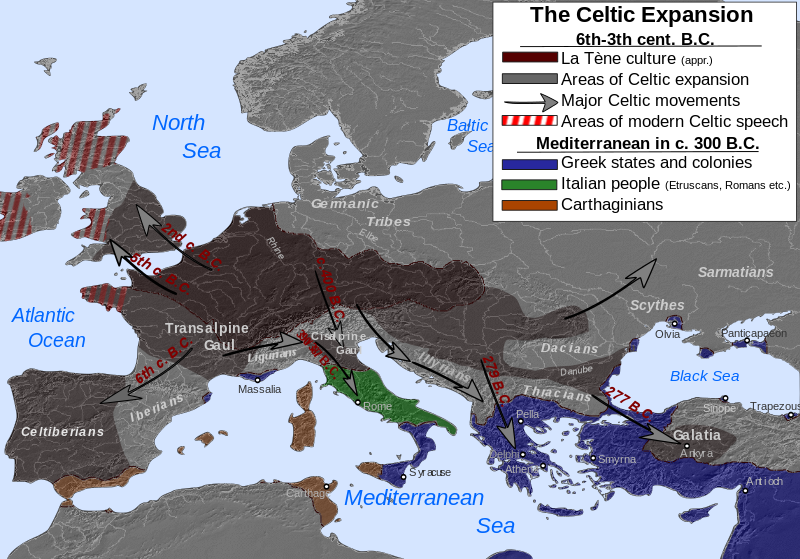 Expansion of Celtic tribes in the 6th-3rd centuries BC
From fear of Gauls to expansion
In Roman memory, Celts long remained the people who had once reached Rome itself. The Gallic invasion and the sack of the city in 390 or 387/386 BCE became a traumatic episode in Roman historical tradition. Northern Italy was therefore seen as a dangerous frontier from which new invasions might come.
As the Republic grew stronger, the relationship changed. Roman wars in Italy, colonization of the Po valley and control of roads gradually pushed independent Celtic groups out of Cisalpine Gaul. The Celtic world was never uniform: some communities fought Rome, others made alliances, traded or served in foreign armies.
Caesar and the conquest of Gaul
The decisive phase was Caesar's Gallic Wars of 58-50 BCE. Caesar presented them as the defence of allies and the restoration of order, but in practice they were a large-scale conquest. The Roman army used alliances, conflicts between tribes, fortified camps, engineering and legionary discipline.
Victory over Vercingetorix at Alesia did not destroy Celtic society, but it sharply changed the political map. Gaul was integrated into the Roman system of taxation, civic communities, roads and military administration. Local aristocrats gradually acquired Roman forms of status and could enter the imperial elite.
Celts inside the Roman Empire
Under the Empire, Celtic lands became several provinces rather than a single 'Celtic country'. In Gaul and Britain, Latin inscriptions, municipal government, Roman law, baths, roads and military camps spread widely. At the same time, local features survived for a long time in religion, names, craft and rural life.
Celtic warriors served in auxiliary units, merchants participated in imperial exchange, and noble families received citizenship. The history of Celts and Rome is therefore not only a history of conquest, but also a history of local societies being integrated into the larger Roman political and cultural world.
Topic navigation
I. Celts
II. Wars and contact
III. Roman world
Related topics
Literature and sources
1. Julius Caesar. Commentarii de Bello Gallico. 2. Livy. History of Rome. 3. Polybius. The Histories. 4. Barry Cunliffe. The Ancient Celts. 5. Greg Woolf. Becoming Roman: The Origins of Provincial Civilization in Gaul.
Interested in Ancient Rome beyond reading? Join Legio X Fretensis or explore our reenactment directions.


