Education in Ancient Greece and Rome
Education in ancient Greece and Rome was not a single state system in the modern sense. It was made up of family upbringing, private teachers, urban schools, gymnasia, rhetorical training, philosophical circles and professional instruction inside a craft or service. Lessons depended on gender, wealth, status, city and period: an Athenian boy of the fifth century BC, a Spartan adolescent, a Roman senator's son, a daughter of a wealthy household, an enslaved scribe and an apprentice craftsman received different skills and different social expectations.
The shared core of ancient education was writing, reading, arithmetic, memory, work with authoritative texts and the ability to speak before others. In Ancient Greece this was linked with paideia, the formation of a person able to live in the polis and understand poetry, music, gymnastics, honour and civic duty. In Ancient Rome school became part of the path to public life: Latin and Greek literature, law, history and rhetoric helped a man speak in court, senate, army and civic administration. At the same time many people in antiquity remained illiterate or had only practical literacy: they could count, sign, read simple inscriptions, keep accounts or understand business records.
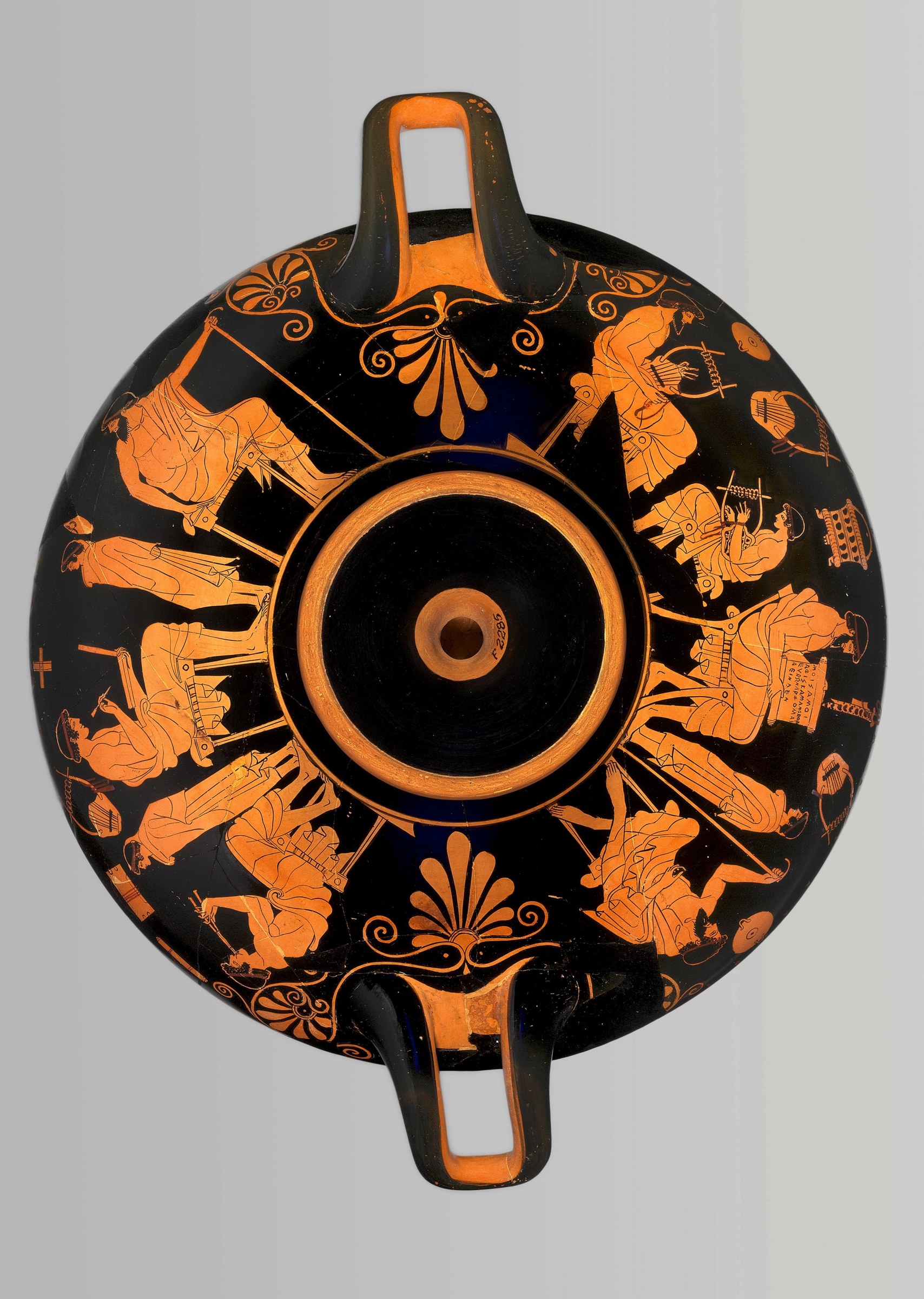 Douris cup with a school scene: teachers, pupils, writing and music. Attica, c. 480 BC; Antikensammlung Berlin.
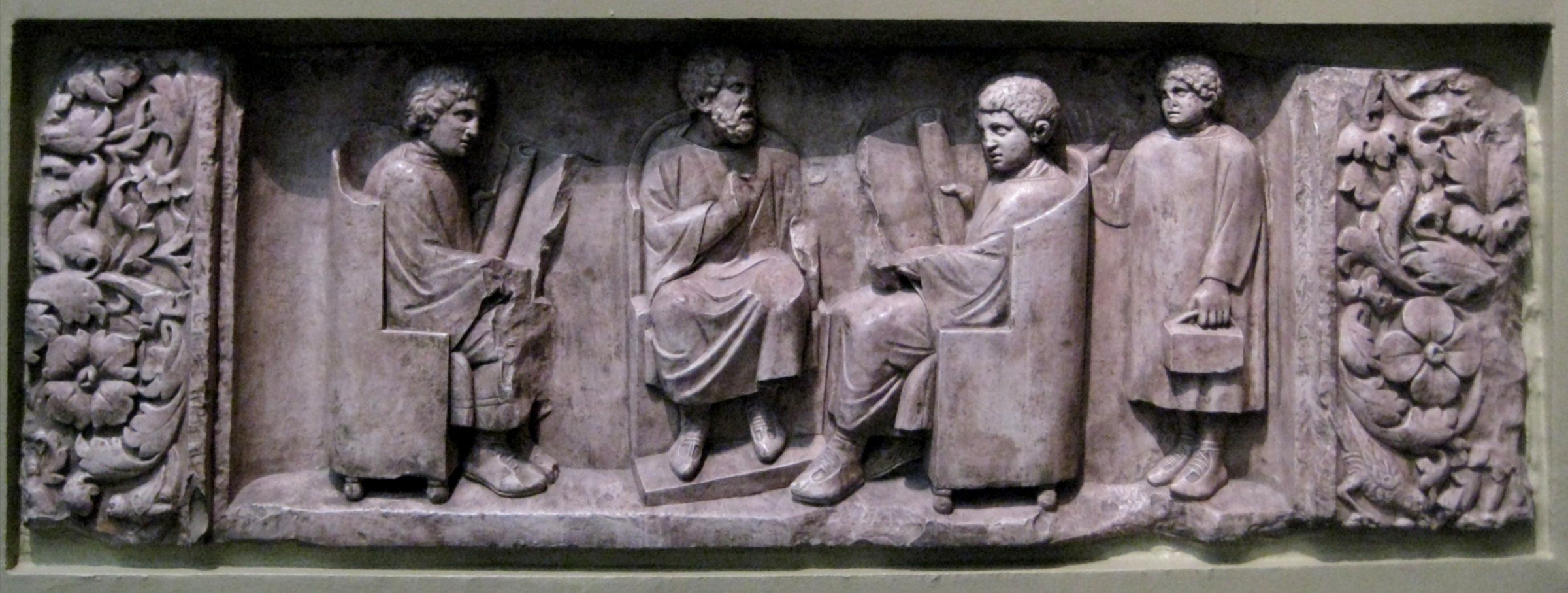 Roman relief with a school scene from Neumagen: a teacher and three pupils. c. AD 180-185; Rheinisches Landesmuseum Trier.
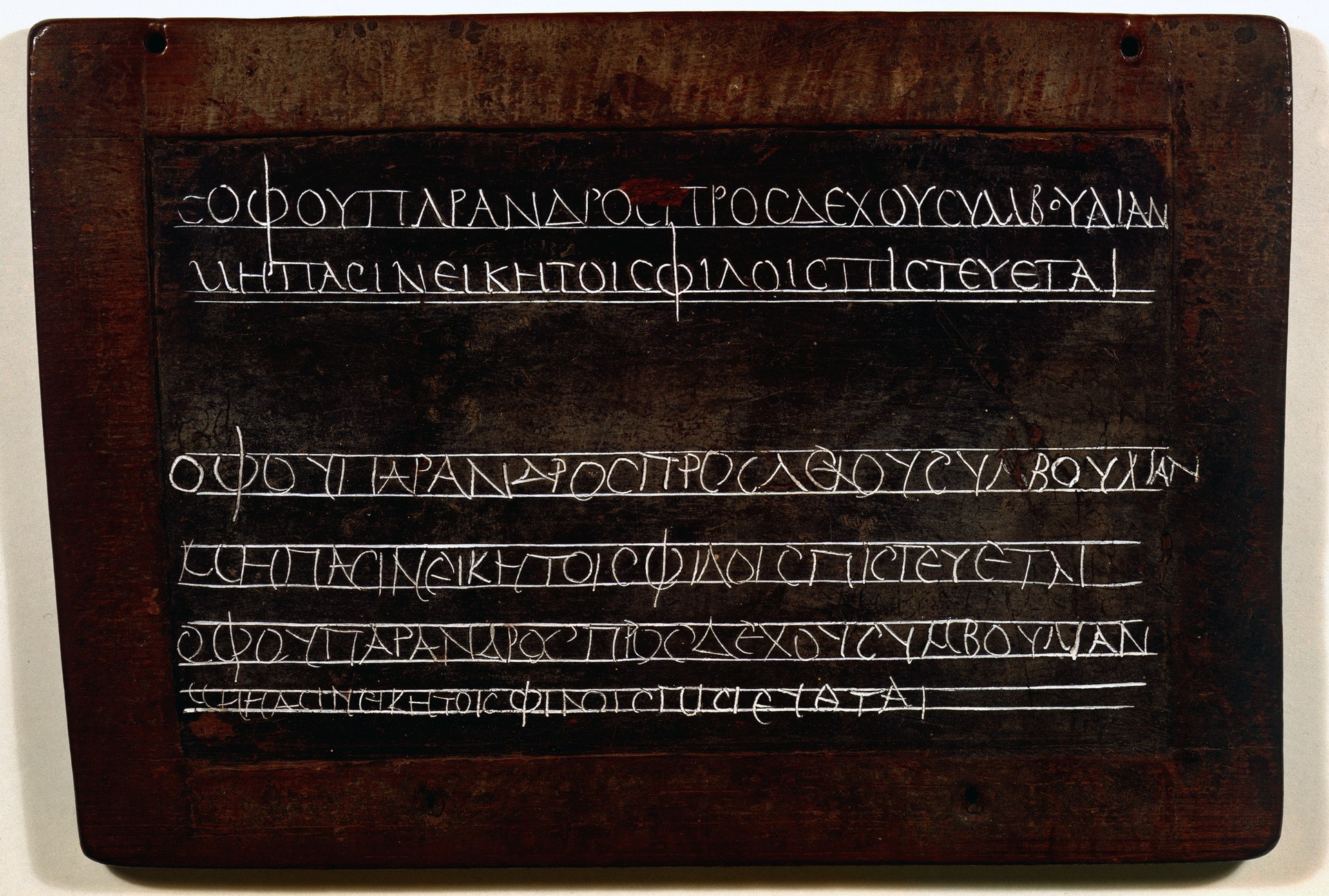 Wax tablet with a Greek school exercise: model lines and a pupil's copies. Egypt, second century AD; British Library, Add MS 34186.
Greek Paideia
In Athens and Ancient Greek cities elementary instruction was usually private. A boy was first raised at home, then he might be accompanied to a teacher under the supervision of a paidagogos, an enslaved or trusted attendant who watched the child's conduct but was not always the teacher himself. The grammatistes taught letters, reading, writing and arithmetic; the kitharistes taught music, rhythm, poetry and the kithara or lyre; the paidotribes taught physical exercise. This programme did not separate intellectual from bodily formation: reading Homer, singing, controlling the body and behaving among citizens were understood as one education of a free person.
Access to this paideia was unequal. A family had to pay teachers, free the child from constant work and support study over years. Children of craftsmen and traders could receive shorter and more practical training: writing for accounts, arithmetic, business memory and basic reading. Sparta is associated with a different model, the agoge, where state discipline and military training mattered more than the private teacher. Endurance, obedience, collective life and preparation for war were valued there, although the literary picture of Sparta survives largely through authors who often wrote from outside.
After the campaigns of Alexander the Great Greek culture spread through the Hellenistic cities of the eastern Mediterranean. The gymnasium became not only a place of exercise but an important civic institution: youths, teachers, officials, honorands, libraries and philosophical circles could meet there. In the Hellenistic world Greek education became a language of status: it allowed local elites to enter the culture of the polis, write decrees, read poetry and participate in civic honours.
Roman School
The Roman system was more clearly staged, but it also remained largely private. A small child first learned at home: mother, father, older relatives, household slaves and freedpeople could provide the first skills in speech, conduct and writing. Then came the ludus litterarius, where the litterator taught letters, reading, arithmetic and writing on wax tablets. At the next level the grammaticus explained poets, myth, history, language and models of style. For those preparing for public life the highest stage was the rhetor: exercises in speeches, disputes, legal cases and political themes.
Romans valued Greek education highly. Wealthy households could keep expensive Greek slaves or freedmen: a paedagogus accompanied the boy and watched his lessons and conduct, a grammaticus or litteratus taught language and literature, another slave might serve as librarian, reader, secretary or scribe. Such people were valuable not for physical labour but for knowledge, language and the ability to form the future master of the household. After manumission some became professional teachers, secretaries or clients of their former family.
School was not a quiet separate building with a unified curriculum. A teacher could work in a shop, portico, rented room or directly beside the street; pupils sat on benches, repeated aloud, copied lines, counted, endured punishments and competed in memory. Wealthy families could hire private tutors and keep children away from the noisy urban school. Poorer families more often stopped at elementary instruction or replaced school with craft, trade, military service and practice within the household.
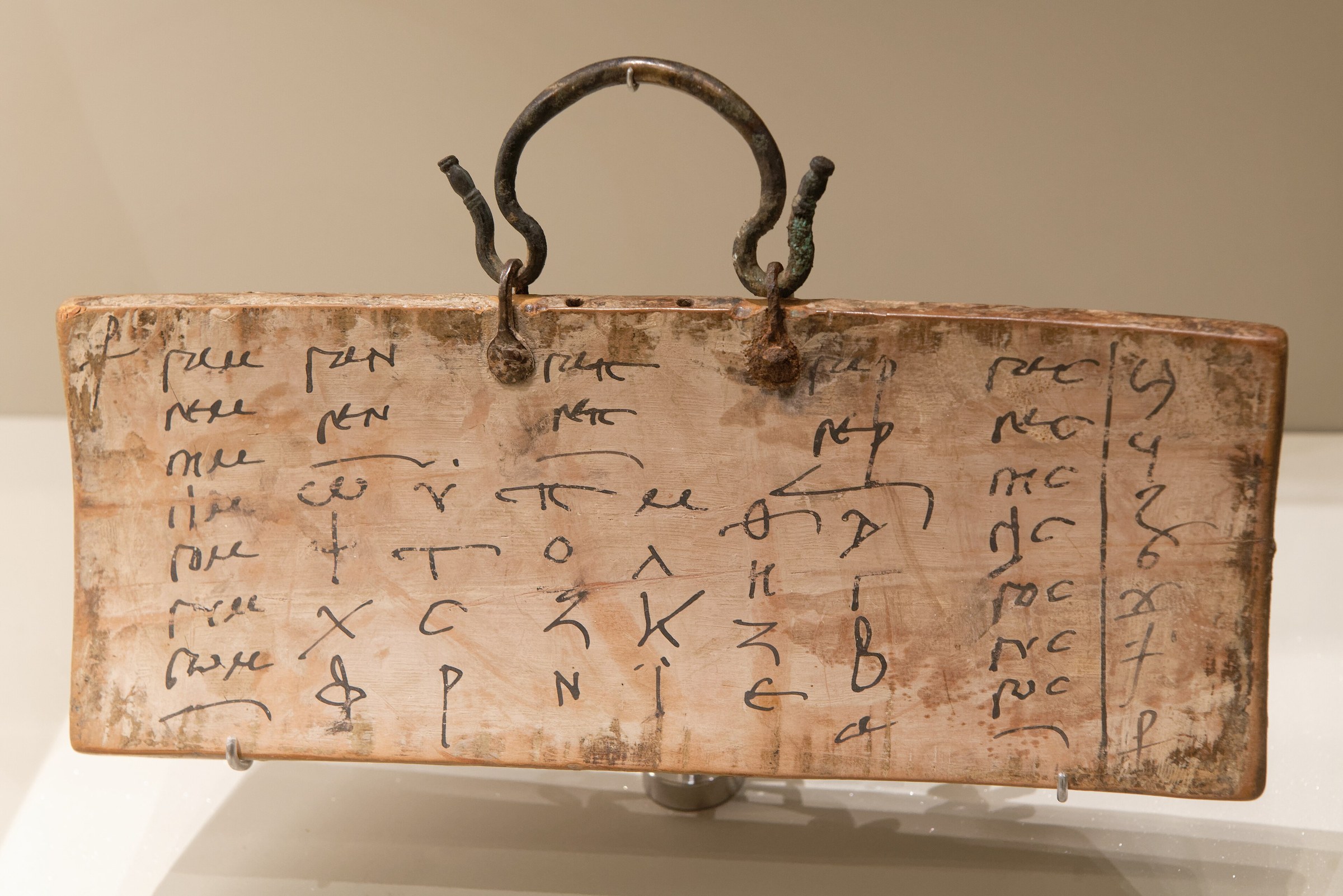 School tablet from Egypt with a Greek and Coptic syllabary and syllable exercises; Bibliothèque nationale de France.
 Attic kylix with a youth writing on wax tablets. c. 410 BC; Fitzwilliam Museum, Cambridge.
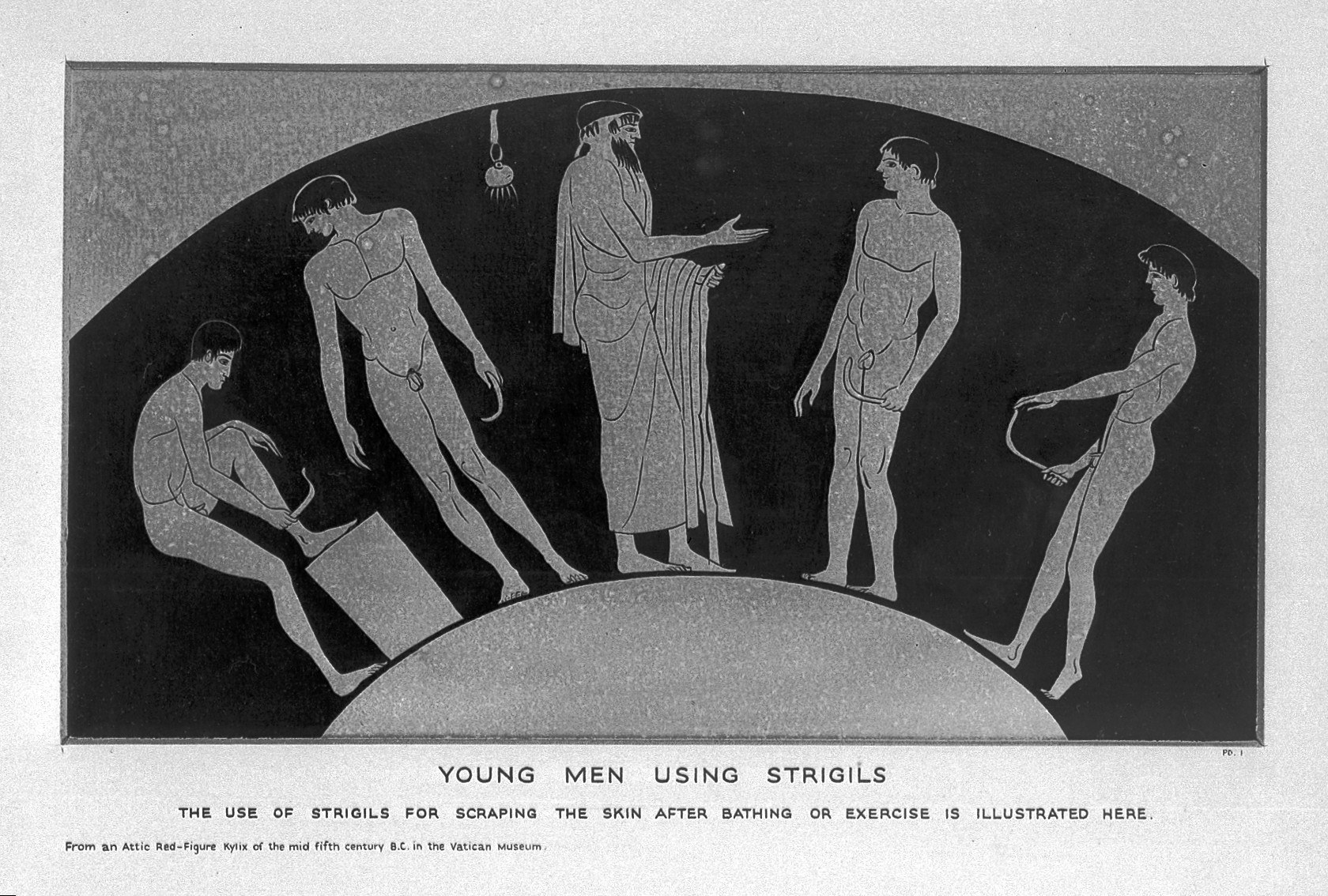 Youths with strigils on an Attic red-figure kylix of the mid-fifth century BC; an image of the gymnasium setting and physical training. Wellcome Collection.
Ordinary People and the Elite
The main divide was not simply between the "educated" and the "uneducated", but between levels of literacy. The political and literary elite aimed at a long sequence of study: grammar, poets, Greek, history, philosophy, law, rhetoric and familiarity with models of speech and writing. Such a man could speak in court, write to patrons, manage an estate, serve in the army or hold office in provincial administration. For a Roman aristocrat education was part of public reputation: speech, memory, historical examples and the ability to quote authors showed that he belonged to the ruling class.
For ordinary people education was often shorter, but not necessarily less useful. A trader had to count, remember debts, read labels, understand measures and prices. A craftsman needed the skills of workshop, orders and apprenticeship. A soldier met lists, receipts, letters, unit names and orders. Townspeople saw inscriptions, notices, graffiti, calendar marks, names of magistrates and shopkeepers. Practical literacy could therefore exist without reading Homer or Virgil: a person did not pass through the school of a rhetor, but used writing where it was needed.
For slaves and freedpeople literacy had a double meaning. On the one hand it made a person useful property: a scribe, accountant, teacher, reader or secretary was more valuable than an unskilled worker. On the other hand, those skills could make manumission, household service, office work or participation in a patron's business easier. Education did not abolish slavery or dependence, but within ancient society it created different levels of status even among the unfree.
Alexander the Great and the Education of a Ruler
The most famous example of elite Greek education is connected with Aristotle and Alexander the Great. According to ancient tradition, Philip II invited the philosopher to Macedonia around 343/342 BC, when Alexander was an adolescent. The lessons are usually connected with Mieza, where young men from the Macedonian nobility studied together with the prince. This was not schooling in a narrow sense, but preparation of a future ruler and his circle.
Poetry, ethics, politics, medicine, observation of nature, Greek literature and the heroic past mattered in such training. Homer had a special place: for the Macedonian prince the Iliad was not only a text to read, but a language of glory, friendship, anger, martial honour and royal behaviour. Later stories may have embellished the link between Alexander and Aristotle, but the education itself shows that for the elite of the fourth century BC philosopher, poet and teacher could become part of politics.
Alexander's education does not explain his conquests by itself. Macedonian military training, Philip's reforms, experience of court conflict and command of the army were no less important. But Alexander's case shows what was expected of a Hellenistic ruler: he had to be warrior, judge, patron of cities, reader of Greek texts, interlocutor of philosophers and a man able to speak to different elites in a shared cultural language.
Writing, Memory and School Materials
Study began with bodily action: the pupil repeated letters aloud, moved the stylus through wax, copied a model, erased and wrote again. The cera, or wax tablet, was useful precisely because it could be reused. Letters, syllables, simple phrases, arithmetic and drafts could be practised on it. Papyrus and parchment were more expensive, so reusable surfaces, sherds, wooden tablets and memory exercises were especially important for elementary work.
Surviving school tablets from Egypt show a very concrete side of education. A teacher could write a model line and the pupil copied it several times below; alphabets, syllables, moral sayings, names, numbers and excerpts from poets survive. Such finds show not an ideal curriculum but the actual hand of a pupil: uneven letters, repetition, mistakes, attempts to keep the line and imitate the model. They show that ancient school was not only a world of great authors, but also a daily technique of writing.
Memory mattered no less than material. Texts were learned by heart because books were expensive and public speech required an inner store of examples, quotations and arguments. The pupil of a grammarian analysed rare words, myths, genealogies, geography and moral examples. With a rhetor he learned to develop a thesis, defend a fictional case, attack an opponent and change the style of speech according to the situation.
Philosophy, Rhetoric and Adult Learning
At the highest level ancient education passed into philosophy and rhetoric. Socrates, Plato and Aristotle were not elementary schoolteachers: they worked with youths and adults, discussing virtue, knowledge, the order of the polis, nature, soul, logic and the way of life. Plato's Academy and Aristotle's Lyceum became models of long-lasting intellectual communities, where learning was built around conversation, reading, argument and research.
Rhetoric was more practical, but not simpler. In Greek cities and in Rome it prepared a person for court, politics, embassies and public ceremonies. The pupil wrote and delivered progymnasmata, preliminary exercises: fable, narrative, chreia, praise, blame, comparison, proposed law or forensic speech. In Rome this training was especially important for those who wanted a career. Cicero became an example of a man for whom education, philosophy, law and speech formed one public identity.
Adult learning did not end with school. Young men of rank travelled to Athens, Rhodes and other centres, heard philosophers, trained with rhetors, collected books and corresponded with teachers. Civic elites attended lectures, public readings and oratorical contests. Ancient education was therefore not only a childhood stage, but a long cultural practice through which a person confirmed his place in society.
Women, Household and Social Boundaries
Female education in antiquity cannot be described by one formula. In many cities girls more often learned at home: household management, spinning, supervision of slaves, religious duties, kinship networks and sometimes reading, writing and music. In wealthy families girls could receive broader training, especially if the household was connected with literature, philosophy or the political elite. Letters, inscriptions and late antique papyri show that female literacy existed, but its social purpose usually differed from the male public career.
Male education was not uniform either. A freeborn boy from a poor family might begin work early; the son of a freedman could receive good schooling for family advancement; the son of a senator was expected to command speech and the culture of power. A Roman matron might read, keep household records and participate in the religious life of the house, but she rarely received the same rhetorical training as a boy preparing for the forum. Education therefore did not usually destroy social boundaries; more often it reproduced them.
Ancient school is best understood as a network of different practices. It included noisy urban classes, household tutors, expensive enslaved paedagogues, gymnasia, philosophical conversations, rhetorical exercises, craft apprenticeship and simple practical literacy. Some paths led to power and literature, others to trade, service, writing in the army or management of the house.
Related Topics
Literature and sources
- Marrou H.-I. A History of Education in Antiquity.
- Morgan T. Literate Education in the Hellenistic and Roman Worlds.
- Bonner S. F. Education in Ancient Rome: From the Elder Cato to the Younger Pliny.
- Cribiore R. Gymnastics of the Mind: Greek Education in Hellenistic and Roman Egypt.
- Too Y. L. Education in Greek and Roman Antiquity.
- Kaster R. A. Guardians of Language: The Grammarian and Society in Late Antiquity.
- Quintilian. Institutio Oratoria.
- Plato. Republic; Laws.
- Aristotle. Politics.
- Cicero. De Oratore; Brutus.
Interested in Ancient Rome beyond reading? Join Legio X Fretensis or explore our reenactment directions.


