The Louvre and Antiquity
The Louvre is one of the key museums for working with ancient art and archaeological parallels from the Mediterranean. Its Department of Greek, Etruscan and Roman Antiquities brings together material from the Neolithic period to the sixth century AD and shows how forms, subjects, materials and ways of representing the human figure changed in the Greek, Etruscan and Roman worlds. For reconstruction, the Louvre is important not only because of famous statues: it also contains pottery, reliefs, inscriptions, bronzes, sarcophagi, portraits, terracottas, cult objects and domestic details that help check specific decisions.
The Louvre's antiquities are also useful because the museum display joins different types of source. Within one route it is possible to see ceremonial marble sculpture, an Etruscan funerary monument, a red-figure vase, a Roman portrait, an inscription and an architectural fragment. These objects are not equal as evidence for everyday life, but together they provide a wide map of ancient visual language: from elite imagery and myth to burial practice, workshop technique and the museum history of collections.
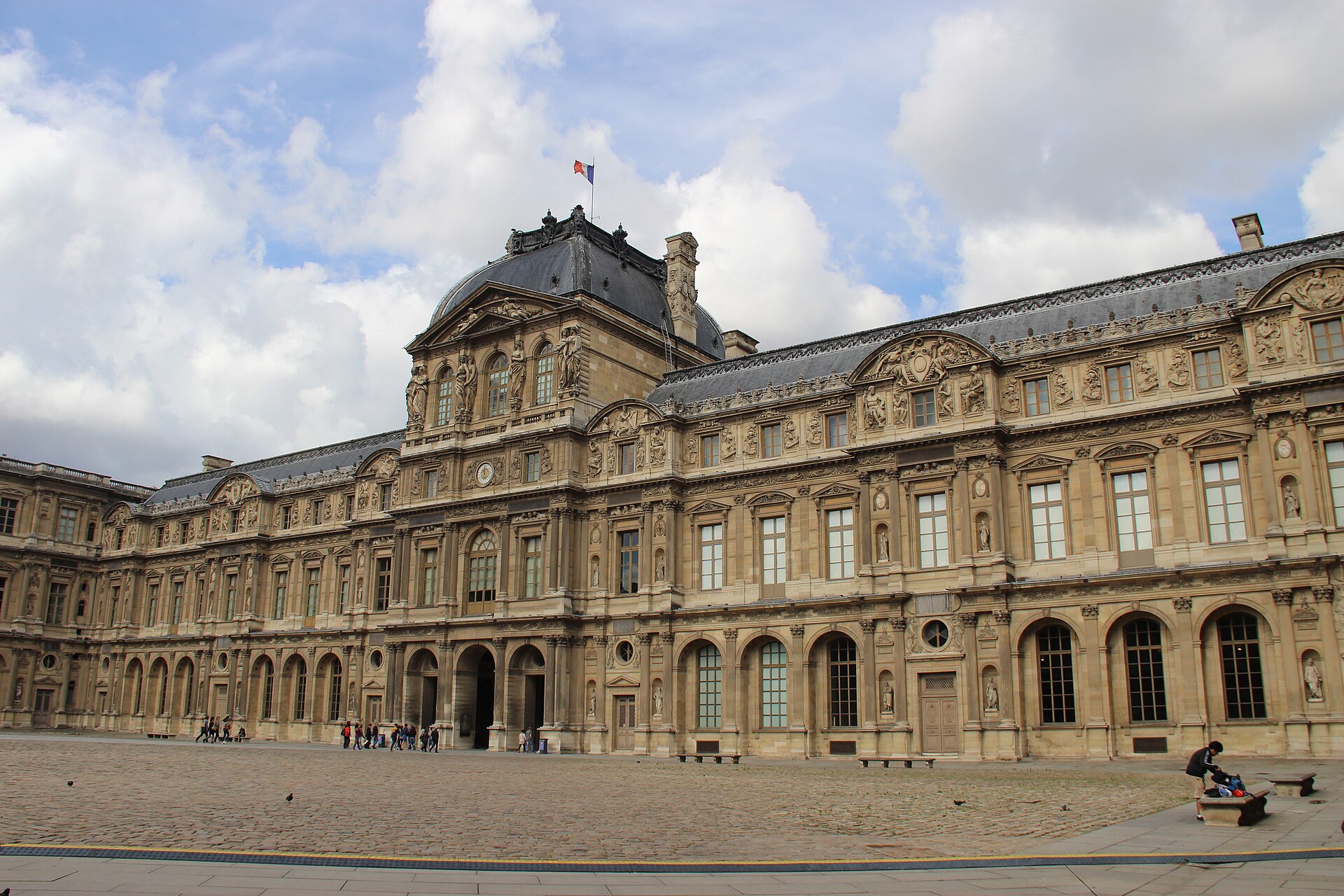 The Louvre's Cour Carrée and palace facade; the ancient collections are displayed within the historic museum complex.
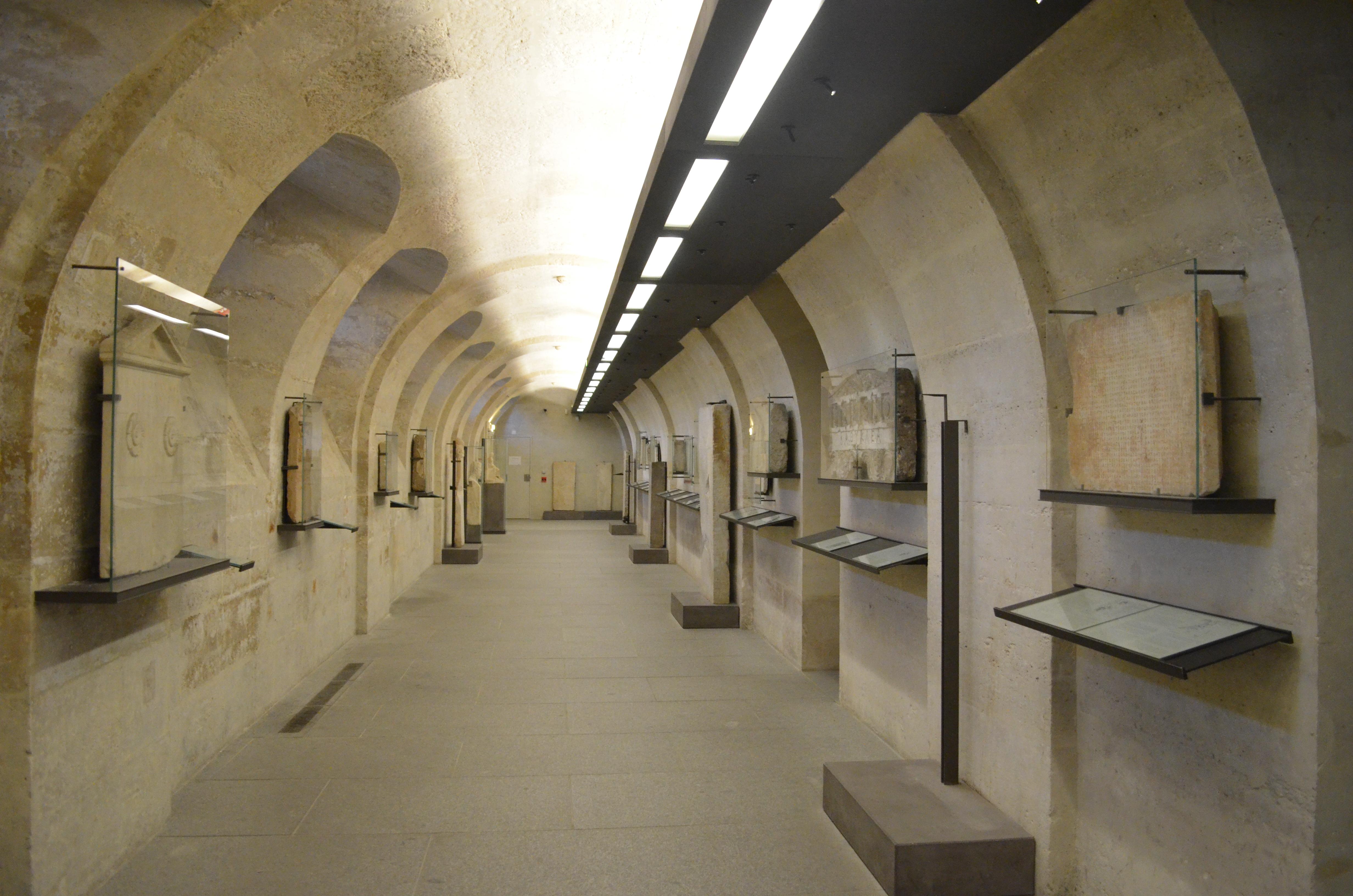 A gallery of the Louvre's Department of Greek, Etruscan and Roman Antiquities: inscriptions and stone sculpture in a museum setting.
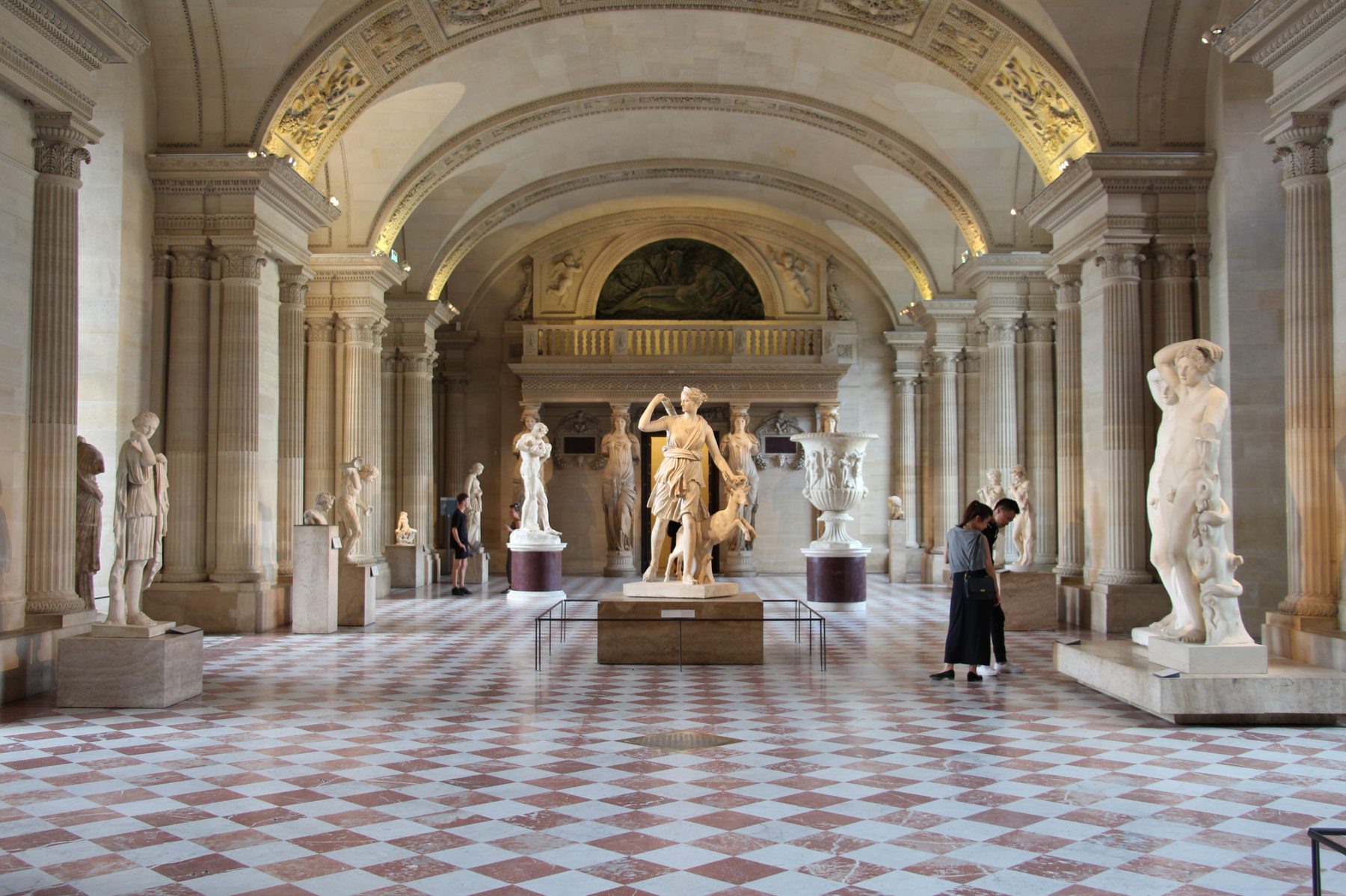 The Salle des Caryatides in the Louvre: large ancient sculpture and historic museum architecture in a single space.
The Museum Route of Antiquity
The Louvre's antiquities route is set inside a palace, where historic architecture itself affects how the exhibits are seen. Large halls, galleries, arcades and display cases present ancient objects within a museum system, not within their original environment. This matters: a marble statue in the Salle des Caryatides, an inscription on a gallery wall and a vessel in a case function as parts of a modern display, although each object has its own date, function and find history.
For practical reading the collection can be divided into several groups. Greek material helps trace the development of vase painting, sculpture and terracottas from the Archaic period to Hellenism. The Etruscan corpus is especially important for funerary culture, terracotta sculpture, bronzes and the links between Italy and the Greek world. The Roman galleries provide portraiture, sarcophagi, reliefs, cult objects and variants of Greek artistic types reworked in Roman settings. The history of collecting also has to be considered: some objects came from older collections, some were acquired in the nineteenth century, and some are connected with restorations and changes of display.
This route offers strong comparative material. One exhibit can be useful for garment form, another for gesture and pose, a third for ornament, a fourth for inscription or social status. Reliable reconstruction, however, does not come from one striking object, but from comparing date, material, context, parallels and the limits of museum display.
The Greek Collection and Vase Painting
The Louvre's Greek material is important above all as a corpus of forms and images. Vases show not only mythological scenes, but also composition, vessel types, ornamental zones, gestures, poses, furniture details, weapons, musical instruments and dress. Attic black-figure and red-figure pottery is especially useful for comparison because it shows clearly the border between pictorial convention and observation of real objects.
Vase painting, however, cannot be read as a photograph of ancient life. The painter chose the subject, figure type and decorative scheme, while the vessel shape determined the placement of scenes. For reconstruction it is therefore useful to look not only at the image, but also at date, provenance, vessel function and the repetition of details. If a gesture, cloak type or weapon appears on different monuments and in different techniques, it becomes a more reliable source.
Sculpture in the Greek department works differently. It shows ideal body, proportions, stance, surface treatment and artistic canon. An Archaic kore, a Classical statue, a dynamic Hellenistic figure and a Roman copy of a Greek type provide different levels of evidence. For dress and armour, sculpture is often useful not as a literal image of everyday life, but as evidence for prestigious, cultic or heroic language of form.
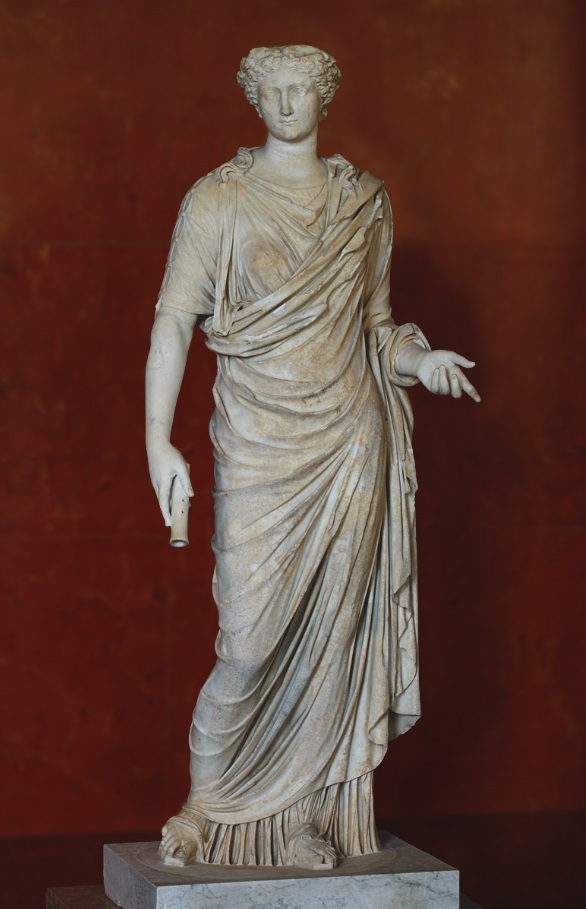 Livia. Marble, mid-first century CE. Louvre, Paris, inv. MR 260 / Ma 1245.
 Corinthian helmet. Bronze, first quarter of the sixth century BC; Louvre.
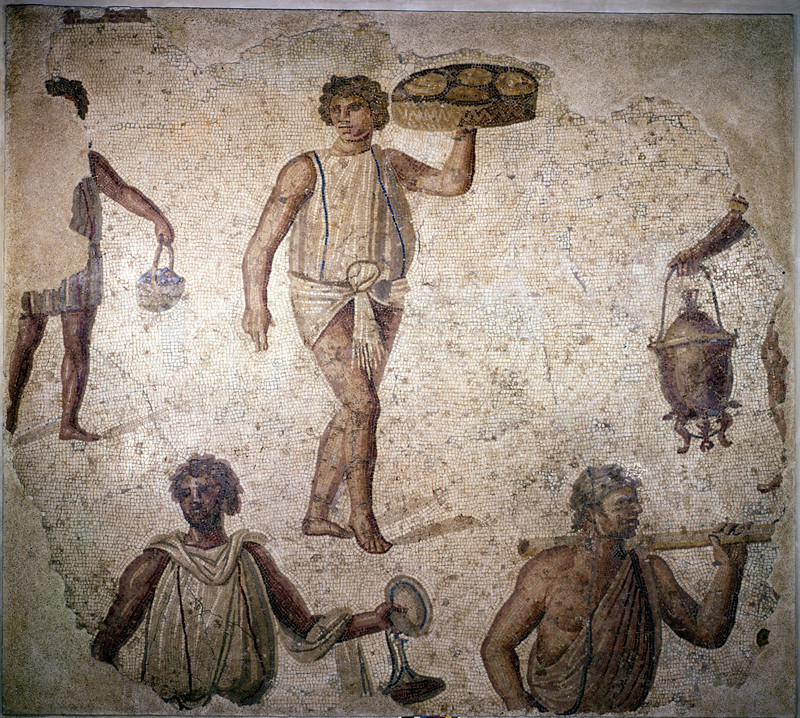 The slaves are preparing for the festival. Mosaic. Carthage. It is kept in the Louvre Museum. 2nd century AD
Etruscan and Roman Material
The Louvre's Etruscan material is especially valuable where it preserves funerary context and local Italic forms. Terracotta sarcophagi, bronzes, pottery, ornaments and cult objects show a society that actively received Greek subjects but used them within its own environment. The Sarcophagus of the Spouses from Cerveteri is a good example: it is important not as a domestic scene in a direct sense, but as an image of funerary memory, family status, banquet and elite language.
The Roman part of the collection helps with portraiture, tomb monuments, sarcophagi, reliefs and decorative sculpture. Roman monuments are often closer to social and legal status than to mythological convention: an inscription can give a name, age, office, family role or formula of memory. A portrait can show age image, hairstyle, beard, fashion and political language. A relief can record dress, cult objects, weapons, processions and architectural details.
Even here caution is required. Many Roman statues are copies or reworkings of Greek types; some monuments came from old collections and lack a complete archaeological context. The Louvre's Roman material is therefore best read together with date, catalogue description, findspot and comparison with parallels from other museums and excavations.
Material for Reconstruction
For reconstruction, the Louvre provides several practical types of source. Vase painting helps check poses, gestures, ornament, furniture details, equipment and clothing, but needs verification through other monuments. Sculpture shows fabric modelling, ideal proportions, attributes and status types. Inscriptions and reliefs give names, formulas, offices, ritual scenes and social roles. Terracottas and small sculpture help reveal a more common and domestic side of imagery than large marble does.
It is especially important to distinguish an "image of an object" from the object itself. A helmet or cloak on a vase can be a conventional sign, while an actual bronze helmet or preserved fibula gives technological information. Yet a real object also does not speak for itself: date, findspot, material, traces of repair, size and function are needed. In reconstruction, Louvre material is therefore best used as a system of cross-checking rather than as a single authority.
The Louvre's strength is the possibility of comparing Greek, Etruscan and Roman material within one museum route. This helps separate the broadly Mediterranean from the local, elite from everyday, and mythological from documentary. When working with dress, arms, ornaments and ritual objects, that distinction is often more important than the fame of the exhibit itself.
Main Materials
- Greek, Etruscan and Roman sculpture: statues, portraits, reliefs, sarcophagi and architectural fragments;
- Greek vase painting: black-figure and red-figure pottery, mythological scenes, ornament and vessel typology;
- Etruscan funerary monuments: terracotta sarcophagi, bronzes, ornaments, cult objects and local Italic forms;
- Roman portraits and inscriptions: social status, memory, names, offices, family roles and public image;
- small-format objects: terracottas, glyptics, bronze fittings, glass, lamps, fibulae and ornaments;
- museum history: old collections, restorations, movement of monuments and the modern display of antiquity.
When using these materials, it is useful to ask the same questions each time: what the object is, where and when it was found, whether its function is known, what is ancient in it and what belongs to restoration or museum display. This approach makes the Louvre not simply a collection of famous objects, but a working tool for checking ancient forms.
Context and Limits
The main limitation of the Louvre as a source is the mixture of different levels of reliability. An old collection object, an item with precise archaeological provenance, a restored statue, a Roman copy of a Greek original and a museum masterpiece that has long become part of modern visual culture can stand side by side. All are useful, but they answer different questions. The Venus de Milo, the Borghese Warrior or an Etruscan sarcophagus should not automatically become the norm for everyday dress, body or behaviour.
The second limitation is the effect of museum fame. The most famous objects are often not the most convenient for reconstruction, because they are unique, elite, restored or have a complex find history. A less famous inscription, pottery fragment, bronze fitting or repeated terracotta type can sometimes provide more direct evidence for practice. Work with the Louvre therefore requires a balance between major images and small sources.
Finally, it is important to remember that the Louvre presents antiquity through the French museum tradition. This is not a defect, but part of the history of the source: the display shows not only the ancient world, but also how modern Europe collected, classified, restored and exhibited ancient monuments. For careful reading, this museum history is as important as inventory number and dating.
Related Topics
Sources
- Louvre: Department of Greek, Etruscan and Roman Antiquities
- Louvre Collections: about the collection database
- Louvre: ancient masterpieces from the royal collections
- Wikimedia Commons: Inventory Louvre, Greek, Etruscan and Roman antiquities


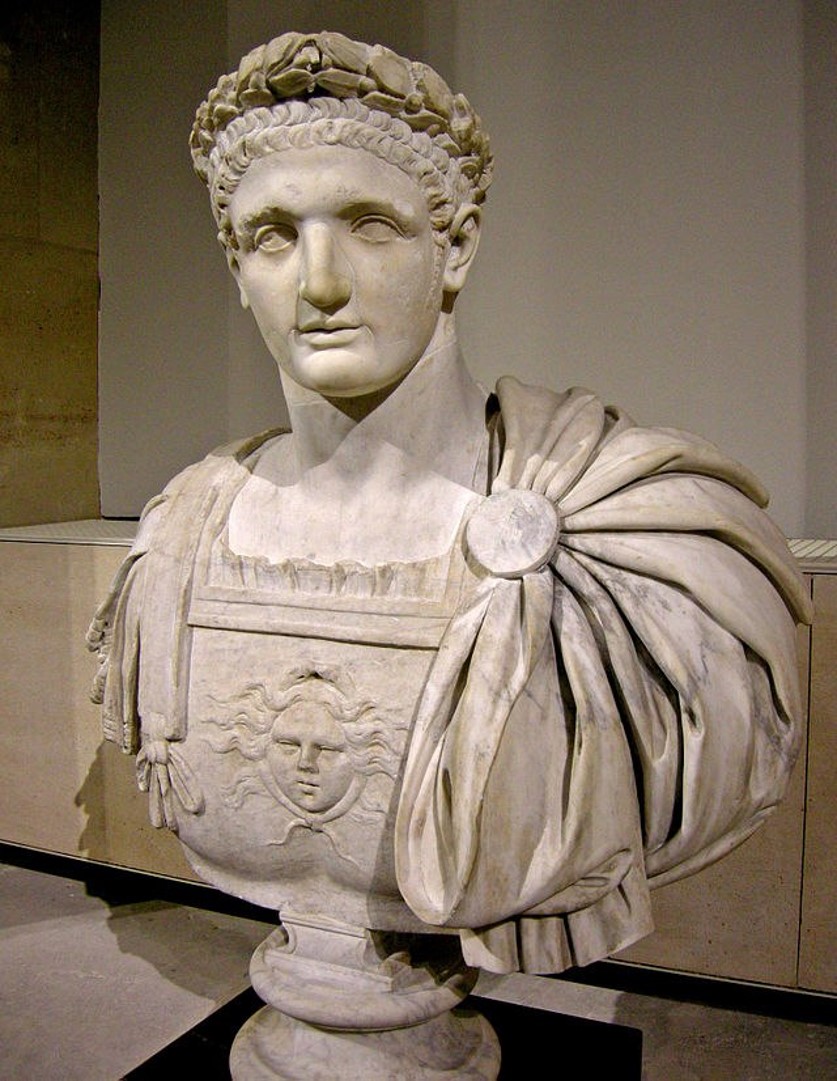 Bust of Domitian. Kept in the Louvre Museum,France. 81-96 A.D.
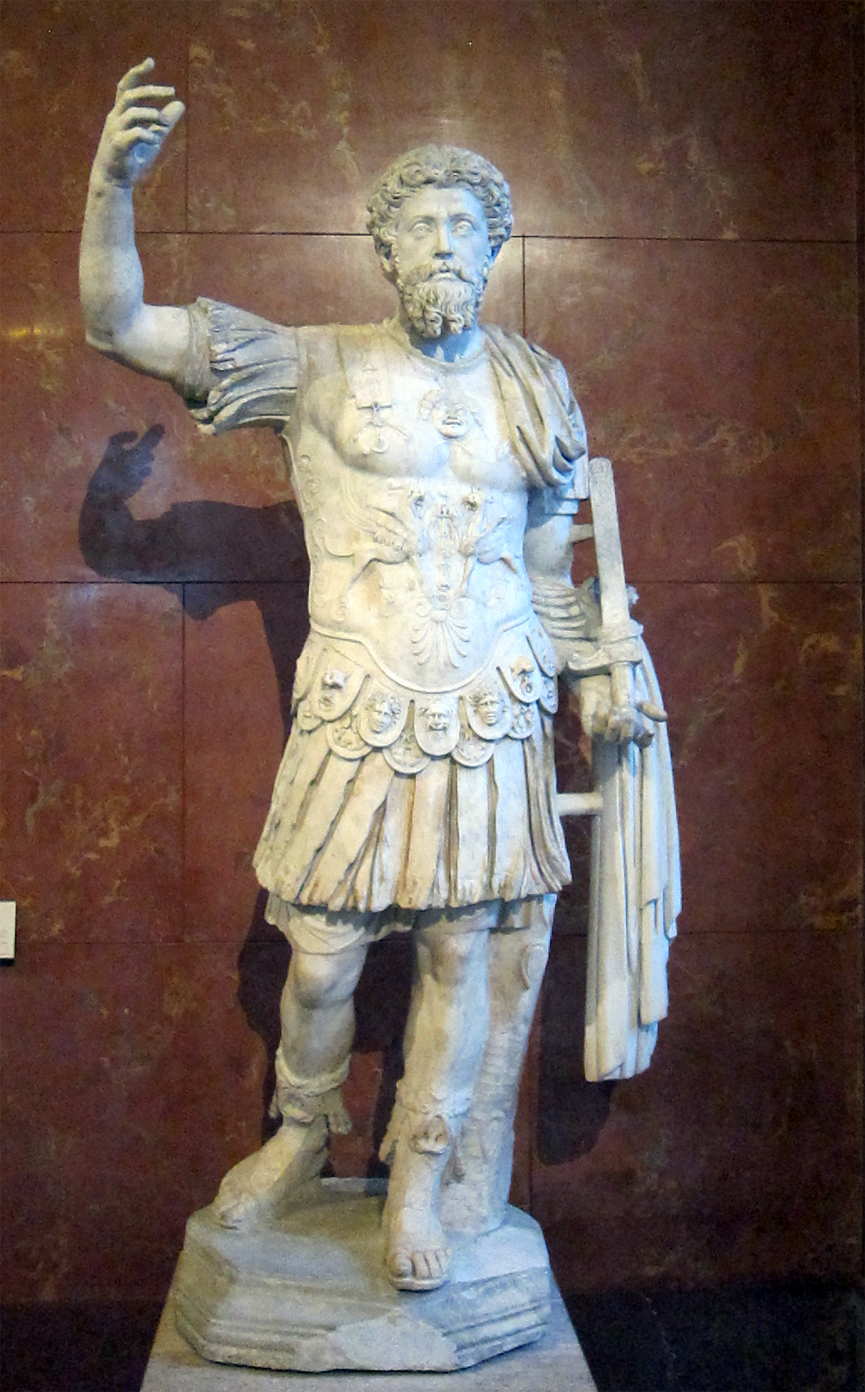 Marcus Aurelius' statue, Louvre. 2nd century CE
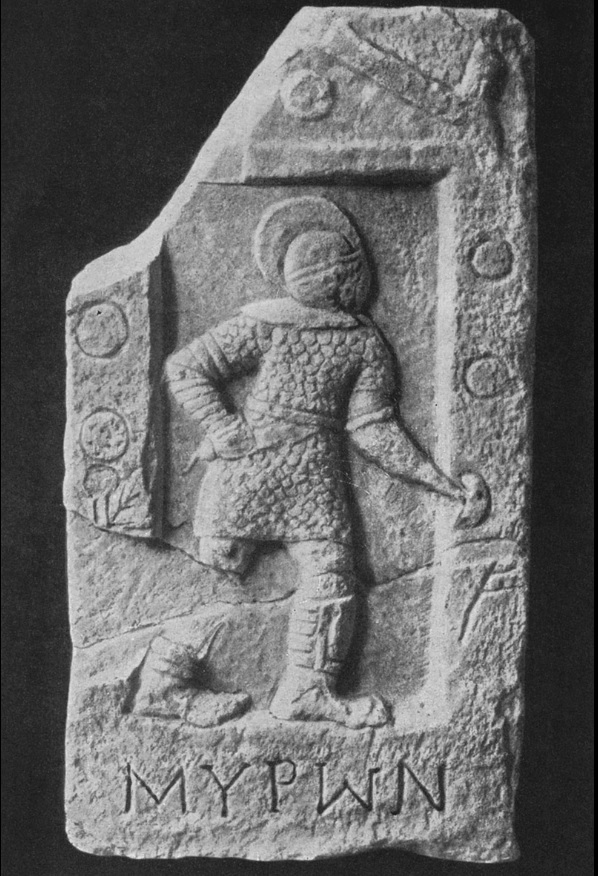 Tombstone bas-relief to Scissor Muron. Louvre Museum,Paris. 1-2 century AD
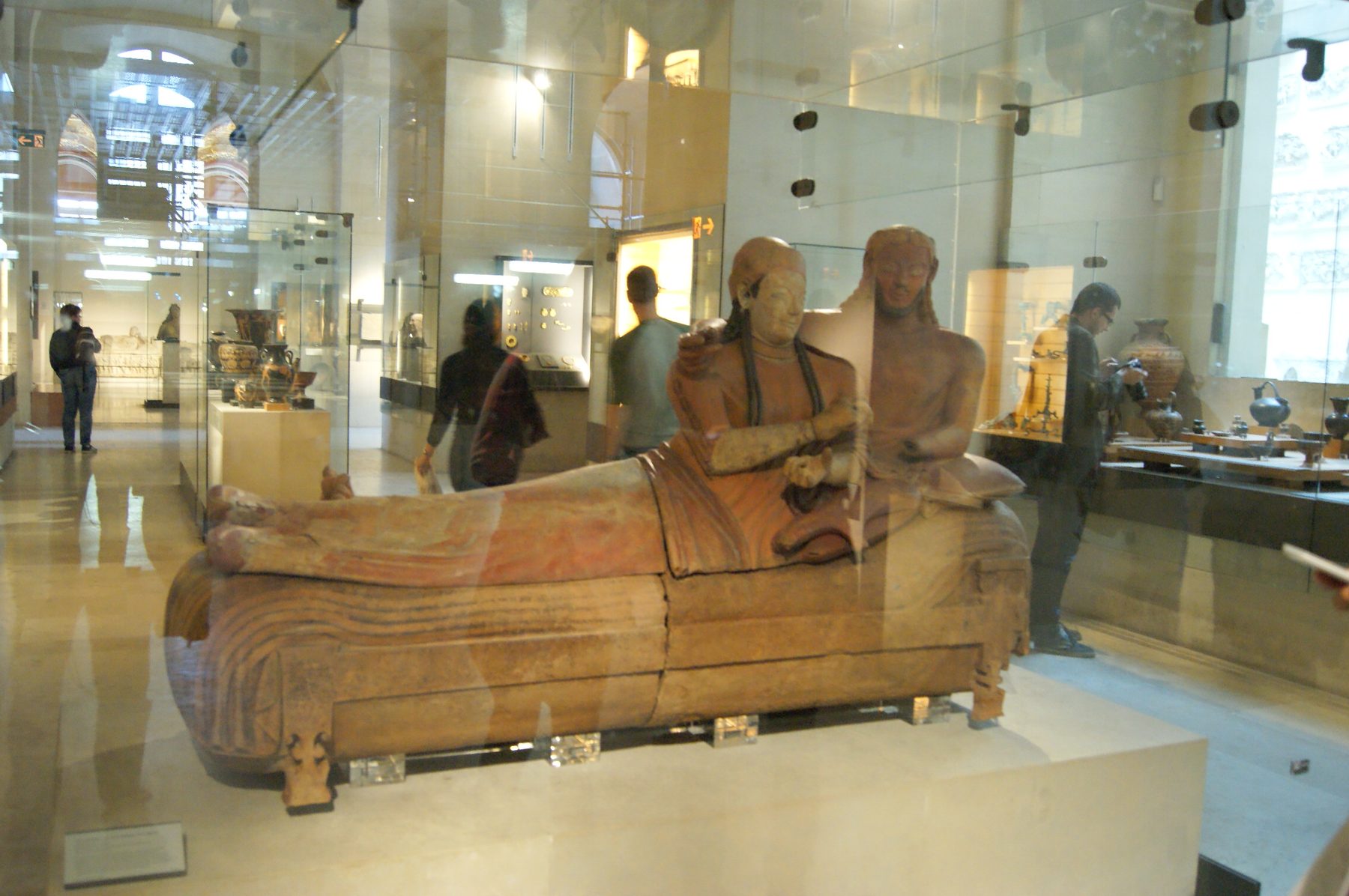 The Sarcophagus of the Spouses from Cerveteri, Etruscan terracotta, c. 520-510 BC; Louvre.
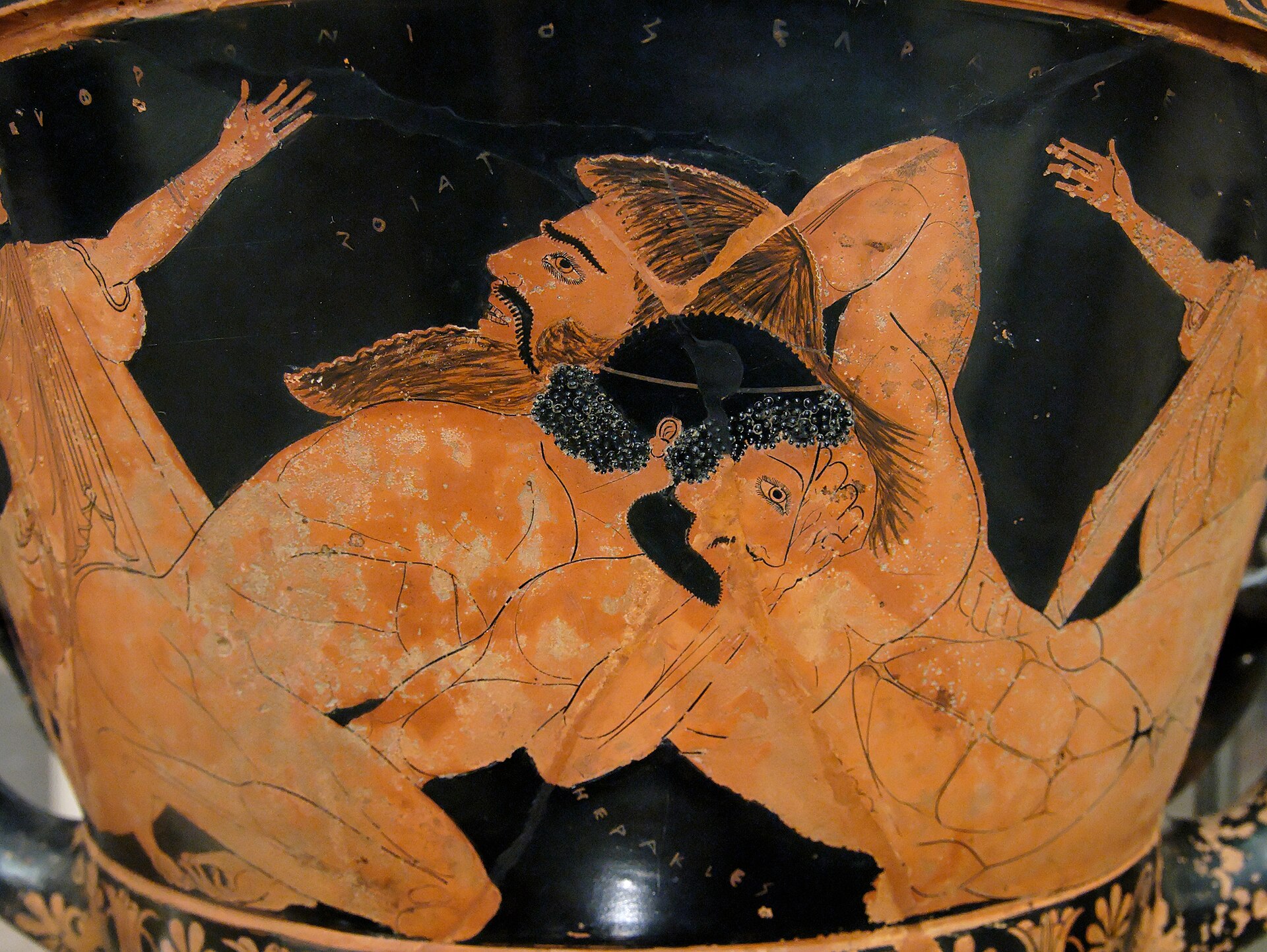 Heracles and Antaeus on an Attic red-figure krater by Euphronios, c. 515-510 BC; Louvre, G 103.
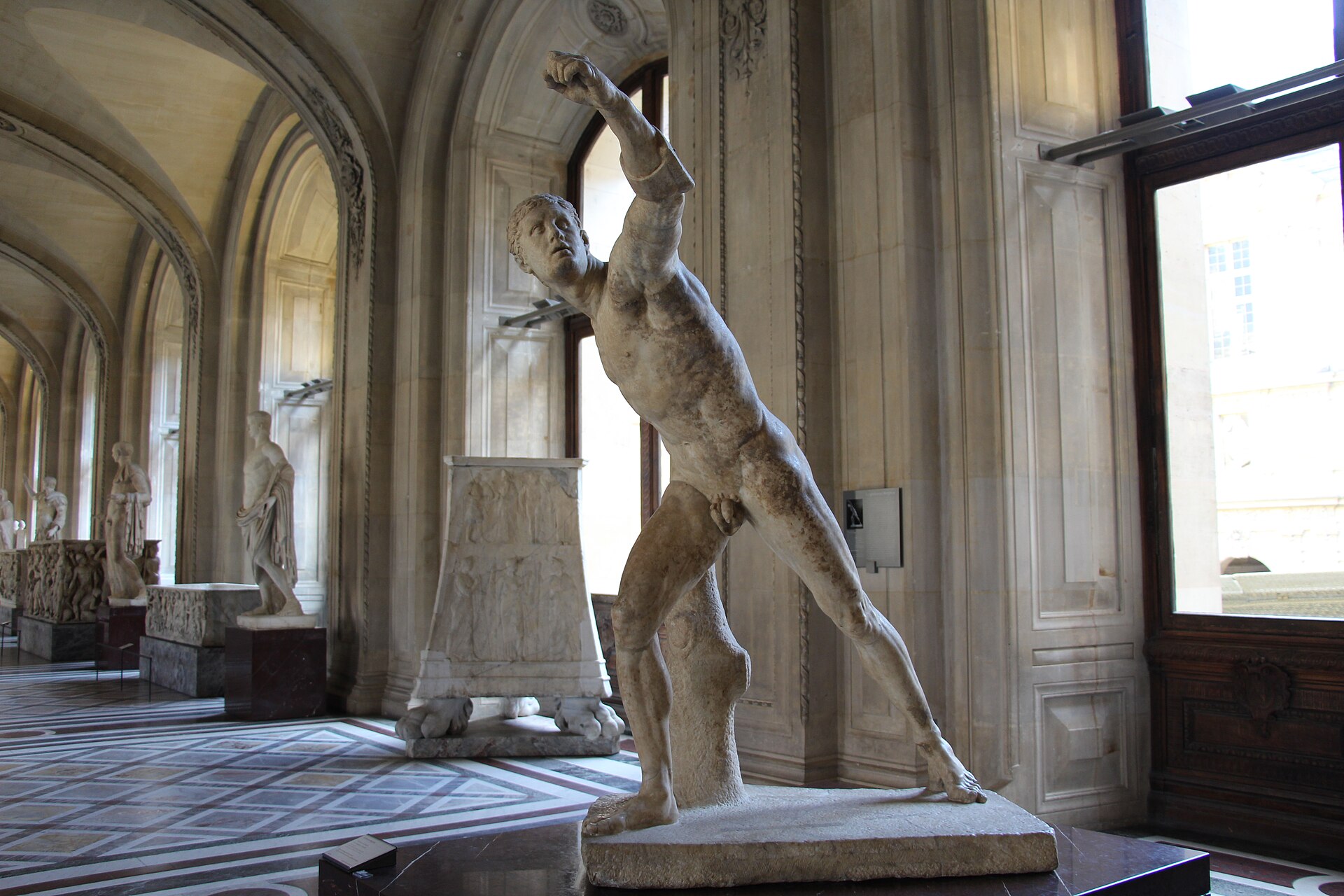 The Borghese Warrior, marble statue by Agasias of Ephesus, c. 100 BC; Louvre, Ma 527.
Interested in Ancient Rome beyond reading? Join Legio X Fretensis or explore our reenactment directions.


