Recreating a Celtic Sprang Cap
This work by O. Goncharova reconstructs a head covering in the sprang technique: an archaic method of interlacing threads that produces a very elastic textile without a loom or complex tools. The archaeological starting point is the cap from Bredmose, associated with the Arden Woman / Bredmose Woman find and already covered on the site among Celtic headwear.
The practical value of the project lies not only in the finished object. It shows clearly how a technique that looks simple requires strict size control: the work proceeds from the edges toward the centre, and once the fabric has begun, length and width cannot be freely corrected.
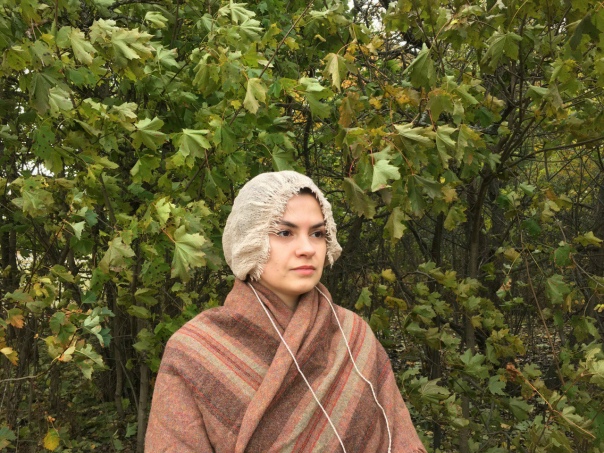 Reconstructed sprang cap in wear, front view.
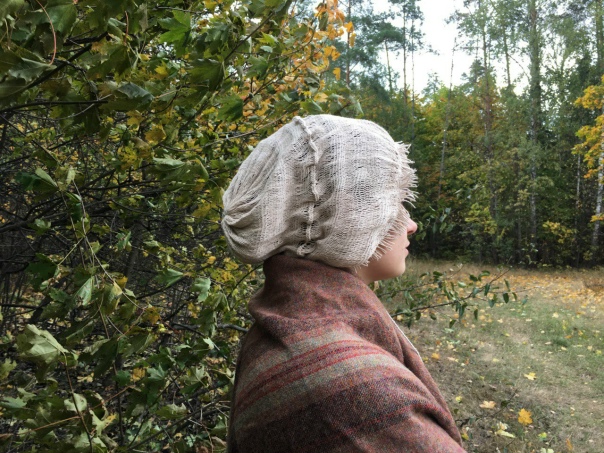 Reconstructed sprang cap in wear, side view.
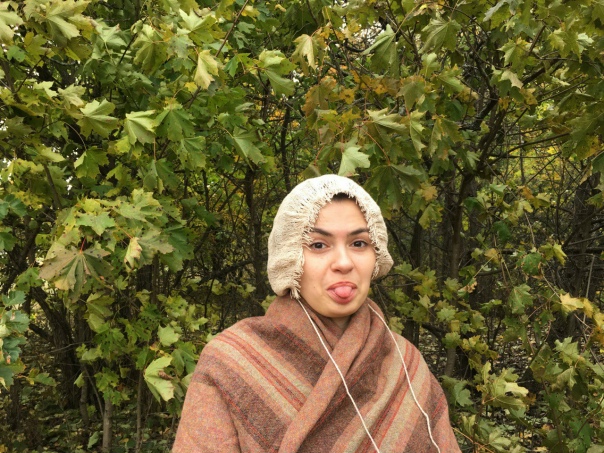 Fit of the cap and ties in the finished impression.
Source: Bredmose / Arden Woman
The prototype is one of the rare northern European textile finds that preserve the shape of a head covering. In the club publication it is described as the cap of a woman found in Danish bogs near Arden; the find is known as Arden Woman or Bredmose Woman. Such objects are valuable for reconstruction because textiles, and especially headwear, usually survive only in fragments.
The preserved cap allows the maker to work with a concrete construction rather than a generic "barbarian" silhouette: rounded volume, sprang structure, edge, ties and the way the object holds a complex hairstyle or covers the hair. For practical reconstruction this gives more than a relief image or a late ethnographic parallel.
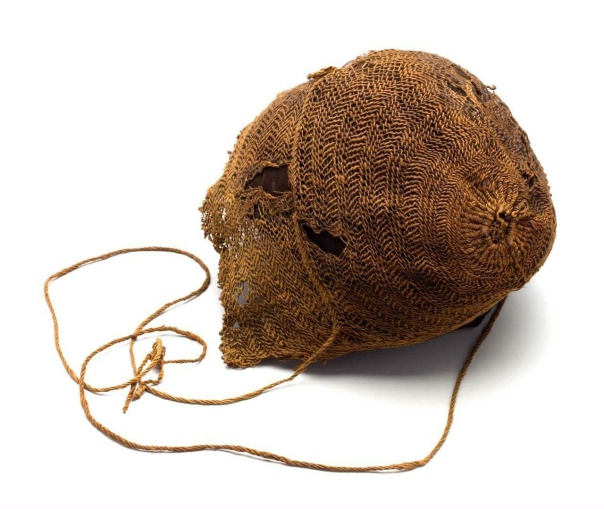 Cap from Bredmose / Arden Woman. Denmark, National Museum, Bronze Age.
The Sprang Technique
Sprang is built by interlinking tensioned threads. Unlike ordinary weaving, it does not form a conventional warp-and-weft structure; the maker crosses the threads in sequence, producing a textile that develops symmetrically from both ends. The work therefore closes in the middle, where the loops must be secured or the object will begin to unravel.
Smooth sticks, fingers and stable tension are enough for the work. This simplicity is deceptive: the main difficulty is not the equipment, but even interlacing, density control and shrinkage calculated in advance. An early mistake becomes visible only when the size can hardly be changed.
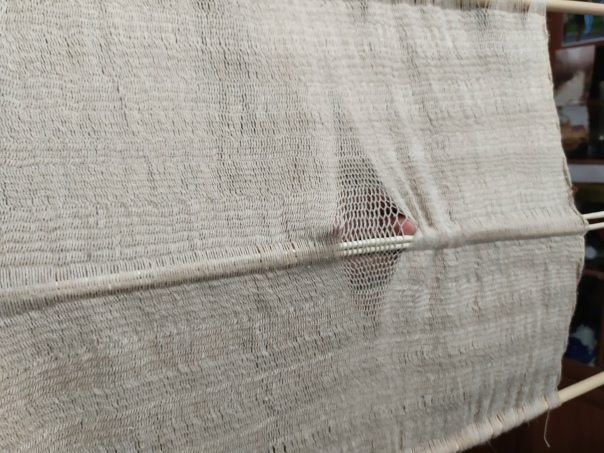 Sprang fabric: the working closure runs through the middle of the textile.
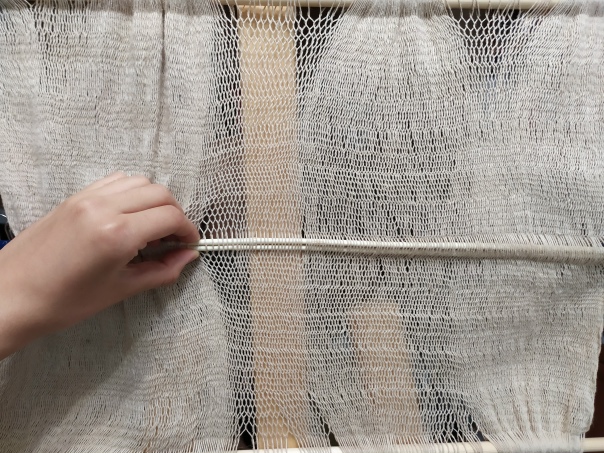 Working the sprang fabric on simple smooth sticks.
Material and Work Process
The reconstruction was made from linen yarn. This material makes the interlaced structure clear and produces a light, readable fabric, but it requires careful tension control: the separate areas need to remain even or the finished cap will show gaps, distortion and uneven mesh density.
The author deliberately began with a full-size object rather than a small sample. This moved the work quickly toward a finished item, but increased the risk: sprang does not forgive a poorly estimated thread length or working density. The fabric ended up about 10 cm longer than intended, which became the main practical lesson of the project.
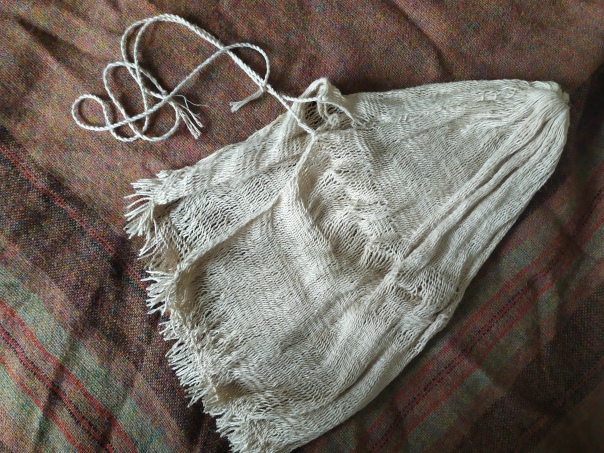 Finished reconstruction in linen yarn, general view.
Fit and Conclusions
The finished cap demonstrates the main property of sprang: strong elasticity. The fabric stretches, gathers on the head and helps form a soft volume, while the ties secure the fit. For reconstruction this matters because size cannot be judged only by a flat layout or thread length before work begins; the final shape appears under tension and in wear.
The experience shows that future reconstructions need a control sample from the same yarn, recorded interlacing density and a separate shrinkage calculation. In this technique simple tools do not mean a simple result: the quality of the object depends on patience, an even working rhythm and understanding exactly where the centre closure will fall.
Related Topics
Literature and sources


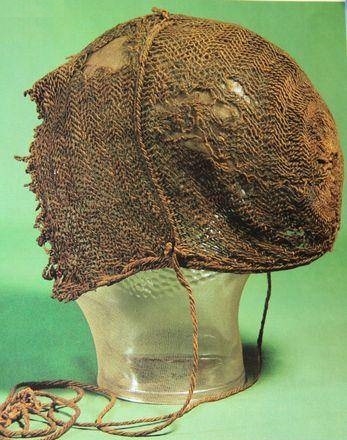 Cap from Bredmose / Arden Woman on a mount, general view. Denmark, National Museum, Bronze Age.
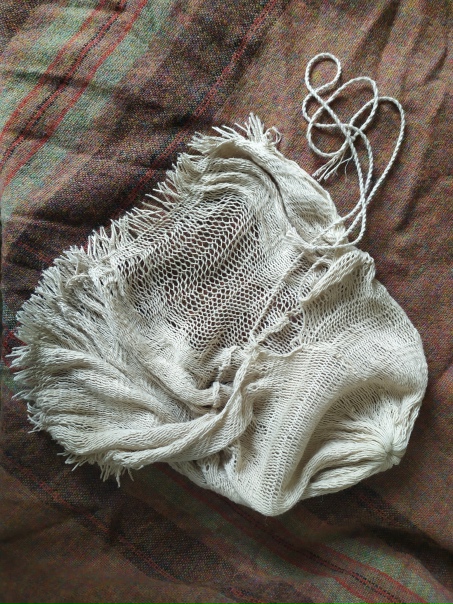 Finished reconstruction: elastic fabric, ties and the edge of the cap.
Interested in Ancient Rome beyond reading? Join Legio X Fretensis or explore our reenactment directions.


