Auxiliary Skirmisher
An auxiliary skirmisher was a lightly armed soldier of the auxilia who operated in front of the main line or on the flanks and used missile weapons: javelins, light hastae, stones or the sling. Unlike the Late Roman lancearius, this was not necessarily a fixed unit title but a tactical role within auxiliary infantry and mixed formations.
Skirmishers screened the line, disrupted enemy formations, provoked attacks, pursued retreating troops and supported reconnaissance. In the Roman army these tasks were often performed by provincial soldiers with local skills and familiar weapons.
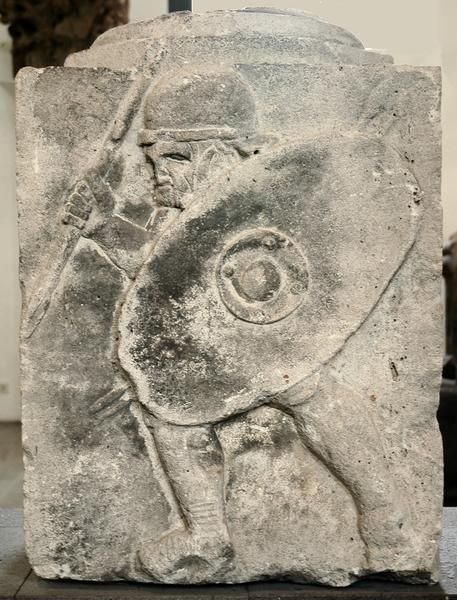 Image of a Roman auxiliary with throwing gasts. Bas-relief of the pedestal of one of the columns that decorated the courtyard in front of the complex of buildings of the headquarters (praetorium and principia) of the citadel of the Roman city of Mogontiac (Latin Mogontiacum,modern. German city of Mainz). "Land Museum",Mainz,Germany. Second half of the first century AD
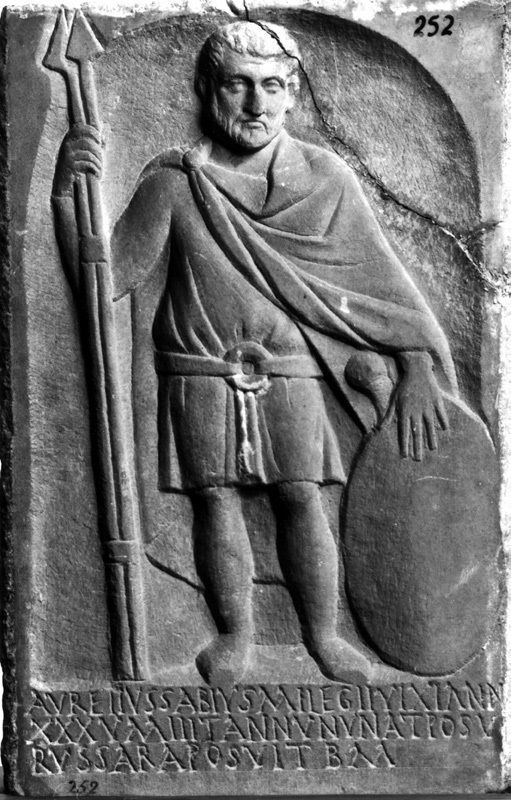 Image of auxilarius Aurelius Sabius with throwing gasts,from legio II Traiana fortis. Alexandria,inv. No. 252. 222-250 A.D.
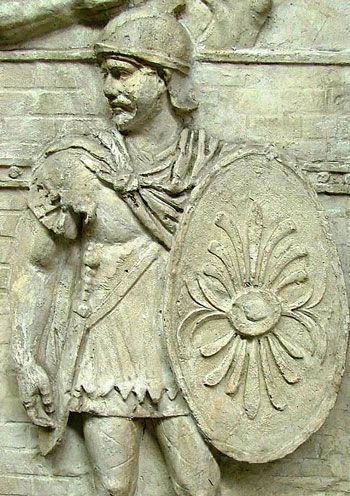 Auxiliary-spearman. Trajan's column. Early second century
Battlefield Role
A skirmisher was not meant to hold the line for long against heavy infantry. His strength was mobility: move forward quickly, throw several missiles, retire behind the shields of heavier infantry or shift to the flank. This role was especially useful against enemies who were heavily equipped, poorly protected against missiles or forced to advance through difficult ground.
Auxiliary skirmishers could operate alongside spearmen, archers and cavalry. In a mixed cohort or temporary vexillation they complemented the denser line: spearmen held contact, archers and slingers struck at range, and javelin throwers worked at short and medium distance.
Equipment
Equipment depended on period, region and unit. A basic kit could include several javelins or light hastae, a small clipeus or parma, a knife, pugio or short sword. Helmet and armour were not mandatory: some images show auxiliaries with protective equipment, but the light role allowed a simpler and more mobile kit.
Visual sources, such as the Mainz reliefs and scenes on Trajan's Column, show auxiliary soldiers with spears and throwing javelins. They are useful because they show not an abstract type of light infantry but real visual variants: tunic, cloak, belt, footwear, small shield and a set of missile weapons.
Reconstruction
For reconstruction it is important not to overload an auxiliary skirmisher with Late Roman elements. For the first or second century CE, the kit should be based on Principate auxilia: tunic, belt, footwear, small shield, several javelins and simple head protection. For the third or fourth century the image moves closer to the Late Roman lancearius, but then the Dominate context should be stated clearly.
The image works well as an intermediate type between the auxiliary spearman and the sagittarius: it shows that Roman auxiliary infantry was not limited to line spearmen and archers.
Related topics
Literature and sources
1. Cheesman G. L. The Auxilia of the Roman Imperial Army. Oxford, 1914.
2. Haynes I. Blood of the Provinces: The Roman Auxilia and the Making of Provincial Society. Oxford, 2013.
3. Bishop M. C., Coulston J. C. N. Roman Military Equipment: From the Punic Wars to the Fall of Rome. Oxford, 2006.
4. Le Bohec Y. The Imperial Roman Army. London, 1994.
Interested in Ancient Rome beyond reading? Join Legio X Fretensis or explore our reenactment directions.


