Herculaneum for Reenactors
Herculaneum
Herculaneum was a small town near Vesuvius, between the Bay of Naples and the slopes of the volcano. It was destroyed in AD 79 together with Pompeii, but preserved in a different way: hot volcanic flows rapidly filled streets and houses, carbonised wood and sealed the town in a dense mass. Doors, partitions, beams, furniture, food remains, scrolls, signs, wall paintings, mosaics and objects that rarely survive elsewhere were preserved.
Herculaneum is valuable as a connected urban environment rather than simply a collection of attractive finds. Its value lies in the archaeological connection between street, house, shop, bath and object.
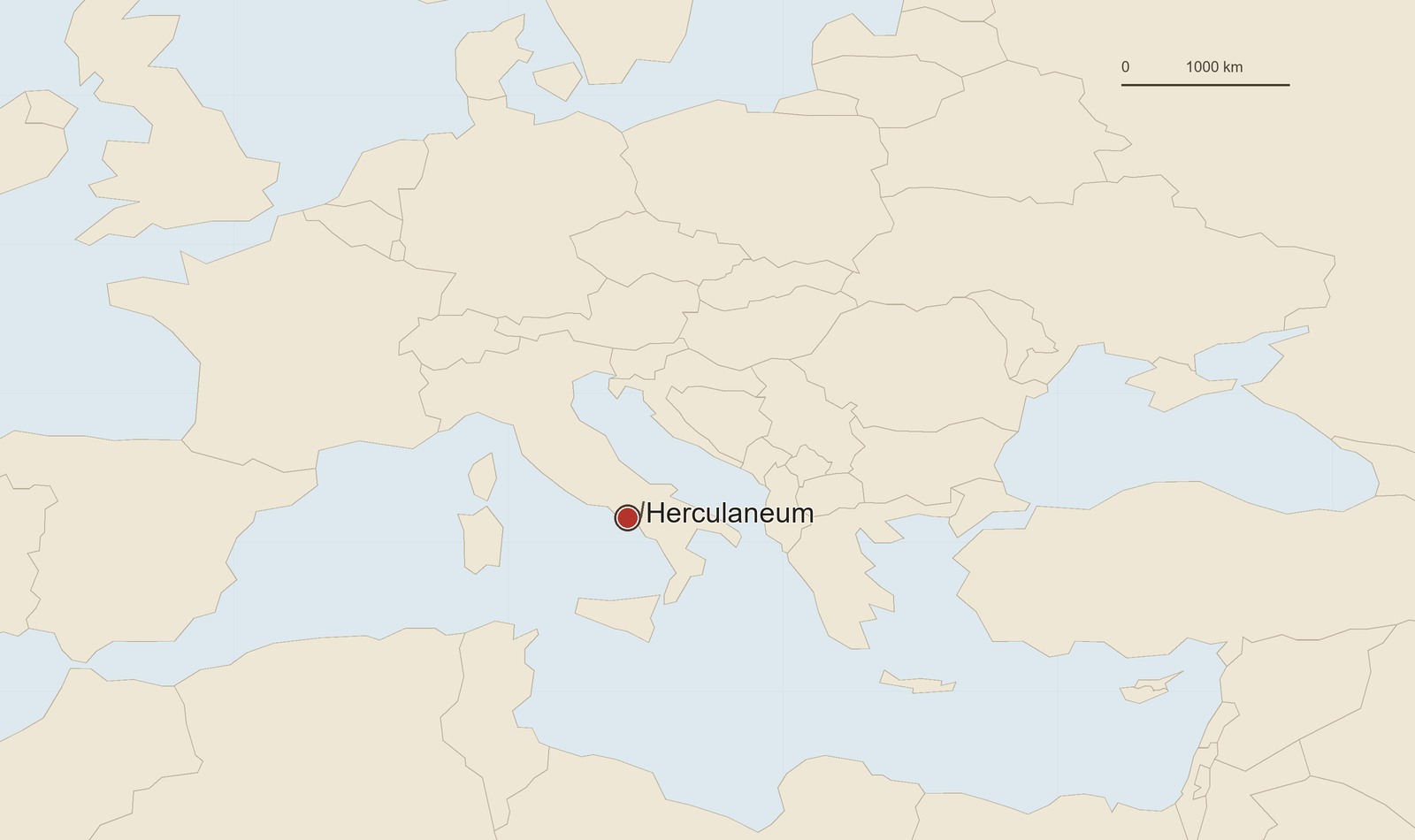 Location map: Herculaneum. The marker shows the ancient site or main archaeological complex.
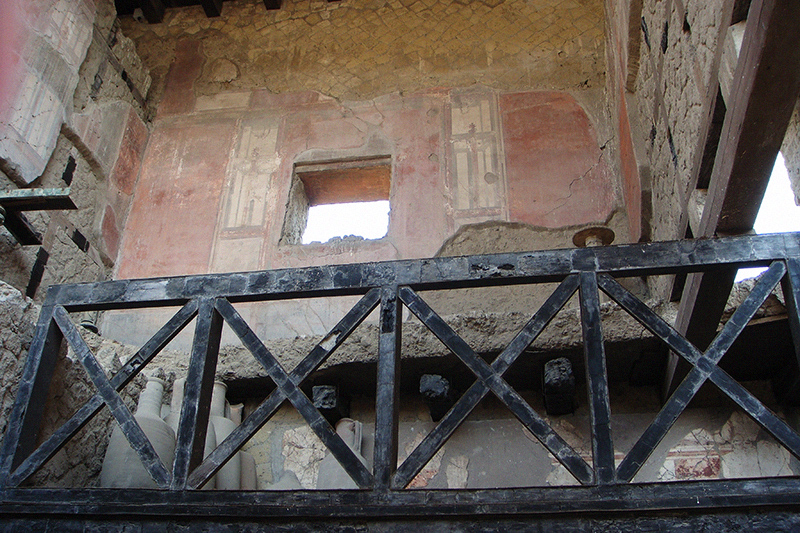 A thermopolium at Herculaneum. The counter with dolia shows the setting of street food and small-scale commerce in the Vesuvian town.
A Town Near Vesuvius
Herculaneum was smaller than Pompeii before the disaster, but its position was favourable: the sea, Campanian roads, villas and countryside were all close. Ancient tradition linked the town with a Greek past, while in the Roman period it functioned as a municipal centre with a forum area, public baths, shrines, residential blocks and shops. Its houses combined local building habits, Roman urban forms and the tastes of wealthy owners.
The town was uncovered gradually. Early eighteenth-century excavations proceeded through tunnels and selected impressive objects for royal collections. Later archaeology paid closer attention to street plans, stratigraphy, building technique and organic preservation. Older Herculaneum finds are therefore sometimes better known as museum objects, while more recent research tells more about the town as an urban system.
The Disaster of AD 79
The eruption of Vesuvius brought more than ash and stones. Pyroclastic flows were decisive for Herculaneum's preservation: a superheated mixture of gas, ash and debris rushed through the town at great speed. People who tried to shelter near the shore died in the boat houses. The upper storeys of many houses were destroyed, while lower rooms were sealed beneath dense volcanic deposits.
This explains the difference from Pompeii. Pompeii preserves a large urban street network, graffiti and shops especially well; Herculaneum is exceptional for wood, organics and interiors. The two towns are not duplicate collections of finds, but evidence for different processes of destruction and preservation.
Houses, Wood and Interiors
Wooden doors, sliding partitions, staircases, shelves and furniture elements survive at Herculaneum. The House of the Wooden Partition shows how an atrium space could be separated from the inner part of the house. Houses with mosaics and wall paintings reveal not only decorative programmes, but also movement through the building: entrance, atrium, peristyle, dining room, bedrooms and service rooms.
Such material is central to understanding the Roman house. Stone walls give the plan, but wood shows how rooms were closed, opened, divided and used every day. Carbonised beams and floors help estimate room height and upper storeys, while furniture fittings restore the scale of human activity.
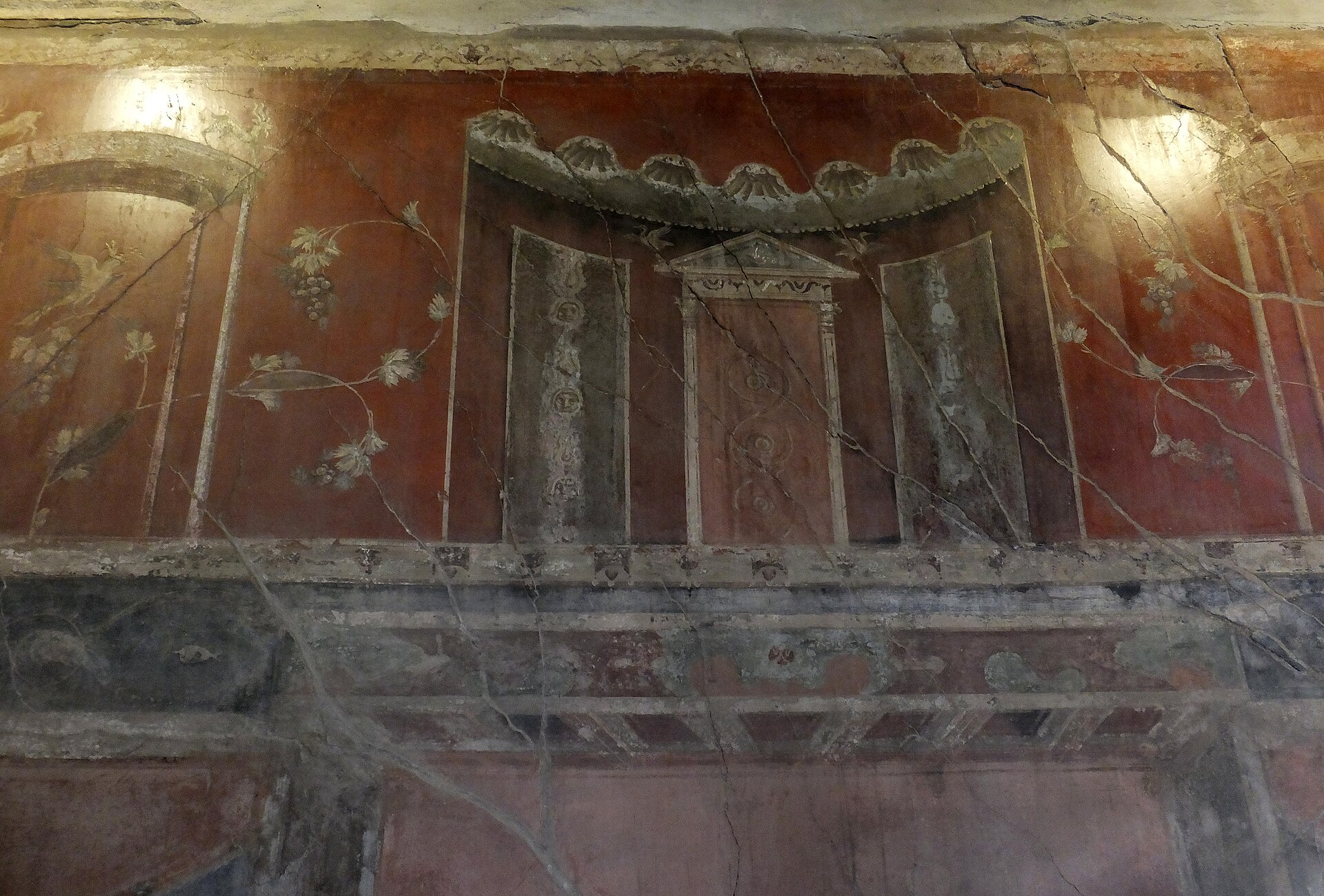 House of the Wooden Partition at Herculaneum: atrium, impluvium and the preserved carbonised partition of the tablinum. Herculaneum, AD 79;.
The Villa of the Papyri and Elite Culture
The most famous suburban complex of Herculaneum is the Villa of the Papyri. It is associated with Roman aristocratic circles of the late Republic and early Empire. The villa takes its name from its library of carbonised scrolls: the only ancient library preserved as an archaeological complex. Most of the texts read so far are connected with Epicurean philosophy, especially Philodemus of Gadara.
The villa matters beyond the papyri. Sculpture, layout, gardens, peristyles and views toward the sea show how a wealthy house combined leisure, education, philosophical fashion, collecting and political prestige. For the Roman elite, Greek culture was not mere decoration: it was a language of status expressed through books, statues, architecture and life amid images of learning.
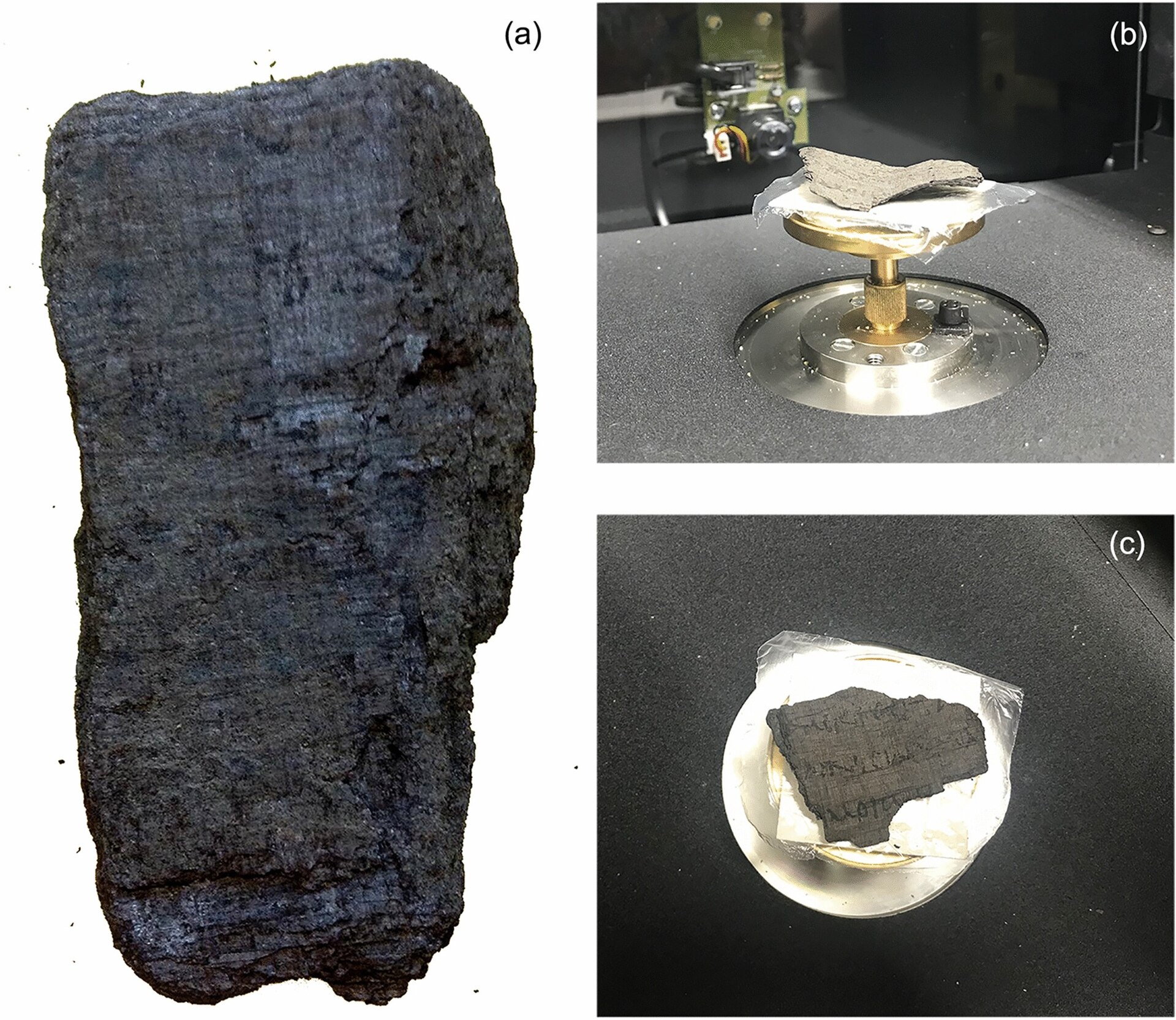 Fragments of the Herculaneum papyri PHerc.1103 and PHerc.110 from the Villa of the Papyri. The carbonised scrolls of AD 79 form the only ancient library preserved as an archaeological assemblage;.
Household Cult and Urban Memory
In Herculaneum's houses, as in Pompeii, lararia, small sacred areas, images of gods and sacrificial scenes are important. They connect Roman household religion with concrete architecture: where an altar stood, who saw it on entering, and how a cult area related to kitchen, atrium or shop. Household cult was part of daily order rather than a separate temple event.
Inscriptions and images also reveal public memory. The names of magistrates, owners, benefactors and the dead connected people with neighbourhood and community. Even a small town near Vesuvius belonged to the Roman system of honours, statuses and obligations. Herculaneum therefore gives not only interior archaeology, but also a picture of civic life.
Shops, Food and Street Life
Herculaneum's shops show the urban economy at a small scale. Thermopolia, workshops and rooms opening onto the street connected houses with everyday commerce. Counters with built-in dolia, food remains, vessels and traces of remodelling help identify where people prepared, sold and ate food.
The street itself also matters. Crossroads and doorways marked social boundaries: where private property began, where a shop stood, which rooms had separate access and which belonged to a house. A fresco or vessel from Herculaneum is especially valuable when its position in the block is known.
Baths, Palaestra and Public Spaces
Public baths and the palaestra connected hygiene, leisure, exercise and urban sociability. In the baths, mosaics and painted walls are only part of the evidence; heating, water supply, room sequence and the separation of users also matter. The palaestra represents another kind of space: an open area for exercise, walking and public presence.
These places show that Herculaneum was not only a town of houses. A Roman town was held together by repeated practices: visiting baths, moving through streets, buying food, maintaining household cults, meeting at doorways and crossing between private and public space.
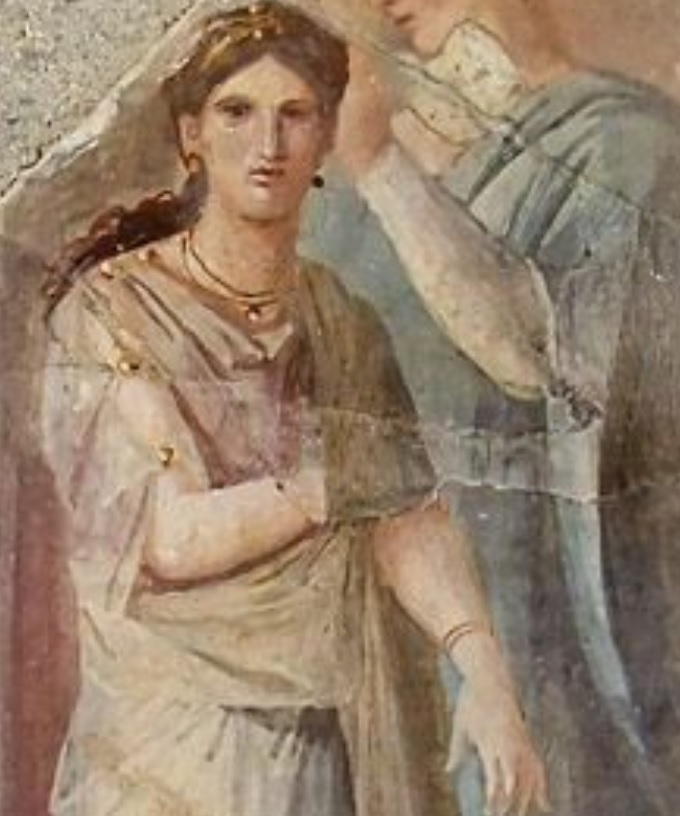 Woman wearing a bracelet, wall painting from Herculaneum; before 79 CE. Evidence for the depiction of arm jewellery.
Dress, Footwear and Images
Herculaneum's wall paintings provide evidence for dress, footwear, hair, gesture and domestic scenes. Yet an image must be distinguished from an object: the painter could follow genre, fashion or compositional convention. Scenes are most valuable when the house, room and neighbouring images are known. Then it becomes possible to decide whether the image belonged to a mythological ensemble, domestic decoration, cult area or everyday room.
Organic finds complement painting. Wood, textiles, food remains and small objects connect the artistic image with the material environment. For reconstruction this is more important than a single attractive picture without provenance.
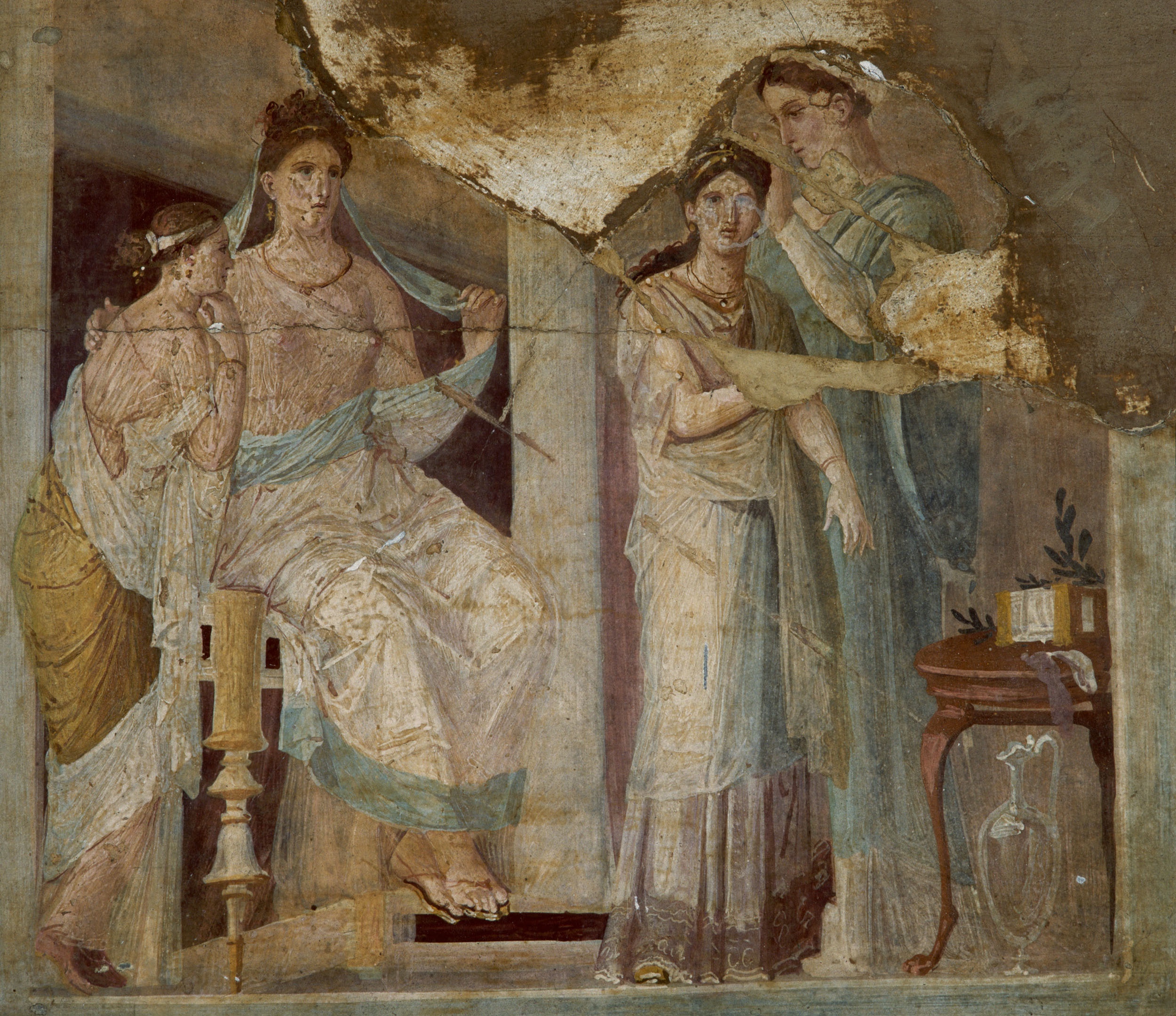 A fresco from Herculaneum with a female figure and footwear. Images of this type matter when read together with their room and archaeological context.
Military and Metal Finds
Herculaneum was not a legionary fortress, but military-type objects occur in the urban environment. Belt fittings, scabbard mounts, knives, tools and metal hardware may have belonged to soldiers, veterans, officials, guards or people connected with administration. These finds do not make the town a military centre, but they show that Roman equipment existed beyond the battlefield.
Small metal objects are especially useful for dating and technology. They reveal fastening methods, repairs, wear and workshop standards. Combined with houses, shops and streets, they show how objects circulated between army, town and private life.
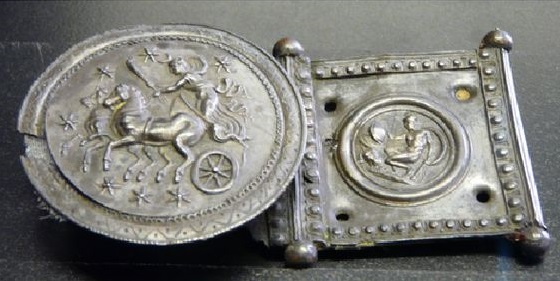 A bronze fitting from a pugio scabbard from the Vesuvian context. Small equipment details show the presence of military gear in Campanian towns.
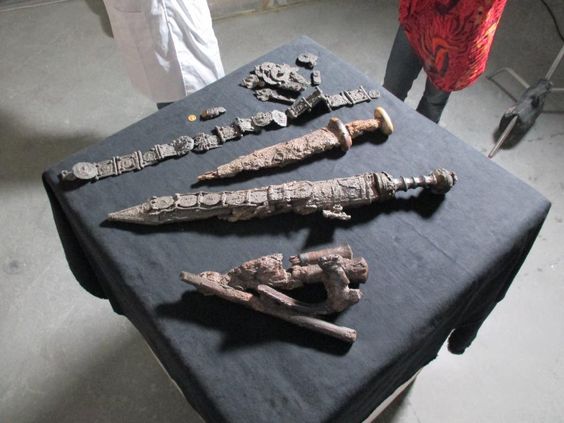 A group of Roman equipment elements from Herculaneum. Metal fittings are important for dating, repair and understanding how military objects entered an urban setting.
Short Chronology
- 8th-6th centuries BC: early settlement in the Bay of Naples area; later tradition connected the town with a Greek past.
- 4th-2nd centuries BC: the town developed within a Samnite and Campanian milieu.
- 1st century BC: incorporation into the Roman political order; rebuilding of houses and public spaces.
- AD 62: an earthquake in Campania damaged the Vesuvian towns.
- AD 79: the eruption of Vesuvius destroyed Herculaneum.
- 1738: systematic royal excavations began.
- 20th-21st centuries: research has focused on conservation, organics, building history and digital recording.
Excavation, Conservation and Limits of Evidence
Herculaneum was long treated as a source of museum masterpieces: statues, papyri and vivid wall paintings entered collections, while the town itself remained difficult to view and preserve. Modern work has shifted attention toward wall condition, drainage, humidity, carbonised wood, biological damage and accurate recording of earlier excavations. Sometimes the best result is not a new discovery, but the preservation of a block already exposed.
Material from Herculaneum therefore needs distinctions between an old find without precise context, an object from a documented room and a modern reconstruction. The town survives with extraordinary richness, but not evenly: some blocks were destroyed, some remain beneath modern Ercolano, and some are known through old tunnels and records. This incompleteness does not reduce Herculaneum's importance; it defines the caution needed in interpretation.
Related Topics
- Pompeii
- Roman archaeological sources
- The Roman Empire
- The Roman army
- Roman clothing
- Roman household religion
- Thermopolium
- Roman baths
Literature and sources
- Maiuri A. Herculaneum. Rome: Istituto Poligrafico dello Stato.
- Wallace-Hadrill A. Herculaneum: Past and Future. London: Frances Lincoln.
- Deiss J. J. Herculaneum: Italy's Buried Treasure. Malibu: Getty Museum.
- Guidobaldi M. P., Esposito D. Herculaneum: Art of a Buried City. Rome.
- Camardo D., Notomista M. Herculaneum: Guide to the Ancient City. Naples.
- Allison P. M. Pompeian Households: An Analysis of the Material Culture. Los Angeles: Cotsen Institute of Archaeology.


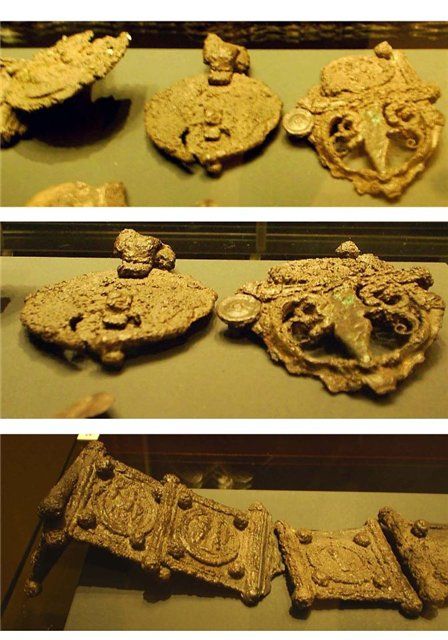 A fragment of a cingulum with metal mounts. Finds of this kind connect urban assemblages with the material culture of Roman soldiers.
Interested in Ancient Rome beyond reading? Join Legio X Fretensis or explore our reenactment directions.


