Evolution of Legionary Equipment
The Roman legionary is often reduced to one familiar scheme: a rectangular or curved scutum, the pilum, a short gladius and segmented armour. That image is useful for the early Principate, but it does not describe the entire history of Roman heavy infantry. Between the third century BCE and the fourth century CE the shield, polearm, sword and use of greaves all changed.
Equipment functioned as a system rather than as isolated objects. When the shield changes, the role of the polearm, the length of the sword and the visual image of the soldier often change with it. Atypical images of legionaries should therefore not automatically be dismissed as artistic mistakes: some reflect a different period, a different military role, a provincial setting or a deliberate use of older artistic language.
Sources Overview
Different kinds of evidence answer different questions. Written authors supply terminology and tactical context: Polybius for the middle Republic, Caesar for the late Republic, and Vegetius and Ammianus Marcellinus for late antiquity. The Notitia Dignitatum preserves a later tradition of unit lists and shield emblems.
Reliefs and tombstones show how soldiers were presented to viewers. Important examples include the Esquiline paintings, the so-called Altar of Domitius Ahenobarbus, the monument of Aemilius Paullus, and tombstones from Mainz, Bonn, Aquincum and Apamea. Trajan’s Column, the monument at Adamclisi, the Column of Marcus Aurelius, the Ludovisi sarcophagus and the Arch of Constantine provide other perspectives. Reused reliefs must be dated separately from their later setting.
Objects provide construction, materials and dimensions: the Fayum and Dura-Europos shields, Mainz and Pompeii sword finds, spathae from Newstead and elsewhere, and spearheads, pila and greaves. Images and finds should be compared, not treated as interchangeable evidence.
Studies by Bishop and Coulston, Simon James, Marcus Junkelmann, Connolly, Feugère, Sim, Ridge and Sumner help assess these different sources. The charts are schematic comparisons, not measured percentages of every soldier in a period. Their values illustrate trends and examples requiring explanation rather than a complete statistical census.
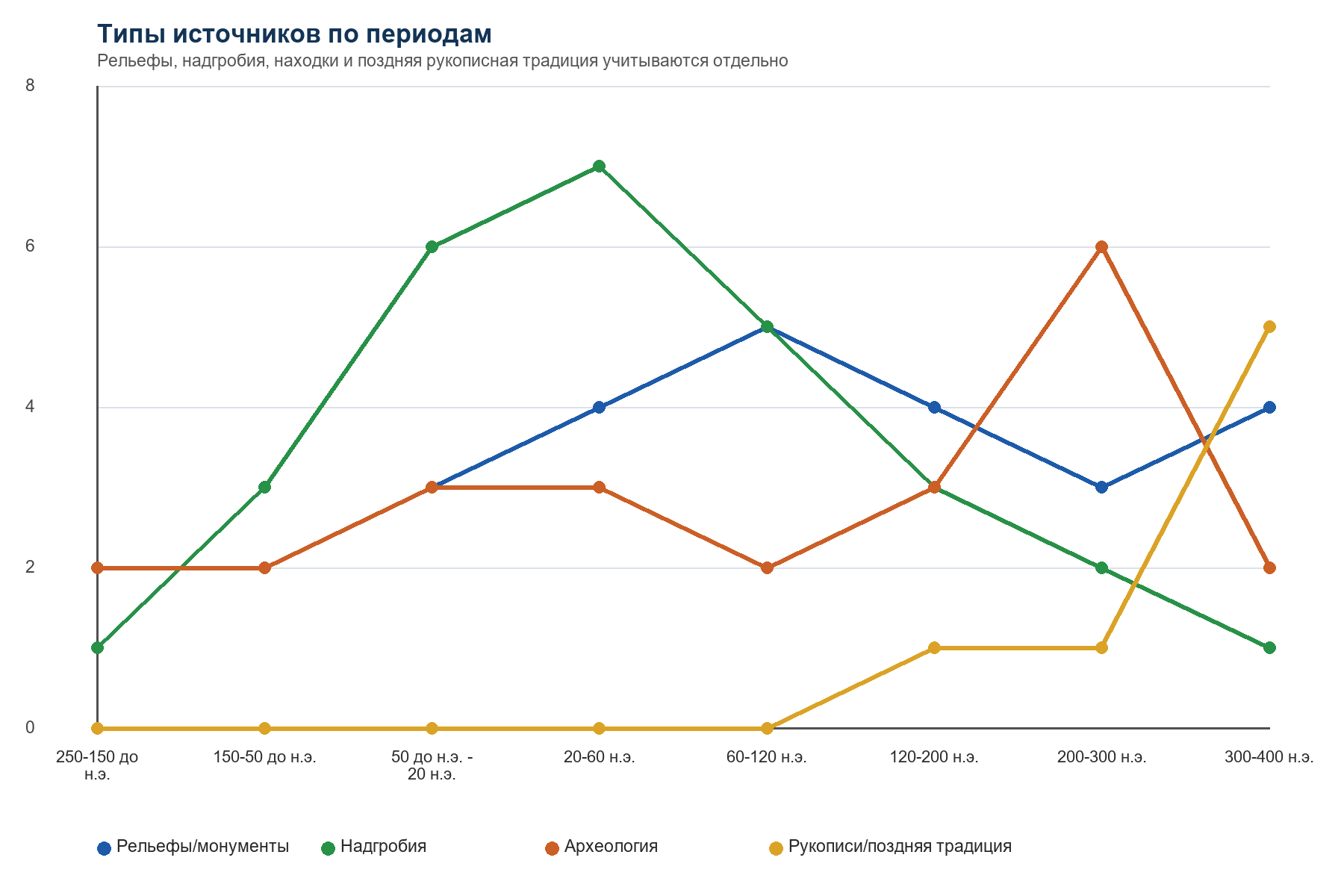 Draft structure of sources by monument type.
Shields: from the Oval Scutum to the Late Lenticular Shield
The early and middle Republican tradition did not begin with the familiar rectangular scutum. Visual and material evidence includes oval and elongated forms connected with manipular infantry and the broader Italic environment. In the late Republic and early Principate the scutum + pilum + gladius complex becomes stronger, and in the first and second centuries CE the large curved or rectangular shield becomes the most recognizable form.
From the second and third centuries the picture changes again. Visual sources more often show oval, round and lenticular shields, and the late Roman army no longer reproduces the classic Trajanic legionary image. A lenticular shield in a Principate context therefore needs separate attribution: it may belong to an auxiliary, cavalryman, praetorian, special role or a problematic artistic context.
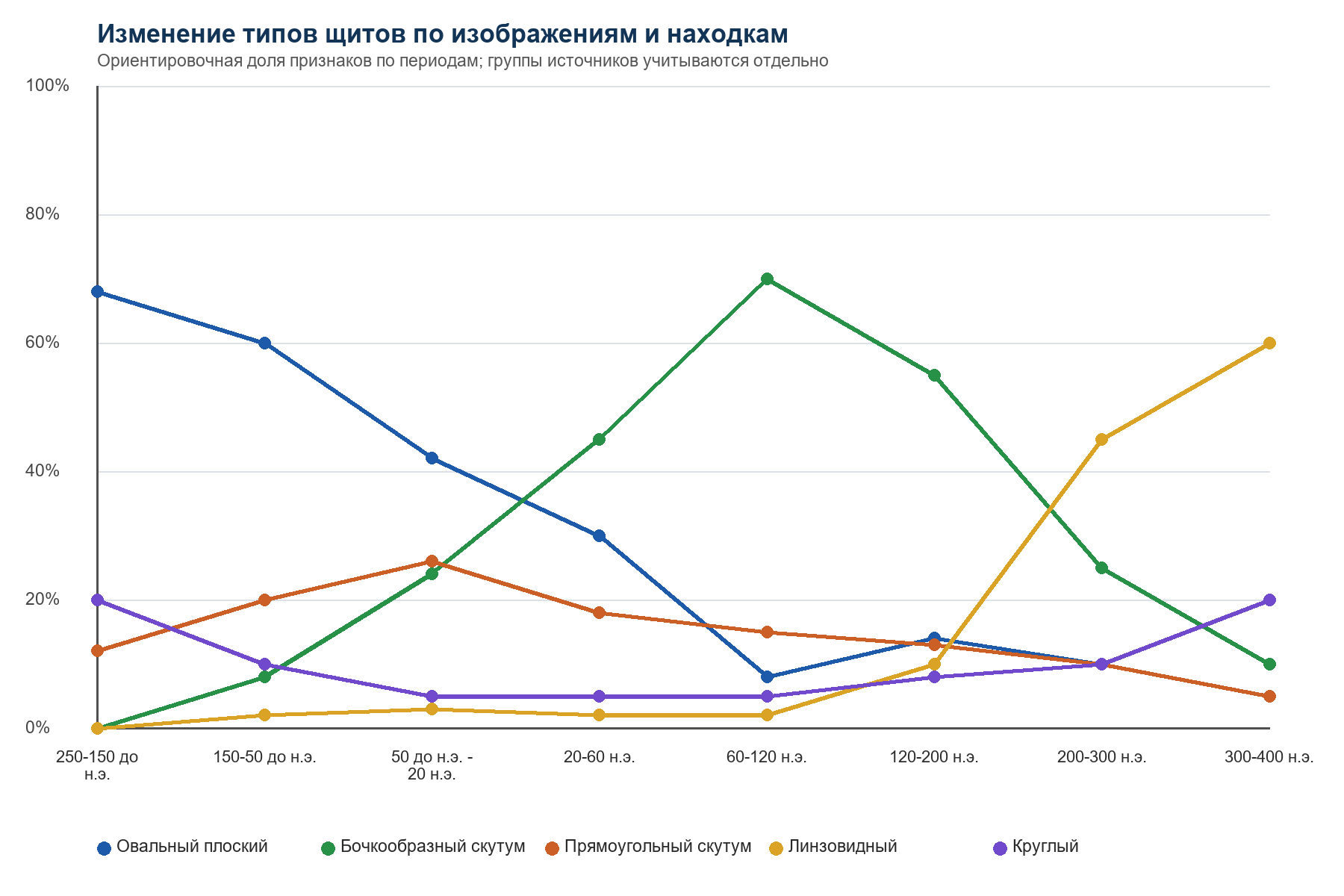 Chart of shield-type change in images and finds.
The examples below compare early oval shields and the early imperial scutum with a late relief from the Arch of Constantine, where the oval-lenticular form belongs to the late Roman norm.
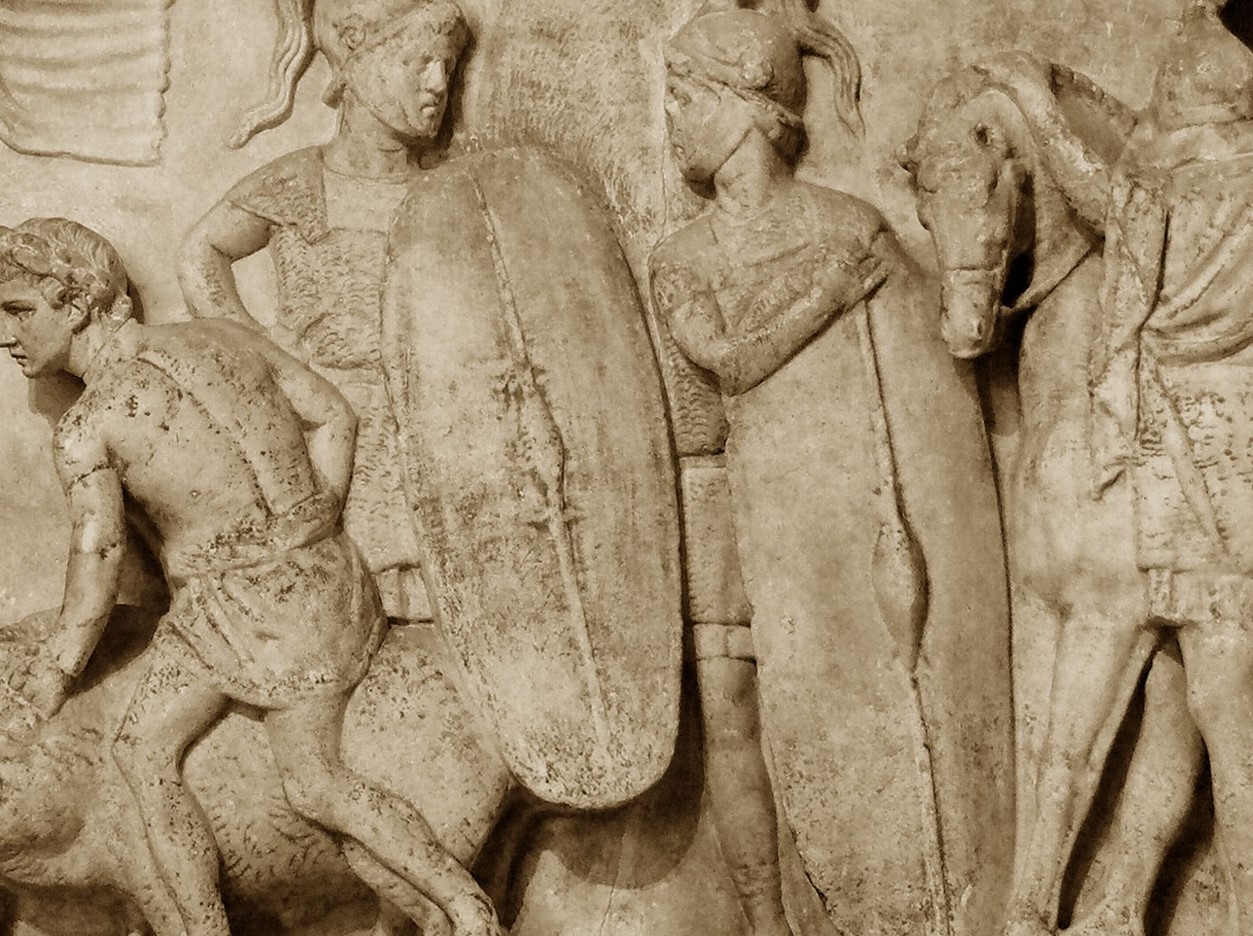 Oval shields on the relief traditionally called the Altar of Domitius Ahenobarbus, from Rome.
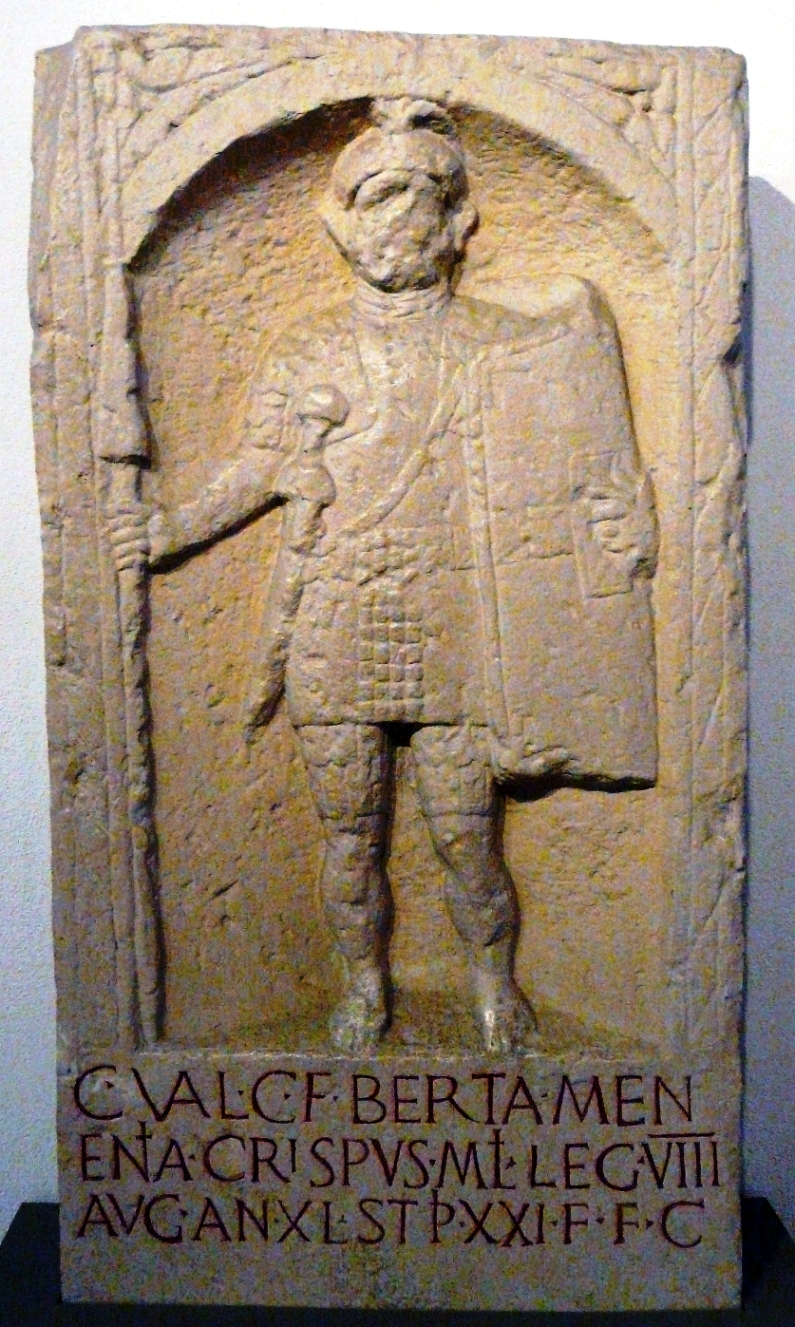 Gravestone of Gaius Valerius Crispus, a soldier of Legio VIII Augusta. Late first century CE; from Roman Wiesbaden, Germany.
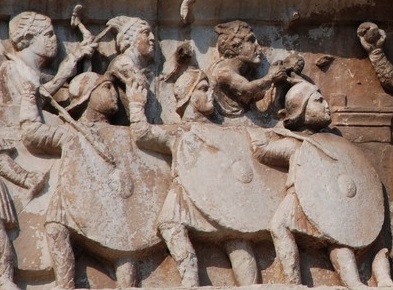 Arch of Constantine, Rome, IV century CE
Polearms: Hasta, Pilum, Lancea and Spiculum
The main line of development runs from spear tradition to the dominance of the pilum and then to the late Roman return of spears and javelins. Early Roman infantry belonged to a world in which the spear was a normal weapon for a heavy fighter. In the Republican and early imperial legion the pilum becomes the central marker: it links the throw before contact with subsequent shield-and-sword fighting.
The later Empire shifts the emphasis back toward the lancea, spiculum and related polearms. This is not a simple return to archaism but a different tactical complex: a longer sword, an oval shield, greater importance of distance pressure and more varied battlefield roles.
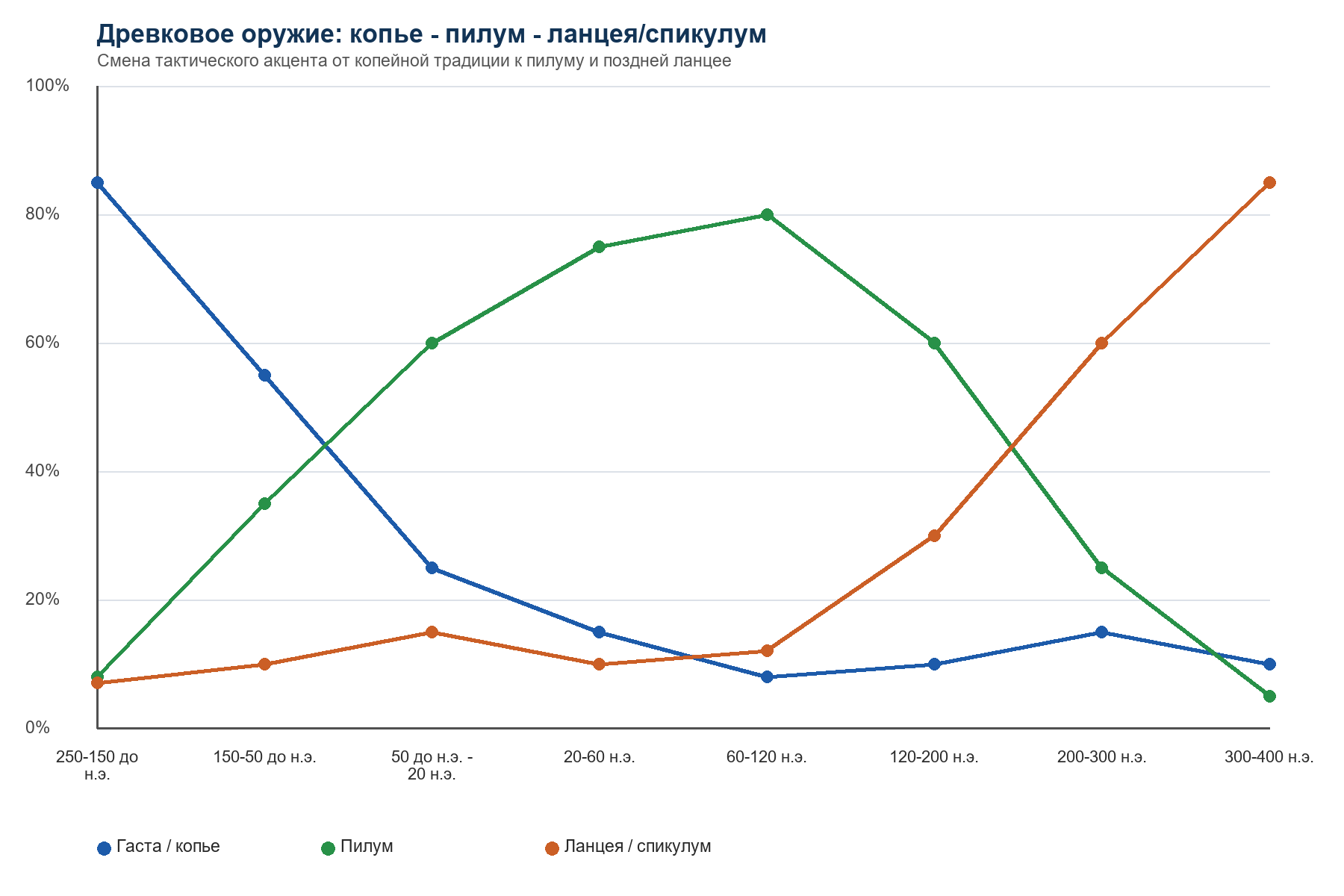 Working chart of polearms: hasta, pilum, lancea/spiculum.
The examples below remain as separate monument photos: they show both the pilum norm and cases requiring separate attribution.
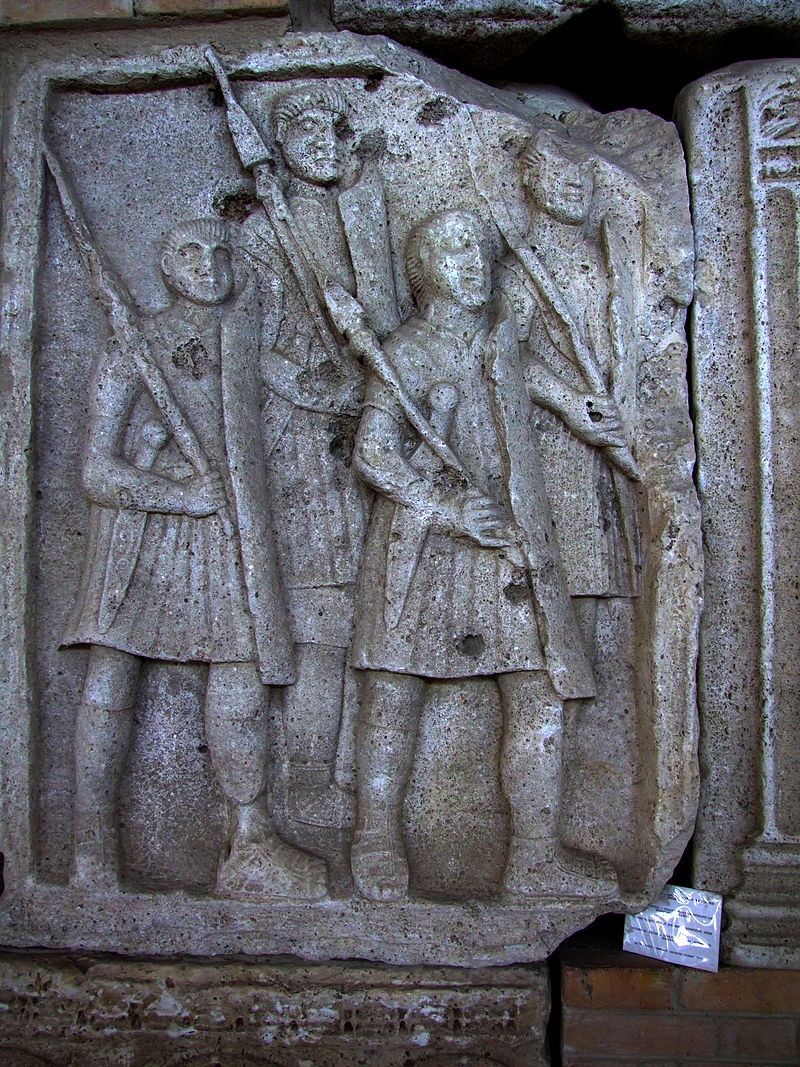 Legionnaires with pilums. Metopes of Trajan's Trophy (109 AD). Adamklisi,Romania
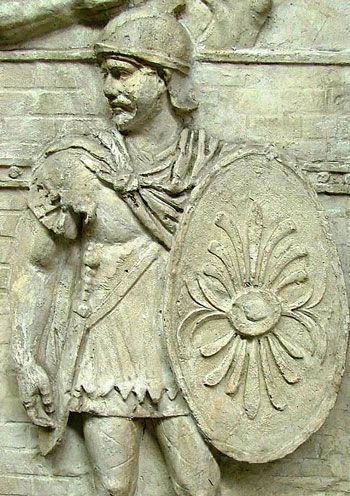 Auxiliary-spearman. Trajan's column. Early second century
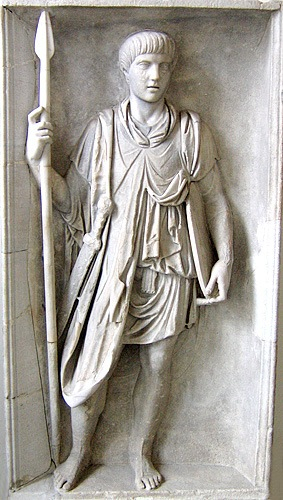 Bas-relief of a Praetorian guard from Pozzuoli,armed with a spear,2nd century AD.
Swords: from the Hispaniensis to the Gladius and Spatha
Sword length changed for structural reasons as well. The Republican gladius Hispaniensis was longer than later forms and fits the transitional environment of the second and first centuries BCE. In the early Principate the shorter Mainz/Pompeii type becomes prominent, working well with the large scutum and close fighting.
From the late second and third centuries the long spatha gradually moves beyond cavalry use and becomes an important part of late Roman infantry equipment. Blade length, however, cannot be measured reliably from images alone: archaeological finds are primary here, while images help explain suspension, status and visual language.
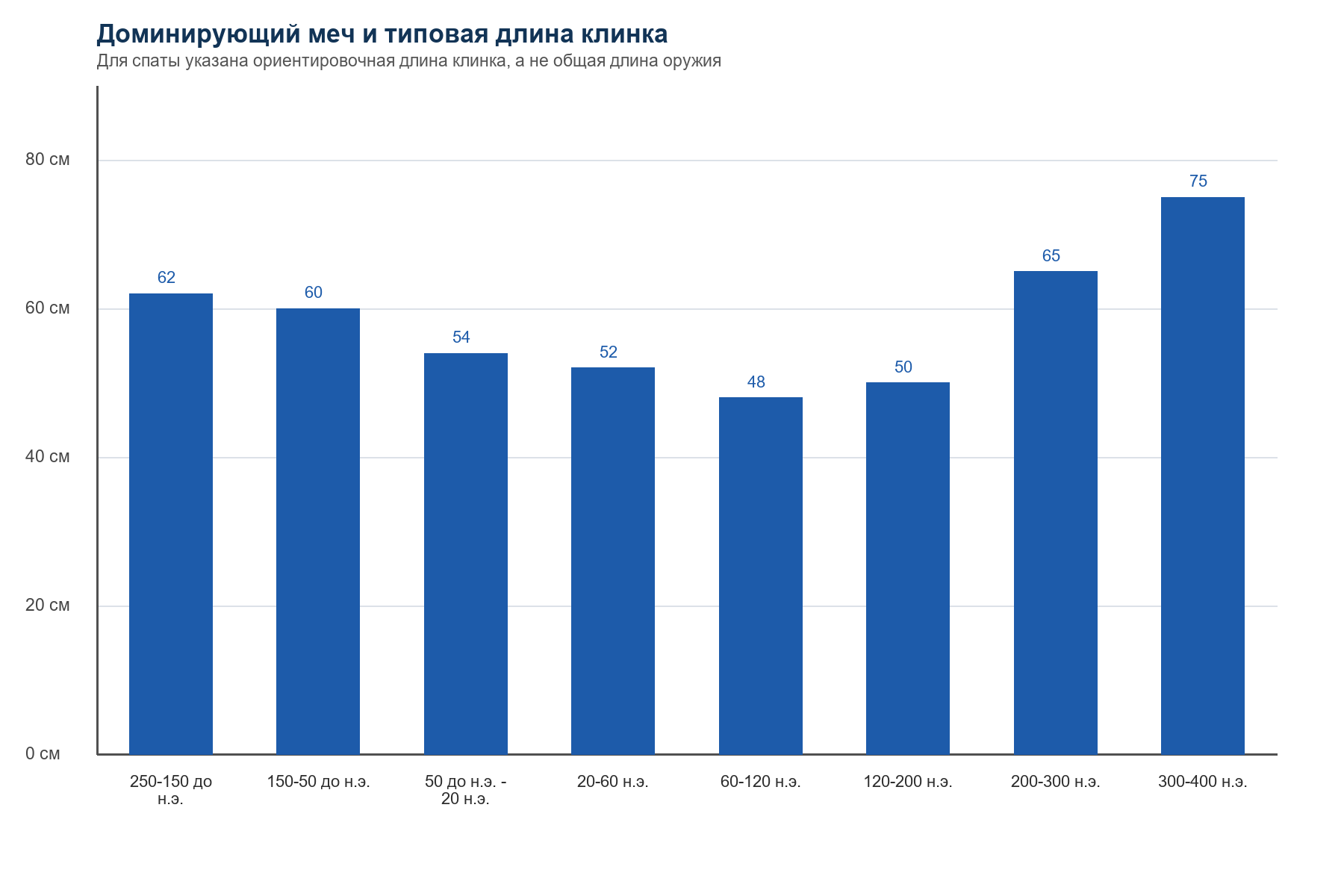 Working chart of typical blade length: from the Hispaniensis to the short gladius and later spatha.
Material finds show blade length more reliably than relief proportions: the examples below keep a short gladius and a longer spatha separate.
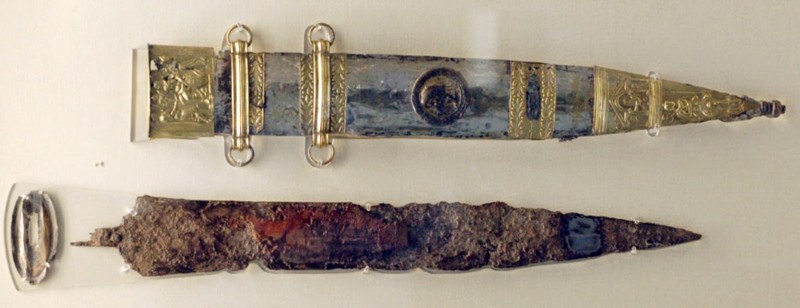 Mainz-type gladius found in the Rhine. Early first century AD; British Museum, London.
 Spatha,presumably auxilic. Iron. Newstead. National Museum of Scotland. 80-100 AD
Greaves
Greaves show why ordinary legionaries, centurions, cavalrymen and special images must be separated. In the early Italic and Republican environment leg protection fits naturally with spear-based fighting. In the classic Principate greaves are less common among ordinary legionaries, but they retain meaning for centurions and in special scenes as a status or functional feature.
In the second and third centuries images of a single greave reappear, often on the leg protected by the shield. This is not a simple return to the early Republic: the feature must be interpreted together with the date of the monument, the figure's role and the type of scene.
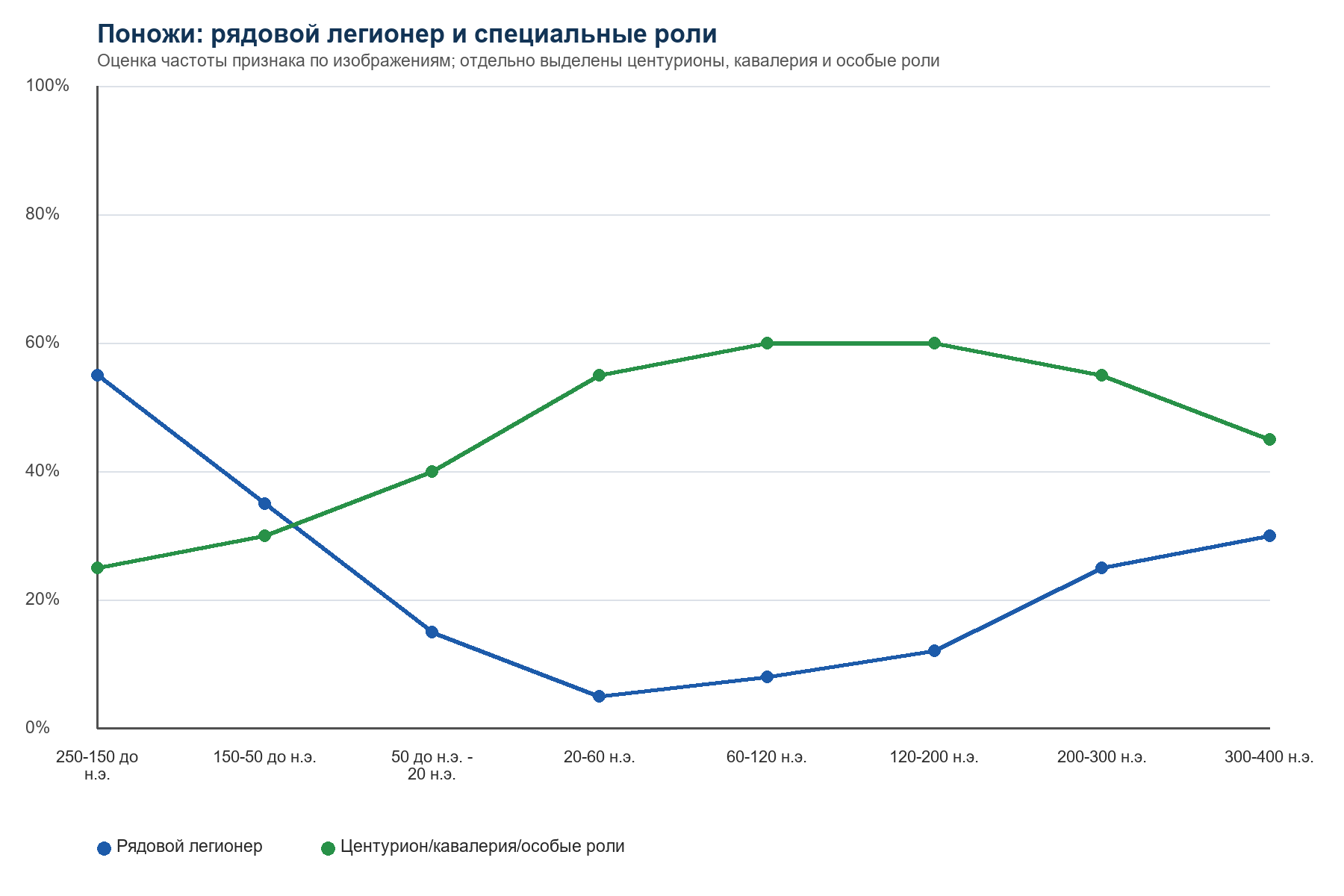 Working chart of greaves among ordinary legionaries and special roles.
The separate examples help keep early greaves, status images and material finds distinct from the general pattern of the ordinary legionary.
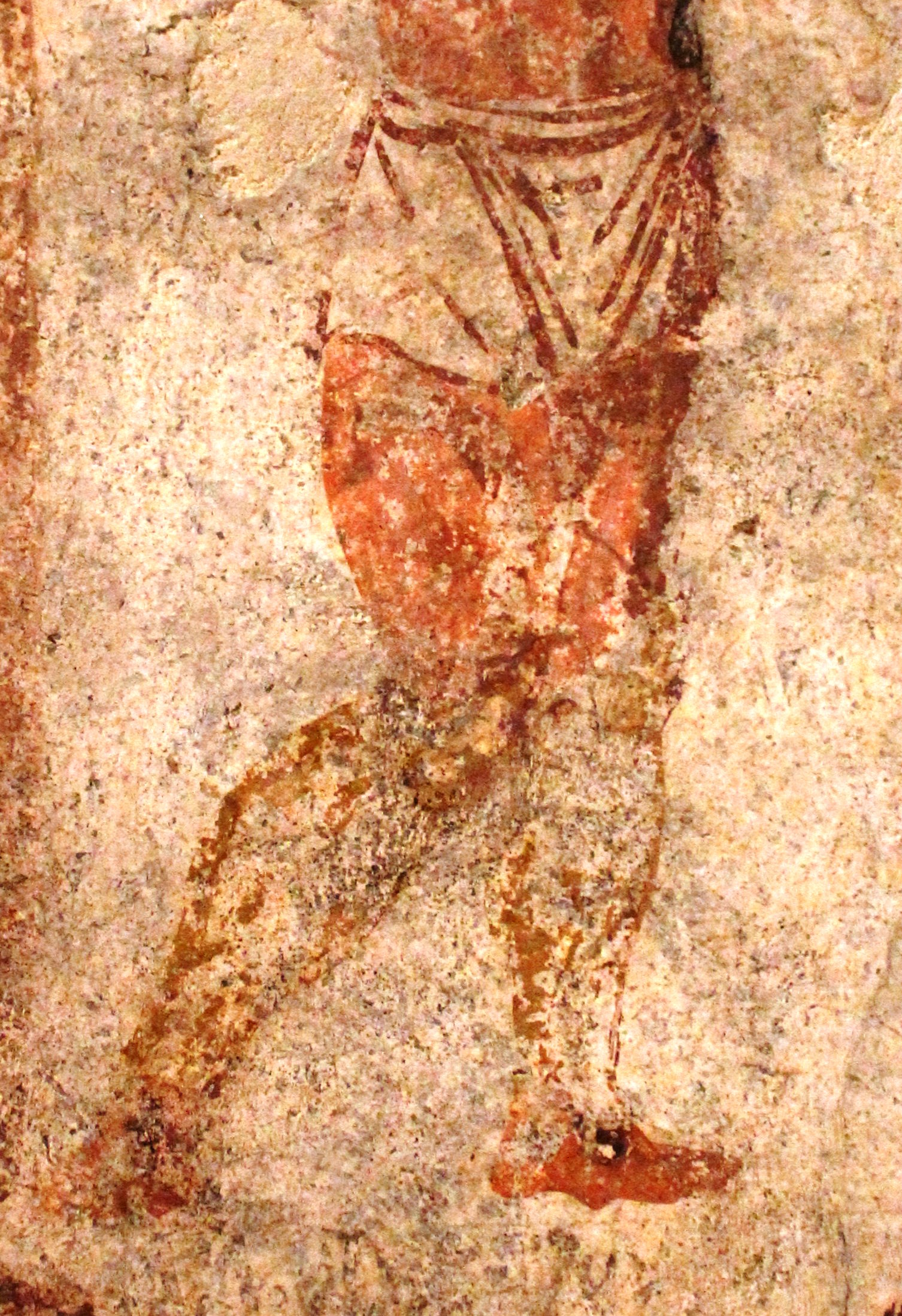 Fragment of an Esquiline fresco. Cortesia Civici Musei Capitolini. 3rd century BC
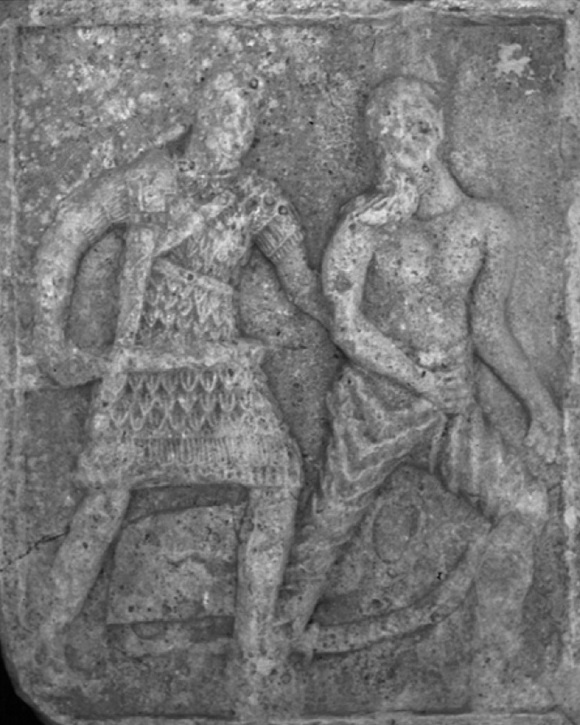 Bas-relief from Adamklisi. On the legionnaire's right,you can see the outline of a greave. Early 2nd century AD
Atypical Images of Legionaries
An image’s significance depends on its date, place and the soldier’s status. The painted rectangular scutum from Dura-Europos shows that the older form survived into the third century alongside other shields. The Arch of Constantine contains both fourth-century reliefs and reused earlier panels: the building’s date is not the date of every image. Oval and lenticular shields cannot be dated solely from a monument’s name. Shield shape, weapons and leg protection require separate comparison with archaeological finds and other depictions.
The strongest case is anachronism or archaizing visual language. The warrior on a Pompeian fresco dated to 80-20 BCE is not shown as a current Roman field soldier of the late Republic, but as a Greek-style heroic warrior, with spear, round shield and armour that evokes the hoplite tradition. This image should not be transferred directly onto the army of Sulla, Caesar or Augustus. Domestic painting could use the language of heroic antiquity rather than that of current military equipment.
At the same time, artistic archaism does not mean that old equipment never stayed in service. Helmets with several ownership inscriptions show that a piece of equipment could pass from soldier to soldier and outlive one military career. An archaic object on a monument is therefore not impossible. The question is whether it agrees with archaeological finds, the local image series and the military context.
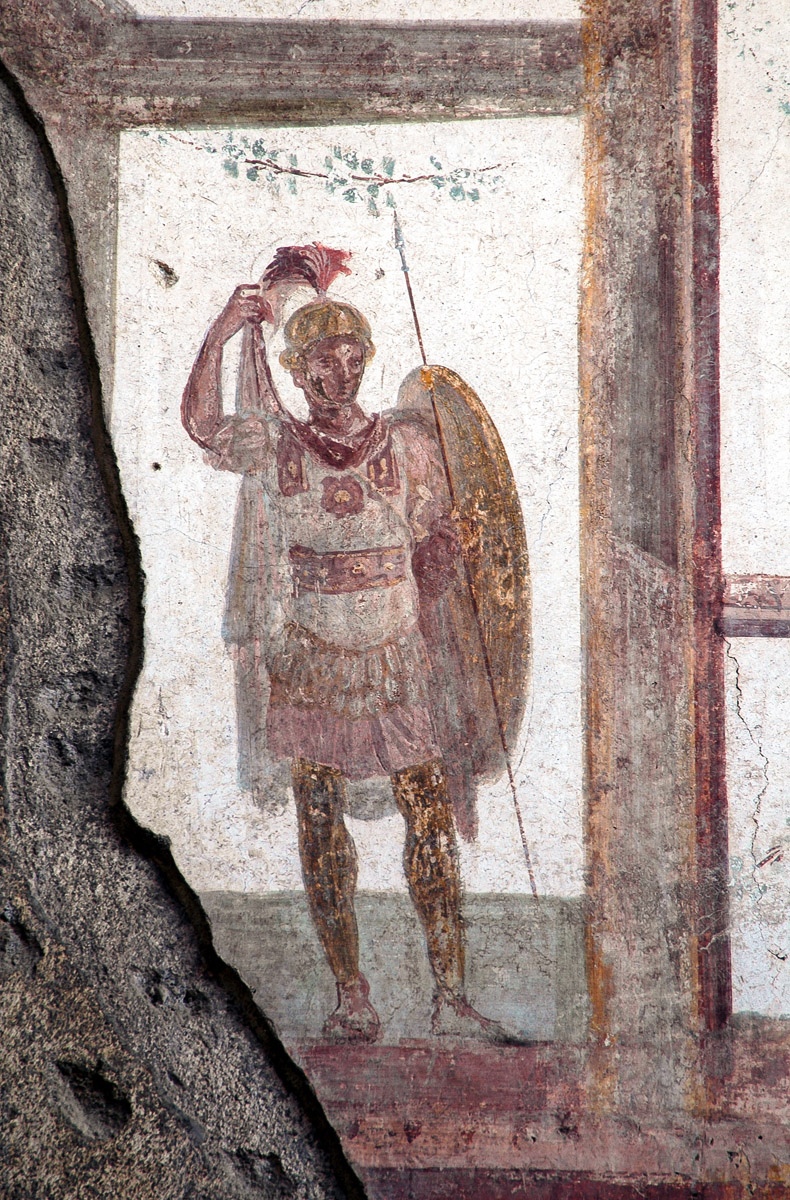 Warrior on a fresco from Pompeii. 80–20 BC.
The classic early imperial scutum is usually imagined as semi-cylindrical and rectangular or near-rectangular. Yet oval shields are already present in first-century legionary funerary imagery. This does not cancel the main pattern, but it weakens the idea of complete uniformity.
The tombstone of Flavoleius Cordus of Legio XIV Gemina, around 43 CE, shows a large oval, probably convex shield behind the soldier. It belongs to an early Claudian moment when republican morphology had not necessarily disappeared from the legionary world. The monument is better read as a transitional form: the soldier belongs to the army of the Principate, but the visual language of the shield still stands close to the late Republican tradition.
The tombstone of Gaius Castricius Victor of Legio II Adiutrix at Aquincum is important for the same reason: an oval shield appears without an obvious auxiliary status for the figure. Possible explanations include Danubian regional tradition, a memory of earlier service, local workshop practice or real coexistence of several shield forms in a legionary setting.
Rhenish monuments, including the stele of Gaius Largennius of Legio II Augusta, are best used as frontier context rather than as isolated proof. Largennius has to be treated cautiously: the published stele is less explicit than Flavoleius Cordus or Castricius Victor, so it is safer to use it as part of a wider Rhenish series. In that series old visual formulas, spear motifs and a late-Republican taste in military self-presentation remain visible.
Webster helps explain this through the nature of the army itself: the legion was an imperial institution, but it lived on a particular frontier, recruited from particular areas and used local workshops. Junkelmann is useful from the other side: his reconstruction of the Augustan legionary constantly reminds us that the date of an object, the date of a monument and the social image of a soldier are not automatically the same thing.
Spear images are just as important. The pilum is one of the defining features of the usual heavy-infantry model, yet Rhenish tombstones of the first century, Syrian monuments of the third century and the Adamclisi reliefs repeatedly show spear-like weapons. One explanation is the lancea, a more flexible throwing spear that could enter the legionary environment through auxiliaries and mixed field armies. Speidel connected some such images with early lanciarii and unusual legionary polearms. Other explanations include campaign adaptation, local terrain and the military traditions of recruits from Gaul, Germany, the Balkans or the eastern provinces.
Funerary monuments can also preserve a biographical memory of equipment. A tombstone does not record a depot issue on the day of death; it records the military identity chosen by the family, comrades or veteran. This is especially plausible after transfer from auxiliaries into a legion, movement between frontiers or long service in expeditionary armies.
Regional inertia is clearest on the German and eastern frontiers. On the Rhine and upper Danube, oval shields, spear motifs, mail and more flexible sword lengths are easier to see. In Syria and Mesopotamia, the Dura-Europos and Apamea material points to another pattern: oval shields, long swords, scale and mail armour, and heavy polearms. In material connected with Legio II Parthica, this looks less like a random anomaly than an eastern legionary style shaped beside Parthian and Sasanian warfare.
State monuments are not simple inventories either. Trajan's Column is often treated as a model, but it contains mail, scale armour, manicae and different shield forms. Adamclisi sharpens the problem: soldiers in trousers, with manicae, oval or polygonal shields and heavy polearms were often read as auxiliaries, but some scholars have linked part of this imagery with legionaries adapted to the Dacian front. Even if not every such figure is a legionary, the monument argues against a rigid single-kit model.
The rule is straightforward: an atypical image should neither be discarded automatically nor merged mechanically with the norm of its period. It has to be checked by inscription, date, place, genre, neighbouring figures, archaeological parallels and likely military biography.
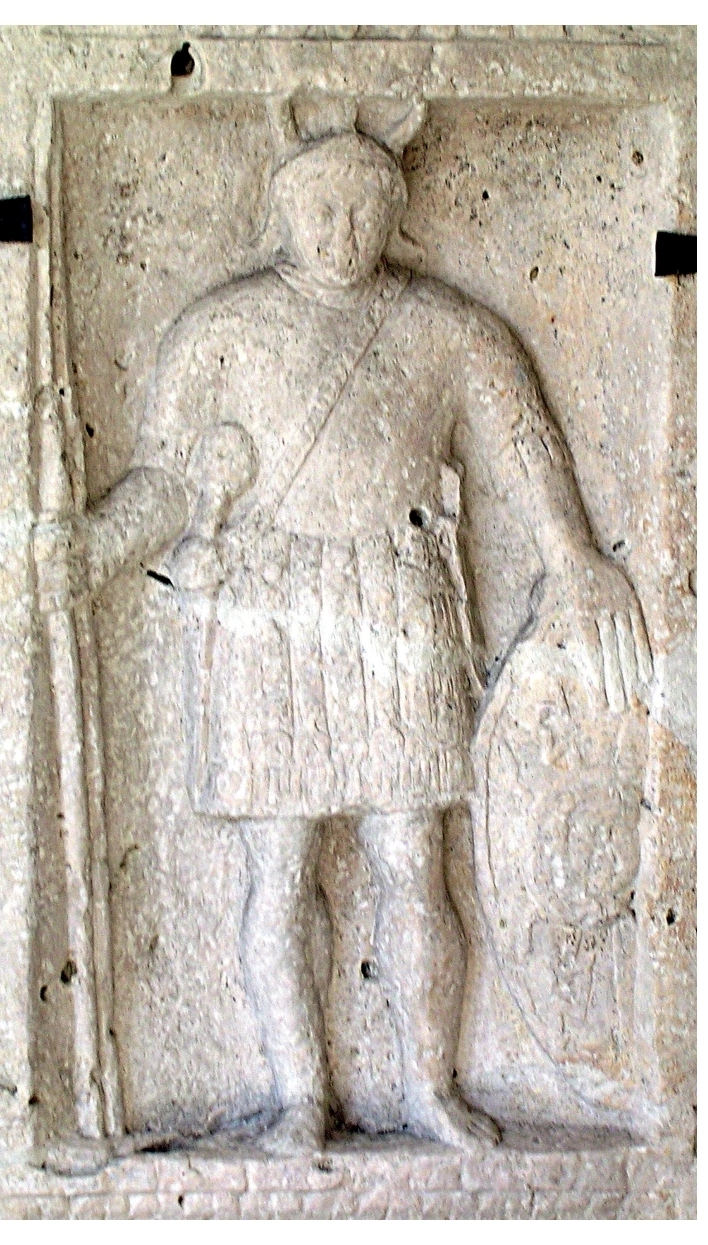 Tombstone of legionnaire Gaius Castricius Victor, Legio II Adiutrix, 1st century. The oval shield is clearly visible
 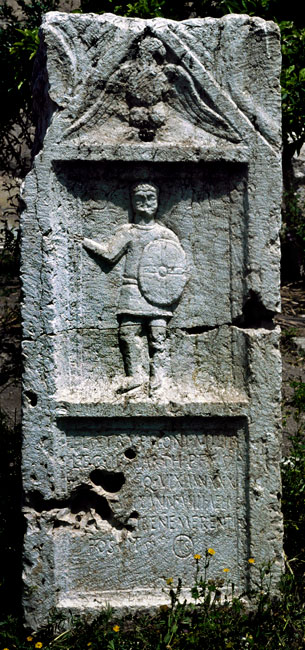 Tombstone of the legionnaire Flavius Tryphon of II Parthia. Apamea, 3rd century AD
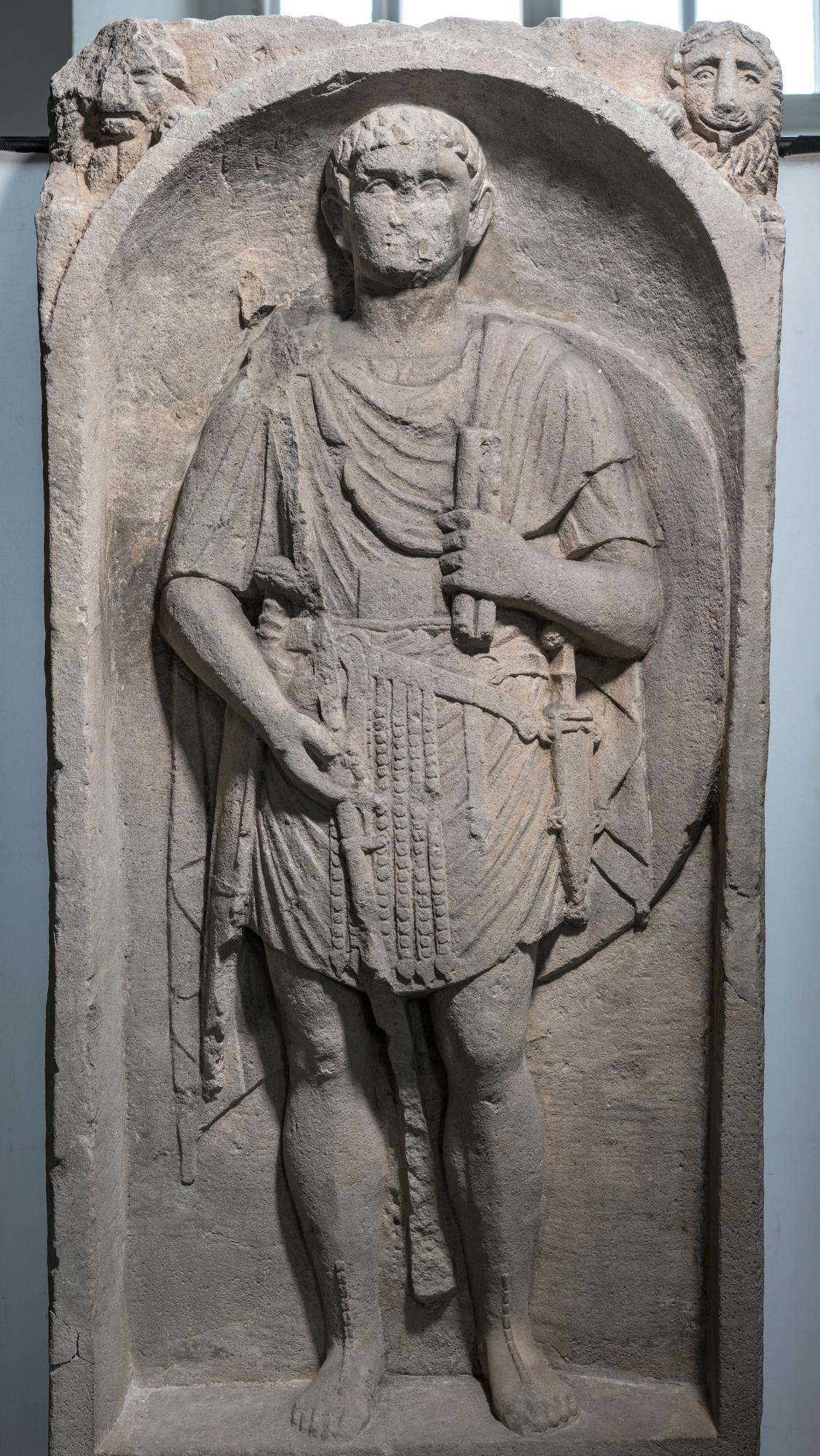 Tombstone of the legionnaire Flavoley Cordas, Legio XIIII Gemina, around 43. An oval shield, probably convex in shape, is clearly visible behind him
The Classic Legionary Index
The final index is not an independent historical fact. It is a calculated visualization based on the same features as the charts above: the share of curved/rectangular scuta, the share of pila, the closeness of the sword to the short gladius and the rarity of regular greaves among ordinary infantrymen. The phalanx background and manipular transition are therefore not included in the line: this version does not contain equivalent coded series for them.
The peak naturally falls in the first and early second centuries CE, when scutum, pilum, short gladius and the lack of regular paired greaves among ordinary soldiers combine into the most recognizable complex. After the second century the index falls not because the soldier becomes worse, but because the late Roman infantryman is typologically different.
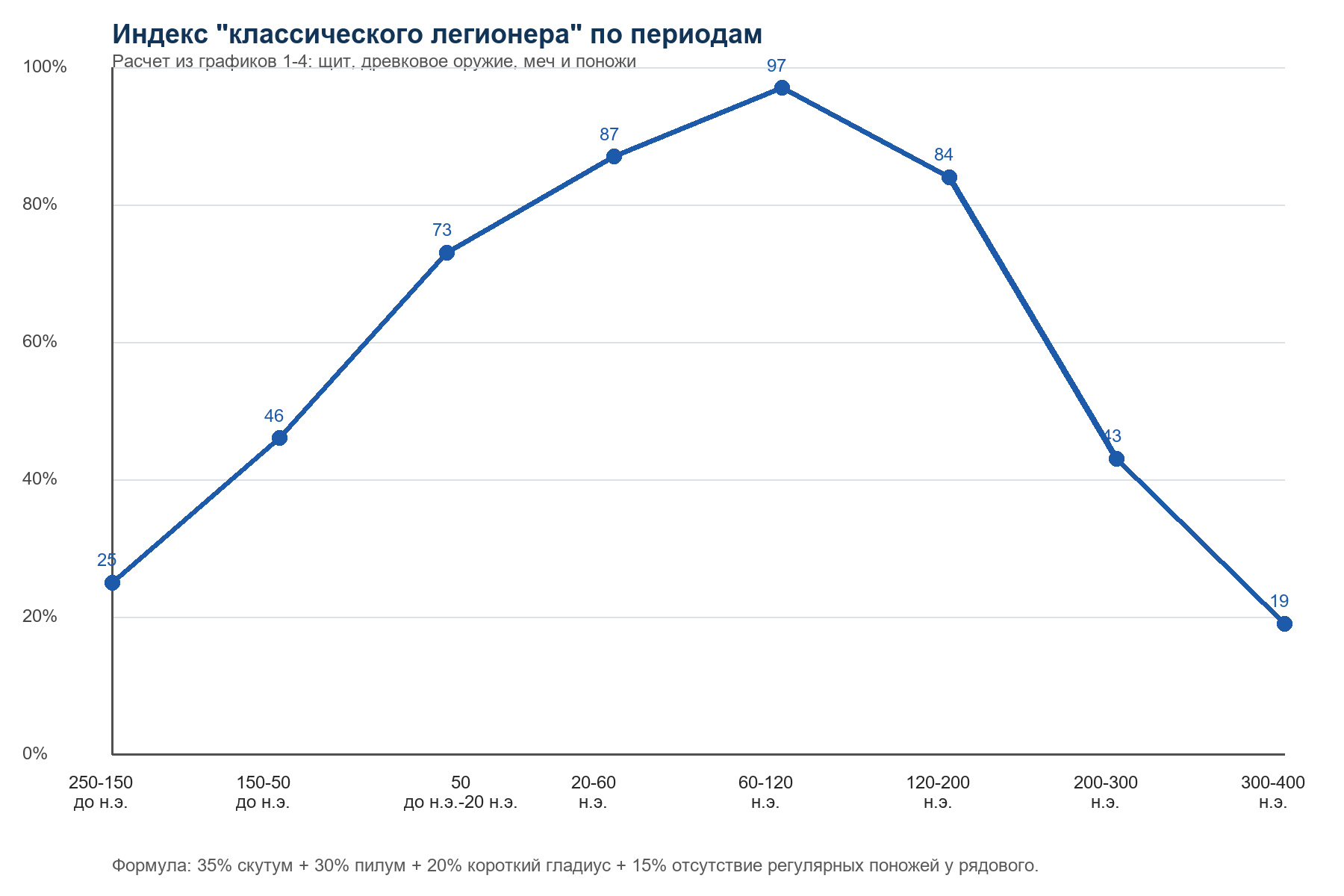 Calculated index of similarity to the classic early-Principate legionary image.
Conclusions
Legionary equipment changed in complexes. The Republic gives an oval shield, a strong spear tradition, a longer sword and more visible leg protection. The early Principate produces the most recognizable set: large scutum, pilum, short gladius and rare greaves among ordinary soldiers. The later Empire shifts toward oval and lenticular shields, spears, javelins and the spatha.
The classic legionary was therefore not an eternal image of the Roman army, but a historically brief convergence of several elements. Atypical monuments do not break this picture if they are read by date, place, genre and the figure's status.
Related Topics
Literature and Sources
- Polybius. Histories, book VI.
- Caesar. De Bello Gallico.
- Bishop M. C., Coulston J. C. N. Roman Military Equipment from the Punic Wars to the Fall of Rome. 2nd ed. Oxford, 2006.
- Connolly P. Greece and Rome at War. London, 2006.
- James S. Excavations at Dura-Europos 1928-1937. Final Report VII: Arms and Armour. London, 2004.
- Speidel M. P. Roman Army Studies. Amsterdam, 1984-1992.
- Webster G. The Roman Imperial Army. London, 1998.
- Le Bohec Y. The Imperial Roman Army. London, 1994.
- Junkelmann M. Die Legionen des Augustus. Mainz, 1986.
- MacMullen R. Inscriptions on Armor and the Supply of Arms in the Roman Empire. American Journal of Archaeology, 1960.
- Sim D., Ridge I. Iron for the Eagles. Stroud, 2002.
- Southern P., Dixon K. The Roman Cavalry. London, 1992.
- Sumner G. Roman Military Dress. Stroud, 2009.
Interested in Ancient Rome beyond reading? Join Legio X Fretensis or explore our reenactment directions.


