Latin Phrases from Ancient Rome
Latin phrases make better sense when their author, setting and place in a text are known. A line from a poem, historical narrative or military treatise was not necessarily an everyday Roman motto. Some famous sayings survive as reported speech; others acquired their familiar form much later.
Caesar: victory and the Rubicon
Veni, vidi, vici means "I came, I saw, I conquered". Suetonius, Julius 37, connects the words with an inscription displayed at Caesar's Pontic triumph. The emphasis is on the speed of victory, not a summary of his entire military career.
Alea iacta est means "the die is cast". Suetonius, Julius 32, gives the phrase in his account of the Rubicon crossing. Plutarch, Caesar 32, transmits a Greek version closer to "let the die be cast". Both are literary accounts written after Caesar's death, not a verbatim contemporary record.
Poetry, theatre and society
Carpe diem is conventionally translated as "seize the day", with an underlying image of plucking or gathering. In Horace, Odes 1.11, it is addressed to Leuconoe and concerns the limits of knowledge about the future. It is not a blanket instruction to take risks or ignore consequences.
Homo sum begins a line in Terence's Heautontimorumenos 77: "I am human; I consider nothing human alien to me." It is spoken by Chremes, a character in a comedy. Its later humanistic use should be distinguished from its dramatic setting.
Panem et circenses, "bread and circuses", occurs in Juvenal, Satires 10.81. It is a poet's biting comment on the Roman people's changed aspirations, not an official welfare slogan. Satire is not an impartial statistical record of public attitudes.
Government and warfare
Festina lente means "make haste slowly". Suetonius, Augustus 25, reports favourite Greek sayings of Augustus warning against rashness. The familiar Latin wording conveys one of those sayings; it should not be presented as the verbatim Latin quotation found in that chapter.
Si vis pacem, para bellum means "if you want peace, prepare for war". It is a familiar shortened formulation, not an exact quotation from Vegetius. The preface to Book III of his Epitome of Military Science reads Igitur qui desiderat pacem, praeparet bellum: "therefore, whoever desires peace should prepare for war". The work is late Roman; attributing the saying to Caesar without evidence is incorrect.
Checking an ancient quotation
A quotation should be traceable to a work and a book, chapter or line number. Distinguish the author from a character, reported speech from a later retelling, and the original from a translation. An unattributed collection of quotations is not enough.
Inscriptions also involve abbreviations and spelling conventions: SPQR is a civic formula, while Roman numerals can identify age, office, unit or date. Latin wording on a modern ring or souvenir does not turn it into ancient evidence.
Not every familiar Latin phrase comes from a book. CAVE CANEM, "beware of the dog", appears in the entrance mosaic of the House of the Tragic Poet at Pompeii. The image and the location of the words establish their practical meaning: an everyday warning.
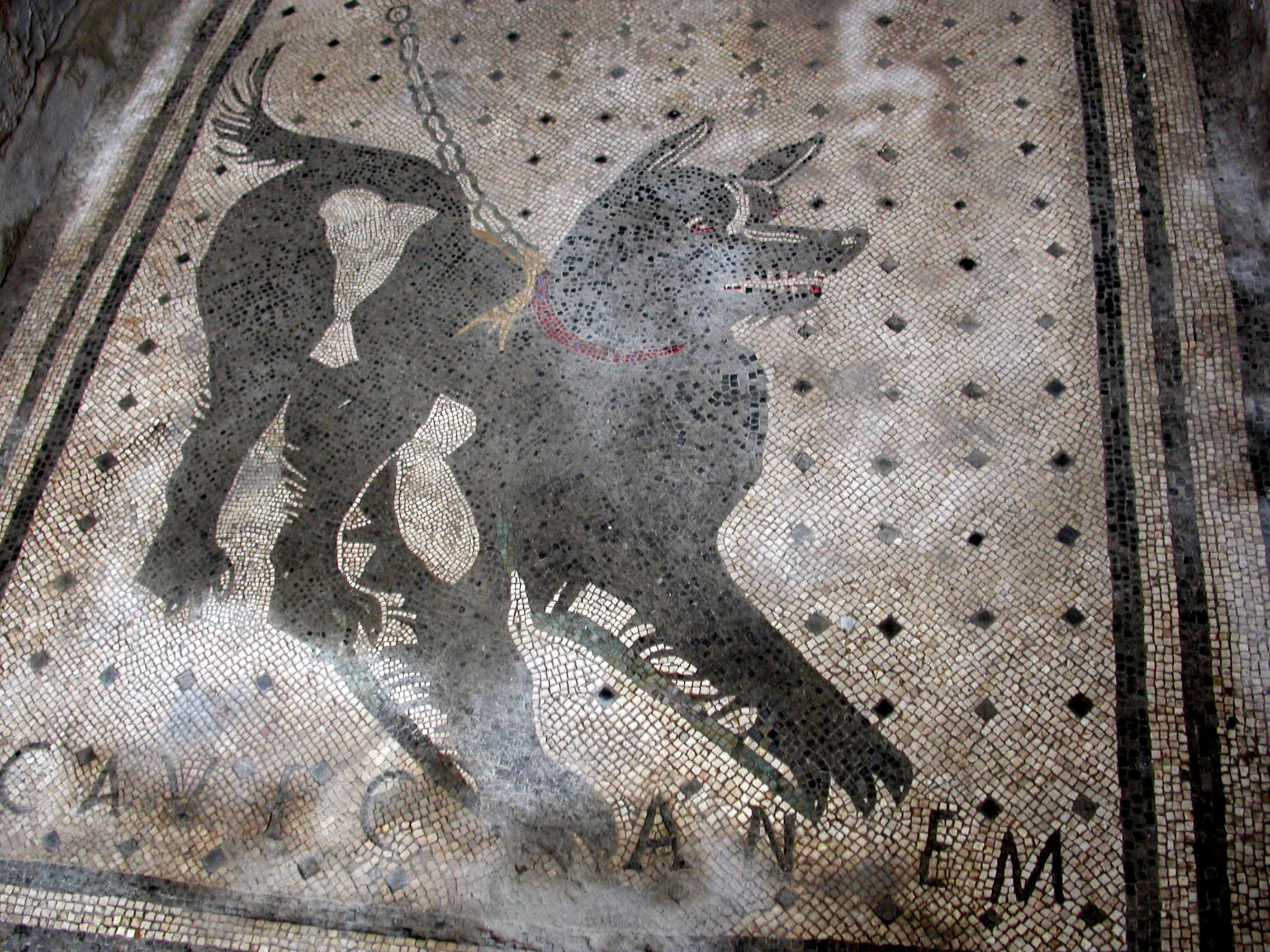 CAVE CANEM, "Beware of the dog", in the entrance mosaic of the House of the Tragic Poet, Pompeii, before 79 CE. An everyday Latin warning rather than a literary quotation. Photograph: CRYptex, public domain.
Related topics
Literature and sources
- Suetonius, Lives of the Caesars: Julius 32 and 37; Augustus 25.
- Plutarch, Caesar 32.
- Horace, Odes 1.11.
- Terence, Heautontimorumenos 77.
- Juvenal, Satires 10.77–81.
- Vegetius, Epitome of Military Science, Book III, preface.
Illustration: file page and attribution; Public domain. The source file was uploaded unchanged; the page displays an automatically resized copy.
Interested in Ancient Rome beyond reading? Join Legio X Fretensis or explore our reenactment directions.


