Masada
Masada is one of the major archaeological complexes of the Judaean Desert and a rare site where Herod the Great's palace-fortress, traces of rebel occupation and the Roman siege system of the First Jewish War survive in one landscape. The site's importance is not limited to Josephus' famous narrative: the plan of the plateau, palaces, cisterns, storehouses, domestic rooms, documents, organic finds, military equipment, Roman camps, circumvallation wall and assault ramp form an archaeological corpus in their own right.
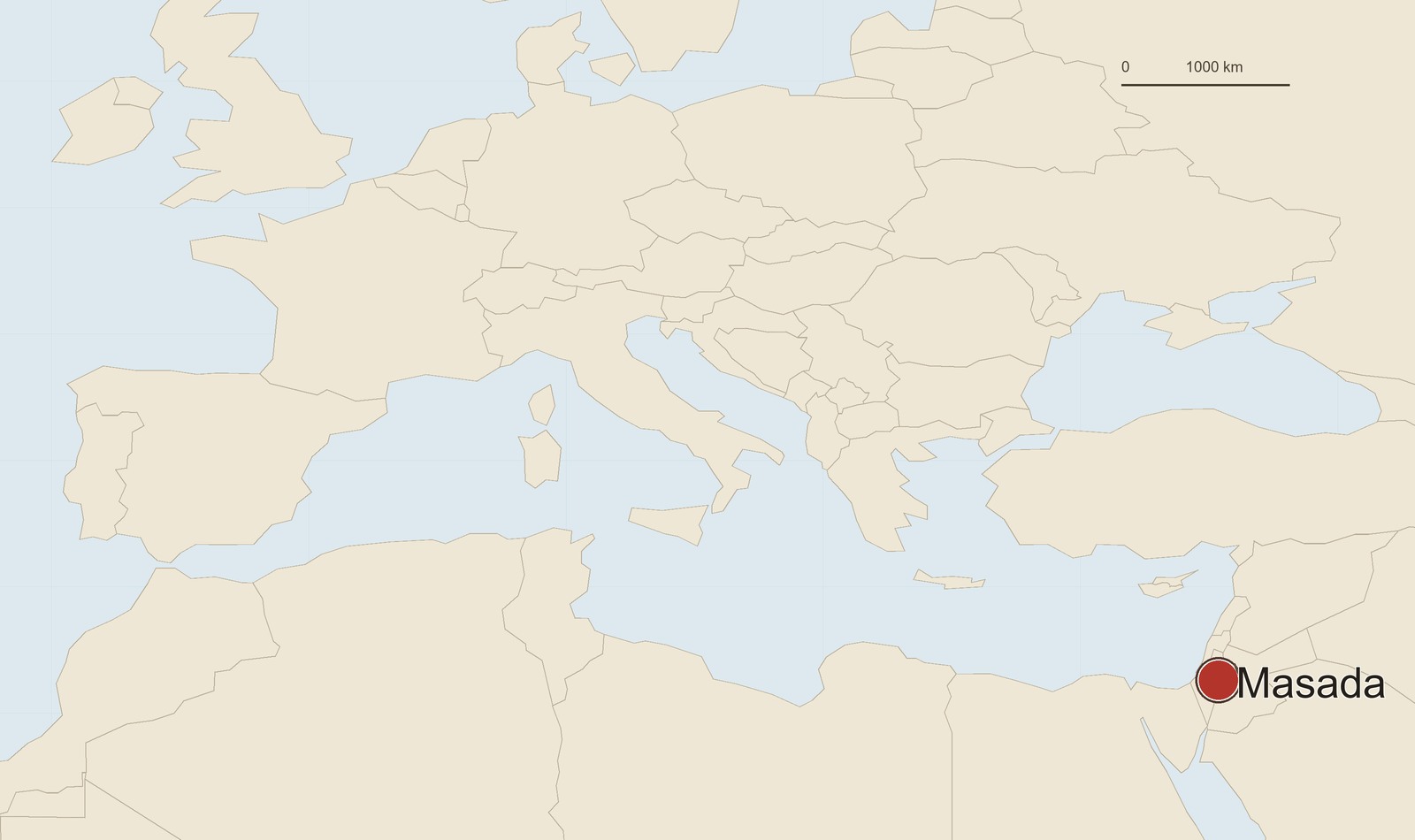 Location map of Masada near the western shore of the Dead Sea.
History of Masada
Masada stands on an isolated rock plateau near the western shore of the Dead Sea, where the Judaean Desert meets the deep rift of the Jordan Valley. The mountain's natural form made it a fortress: steep slopes restricted access, while the summit provided space for palaces, storehouses, casemates and cisterns. An earlier fortified point existed here before Herod, but the visible archaeological character of Masada belongs mainly to his late first-century BC building programme.
For Herod the Great, Masada was not an ordinary frontier tower but a reserve residence and refuge in a politically dangerous country. After taking power he fortified the summit and built the Northern and Western Palaces, bathhouses, storehouses, casemate wall and water-collection system. Food, weapons and water could be stored there, and the isolated location protected the court and garrison from sudden attack. Masada therefore combined the functions of a palace complex, military depot and final refuge of the ruler.
During the First Jewish War the role of Masada changed. In AD 66, after the revolt against Rome began, the Sicarii seized the fortress and its stores. Unlike Jerusalem, Masada was not the political centre of the revolt, but it became a durable base on the desert edge of Judaea: families found refuge there, supplies were concentrated, and an armed group remained able to control nearby routes and survive the fall of major cities.
After the capture of Jerusalem in AD 70 and the suppression of other centres of resistance, Masada remained one of the final symbols of the war. In the last phase the fortress was held by a group of Sicarii led by Eleazar ben Yair. For Rome, its survival meant an unfinished campaign: as long as an armed group remained on an inaccessible mountain, victory in Judaea did not look complete in either military or political terms.
The Roman operation against Masada is traditionally associated with the governor Lucius Flavius Silva and Legio X Fretensis. The army surrounded the mountain with camps and a circumvallation wall, blocked exits from the plateau and began building the western ramp, which allowed a siege tower and ram to be brought up to the wall. After the breach, according to Josephus, the defenders chose death rather than surrender; archaeology does not confirm every detail of that episode literally, but it preserves the material shape of the operation itself - camps, the enclosing line, the ramp, traces of fire, coins, documents and finds on the plateau. The fall of the site is usually dated to AD 73 or 74; the range reflects different chronological schemes for the final stage of the war.
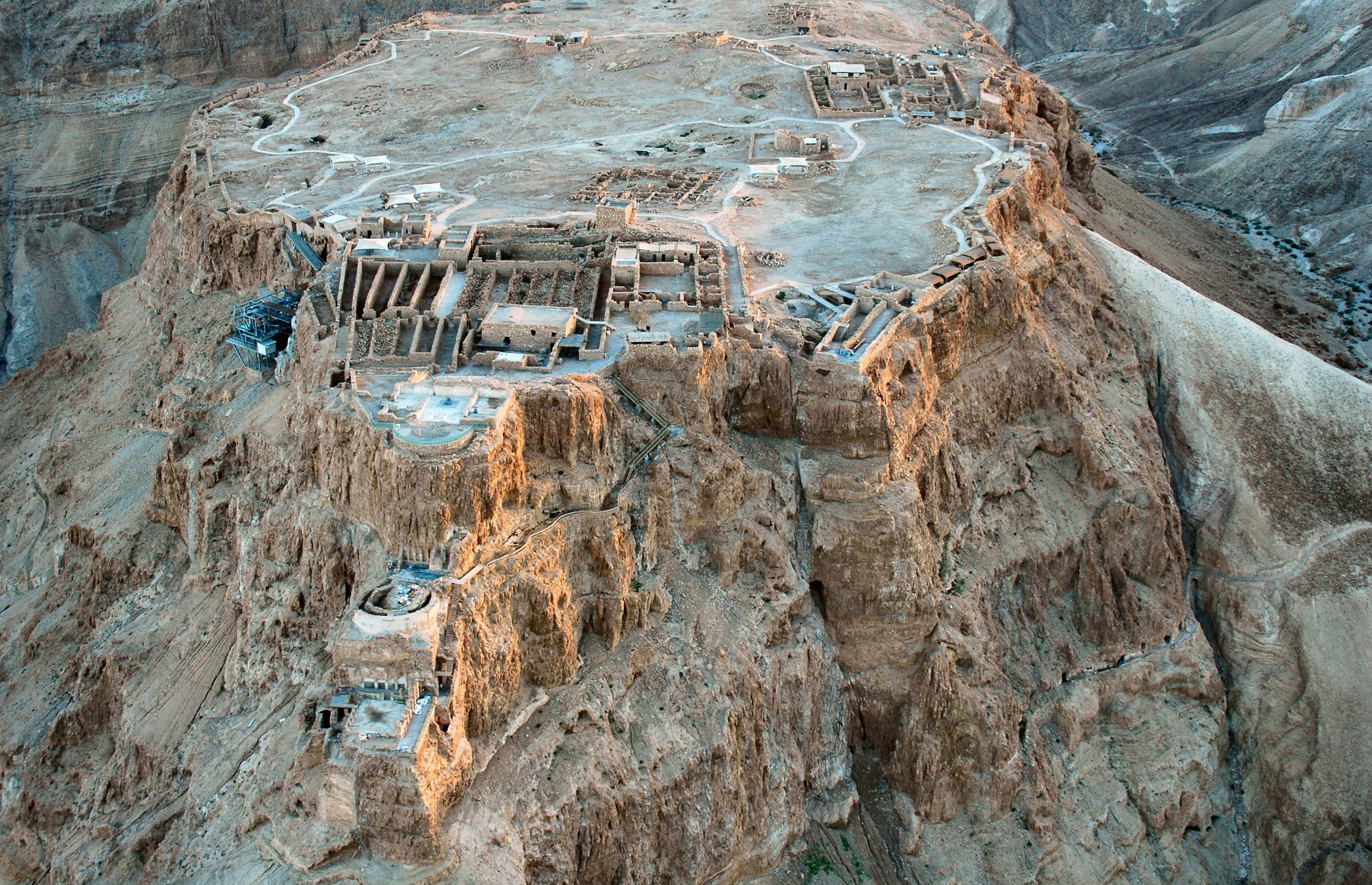 A modern view of the Masada Fortress
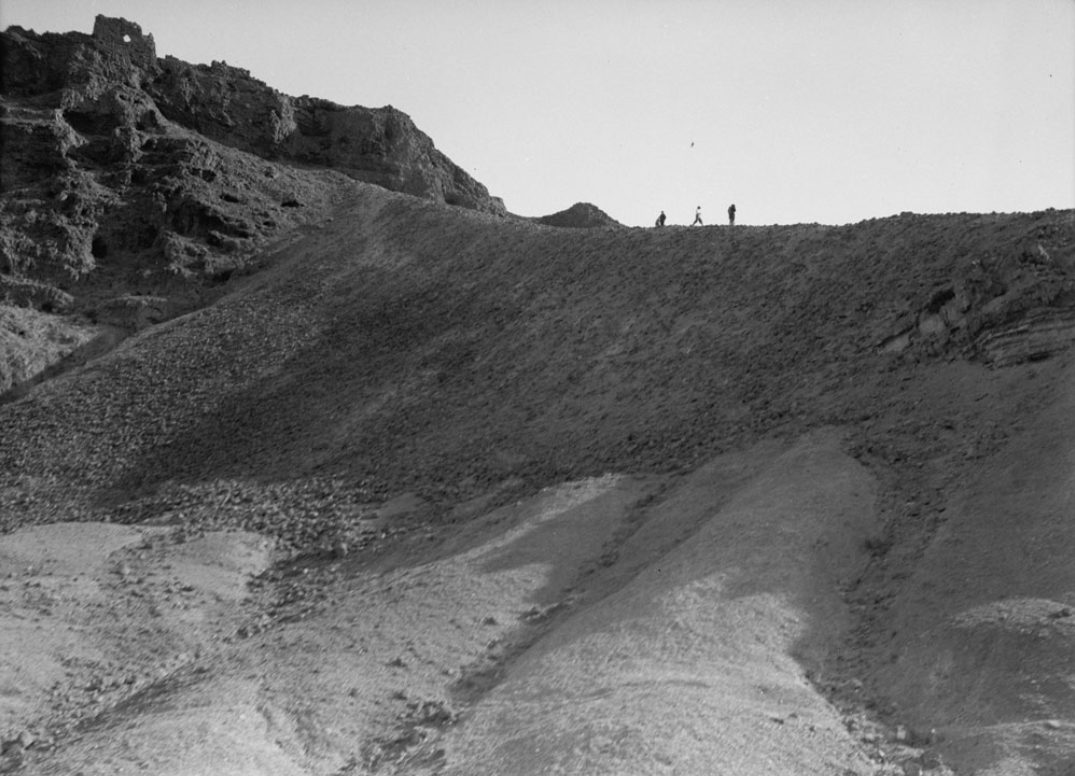 A banket built by legionnaires to get to the walls of the Masada Fortress
Archaeological Complex
Several groups of monuments on the summit are important. The Northern Palace, Western Palace, storehouses, baths, cisterns, casemates and domestic areas show not a single moment but a sequence of use: Herodian residence, rebel reuse and later occupation traces. The dry climate helps preserve organic material, so textiles, leather, wood, seeds, ropes and small everyday objects matter alongside stone architecture.
Around the plateau the Roman siege system survives: camps, circumvallation wall, posts, roads and the western ramp. This is what makes Masada especially valuable for Roman military engineering. Unlike many battlefields where camps have been erased by later building or agriculture, the desert topography preserved the general layout of the operation.
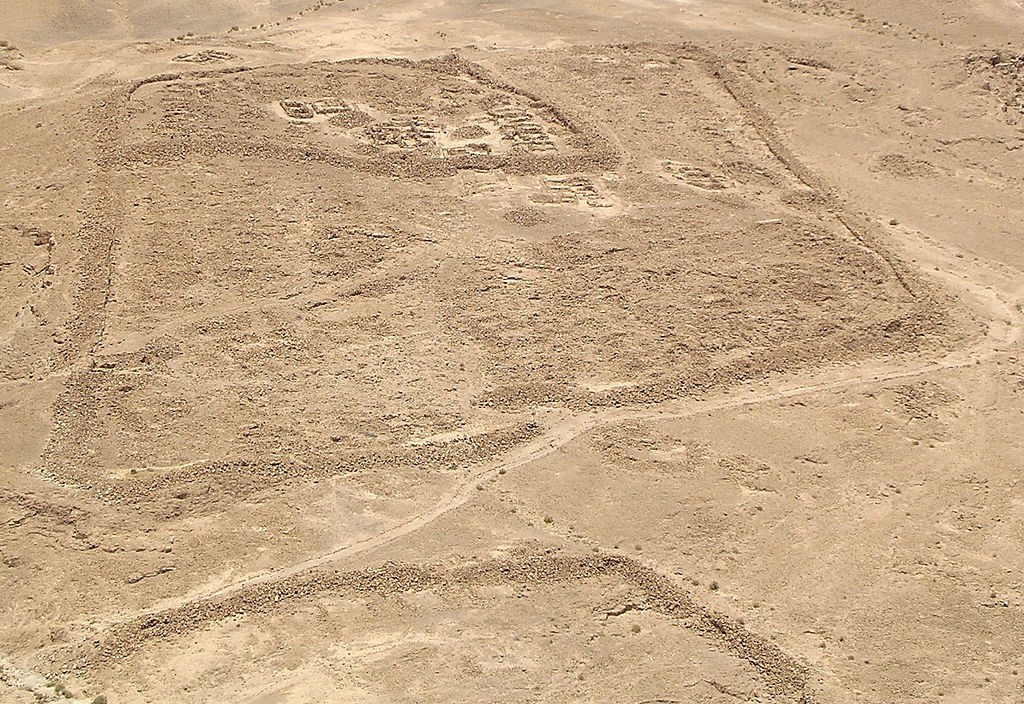 Map of the Roman camp at the foot of the Masada fortress in Israel
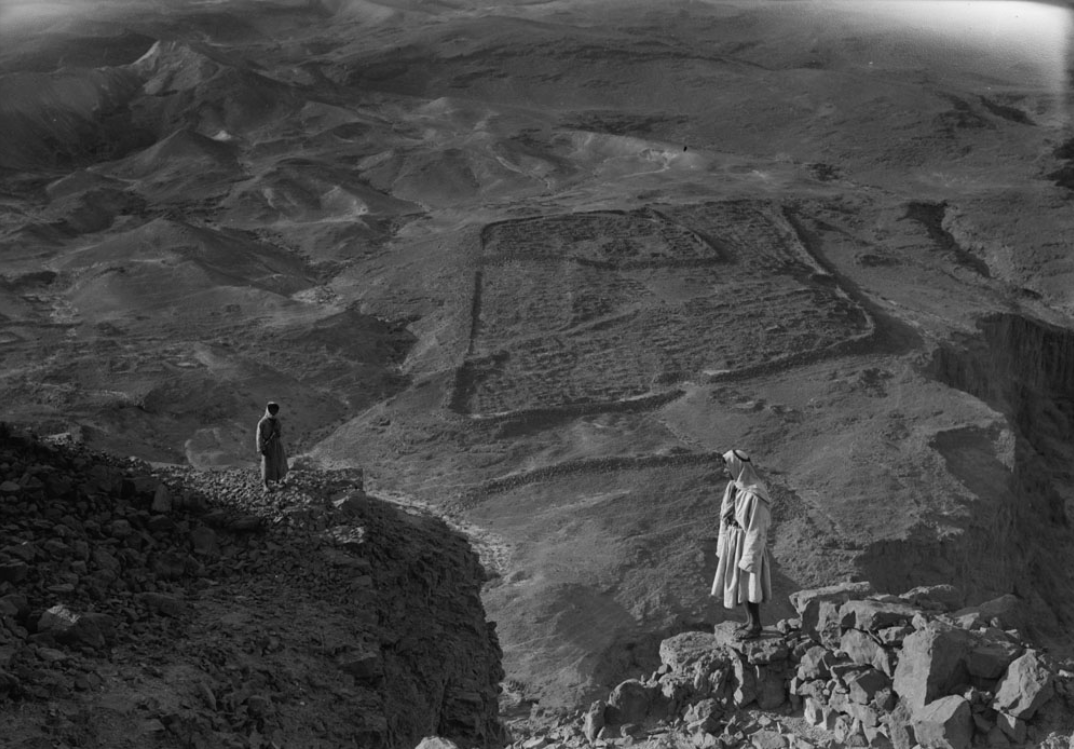 A view on the ruins of Tenth Legion's castrum from the remains of the fortress
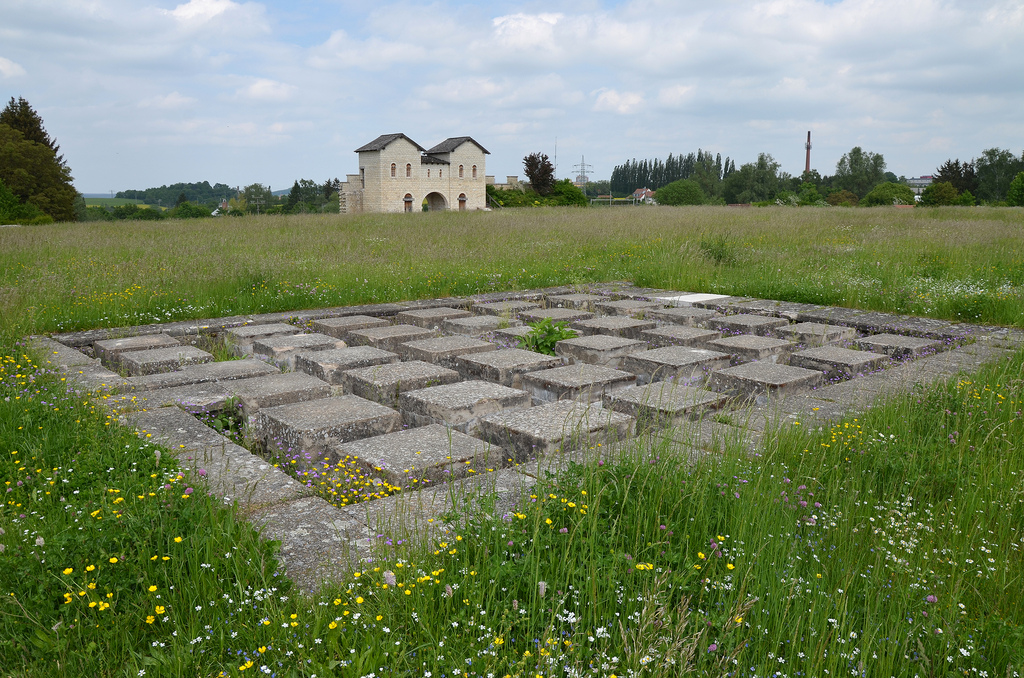 Principia's foundation (headquarters)
Water and Preservation
Water supply was as much a part of the Herodian project as the palaces and walls. Wadis around the plateau channelled winter floodwater into rock-cut conduits and cisterns. This infrastructure made life on the isolated summit possible and explains why the fortress could function as a residence, storage centre and refuge, not merely as a lookout above the Dead Sea.
The desert environment preserved materials that rarely survive in Mediterranean archaeological layers. Textiles, leather, baskets, ropes, wood remains, seeds and food traces reveal the everyday side of life on the plateau as well as the architecture. The Masada publications therefore work as a set of connected catalogues: architecture, documents, coins, pottery, military equipment, textiles and organic finds clarify one another, although they do not always belong to the same phase.
The Roman Siege
The siege of Masada shows Roman spatial organization in an unusually visible form. The camps around the mountain record troop placement and control of approaches; the circumvallation wall isolated the fortress from the outside; the western ramp solved the main engineering problem - bringing siege equipment up to the wall on the plateau. The system links strategy, landscape, labour and architecture in one archaeological complex.
At the same time Masada is not an ordinary legionary camp. It is a siege system built for one mountain, one task and one desert landscape. The camps, circumvallation line and ramp are strong evidence for Roman engineering practice and the presence of the Tenth Legion in Judaea, but they do not replace evidence for long-term castra in Britain, on the Danube or on the Rhine.
Recent topographical and 3D research has refined the scale of the works around the plateau. A Journal of Roman Archaeology study argues that the circumvallation wall and camps could have been built comparatively quickly, in a matter of weeks, after which the main effort shifted to the western ramp and the movement of siege equipment. This does not erase Josephus' narrative, but it changes how the duration and logistics of the Roman operation are understood.
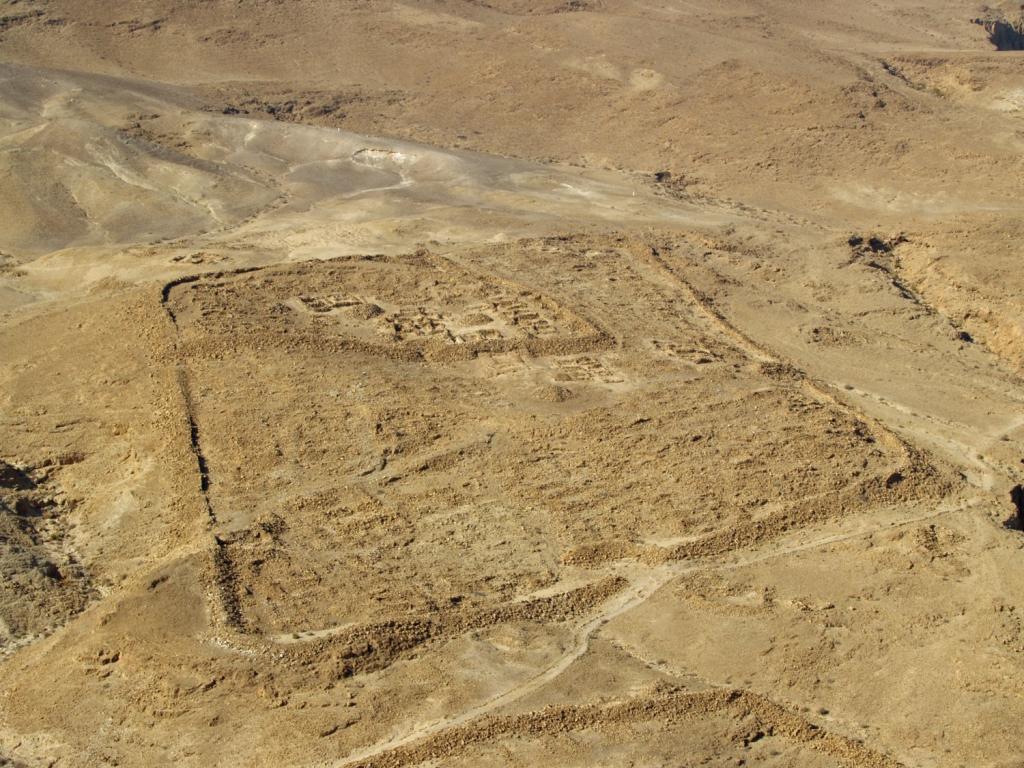 A modern view of the Castrum's ruins
 Masada,an inscription left by a soldier of the Legio X Fretensis in 74 AD. Museum in Massada. Israel
Material Culture
The military finds from Masada include weapons and defensive equipment, including scales from lorica squamata, arrowheads, projectiles and equipment connected with the final phase of the siege and life on the plateau. Some objects belong to the Roman presence, some to the rebel population, and some require cautious attribution because rooms were reused and objects moved within the complex.
Textiles and leather provide rare evidence for clothing, straps, bags, upholstery, household objects and repair. The publications matter not only for the shape and colour of fabrics but also for fibre, weave, dye traces, seams, scraps and secondary use. Baskets, ropes, wood remains, stone vessels, spindle whorls and small domestic objects add to the everyday picture that stone architecture alone cannot provide.
Documents, ostraca, coins and inscriptions separate phases of the site and connect finds with specific historical settings. Herodian architecture, objects used by the rebel population, Roman siege infrastructure and later traces all occur in one place, so an individual object from Masada only makes sense together with its publication, findspot, date and stratigraphic context.
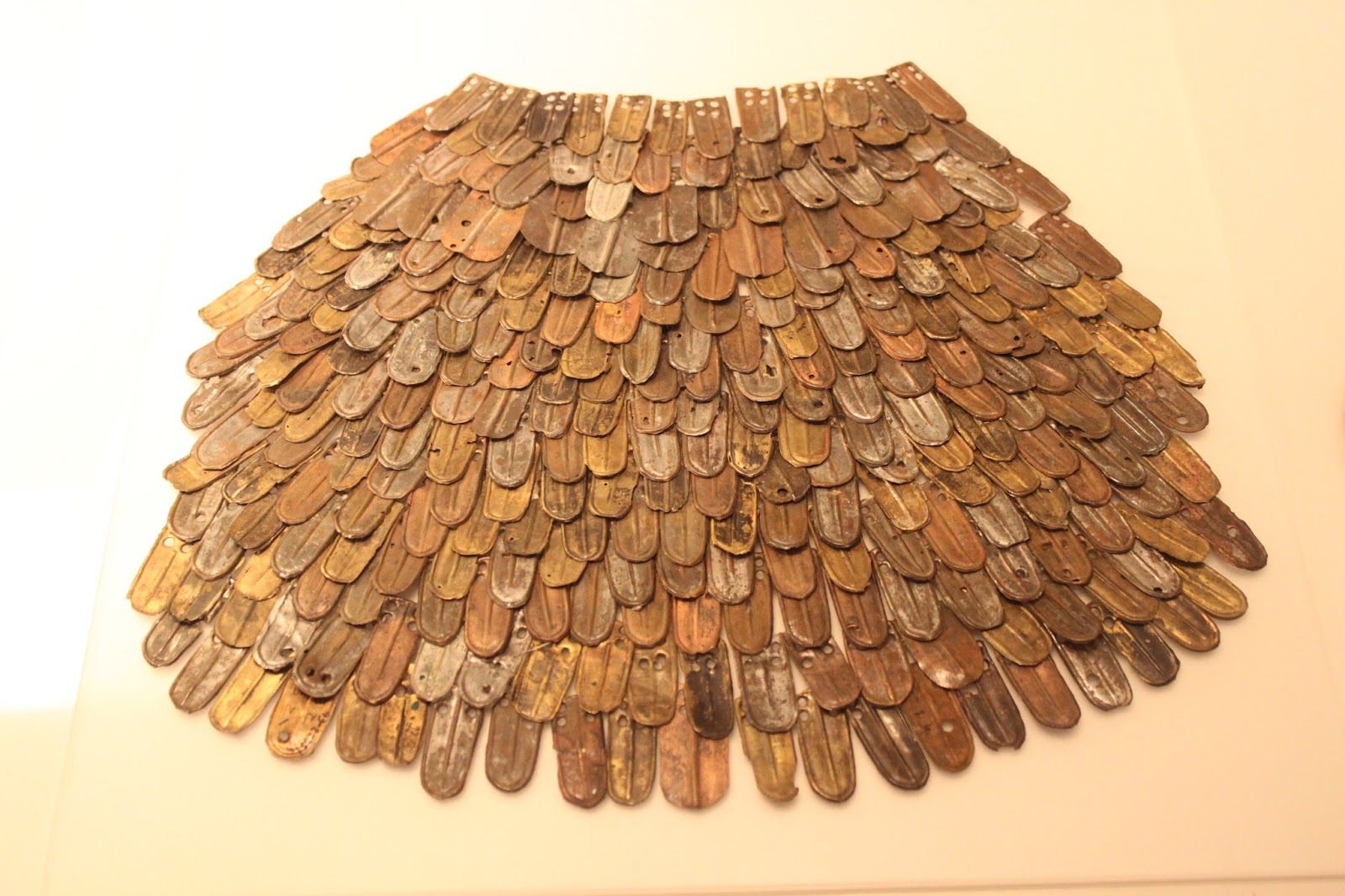 A fragment of squamata. Museum of Israel. Found in Masada, 73 CE
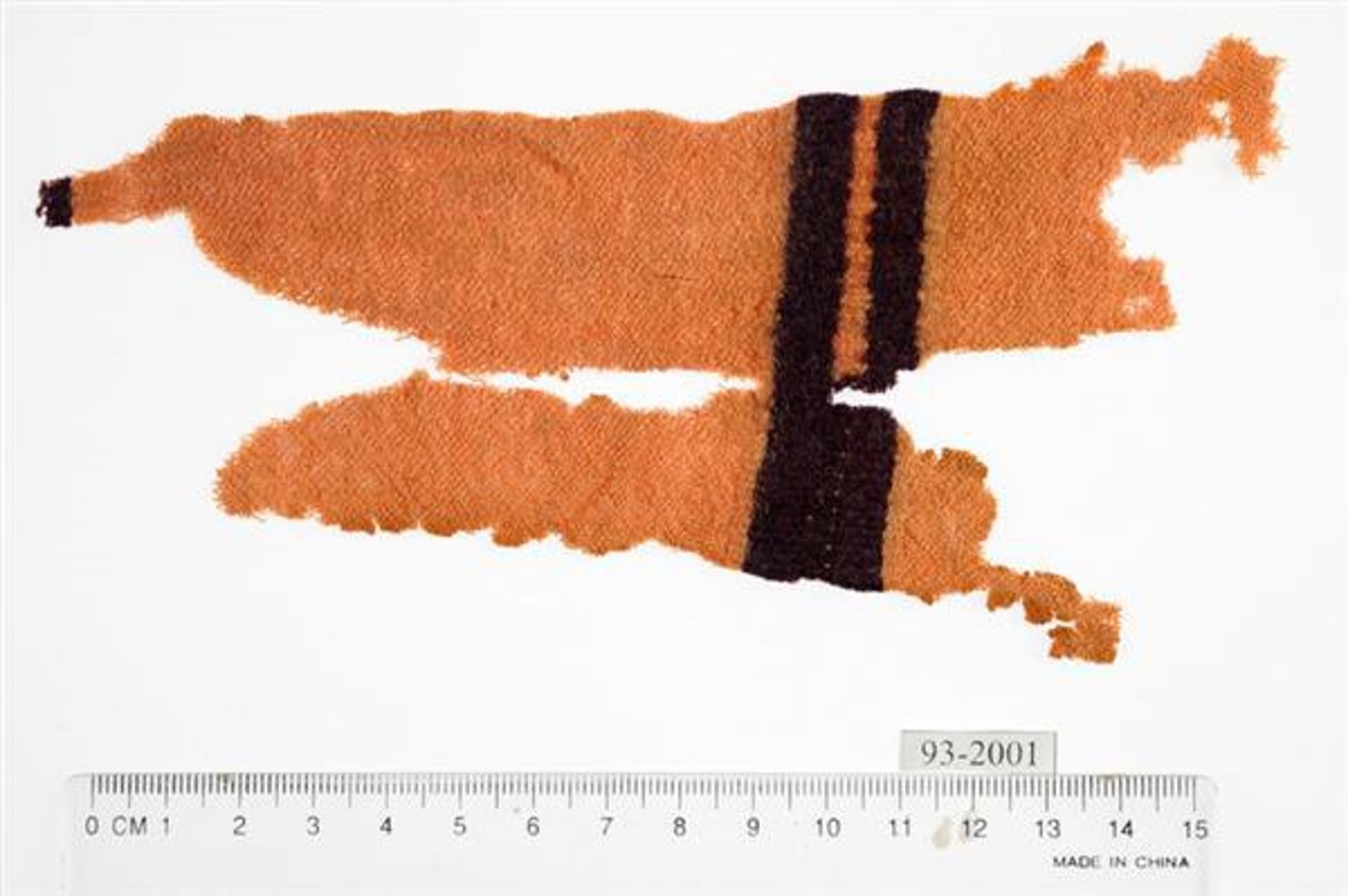 Wool textile fragment from Masada, first century CE, 17 × 7 cm; published by A. Sheffer and H. Granger-Taylor.
Sources and Interpretation
The written tradition about Masada depends almost entirely on Josephus, so the archaeological material does not simply illustrate the text but provides a separate line of evidence. The camps, circumvallation wall and ramp confirm the scale of the Roman operation; documents, coins and ostraca show administrative and everyday life; organic finds and small objects broaden the picture beyond the dramatic end of the siege.
The final reports of Yadin's excavations divide the material by category: Semitic ostraca and coins, Greek and Latin documents, architecture, lamps, textiles, basketry, wood, ballista stones, pottery, military equipment, ritual baths and other groups. That structure matters for interpretation: objects from the plateau, Roman siege works and later traces should not automatically be collapsed into a single phase.
The closest parallels for Masada usually come from Judaean Desert sites, including the Cave of Letters, while military and organic material can be compared with well-published complexes such as Dura-Europos, Pompeii and Vindolanda. These comparisons provide context only: a find from Judaea in AD 73/74 remains tied to local history, climate and the circumstances of the siege.
Related Topics
- Archaeology and museums
- Legio X Fretensis
- Castrum
- Lorica squamata
- Textiles in Antiquity
- Cave of Letters
- Dura-Europos
Literature and Sources
- Josephus. The Jewish War. Book VII.
- Yadin Y. Masada: Herod's Fortress and the Zealots' Last Stand. London, 1966.
- Yadin Y., Naveh J., Meshorer Y. Masada I: The Yigael Yadin Excavations 1963-1965. Final Reports. The Aramaic and Hebrew Ostraca and Jar Inscriptions; The Coins of Masada. Jerusalem, 1989.
- Cotton H. M., Geiger J. Masada II: The Yigael Yadin Excavations 1963-1965. Final Reports. The Latin and Greek Documents. Jerusalem, 1989.
- Netzer E. Masada III: The Yigael Yadin Excavations 1963-1965. Final Reports. The Buildings, Stratigraphy and Architecture. Jerusalem, 1991.
- Sheffer A., Granger-Taylor H. Textiles from Masada: A Preliminary Selection. In: Masada IV: The Yigael Yadin Excavations 1963-1965. Final Reports. Jerusalem, 1994.
- Bar-Nathan R. Masada VII: The Yigael Yadin Excavations 1963-1965. Final Reports. The Pottery of Masada. Jerusalem, 2006.
- Stiebel G. D., Magness J. The Military Equipment from Masada. In: Masada - The Military equipment.
- Grossberg A. The Mikva'ot (Ritual Baths) at Masada. In: Masada - The Military equipment.
- Ashkenazi H., Ze'evi-Berger O., Gross B., Stiebel G. D. The Roman siege system of Masada: a 3D computerized analysis of a conflict landscape. Journal of Roman Archaeology 37.1, 2024.
- UNESCO World Heritage Centre: Masada.
- Israel Nature and Parks Authority: Masada National Park.
Interested in Ancient Rome beyond reading? Join Legio X Fretensis or explore our reenactment directions.


