Roman Magistracies
Roman magistracies were public offices through which government, jurisdiction and military command were exercised. In the Republic, many were elective, collegiate and limited in duration. A magistrate held an office; a senator belonged to a council. The categories overlapped, but were not identical.
Powers, terms and colleagues
Many ordinary offices lasted a year. A colleague could obstruct another holder of the same office, while plebeian tribunes had their own powers of intervention. This was not a modern separation of powers: political, judicial, religious and military functions overlapped.
Imperium denoted a particular authority associated above all with senior command and government. Consuls and praetors held it; not every public official did. A magistrate's effective powers also depended on location, assigned responsibilities and historical period.
Principal Republican offices
- Quaestors undertook financial duties at Rome, in provinces and under commanders; their number and responsibilities changed over time.
- Aediles supervised aspects of urban administration, markets and games. The office could advance a career but was not compulsory for everyone.
- Praetors held imperium and undertook judicial and command responsibilities.
- Consuls were the highest ordinary magistrates, convening Senate and assemblies, directing public business and commanding armies. There were normally two.
- Censors conducted the census, revised the Senate's membership and undertook other duties. This was not a routine annual step: elections were less frequent and their tenure was limited.
- Plebeian tribunes protected plebeians, intervened in public decisions and brought proposals before the plebeian assembly. Their origins and powers differed from those of consuls.
The curule chair marked the rank of several senior magistracies. It also appeared on coins, including a denarius of C. Considius Paetus issued in 46 BCE. The chair on the reverse is a political symbol, not a depiction of the Senate's meeting place.
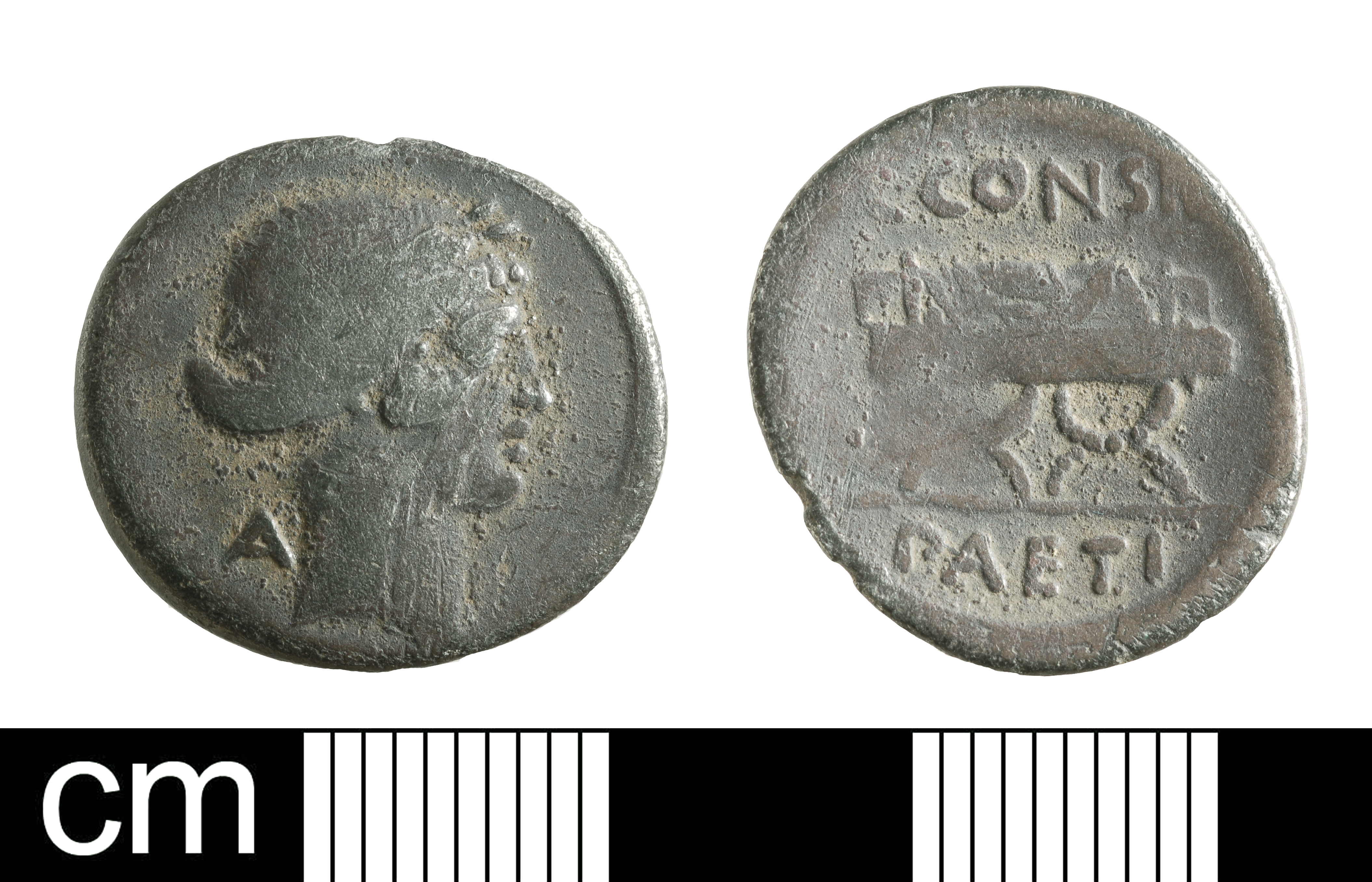 Silver denarius of C. Considius Paetus, 46 BCE. The reverse depicts a curule chair, a symbol of magisterial rank. Portable Antiquities Scheme, BH-D70528 / FindID 772011. Photograph: Julian Watters / St. Albans District Council, CC BY 2.0.
Cursus honorum: a political career
The sequence of offices was called the cursus honorum. Laws established and altered minimum ages, intervals and the order of offices; the Lex Villia of 180 BCE and Sulla's reforms were particularly important. A single age chart should therefore not be projected across the entire Republic.
A career required resources, connections and electoral support. The absence of a regular salary did not make office equally accessible to all citizens. Family background, military reputation, advocacy and public entertainment all mattered. See elections and Roman citizenship for political participation.
Dictators, promagistrates and legates
A Republican dictator was appointed for a specific extraordinary task; traditionally his authority ended after six months or on completion of the assignment. The dictatorships of Sulla and Caesar were not straightforward repetitions of that early model.
A proconsul or propraetor could continue to command through an extension of authority: a promagistrate was not necessarily a consul elected for another term. A legate served as a representative or deputy; that status was not equivalent to an independent elected magistracy.
Under the emperors, older office names survived, but the ruler's authority and influence over appointments became decisive. Republican institutions should therefore be distinguished from the careers of imperial officials and commanders.
Related topics
Literature and sources
- Polybius, Histories 6.11–18.
- Andrew Lintott. The Constitution of the Roman Republic. Oxford University Press, 1999.
- T. Robert S. Broughton. The Magistrates of the Roman Republic. 1951–1986.
- Cursus honorum: Livius.
Illustration: file page and attribution; CC BY 2.0.
Interested in Ancient Rome beyond reading? Join Legio X Fretensis or explore our reenactment directions.


