Roman Legion - Legio II Parthica
Legio II Parthica was a Roman imperial legion raised by Septimius Severus in AD 197 for the war against Parthia. Unlike Legio I Parthica and Legio III Parthica, which remained in the east, the Second Parthian legion was stationed in Italy at Castra Albana near Rome and became an imperial strategic reserve.
Founded: AD 197.
Symbol: centaur.
Names and titles: Parthica, Albana; in the third century the legion is attested with honorific titles such as Pia Fidelis Felix Aeterna and later repeated formulas of loyalty to the emperor.
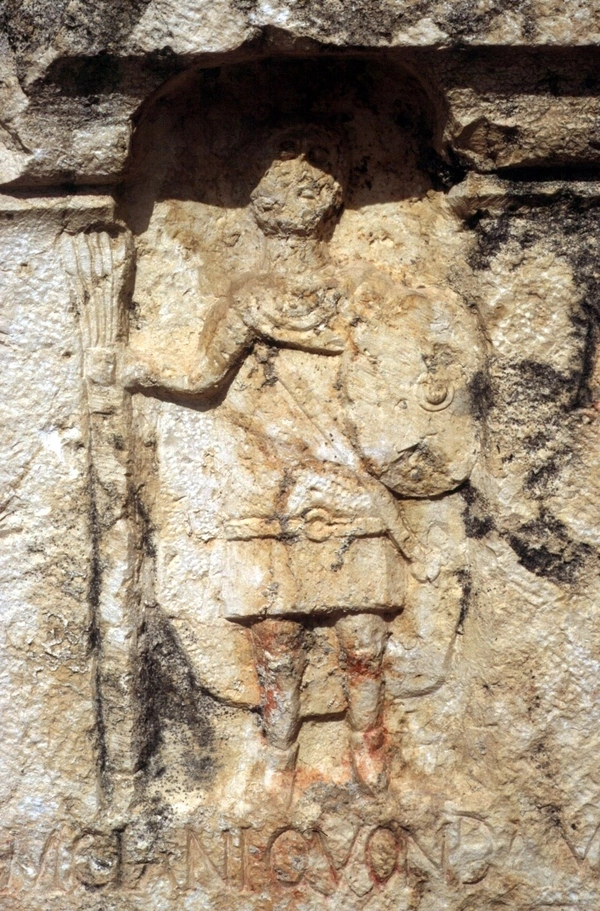 Aurelius Mucianus, centurion of II Parthica, III century CE
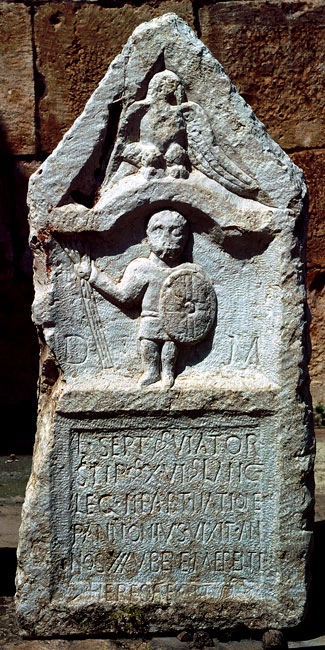 Lucius Septimius Viator, lanciarius of II Parthica, 218 CE, Apamea, Syria
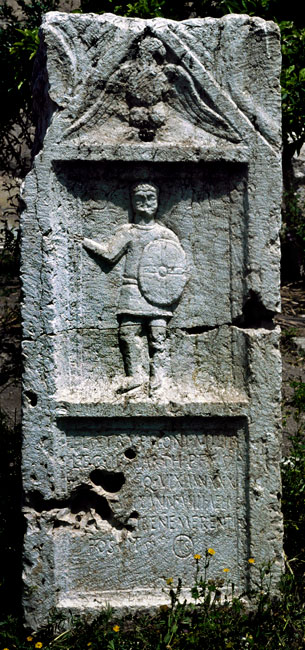 Tombstone of the legionnaire Flavius Tryphon of II Parthia. Apamea, 3rd century AD
Foundation and Castra Albana
The three Parthian legions were created after Septimius Severus had won the civil war and before his eastern campaign. According to Cassius Dio, the First and Third Parthian legions remained in the new province of Mesopotamia, while II Parthica was moved to the Alban mountain. This broke with older practice: a full legion was again placed close to Rome, where normally only the Praetorian Guard was stationed.
Its position near the capital made II Parthica more than a local garrison. It could be sent quickly to a threatened frontier, support the emperor in Italy and balance dangerous politics in Rome. For this reason ancient and modern writers often refer to it as the Alban legion.
Service in the Third Century
Under the Severans the legion functioned as a mobile reserve. It is associated with Septimius Severus' British campaign, Caracalla's eastern war, the events of AD 217-218 in Syria and the struggle around Macrinus and Elagabalus. Tombstones from Apamea show soldiers of II Parthica in Syria, including men who died or were buried far from Alba.
In the 230s and 240s detachments of II Parthica served in wars against the Sasanians and Germanic peoples. The legion supported Maximinus Thrax, was involved in the march on Aquileia, and was again sent east under Gordian III. Third-century inscriptions place it in several parts of the empire, fitting its role as a mobile reserve.
Later History
By the end of the third century II Parthica was again in Italy. The old Alban unit was probably dissolved after Constantine's victory over Maxentius in AD 312, together with forces that had supported Constantine's rival. In the fourth century a legion of the same name appears on the Tigris at Bezabde; it probably developed from a detached mobile subunit of the earlier legion. Bezabde was captured by the Persians in AD 360, after which the later II Parthica disappears from the record.
For reconstruction the legion is important because its Syrian tombstones show late antique forms of legionary light infantry: lancearii, light javelins, spathae and the changing role of the old legion in the armies of the third century.
Related topics
List of Roman legions, Legion, Roman army, Legio I Parthica, Dominate-era lancearius, Spatha, Galea
Literature and sources
1. Cassius Dio. Roman History.
2. Herodian. History of the Empire after Marcus.
3. Ritterling E. Legio // Realencyclopadie der classischen Altertumswissenschaft.
4. Le Bohec Y. The Imperial Roman Army. London, 1994.
5. Lendering J. Legio II Parthica // Livius.org.
Interested in Ancient Rome beyond reading? Join Legio X Fretensis or explore our reenactment directions.


