Roman Calendar
The Roman calendar organised festivals, court business and public activity as well as the passage of time. Its form changed: the Republican calendar with an intercalary month must be distinguished from the Julian calendar introduced under Caesar. Romans commonly dated days in relation to the Kalends, Nones and Ides, and identified a year by its serving consuls.
Months and the beginning of the year
The developed Republican calendar had twelve months. September, October, November and December retained names derived from seven, eight, nine and ten, although their positions differed in a year beginning with January. Roman tradition credited Romulus with a ten-month calendar and Numa with reforms. These early accounts survive in much later writers, and their details remain disputed.
From 153 BCE consuls entered office on 1 January. This should not be treated as the single origin of every Roman New Year convention: civic dating, terms of office and religious cycles had different histories. Quintilis and Sextilis were later renamed Julius and Augustus.
Kalends, Nones and Ides
The Kalends fell on the first day of each month. In March, May, July and October the Nones fell on the seventh and the Ides on the fifteenth; in the other months they fell on the fifth and thirteenth. Intermediate dates were counted backwards to the next fixed day, including both the starting and ending days.
For example, 13 March was the third day before the Ides of March: the inclusive count comprises 13, 14 and 15 March. The fourteenth was pridie Idus Martias, the day before the Ides. Simply subtracting the numeral therefore gives the wrong date. Roman numerals help in reading abbreviated dates; a.d. here means ante diem, not Anno Domini.
Intercalation and Caesar's reform
An ordinary Republican year contained 355 days. An intercalary month brought it into line with the solar year, under the supervision of the pontiffs. Irregular intercalation caused civil dates to drift from the seasons. A Republican date therefore cannot be converted into a modern one merely by substituting the month's Latin name.
Julius Caesar's reform established a solar year of 365 days with an extra day every four years. It took effect in 45 BCE. The preceding year, 46 BCE, was extended to correct the accumulated discrepancy. Early mistakes in applying the leap-year rule were subsequently addressed under Augustus.
In Roman dating the extra day repeated the sixth day before the Kalends of March, ante diem sextum Kalendas Martias. Hence bissextilis, literally “twice sixth”. In the ordinary inclusive count this date corresponded to 24 February. The modern designation “29 February” locates the additional day differently and does not reproduce the ancient formula literally.
Festivals and public business
Surviving calendars, or fasti, recorded festivals and categories of days. F marked a dies fastus, when a magistrate could perform certain judicial acts; N a dies nefastus, when those acts were restricted; and C a dies comitialis, permitting popular assemblies. These categories were not modern working days and weekends: restricting a particular public act did not stop all economic activity.
The eight-day nundinal cycle, labelled A–H, was associated with market days. The planetary seven-day week spread later. The two systems coexisted for a time, so the Roman calendar should not be imagined as a familiar weekly grid throughout its history.
A year was often identified by the names of its consuls. Dating from Rome's foundation appears in historical works, but was not the sole everyday standard. Imperial inscriptions can be dated through consulships, tribunician powers and other elements of a ruler's titulature.
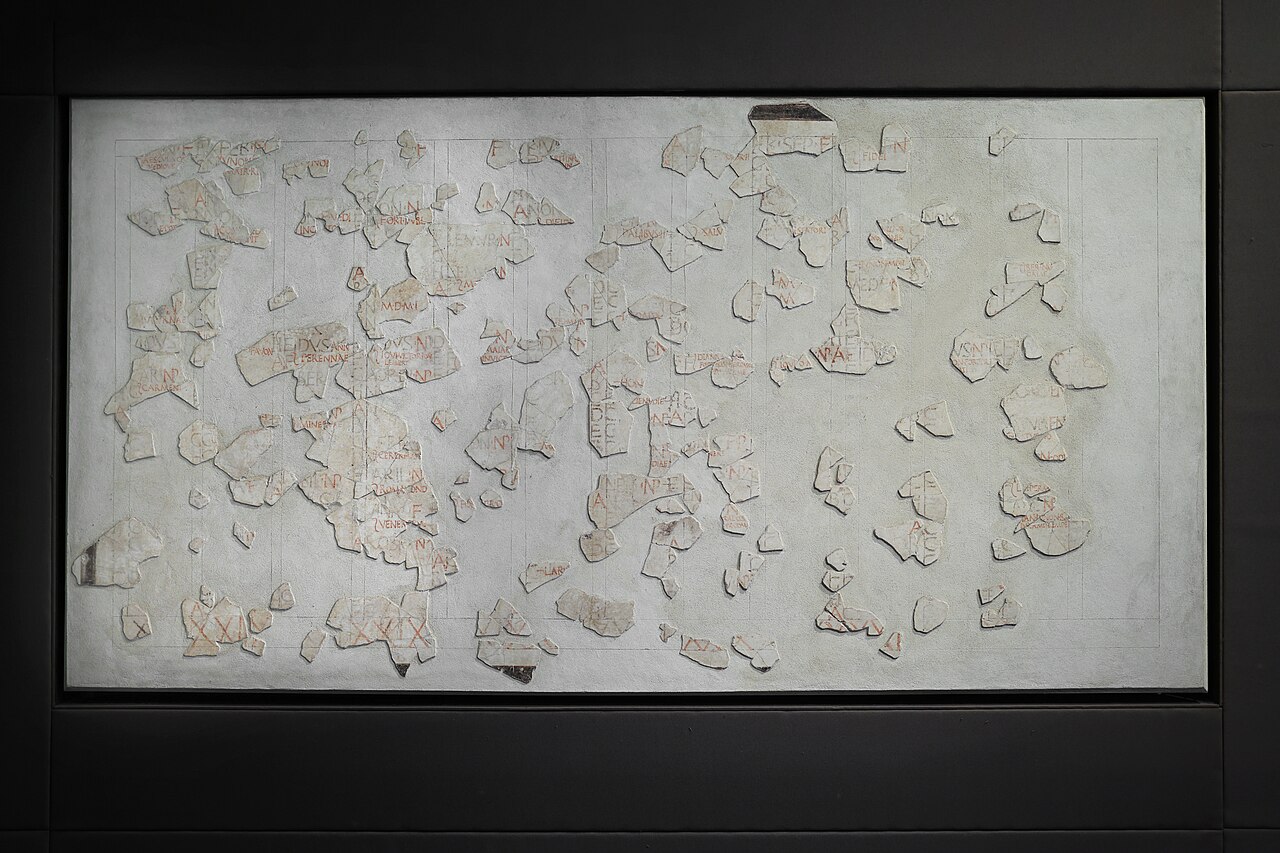 Fasti Antiates maiores: fragments of a pre-Julian calendar from Antium, 84–55 BCE. The calendar was painted in black and red on plaster. Museo Nazionale Romano, Palazzo Massimo. Photograph: Fabrizio Garrisi, CC0.
Related topics
Literature and sources
- Ovid, Fasti: a poetic account of festivals, not a neutral calendar handbook.
- Roman calendar: Encyclopaedia Romana.
- Julian calendar.
- Jörg Rüpke. The Roman Calendar from Numa to Constantine. Wiley-Blackwell, 2011.
Illustration: file page and attribution; CC0.
Interested in Ancient Rome beyond reading? Join Legio X Fretensis or explore our reenactment directions.


