Music in Ancient Rome
Music in ancient Rome accompanied sacrifice, processions, theatre, banquets, funerals, weddings, public games and military commands. There was no single "Roman sound": musical life changed from the Republic to the later Empire, differed between Rome and the provinces, and combined Italic, Etruscan, Greek, Egyptian and eastern traditions.
Romans inherited many instruments and musical concepts from the Greek world but placed them within their own institutions and spectacles. The tibia sounded in cult and on the stage, the kithara accompanied song, the cornu and tuba carried signals and took part in ceremony, and the hydraulis became conspicuous at public games. Music was made by professionals of different legal status—free people, freedpeople and enslaved people, men and women, soloists, choruses and ensembles.
 Musicians with a hydraulis and cornu. Floor mosaic from the Roman villa at Nennig on the Moselle, Germany, mid-3rd century CE. The scene shows a water organ and a curved brass instrument in the context of public games.
What Survives of Roman Music
Sound vanishes as it is performed, so the evidence preserves aspects of a performance rather than the concert itself. Archaeologists recover pipes, mouthpieces and bone or metal fittings of wind instruments; strings and wooden sound boxes survive far less often. Reliefs, frescoes, mosaics, coins and lamps show instruments and ensembles. Inscriptions name musicians, associations, offices and winners of competitions.
Literary texts describe audiences, payment, moral judgement and exceptional performances, but authors could exaggerate for satire or praise. Musical theory and notation survive more fully in the Greek tradition that continued within the Roman Empire. Instruments, settings and a limited body of melodic evidence can therefore be studied, but there is no complete repertoire for all Roman cities.
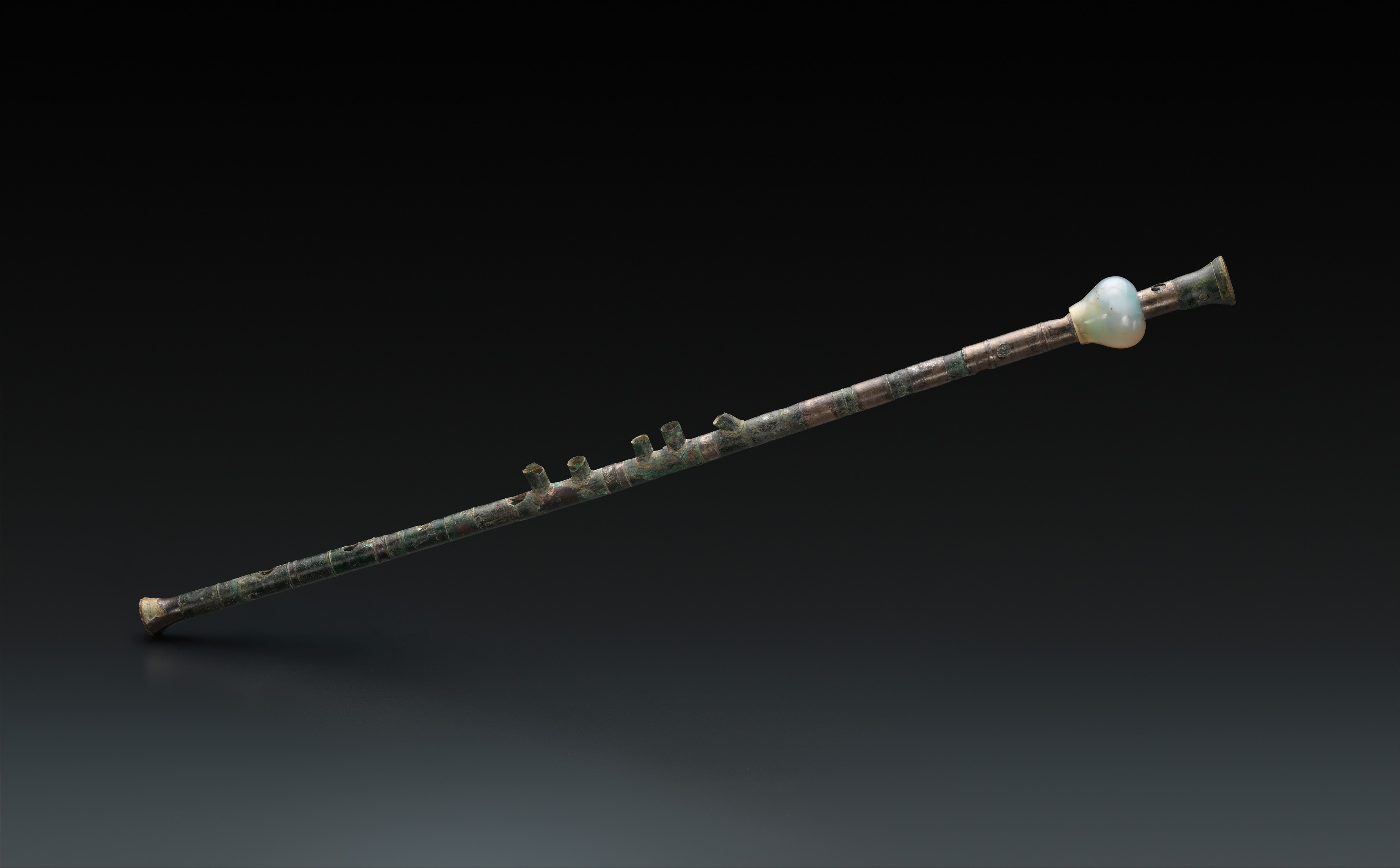 Tibia with side chimneys and rotating rings. Ivory, silver and chalcedony; Syria, Late Roman, 1st-5th centuries CE; The Metropolitan Museum of Art, acc. 58.40. The double-reed instrument was commonly played as a pair of pipes. Public Domain.
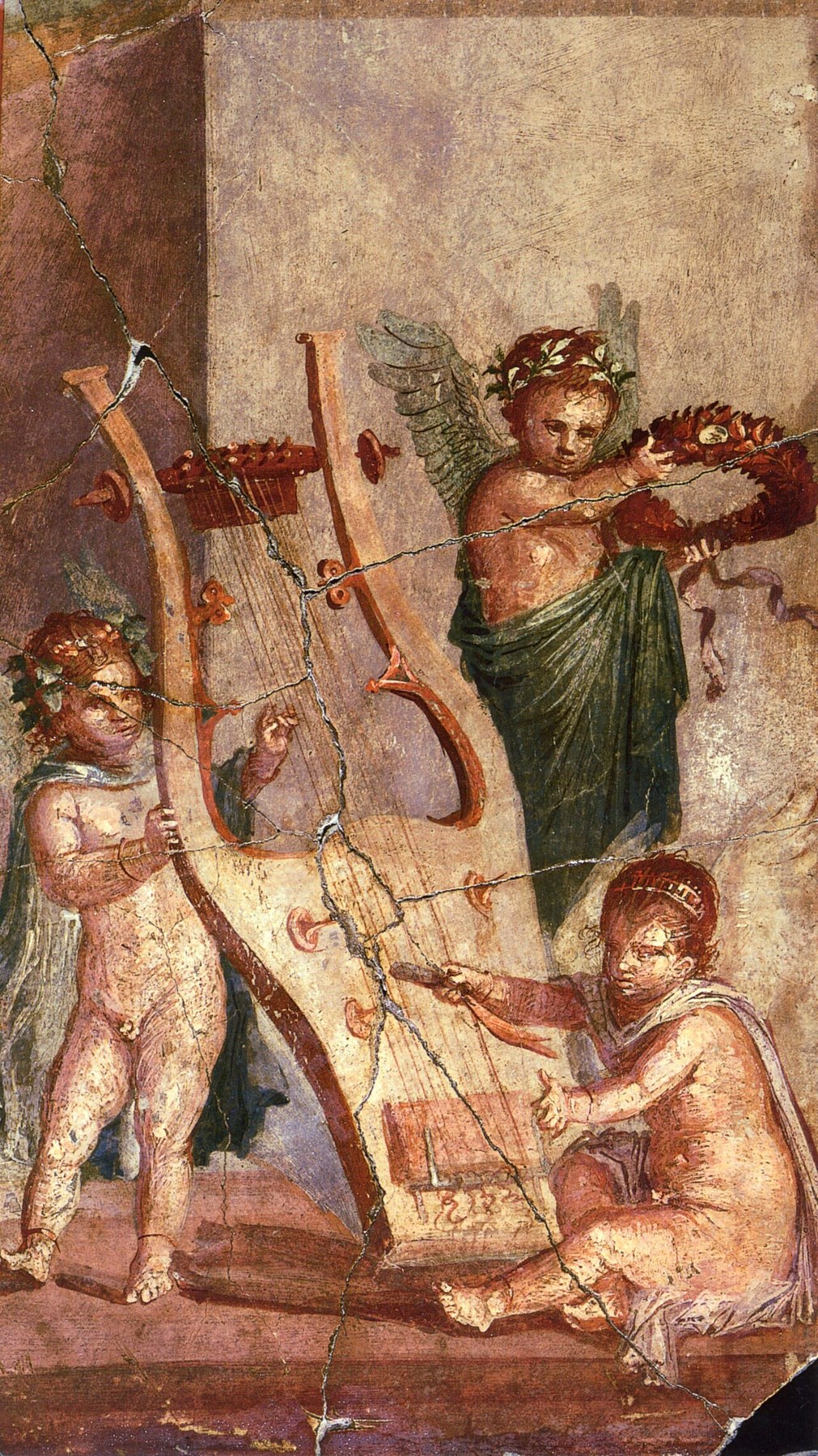 Herculaneum: Herculaneum - Lyre and Cupids; archaeological view, find or museum context connected with the site, Roman period or local archaeological context.
Instruments
The tibia was a double-reed wind instrument. A player often sounded two pipes at once, controlling holes with the fingers or rotating rings. It accompanied sacrifice, theatre, banquets, weddings and funerals. The Greek aulos belongs to the same broad tradition, but the modern word "flute" is misleading: sound came from a reed rather than air blown across an opening.
The lyre and larger kithara joined strings, voice and poetry. The kithara required professional technique and often appears with Apollo, singers and educated figures. Percussion included cymbals, crotala, the sistrum and tympanum; these are especially visible in Dionysiac and eastern cults, although an image of a mythical maenad cannot automatically be treated as an everyday scene.
The tuba was a long straight trumpet, while the cornu was a large curved horn with a crossbar. The terms bucina and cornu do not always identify a precise shape in written sources, so an archaeological object or image is more reliable than a simple diagram. The specialised performers and signals are discussed in Cornicen, Bucinator and Tubicen.
The hydraulis, or water organ, used water to stabilise the air pressure supplied to its pipes. Invented in the Hellenistic world, it spread through the Roman Empire and sounded in theatres, circuses and amphitheatres. The find from Dion and mosaics such as the example from Nennig allow Vitruvius's description to be compared with an actual mechanism and ancient imagery.
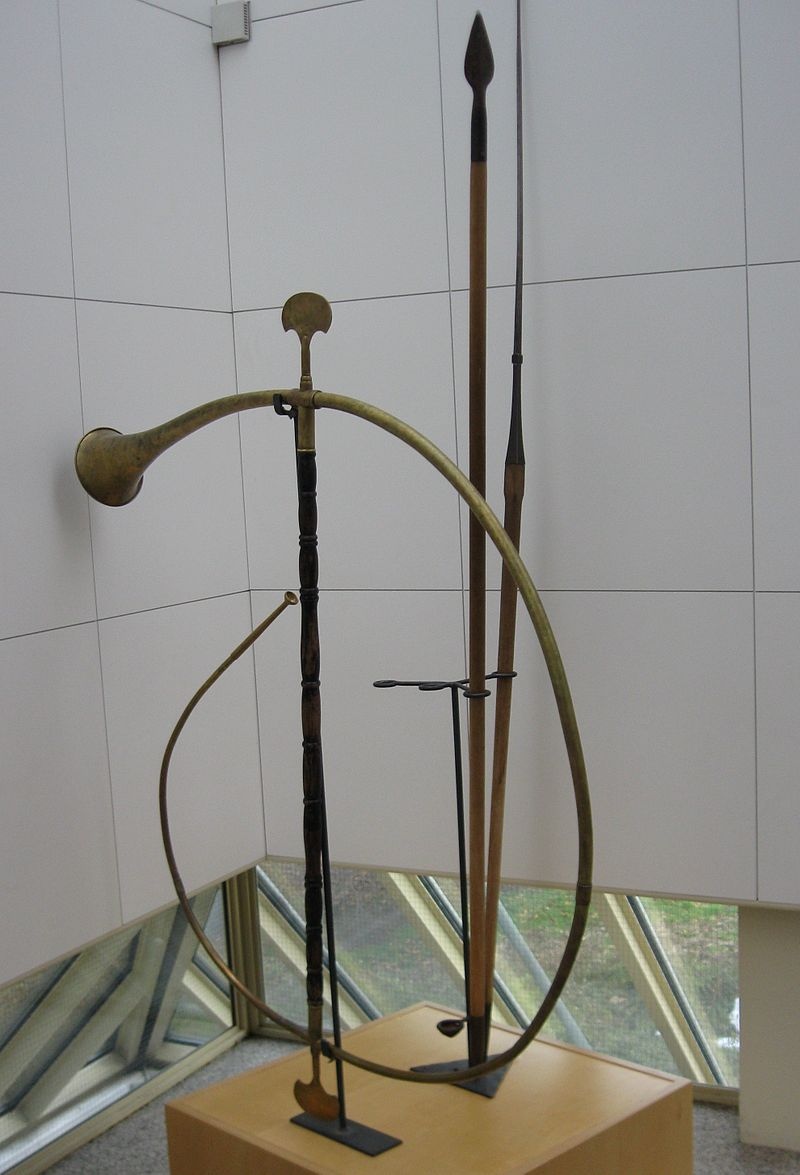 Kornu made of bronze. Roman Museum,Aalen,Germany. 1-2 century AD
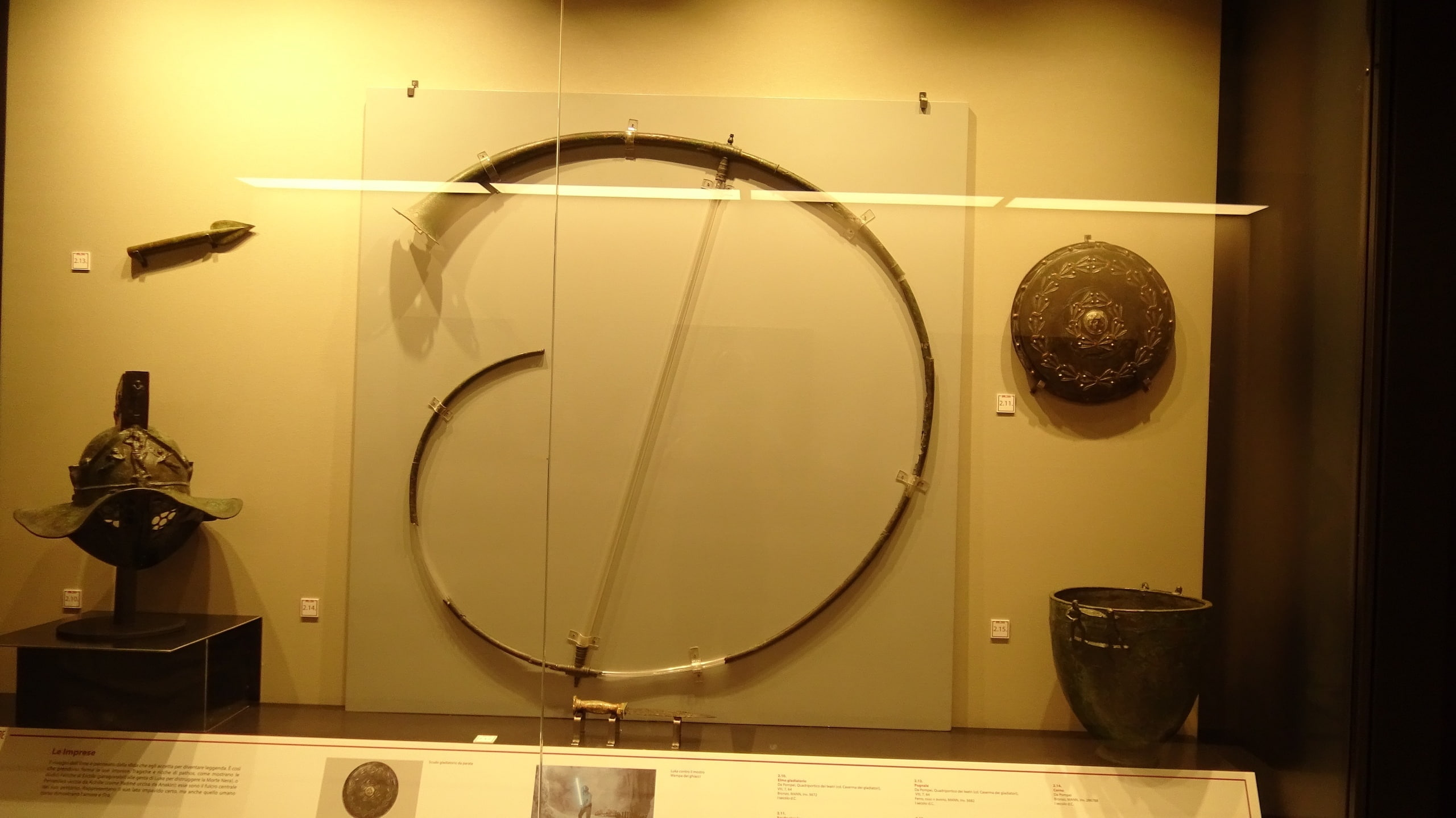 Bucina. National Museum of Naples. 1st century AD
Cult, Theatre and Public Spectacle
Music at a sacrifice was not decorative background. The tibia accompanied the rite and helped separate sacred action from surrounding noise. Processions joined movement, song, winds and percussion. Musicians are shown beside altars, priests and participants, so a figure's position in a composition matters as much as the instrument.
In the Roman theatre music accompanied entrances, songs, choral and danced episodes. Mime and pantomime depended especially on rhythm, orchestra and sung text. In amphitheatres and circuses the hydraulis, cornu and other instruments marked action, supported ceremony and directed attention. An image of musicians beside gladiators does not prove uninterrupted "battle music," but it securely places performers within the organisation of games.
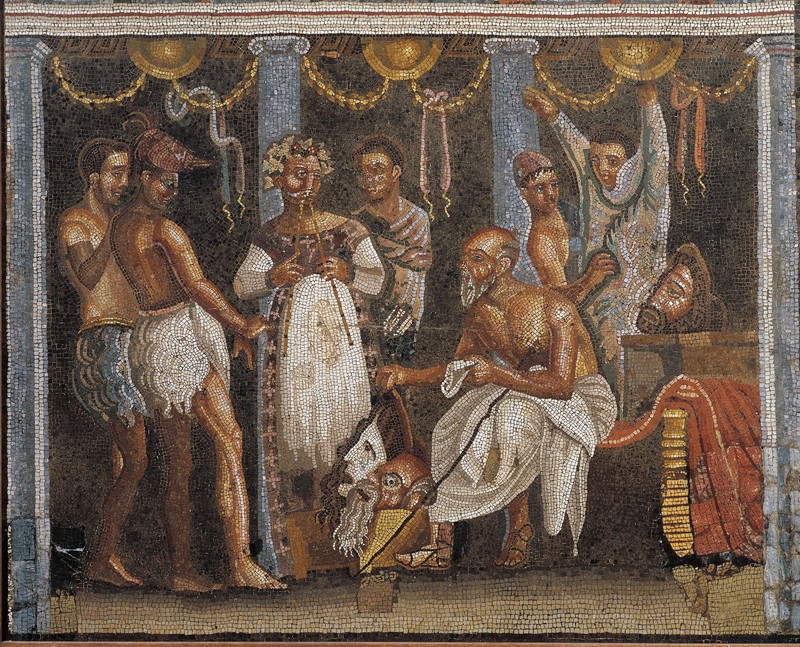 Actors preparing for a satyr play. Mosaic from the House of the Tragic Poet at Pompeii, 69–79 CE; Naples, National Archaeological Museum, inv. 9986. Masks, costume, danced movement and a double-pipe player turn a lost performance into a carefully organised image.
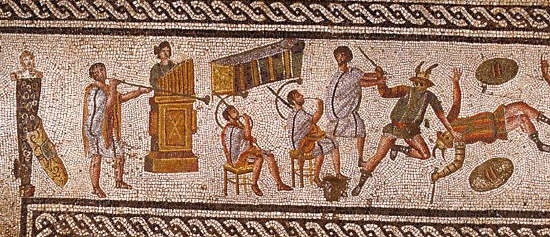 Mosaic with musicians and gladiators. 1-3 century AD
Home, Banquet, Education and Profession
Music sounded in the home beyond major festivals. Singing and strings accompanied leisure, poetry and education. In elite culture, playing the lyre or kithara could advertise Greek learning, but a professional performer was judged differently from a householder making music for a private circle.
Banquets employed singers, instrumentalists and dancers. Some belonged to a household, while others were hired for an event. Inscriptions record male and female musicians, family relationships, associations and professional titles. A successful artist could gain fame and money even though stage work was often associated with low legal or social status.
Images of musical education often come from Greek settings, and Roman patrons consciously adopted this visual language. An Attic school scene therefore illuminates a cultural ideal but is not a direct photograph of a lesson in Rome.
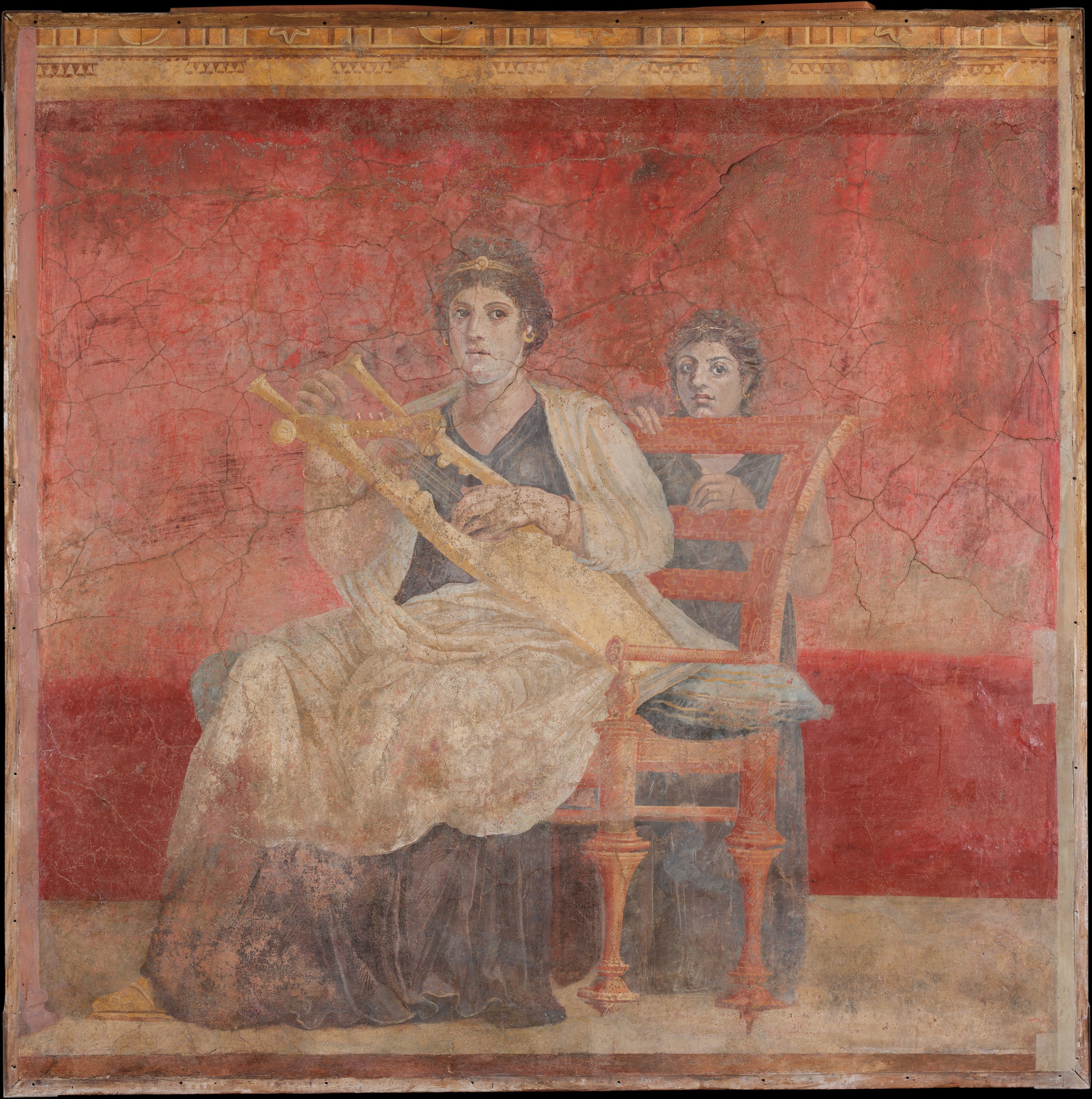 A woman with a kithara and a girl in a wall painting from Room H of the Villa of Publius Fannius Synistor at Boscoreale. Fresco, c. 50-40 BCE; The Metropolitan Museum of Art, acc. 03.14.5. Public Domain. Source: The Met, 03.14.5
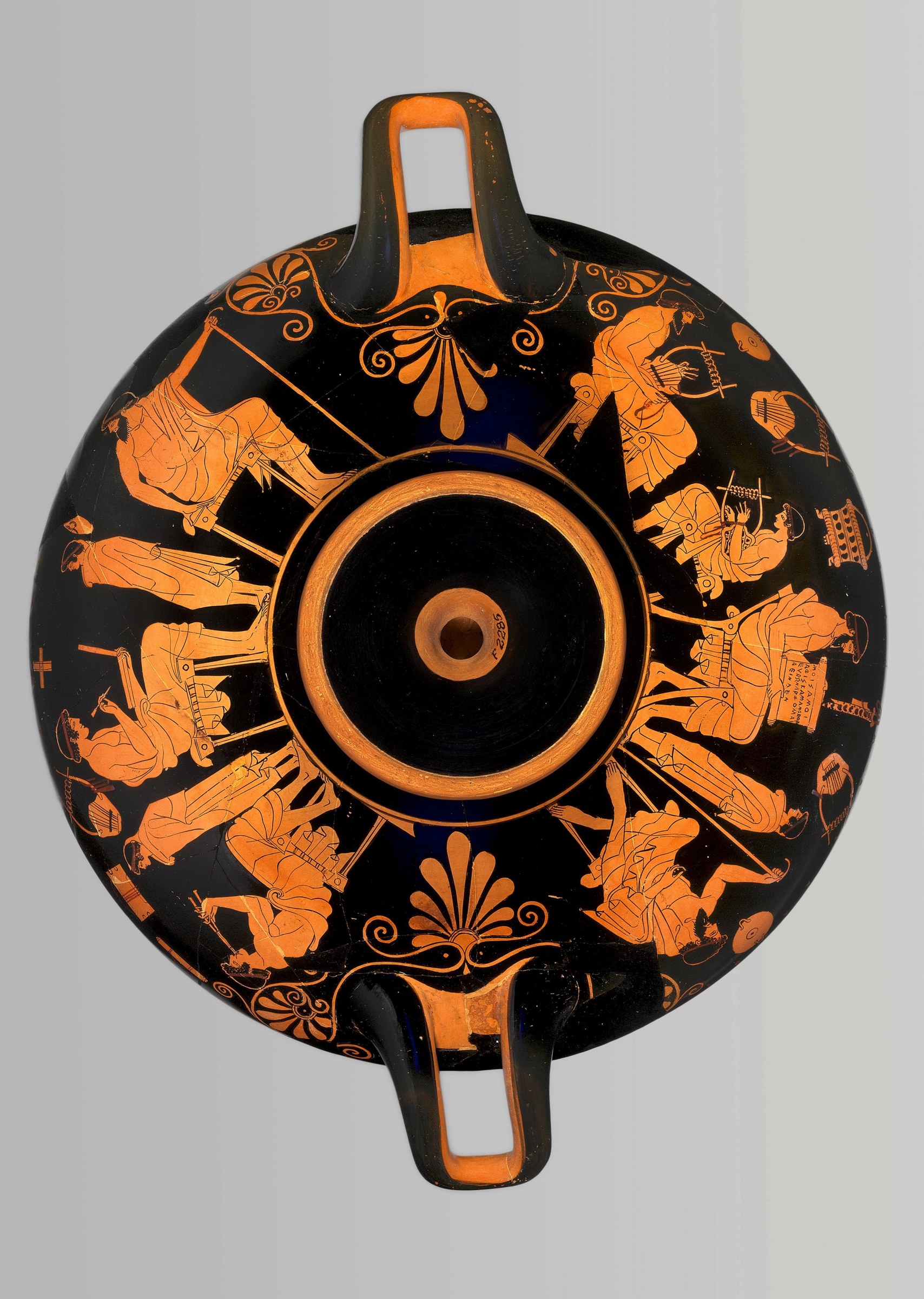 Douris cup with a school scene: teachers, pupils, writing and music. Attica, c. 480 BC; Antikensammlung Berlin.
Military Signals as a Distinct Field
The army used sound primarily for communication: assembly, guard changes, movement, alarm and ceremony required short recognisable signals. Cornicines, tubicines and bucinatores belonged to an organised system for transmitting orders. Reliefs place them beside standards and marching troops, while tombstones name an office and unit.
Military signals matter to the history of Roman music but do not define it as a whole. Their instruments and techniques overlapped with civic ceremony and games, but the purpose of a signal differed from song, theatrical accompaniment or a banquet ensemble.
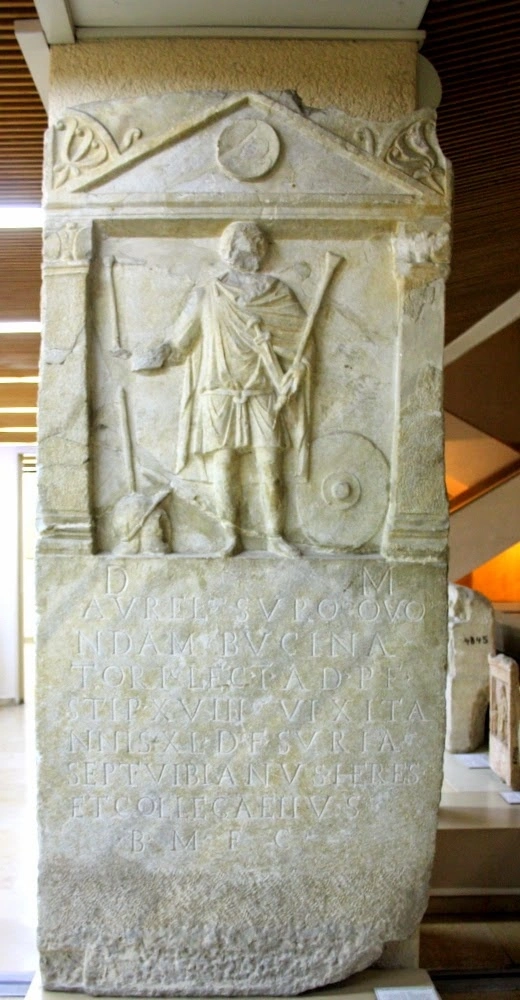 Tombstone of Aurelius Suron, bucinator of the I Auxiliary Legion, 3rd century AD
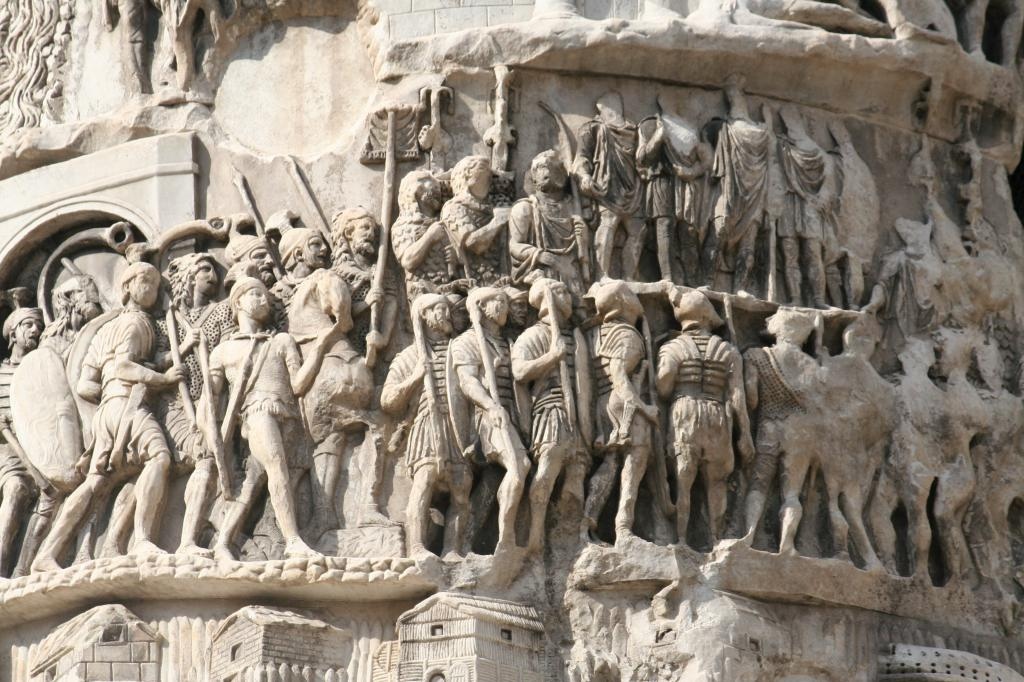 Kornitseny on the march. The Aurelian Column. 2nd century AD
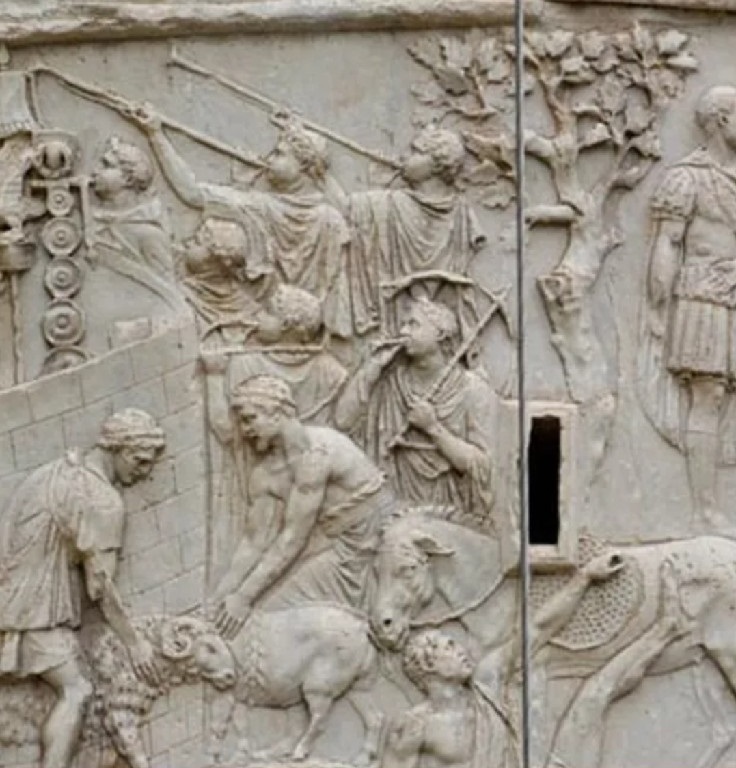 Fragment from Trajan's column. Early 2nd century AD
Can Roman Sound Be Reconstructed?
A replica can test fingering, breath, range and volume, but the outcome depends on material, dimensions, reed and the ability of a modern player. Even a carefully made tibia or hydraulis does not automatically reveal the melody performed at a particular festival.
Notated Greek works of the imperial period, musical treatises and the acoustics of surviving theatres provide further evidence. Responsible reconstruction separates measurable features—pipe length, finger holes and organ mechanism—from assumptions about tempo, ornament and style. It is therefore more accurate to propose several historically grounded sound possibilities than one "authentic music of Rome."
Related Topics
- Art of Ancient Rome
- Dance in Ancient Rome
- Theatre
- Cornicen
- Bucinator
- Tubicen
- Roman Religion
- Gladiatorial Games
- Education in Ancient Greece and Rome
- Painting in Ancient Rome
Literature and Sources
- Vitruvius. De architectura, V.5 and X.8.
- Quintilian. Institutio oratoria, book I.
- Landels, John G. Music in Ancient Greece and Rome. Routledge, 1999.
- Wille, Günther. Musica Romana: Die Bedeutung der Musik im Leben der Römer. Schippers, 1967.
- Habinek, Thomas. The World of Roman Song: From Ritualized Speech to Social Order. Johns Hopkins University Press, 2005.
- Péché, Valérie; Vendries, Christophe. Musique et spectacles dans la Rome antique et dans l'Occident romain. Errance, 2001.
- The Metropolitan Museum of Art. Tibia, acc. 58.40
- Hellenic Heritage. Archaeological Museum of Dion and the Hydraulis
Interested in Ancient Rome beyond reading? Join Legio X Fretensis or explore our reenactment directions.


