Painting in Ancient Rome
Painting in ancient Rome is known above all from the decorated walls of houses, villas, temples, tombs and public buildings. Romans also valued pictures on wood and other portable supports, but organic materials have rarely survived. Our view of Roman painting therefore depends heavily on the frescoes of Pompeii and Herculaneum, the villas at Boscoreale and Boscotrecase, paintings from Rome and the provinces, and portraits from Roman Egypt.
Roman painting was not merely a continuation of Greek art. Painters employed Hellenistic subjects and compositions but adapted them to Roman houses, cult, ancestral memory and displays of status. An image must be read together with its room: the same mythological scene communicated differently in a dining room, bedroom, garden or household shrine.
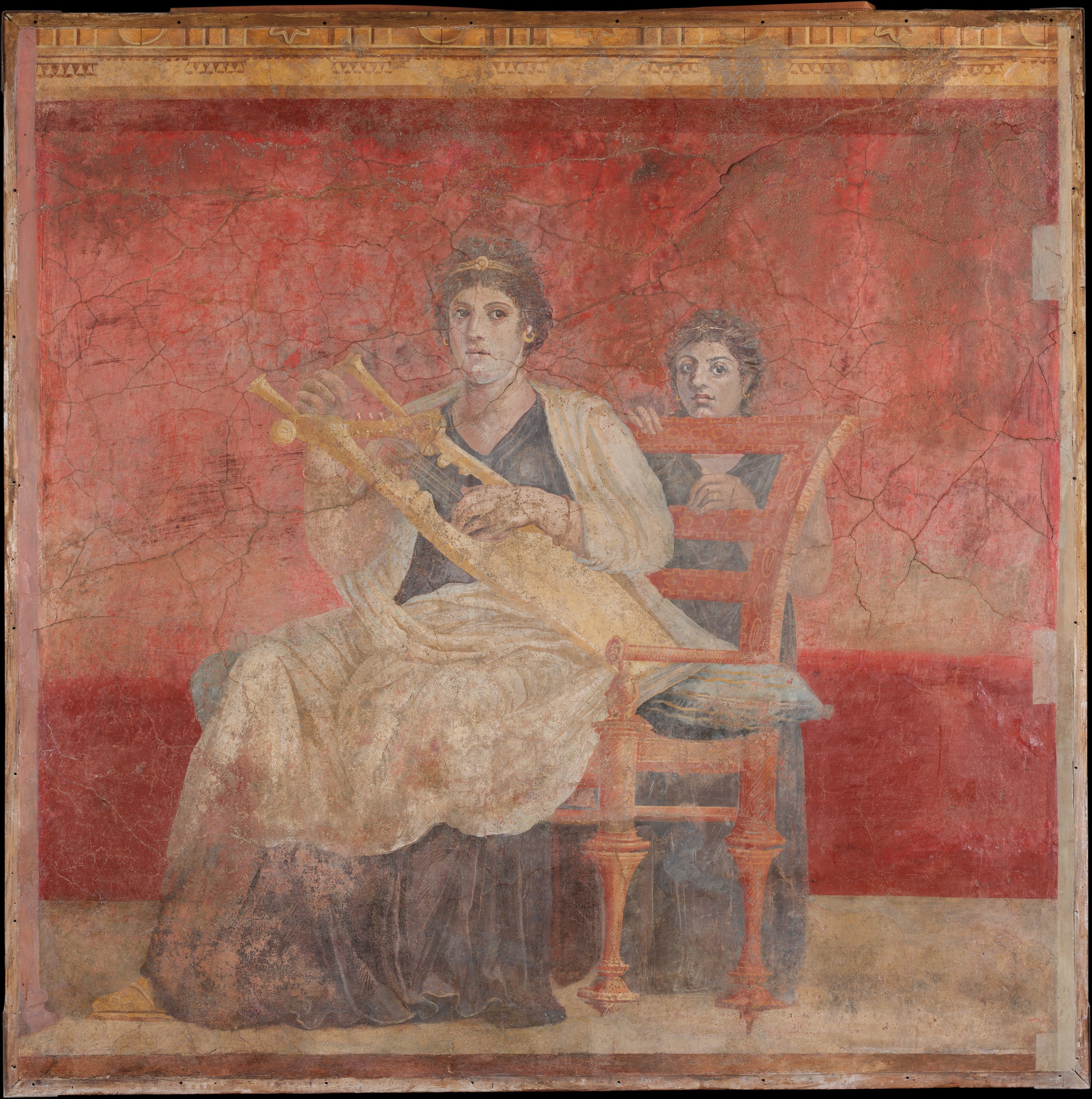 A woman with a kithara and a girl in a wall painting from Room H of the Villa of Publius Fannius Synistor at Boscoreale. Fresco, c. 50-40 BCE; The Metropolitan Museum of Art, acc. 03.14.5. Public Domain. Source: The Met, 03.14.5
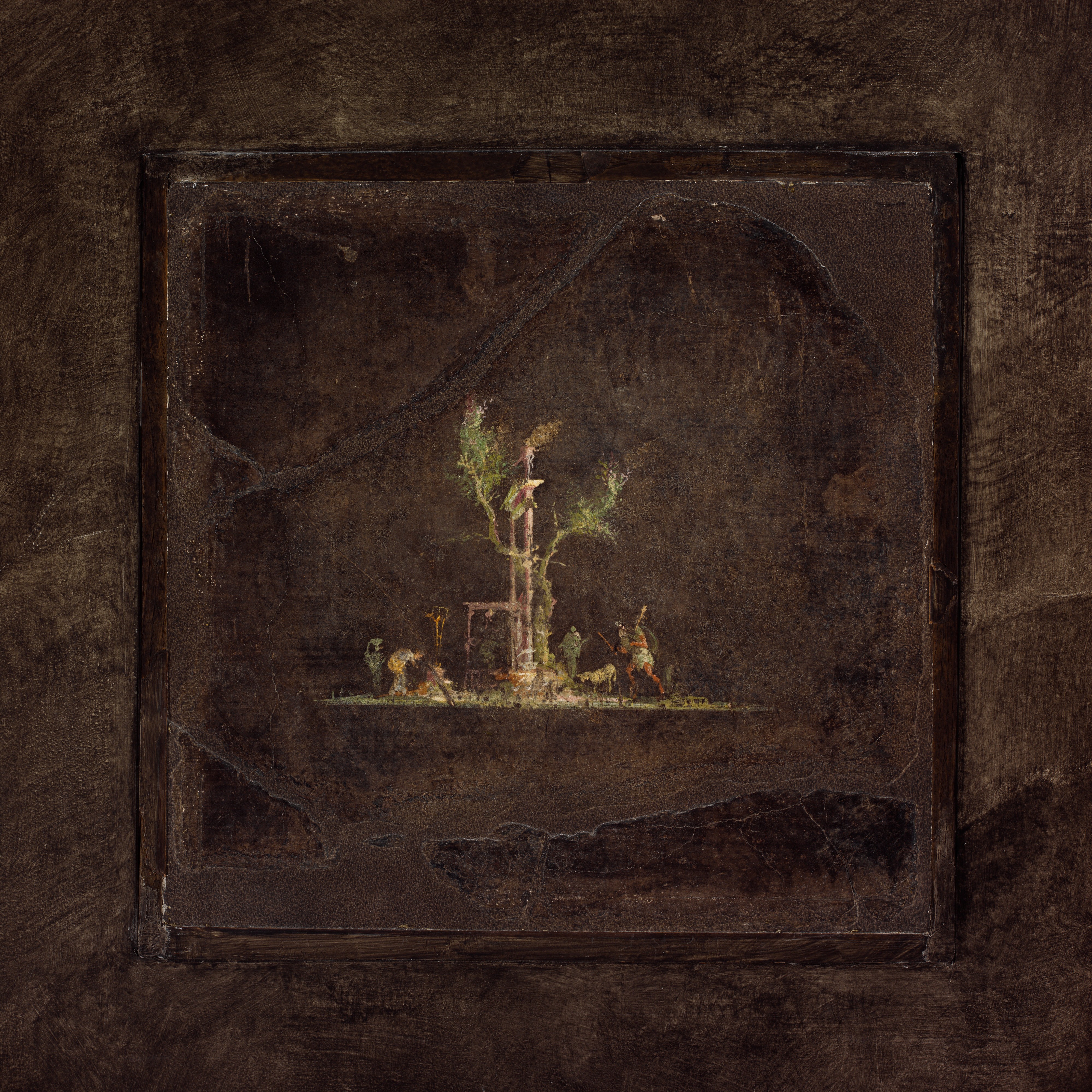 Wall painting on a black ground with a landscape vignette from the imperial villa at Boscotrecase. Fresco, last decade of the 1st century BCE; The Metropolitan Museum of Art, acc. 20.192.10. Third Pompeian Style. Public Domain.
Evidence and Preservation
In book VII of his architectural treatise, Vitruvius describes the preparation of plaster, several pigments and methods of finishing. Pliny the Elder, in book XXXV of the Natural History, lists painters, famous portable pictures and colours. These texts show that highly valued works existed in media that have almost completely disappeared. Archaeology, by contrast, preserves painting attached to walls far more readily.
The eruption of Vesuvius in 79 CE sealed a vast body of Campanian interiors, but it cannot represent the entire Empire or every century. Pompeii is especially informative about domestic environments of the late Republic and early Empire. Rome, Ostia, provincial towns, the catacombs, Dura-Europos and Roman Egypt add different genres, patrons and religious traditions.
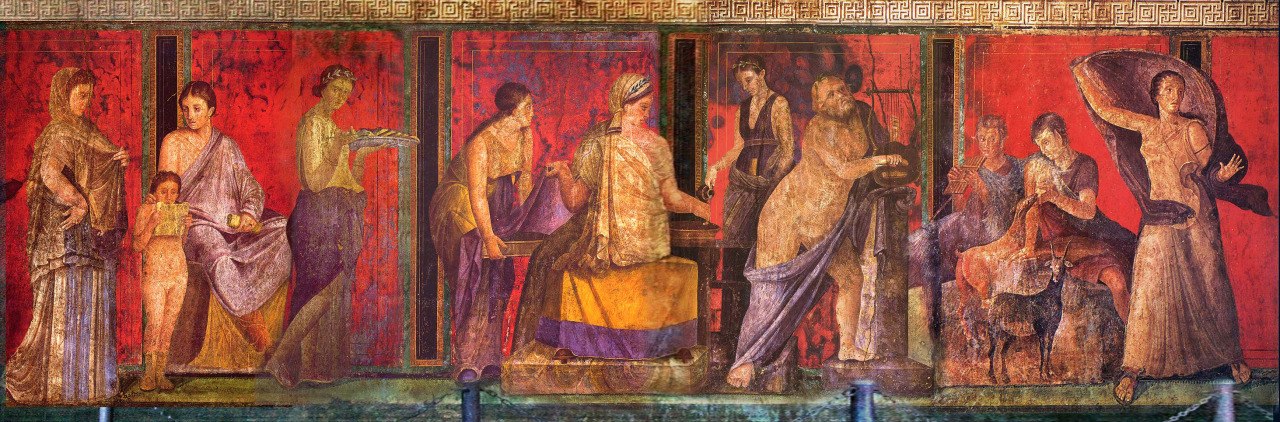 Fragment of the monumental wall painting from the Villa of the Mysteries near Pompeii, mid-1st century BCE. Second-Style figures form a continuous ritual and mythological frieze; the scene's precise interpretation remains debated.
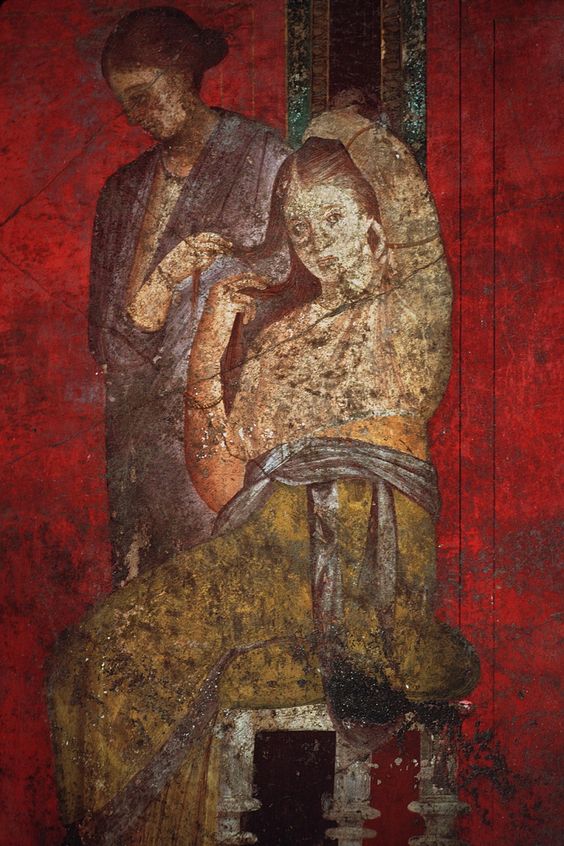 Fresco from the Villa of the Mysteries,Pompeii. 1st century AD
Walls, Plaster and Workshop Practice
Roman wall painting is commonly called fresco, although its technique was more complex than a single formula. Walls were levelled with several layers of mortar and fine plaster. Some colours were applied to damp lime plaster and fixed as it dried; details and particular pigments could be added after the surface had begun to set. Polishing compacted the surface and intensified the colour.
Work was divided among specialists. Some prepared and ruled the wall, while others painted ornament, figures or central panels. Repeated poses and subjects point to pattern books, drawings and a stable repertoire. Quality nevertheless varied greatly: alongside virtuoso villa decorations were rapid and inexpensive paintings in shops, corridors, kitchens and small household shrines.
The palette included earth ochres, carbon black, lime white, cinnabar, Egyptian blue and other mineral or manufactured colours. An expensive pigment alone did not determine the cost of an interior: area, number of layers, complexity and the skill of the painters also mattered.
 Wall painting from the House of the Surgeon, Pompeii. National Archaeological Museum, Naples, inv. 9018. 50–79 CE.
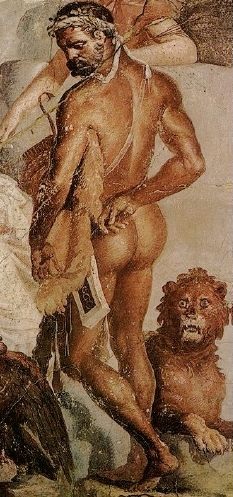 Detail from the fresco "Allegories of Hercules". Fresco from Herculaneum,National Archaeological Museum,Naples. 1st century AD
The Four Pompeian Styles
The Four Pompeian Styles are a modern classification of Campanian wall painting. They form a useful chronological framework, not a set of rules used by Roman painters themselves.
- The First Style, broadly the second and early first centuries BCE, imitated walls faced with coloured stone and raised architectural blocks.
- The Second Style, broadly 80-20 BCE, opened the wall through illusionistic architecture, colonnades, perspective views and large figures. The Villa of the Mysteries and Boscoreale contain some of its best-known examples.
- The Third Style, broadly 20 BCE-20 CE, stressed the flatness of the wall. Slender candelabra, small landscapes and central pictures were placed on monochrome fields.
- The Fourth Style, broadly 20-79 CE, combined architectural illusion, ornament and large mythological scenes in denser compositions.
The boundaries are approximate, and the system does not always fit painting outside Campania. A house could be renovated room by room and retain decorations of several periods at once.
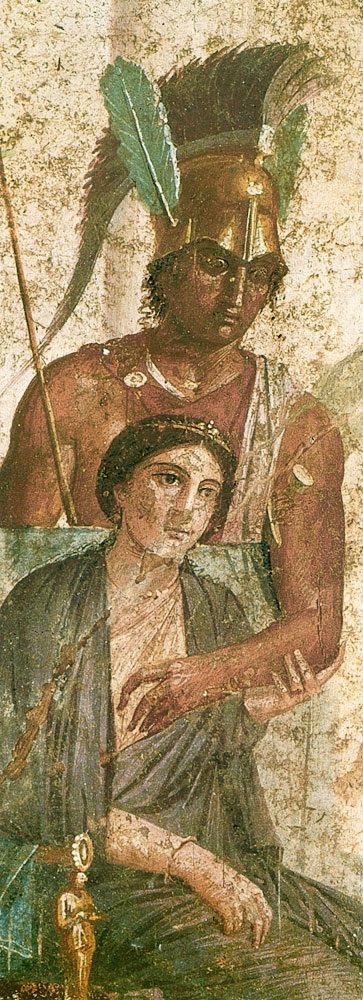 Venus and Mars on a fresco from Pompeii, 1st century AD; an image of love, war and Roman mythological memory.
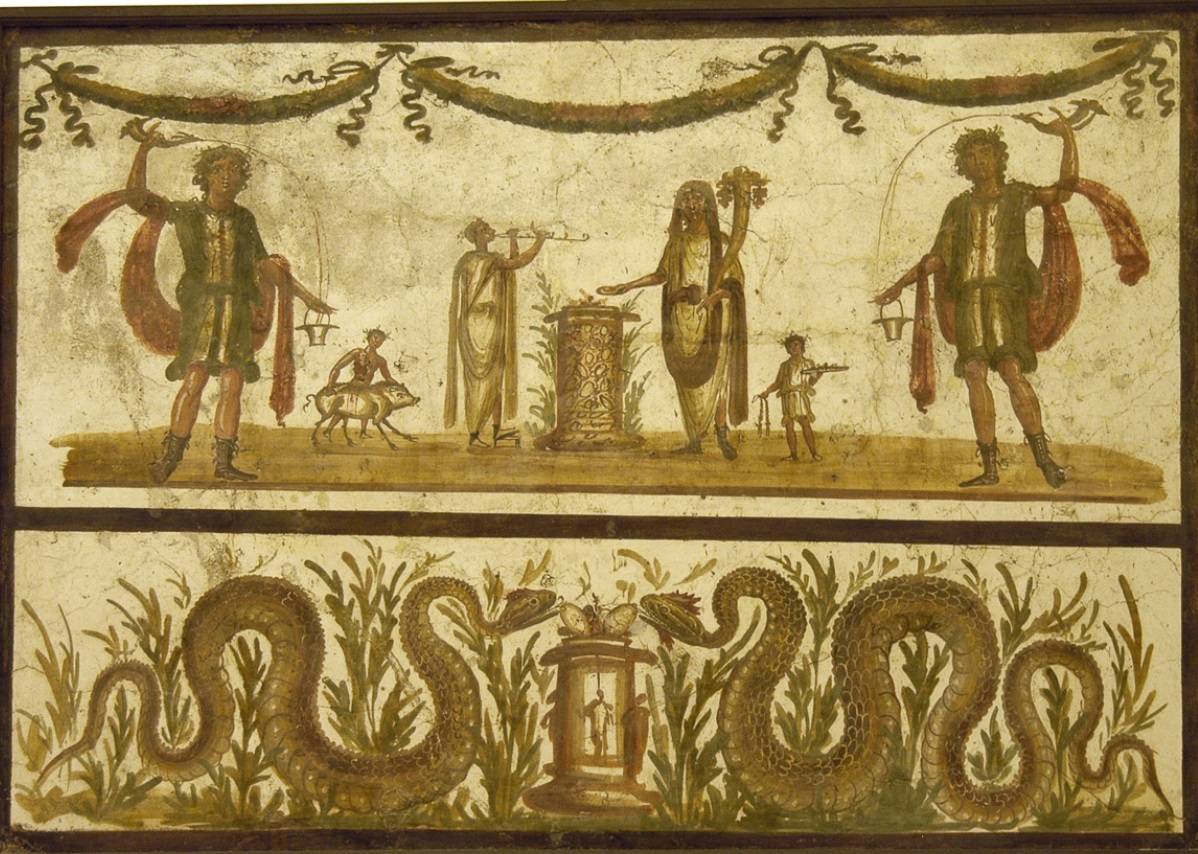 Lares, genius and serpents on a fresco from a Pompeian lararium, Insula VIII.2; Naples, National Archaeological Museum, inv. 8905, AD 69-79.
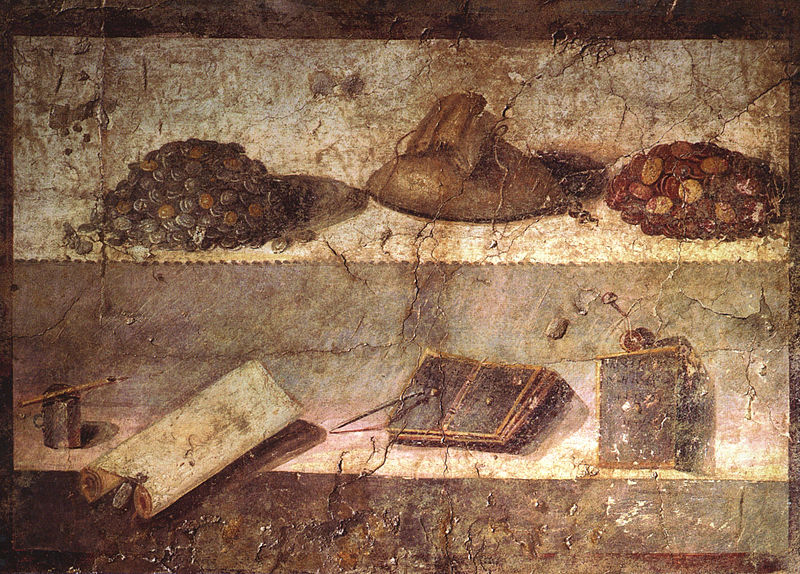 Fresco from Pompeii. Archaeological Museum of Naples. 1st century AD
Subjects, Rooms and Viewers
Paintings represented gods and heroes, theatrical motifs, gardens, harbours, villas, still lifes, animals, erotic subjects, ritual and everyday activities. A mythological picture could advertise the owner's education, prompt conversation or associate a room with love, dining, victory or danger. A landscape did not necessarily portray a real place; it created an imagined space beyond the wall.
Decoration responded to the viewer's movement. Entrance and atrium shaped the public image of the house, the dining room accompanied the banquet, the cubiculum created a more intimate setting, and garden paintings enlarged confined rooms. Lararia joined images of Lares, the household genius, serpents and an altar to daily domestic cult. A figure cut from its wall therefore loses part of its meaning even when the paint itself survives well.
Portraits formed another important category. Literary sources mention ancestral portrait shields and commissions to painters, while Roman Egypt has preserved funerary portraits on wooden panels. They demonstrate that portable painting existed on a large scale even though the Italian climate has left little physical evidence.
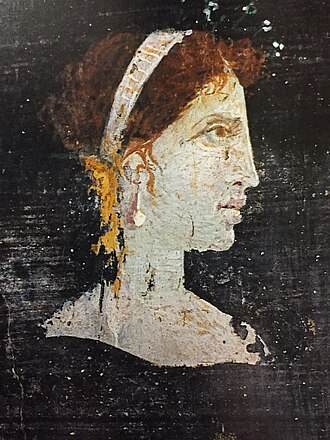 Herculaneum: Posthumous painted portrait of Cleopatra VII of Egypt, from Herculaneum, Italy; archaeological view, find or museum context connected with the site, Roman period or local archaeological context.
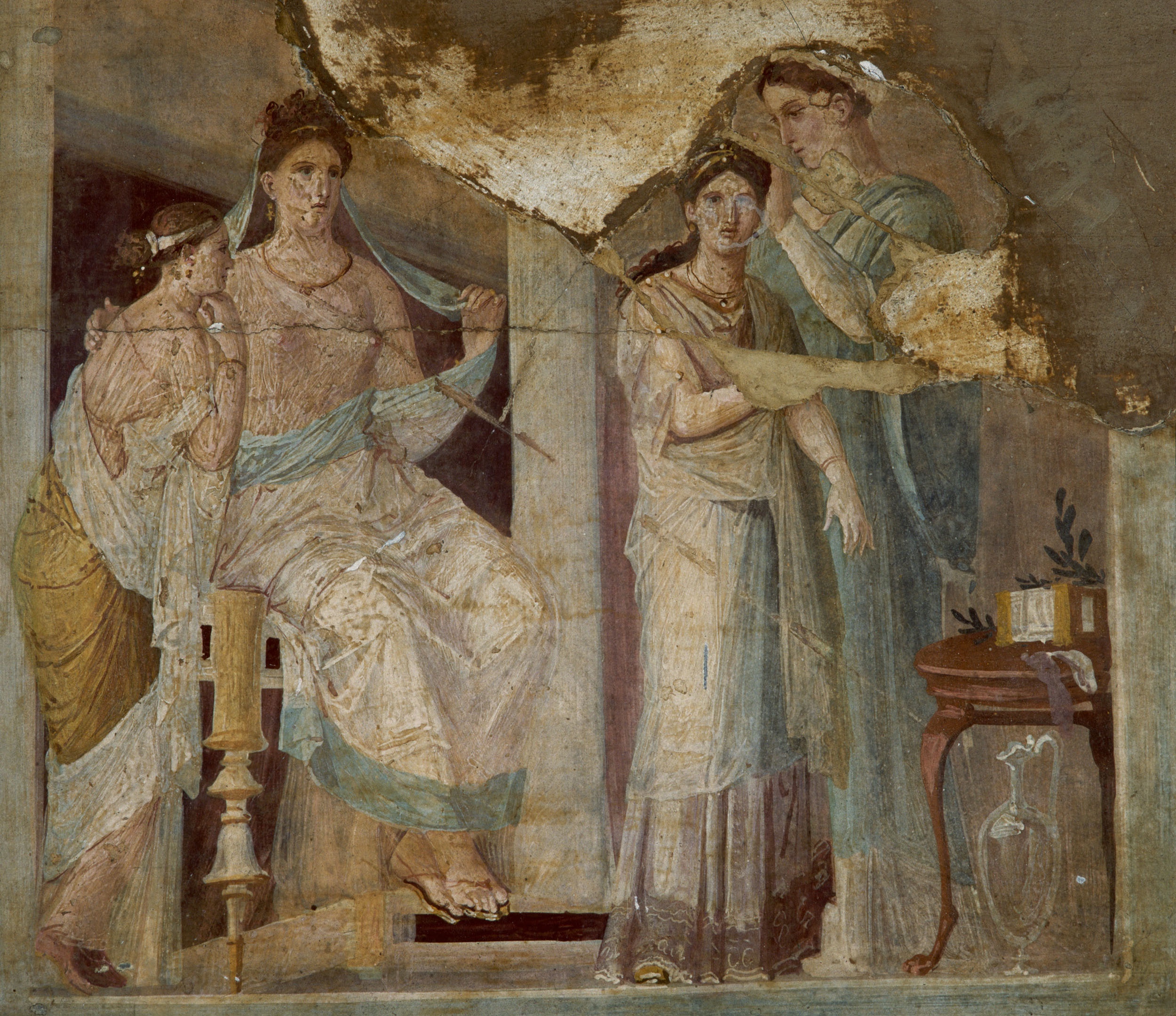 A fresco from Herculaneum with a female figure and footwear. Images of this type matter when read together with their room and archaeological context.
How to Read a Roman Painting
Roman wall painting is both a work of art and an archaeological source. Interpretation should begin with date, findspot, room, position on the wall, later restoration and relation to neighbouring images. A figure in conventional Greek dress may represent a deity, hero or stage character rather than a Roman in everyday clothing.
The copying of Greek models also requires caution. A Roman version of an earlier composition documents the taste and workshop practice of its own period, but it is not a photographic record of Classical Greece. The strongest reading joins the image to the architecture of the house, inscriptions, objects from the room and the history of excavation.
Related Topics
- Art of Ancient Rome
- Pompeii
- Herculaneum
- Architecture in Ancient Rome
- Greek Mythology
- Roman Religion
- National Archaeological Museum of Naples
- Music in Ancient Rome
- Dance in Ancient Rome
Literature and Sources
- Vitruvius. De architectura, book VII.
- Pliny the Elder. Natural History, book XXXV.
- Ling, Roger. Roman Painting. Cambridge University Press, 1991.
- Clarke, John R. The Houses of Roman Italy, 100 B.C.-A.D. 250: Ritual, Space, and Decoration. University of California Press, 1991.
- Wallace-Hadrill, Andrew. Houses and Society in Pompeii and Herculaneum. Princeton University Press, 1994.
- Leach, Eleanor Winsor. The Social Life of Painting in Ancient Rome and on the Bay of Naples. Cambridge University Press, 2004.
- The Metropolitan Museum of Art. Roman Painting
- Archaeological Park of Pompeii
- Image source: Wall painting on a black ground with a landscape vignette from the imperial villa at Boscotrecase
Interested in Ancient Rome beyond reading? Join Legio X Fretensis or explore our reenactment directions.


