Roman Mosaics and Decorative Arts
Mosaics in ancient Rome belonged to architecture, while decorative art belonged to action. A stone design directed a person across a threshold, marked the centre of a room, surrounded a basin or accompanied a banquet; a silver cup was simultaneously tableware, stored value and a surface for imagery; a mirror, ring or glass cup joined practical use to myth, status and personal memory. A mosaic therefore cannot be studied only as a picture made of tesserae, nor decorative art as a cabinet of beautiful museum objects.
'Decorative arts' is a useful modern expression rather than a single ancient category. It includes fixed decoration—floors, wall and vault revetment, fountains and furniture—and portable work in silver, bronze, glass, pottery, bone, gemstones and organic materials. Its boundaries overlap with sculpture, painting and architecture: relief could become a vessel handle, a glass panel part of a wall, and a figured mosaic the principal image of a room.
Survival distorts the picture. Stone, fired clay, glass and metal outlast wood, textile and paint; precious metal was often melted down, while mosaics could be lifted, restored or reassembled without their original borders. Reliable interpretation begins with material, technique, traces of use and an exact find context.
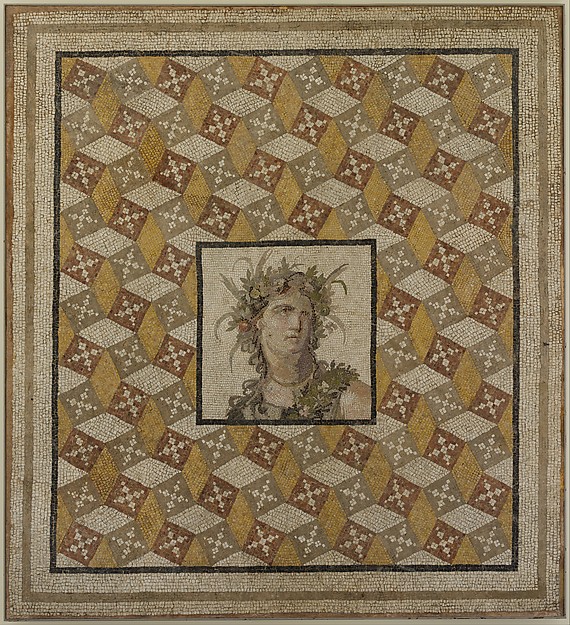 Mosaic floor from Daphne near Antioch, 2nd century CE; stone, tile and glass, 226.1 × 251.5 cm. The central figure was traditionally called Spring, but the museum now identifies her more cautiously as a personification of abundance and good living. The Metropolitan Museum of Art, acc. 38.11.12. Public Domain.
Tesserae, Mortar and Principal Techniques
An ordinary Roman mosaic was assembled from tesserae—small pieces of stone, marble, fired clay and sometimes glass paste. Size, colour and shape followed the task. Larger cubes suited geometric backgrounds and extensive surfaces; small pieces could model a face, cloth or animal fur. Glass broadened the palette, although cost and wear limited its use in floors. Black-and-white stone could produce a composition as sophisticated as a polychrome pavement.
A floor required a stable foundation. Vitruvius describes preparation of the ground, layers of rubble and mortar, levelling and the finished surface, but actual construction varied with soil, room, budget and repair. An excavator encounters a particular sequence rather than a textbook section. Impressions, cracks, patches, reused tesserae and the edges of work zones can reveal more about production than a perfectly cleaned face.
Several terms provide orientation. Opus tessellatum denotes work in comparatively large tesserae; opus vermiculatum especially fine work whose rows seem to flow around figures; opus signinum a water-resistant mortar containing crushed pottery and sometimes simple inserted designs; opus sectile revetment made from stone, marble or glass pieces cut to shape. This is a useful archaeological classification, but ancient usage was not always so consistent, and one pavement could combine techniques.
A central figured panel is often called an emblema. It could be made in a workshop on a separate support and inserted into a larger floor, although not every central scene was portable. Craftspeople set out axes and borders before laying background, frames and figures, and several hands might contribute to one composition. Visible joints need not indicate poor work: they can record the organisation of labour or a later repair.
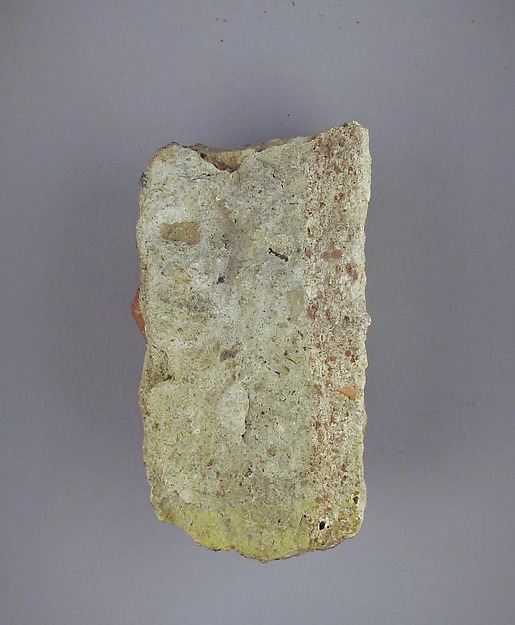 Fragment of Roman mosaic floor bedding: tile elements held in mortar; 14 × 6.4 cm. The catalogue gives neither a secure date nor a findspot, so the object should not be treated as a universal section through every Roman floor. The Metropolitan Museum of Art, acc. 94.4.388. Public Domain.
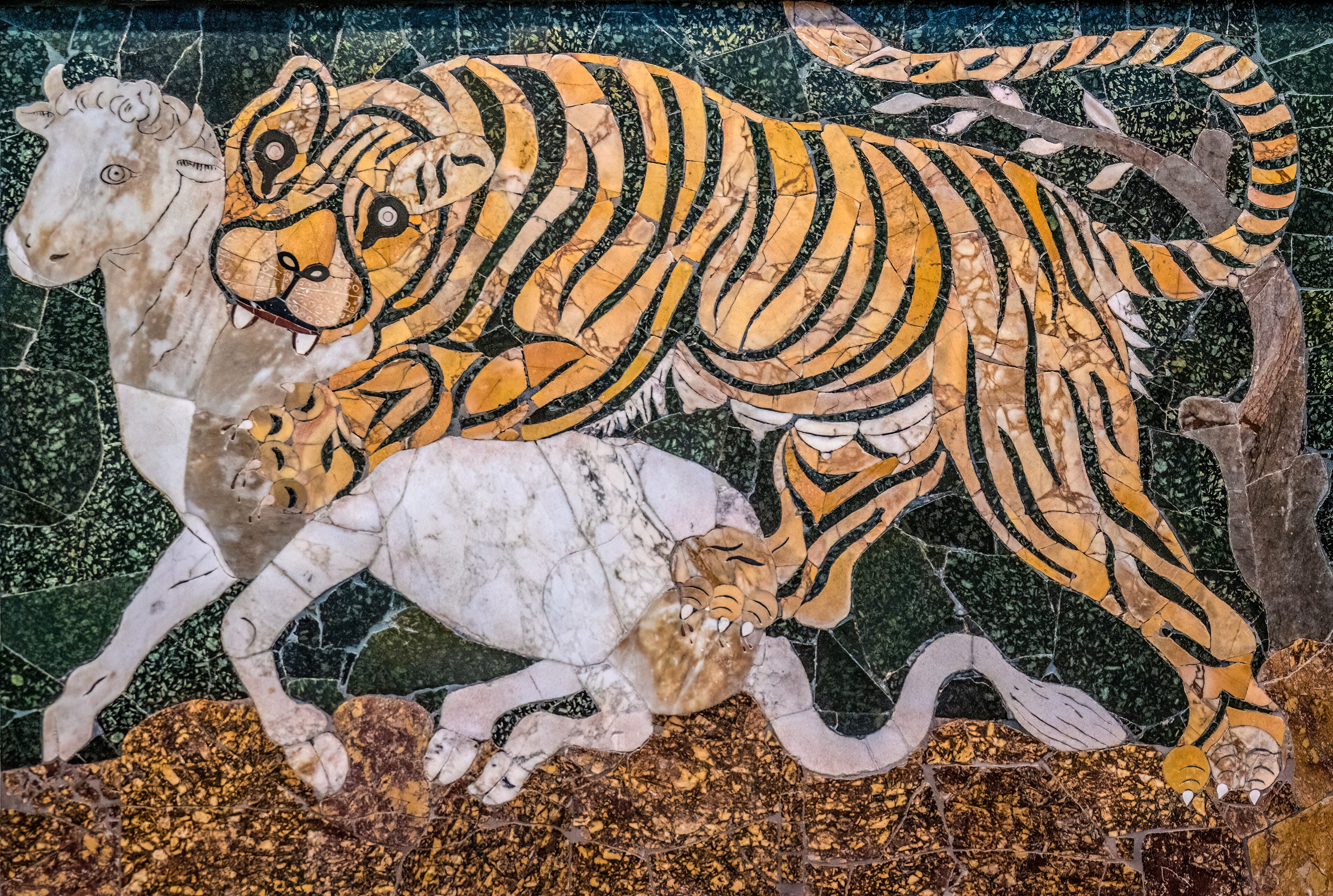 Tiger attacking a calf: opus sectile panel in coloured marbles, second quarter of the 4th century CE; from the Basilica of Junius Bassus on the Esquiline. Capitoline Museums, inv. MC 1226. Photo by Wilfredor, Wikimedia Commons, CC0.
Image, Ornament and the Organisation of Space
A mosaic floor first organised a room. A border separated the centre from circulation, a repeating meander related to the walls, and the orientation of a figure indicated the proper viewpoint. An image at a threshold confronted an entrant; a dining-room pavement could face couches and the open service side; sea creatures around a basin connected image and water. These relationships are easily lost when a floor is mounted vertically in a museum.
Geometric grids, guilloches, waves, rosettes and vegetal scrolls formed the basic repertoire. Figured scenes included gods and heroes, theatre and games, hunting, fish, seasons, personifications, still life, animals and daily labour. Meaning arose from subject and location together. Dionysos in a dining room, Neptune in a bath and a dog at an entrance did not perform the same work, even though all belonged to a shared visual culture.
An inscription might name a figure, offer good fortune, warn an entrant or record a maker. Pompeii's CAVE CANEM does not prove that every mosaic dog was a literal warning sign: the threshold position is crucial. Captions naming gladiators or charioteers turned images into memories of spectacle, although stock names could outlive any one performance.
Some elaborate compositions draw on Hellenistic painting, theatrical imagery or literary culture. Calling them 'copies of paintings' requires care. Translation into stone altered scale, palette, contour and viewing; a mosaicist could abridge, reorder and combine figures. The pavement of actors preparing for a satyr play records no single backstage instant but constructs an image about theatre, education and the householder's culture.
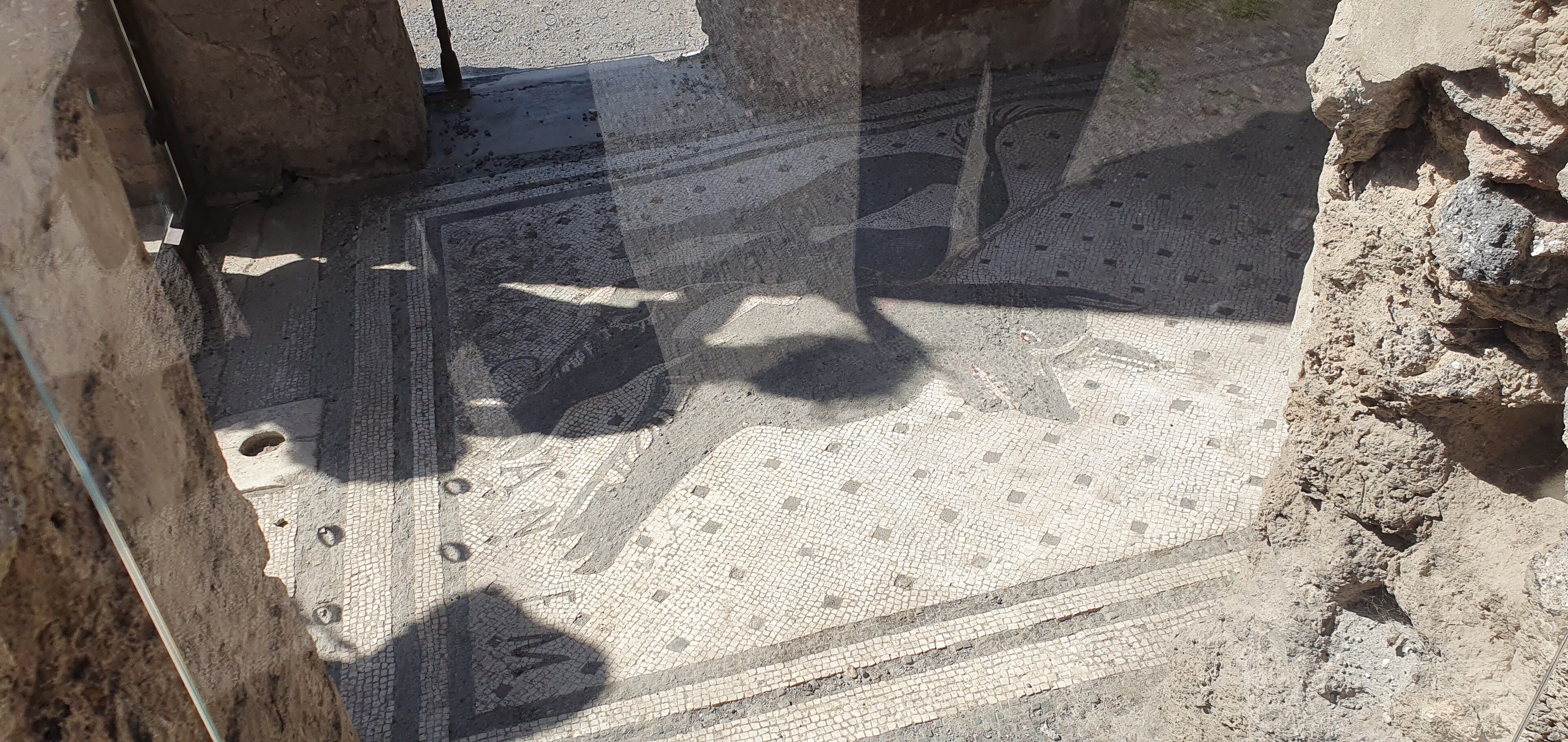 Dog mosaic with the inscription CAVE CANEM ('Beware of the dog') at the entrance to the House of the Tragic Poet, Pompeii, 1st century CE. The image worked with the threshold and the visitor's direction of movement rather than as an isolated museum picture. Photo by Yair Haklai, Wikimedia Commons, CC BY-SA 4.0.
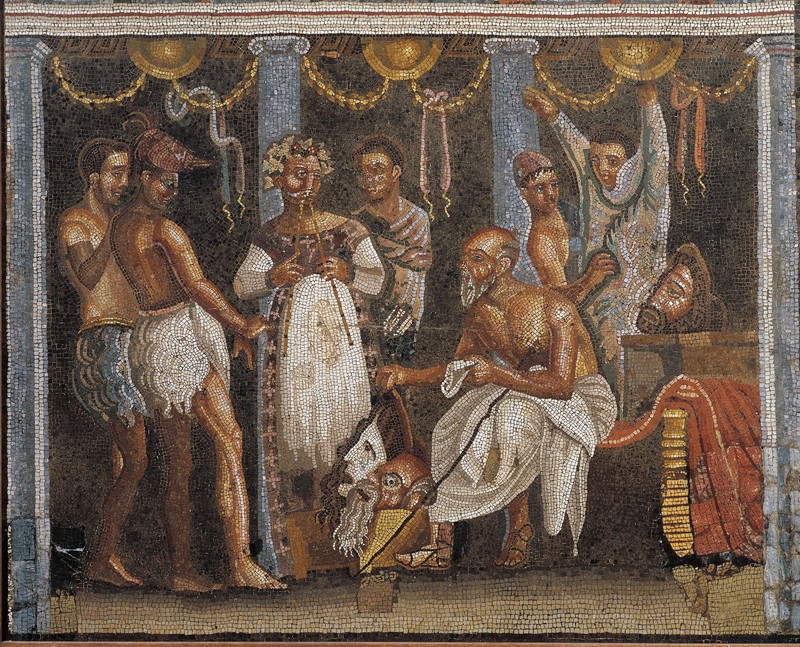 Actors preparing for a satyr play. Mosaic from the House of the Tragic Poet at Pompeii, 69–79 CE; Naples, National Archaeological Museum, inv. 9986. Masks, costume, danced movement and a double-pipe player turn a lost performance into a carefully organised image.
House, Baths and Public Space
In a Roman house or villa mosaics distributed attention among entrance, atrium, peristyle, dining room, bedroom, garden and service areas. An expensive figured scene often marked an important viewpoint, while a corridor could receive a durable repeating design. Simple geometry does not imply poverty: material quality, precision, area and coordination with architecture also displayed investment.
In baths decoration endured moisture, temperature change and the movement of bare feet. Sea gods, fish, dolphins and waves related surface to water; athletes to the palaestra and bodily exercise. Ostia's black-and-white mosaics produced large silhouettes legible at a distance. A pavement worked together with basins, columns, wall revetment, steam and reflected light.
Public buildings used mosaics to mark associations, trade, cult and benefaction. At Ostia, ships and the names of communities on the Square of the Corporations tied individual spaces to the port economy; in sanctuaries a decorated surface might accompany a dedication; in tombs, a name, portrait and claim to memory. A small pavement is not automatically domestic, nor a large one necessarily public.
Late antique villas such as the Villa Romana del Casale turned long cycles of hunting, spectacle, myth and athletics into a route through architecture. Their scale reflects concentrated resources and organised workshops rather than the sudden invention of mosaic. Nicknames such as 'bikini girls' are memorable but project modern clothing and habits onto a 4th-century scene of female exercise.
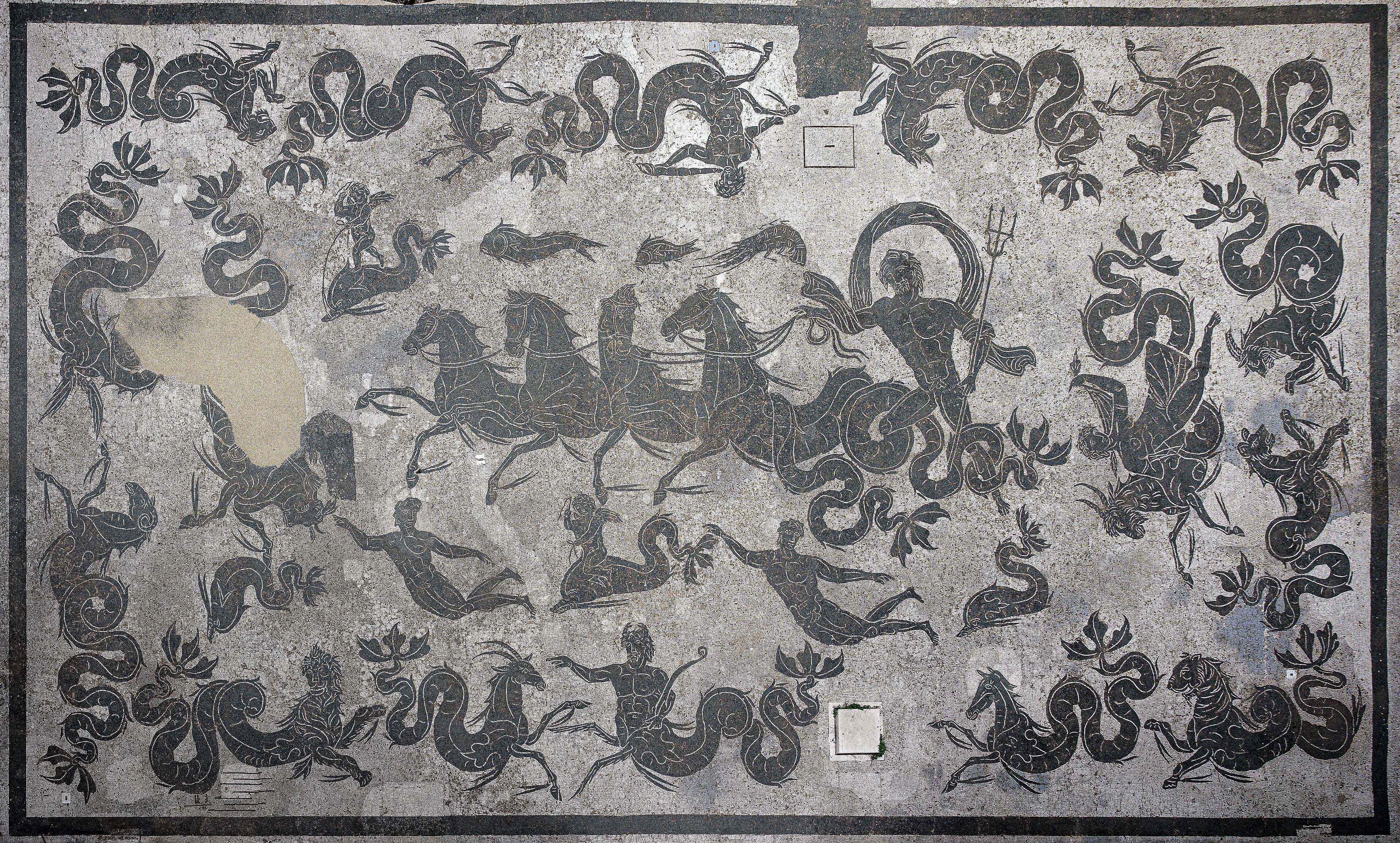 Neptune in a chariot among Tritons, Nereids, dolphins and marine creatures. Black-and-white floor mosaic in the Baths of Neptune at Ostia, Hadrianic period, 117–138 CE. Its marine subject matches the function of the room. Panorama by Justin Benttinen, Wikimedia Commons, CC BY-SA 4.0.
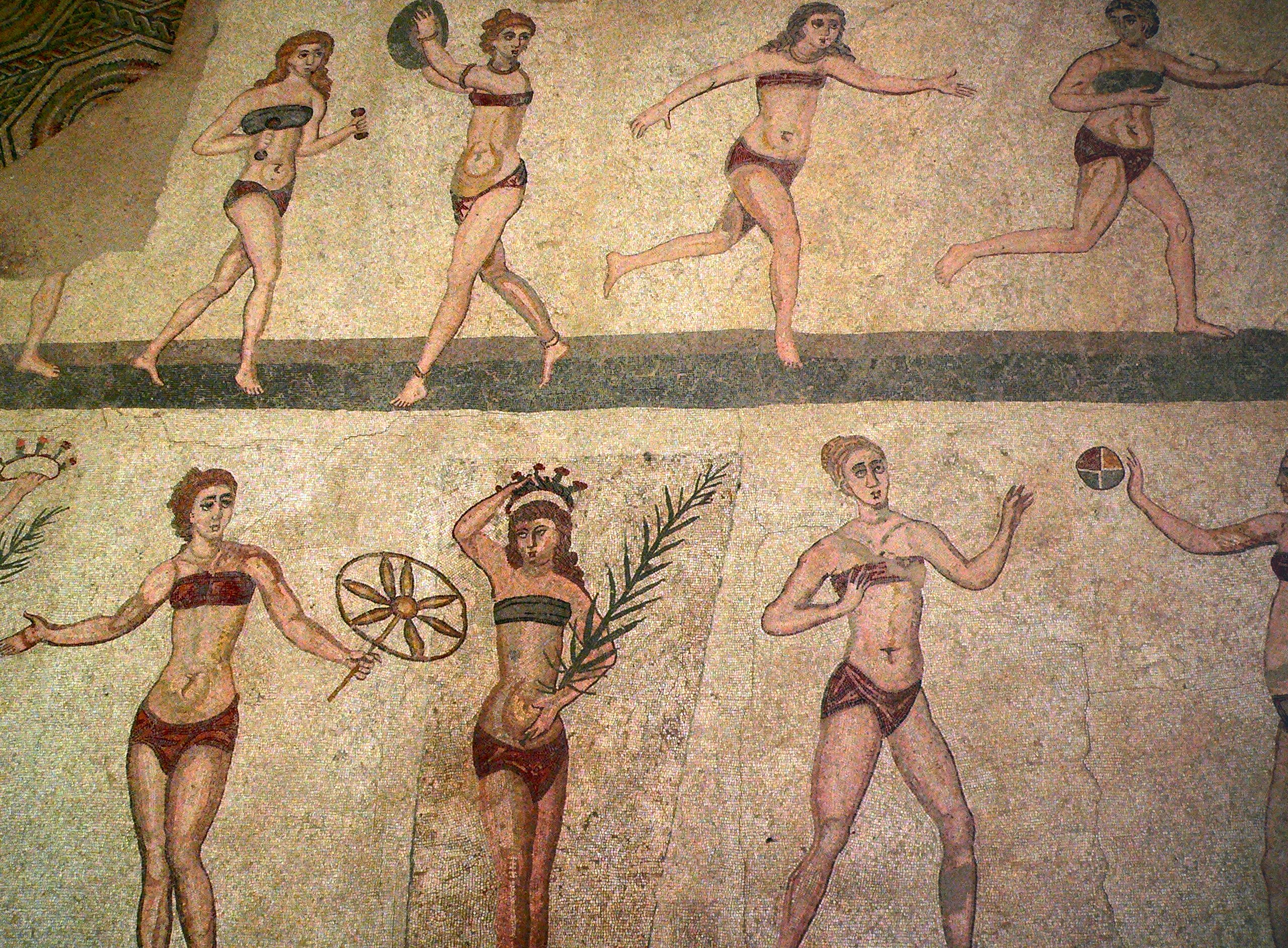 The so-called 'bikini girls' mosaic: young women exercise and receive prizes. Room of the Ten Maidens, Villa Romana del Casale near Piazza Armerina in Sicily, 4th century CE; the mosaic remains in situ. The nickname depends on a modern resemblance of clothing and is not an ancient term.
Metalwork, Furniture and Pottery
Portable objects shaped an artistic environment as much as floors and walls. Silver vessels were raised from sheet, cast in parts, chased and engraved, joined by solder and enriched with gilding, niello or applied elements. Repairs and inscriptions recording weight show that a vessel was valued as more than an image: it could be weighed, transferred, pledged and inventoried. Hoards preserve ensembles, although the reason for burial is not always recoverable.
Bronze supplied mirrors, lamps, incense burners, handles, locks, tripods and the feet of couches and tables. Wooden furniture has mostly vanished, so a metal mount may be the sole remnant of a larger object. A handle shaped as a head, hoof or animal was not an independent statuette: stress, attachment and wear help reconstruct its function.
A reflecting face could be bronze or a specialised alloy, while the back and handle carried relief. The Three Graces suit a toilet article, but their significance exceeds a simple label of 'beauty': the group also appears in sculpture, painting and mosaic. Repetition shows images moving among materials, not a single mandatory interpretation.
Pottery ranged from painted and relief tableware to lamps and architectural terracotta. Moulds enabled serial production, but clay recipe, firing, finishing and stamps still distinguished workshops. Repetition did not erase meaning: a lamp with a theatre mask, a gladiator cup or relief bowl placed an ordinary buyer within a world of public images.
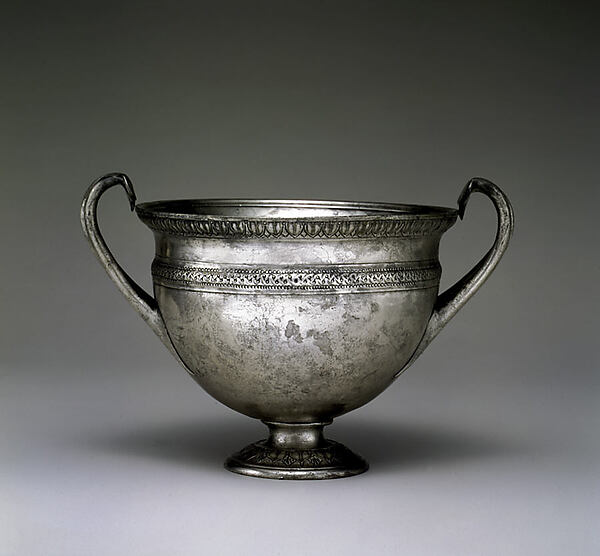 Silver skyphos, or two-handled drinking cup, mid-1st century BCE; height 9.5 cm. The underside of the foot records the vessel's weight and the owner's name, Sattia: a decorated object was also accountable property. The Metropolitan Museum of Art, acc. 20.49.2. Public Domain.
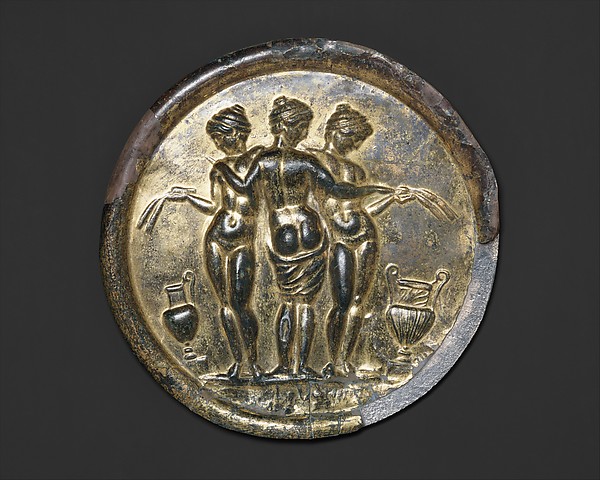 Gilded bronze mirror with the Three Graces, mid-2nd century CE; bronze, silver, gold and speculum alloy, diameter 12.1 cm. The mythological subject turned a toilet article into an image and also circulated in sculpture and mosaic. The Metropolitan Museum of Art, acc. 1987.11.1. Public Domain.
Glass, Cameos and Personal Adornment
Roman glass cannot be reduced to the invention of blowing. Vessels were cast and ground, moulded, free-blown and mould-blown, decorated with trails, blobs, cutting, painting and engraving. Techniques coexisted: expensive cast bowls did not immediately vanish when blowing spread, while the new process enlarged the market and enabled forms difficult in stone or metal.
'Mosaic glass' is not a floor mosaic. A glassworker bundled rods of different colours into a composite cane, heated it, cut transverse slices and fused the pieces into a blank for a dish or bowl. The design ran through the material. A glass revetment panel served another purpose, carrying the brilliant surface of vessels into architecture.
Cameo glass used differently coloured layers; cutting removed the upper layer to leave pale relief against a dark ground. In gemstones, a raised cameo differed from an incised intaglio suitable for a seal impression. A ring could verify identity, act as an amulet, preserve a family image or display a connection with the emperor. A glass portrait of Augustus imitated more expensive sardonyx and made the dynastic image more accessible.
Mould blowing multiplied inscriptions and relief scenes. Cups with gladiators and charioteers resemble souvenirs, but their precise market and buyer are not always known; names shared with famous performers support a hypothesis, not an owner's biography. At the opposite technical extreme stand cage vessels, whose openwork layer was cut from the wall and left attached by narrow bridges. Dichroic glass added a change of colour under different lighting.
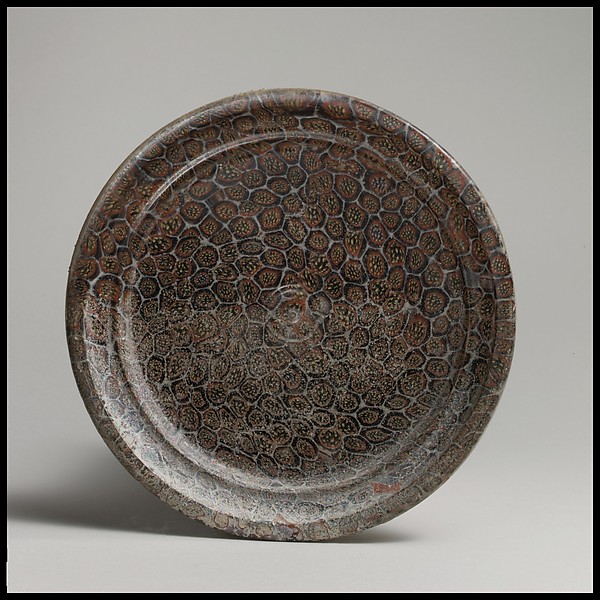 Glass mosaic dish, late 1st century BCE–early 1st century CE; cast and cut, diameter 16 cm. The pattern was assembled from slices of composite glass canes fused into a blank; 'mosaic glass' names a vessel-making technique, not a floor. The Metropolitan Museum of Art, acc. 59.11.6. Public Domain.
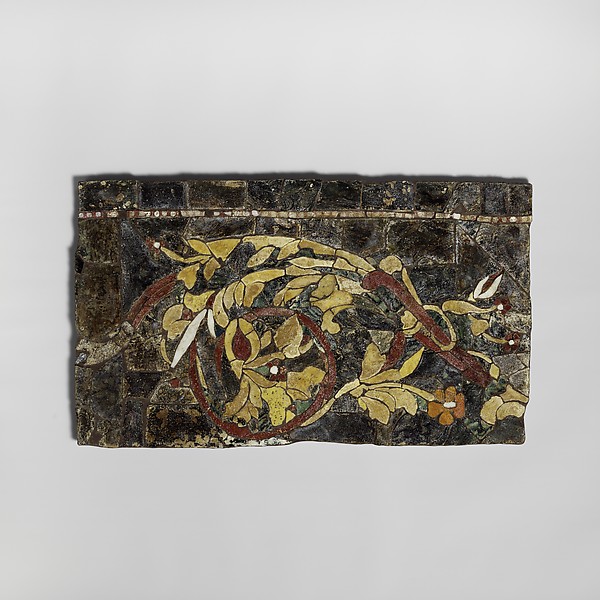 Glass mosaic revetment panel with a floral design, mid-1st century CE; height 43.2 cm. It is said to have been found on the Palatine and may have decorated an imperial palace, perhaps Nero's Domus Aurea, but that association is not secured by an excavated context. The Metropolitan Museum of Art, acc. 13.231.4. Public Domain.
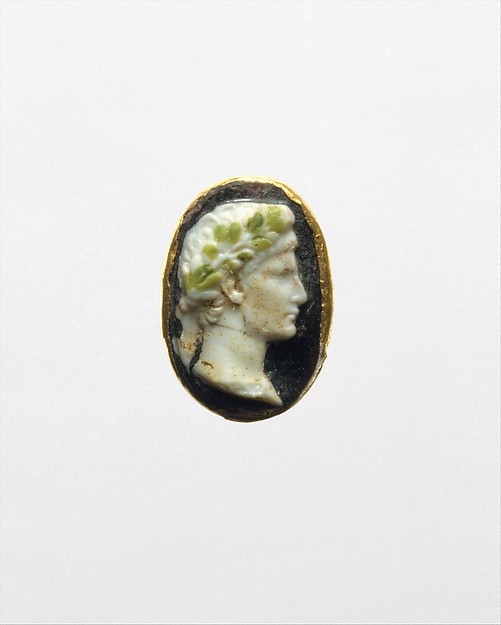 Gold ring with a glass cameo portrait of Augustus, first half of the 1st century CE; mount about 1.9 cm high. The miniature official image joined personal adornment, dynastic allegiance and an imitation of more expensive sardonyx. The Metropolitan Museum of Art, acc. 1995.85.1. Public Domain.
Workshops, Provinces and Late Antiquity
A mosaic involved patrons, designers and craftspeople of different skills. Signatures exist, but most pavements are anonymous. Repeated schemes could travel through training, marked exemplars, preparatory drawings and mobile workers; direct 'pattern books' scarcely survive. A shared border alone does not prove one workshop—technique, material, mistakes, laying habits and geography must also be compared.
The Roman Empire did not export one metropolitan package of decoration. Italy, Britain, Gaul, Iberia, the Balkans, North Africa, Egypt, Syria and Asia Minor joined shared subjects to local stone, craft traditions and patrons' preferences. Black-and-white pavements are especially prominent in many Ostian buildings, North African workshops developed rich hunting and daily-life imagery, while Antioch and its environs became famous for polychrome myth and personifications. These are tendencies, not rigid borders.
Trade moved raw materials and finished goods. Marble came from distant quarries, glass and silver travelled far, and stamped pottery circulated in series. A findspot is not therefore a production centre. Attribution compares composition, form, technique, stamps, context and the distribution of parallels.
Mosaic did not 'disappear with the classical world' in Late Antiquity. Great villas, baths, palaces, synagogues and churches continued to commission floors and wall compositions. Figure scale, hierarchy, inscriptions and religious subjects changed; pagan images could coexist with Christian ones. Luxury glass reached extraordinary complexity in cutting and composition. Such changes should be explained through new spaces, patrons and modes of viewing rather than a general formula of decline.
Modern conservation is part of an object's history. Lifting a floor, filling losses, polishing, mounting it vertically and digitally correcting perspective help preserve and display a monument but alter its effect. Publication should distinguish ancient tesserae from additions, original from museum location, and secure identification from a traditional name.
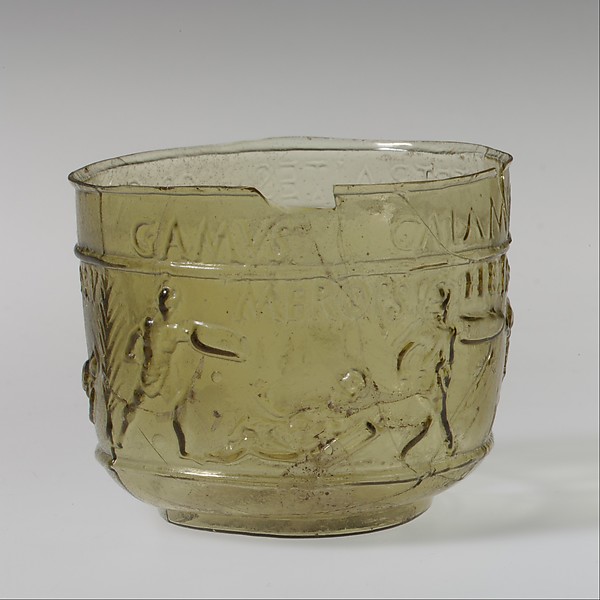 Glass cup with four pairs of gladiators and their names, ca. 50–80 CE; blown in a two-part mould, height 7.9 cm. Serial production allowed recognisable spectacle imagery to circulate as souvenir ware. The Metropolitan Museum of Art, acc. 81.10.245. Public Domain.
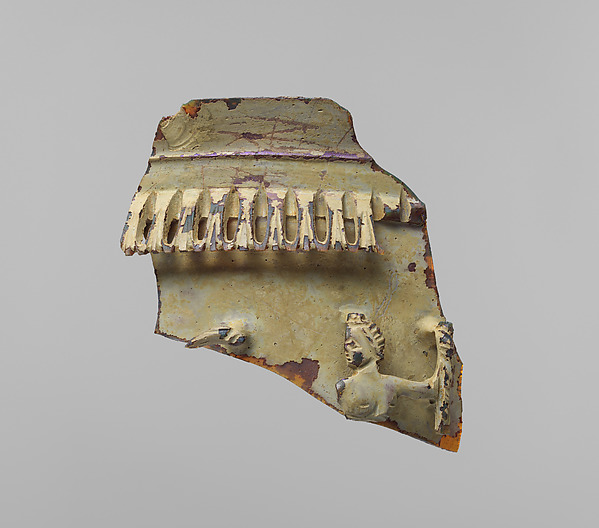 Fragment of a cage vessel with an openwork figure of a satyr or possibly Dionysos, late 3rd–4th century CE; dichroic glass, 5.6 × 7.6 cm. Gold and silver particles make the glass appear olive green in reflected light and reddish amber in transmitted light. The Metropolitan Museum of Art, acc. 26.60.95. Public Domain.
Related Articles
- Art of Ancient Rome
- Architecture of Ancient Rome
- Painting in Ancient Rome
- Sculpture in Ancient Rome
- Roman Villas
- Roman Baths
- Pompeii
- Herculaneum
- Ostia Antica
- Roman Religion
- National Archaeological Museum of Naples
- Museums of Antiquity
Literature and sources
- Vitruvius. De architectura. Book 7.
- Pliny the Elder. Natural History. Books 33–37.
- Clarke, John R. Art in the Lives of Ordinary Romans. University of California Press, 2003.
- Croom, Alexandra T. Roman Furniture. Tempus, 2007.
- Dunbabin, Katherine M. D. Mosaics of the Greek and Roman World. Cambridge University Press, 1999.
- Fleming, Stuart J. Roman Glass: Reflections on Cultural Change. University of Pennsylvania Museum, 1999.
- Ling, Roger. Ancient Mosaics. Princeton University Press, 1998.
- Strong, Donald E. Greek and Roman Gold and Silver Plate. Methuen, 1966.
- The Metropolitan Museum of Art. Mosaic floor from Daphne, acc. 38.11.12
- The Metropolitan Museum of Art. Glass mosaic panel, acc. 13.231.4
- The Metropolitan Museum of Art. Gilded mirror with the Three Graces, acc. 1987.11.1
- The Metropolitan Museum of Art. Glass cage cup fragment, acc. 26.60.95
- Archaeological Park of Ostia Antica. Mosaics of the Baths of Neptune
- UNESCO World Heritage Centre. Villa Romana del Casale
- J. Paul Getty Museum. Roman Mosaics across the Empire
- Image source: Fragment of Roman mosaic floor bedding: tile elements held in mortar; 14 × 6.4 cm
- Image source: Tiger attacking a calf: opus sectile panel in coloured marbles, second quarter of the 4th century…
- Image source: Dog mosaic with the inscription CAVE CANEM ('Beware of the dog') at the entrance to the House of…
- Image source: Neptune in a chariot among Tritons, Nereids, dolphins and marine creatures
- Image source: Silver skyphos, or two-handled drinking cup, mid-1st century BCE; height 9.5 cm
- Image source: Gold ring with a glass cameo portrait of Augustus, first half of the 1st century CE; mount about…
- Image source: Glass cup with four pairs of gladiators and their names, ca
- Image source: Glass mosaic dish, late 1st century BCE–early 1st century CE; cast and cut, diameter 16 cm
Interested in Ancient Rome beyond reading? Join Legio X Fretensis or explore our reenactment directions.


.jpg)
.jpg)
