Sculpture in Ancient Rome
Sculpture in ancient Rome means far more than white-marble statues of emperors. It includes portrait heads and busts, cult images, bronze figurines from household shrines, reliefs on altars and triumphal monuments, tombstones, sarcophagi, architectural terracotta and garden sculpture. A work could be a free-standing figure, part of a building, the support for an inscription or the focus of ritual.
Roman sculpture is often reduced to two formulas: "realistic portraiture" and "copies of Greek originals." Both describe important phenomena, but neither covers the whole field. A single portrait could combine individual features with an age ideal, hairstyle, clothing and political role; a repeated Greek model could change material, scale, attributes and setting. Meaning arose not only in the workshop but also in a forum, temple, house, garden or tomb.
Most surviving evidence belongs to the Late Republic and Empire, although its foundations developed in Etruscan and Italic settings. Its geography is also wider than the city of Rome: workshops and patrons operated from Britain and Spain to North Africa, Syria and Egypt. "Roman" therefore names a historical system of commissioning, circulating and viewing images rather than one unchanging style.
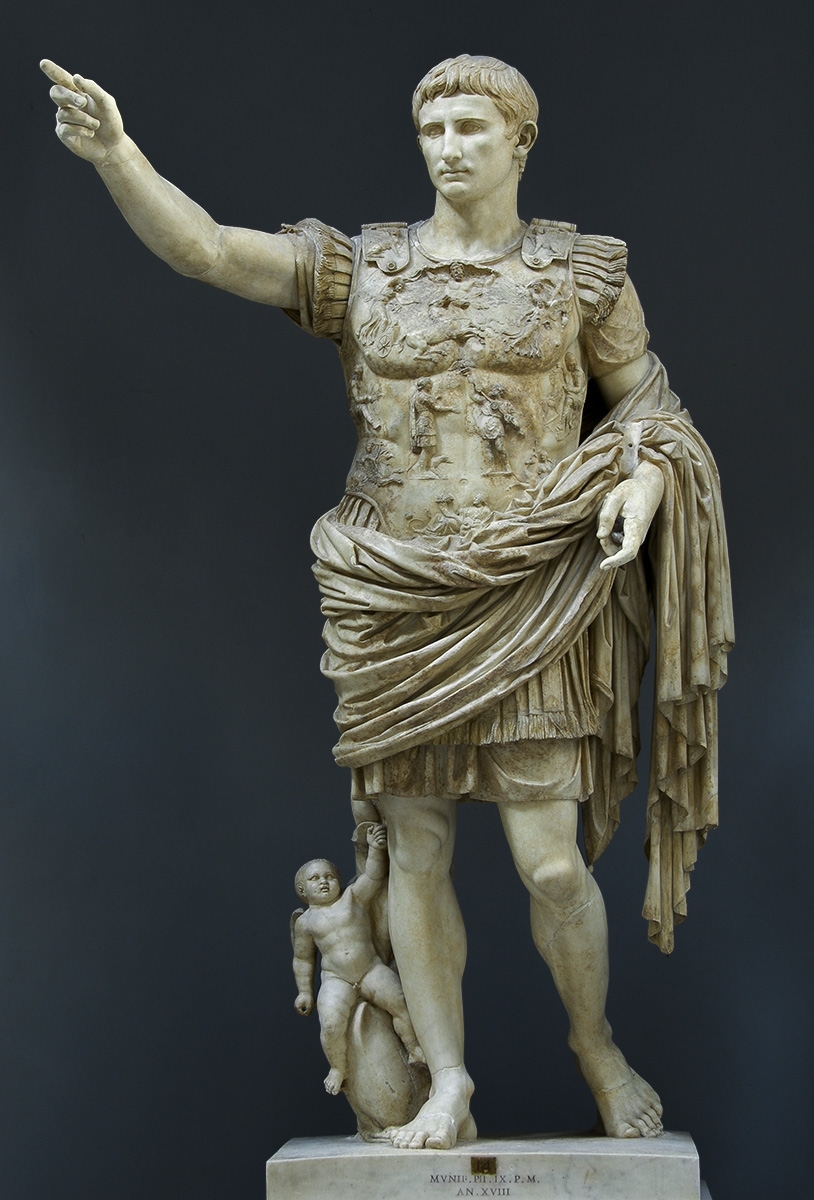 Augustus of Prima Porta, Tiberian period, early 1st century CE; Parian marble with traces of polychromy, height 217 cm. The marble statue repeats a bronze image created shortly after 20 BCE; found at Livia's villa near Prima Porta. Vatican Museums, inv. MV.2290.0.0.
Sculptural Forms and the Greek-Italic Inheritance
Early Rome inherited temple terracotta, bronze casting, funerary portraiture and ways of signalling public status from the Etruscans and other peoples of Italy. Greek cities in southern Italy transmitted mythological types and stone-working skills. After the conquests of the 2nd and 1st centuries BCE, Rome received looted statues, works sold on the art market and makers from the Greek-speaking world. This did not erase local traditions; it created a market in which an old image acquired a new function.
Ancient repetition was not the equivalent of a modern factory copy. A sculptor might combine the head of one type with the body of another, translate a bronze composition into marble, replace an attribute or produce companion figures for a garden. A series can help reconstruct a lost prototype, yet every surviving version also belonged to its own patron and space. Inscription, base and neighbouring statues could alter its reading more than a small difference in carving.
The bronze Spinario demonstrates this flexibility: makers in the 1st century BCE combined a Hellenistic conception of the body with a head derived from an earlier Greek tradition. The Augustan relief of a maenad likewise uses a late Classical type but turns it into an object of Roman decorative culture. Such works should not be ranked on a ladder from "original" to "inferior copy"; the more useful questions concern who commissioned a particular version, where it stood and what it did.
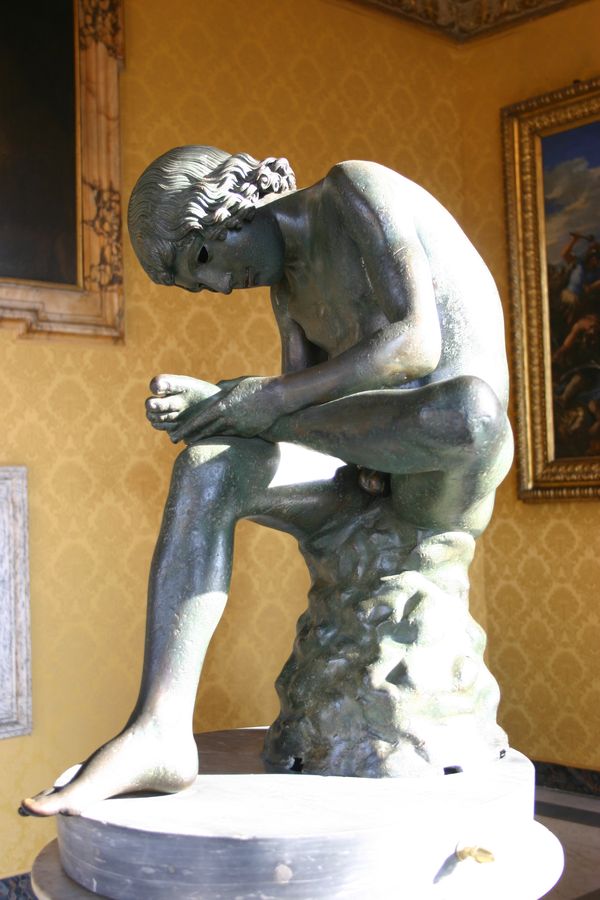 Spinario ('Boy Pulling a Thorn'), bronze, 1st century BCE, height 73 cm. The Roman eclectic composition combines a Hellenistic model for the body with a head type derived from 5th-century BCE Greek art. Capitoline Museums, inv. MC1186.
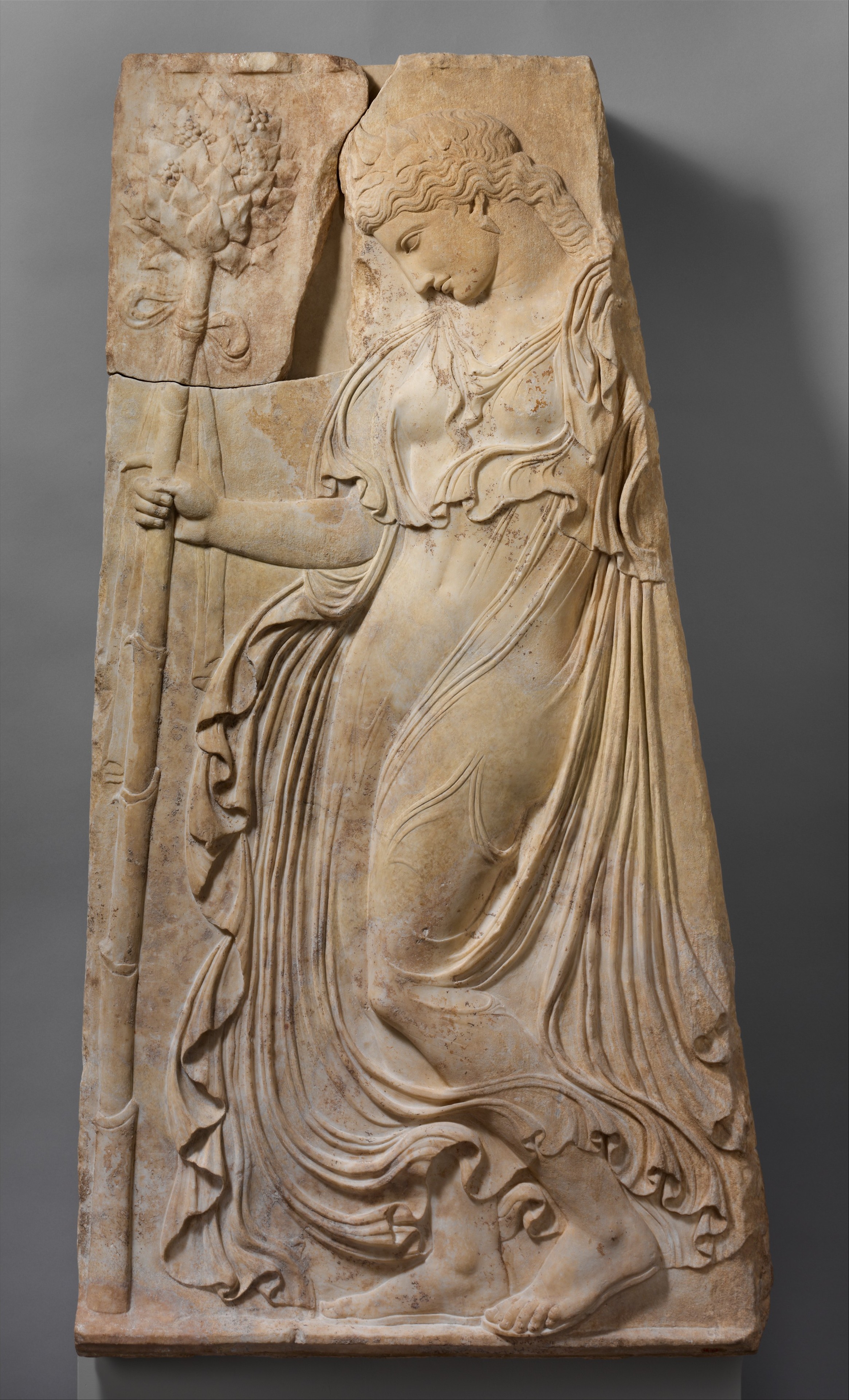 Dancing maenad with a thyrsos, Roman marble relief of the Augustan period, ca. 27 BCE–14 CE; an adaptation of a late Classical Greek type. The Metropolitan Museum of Art, acc. 35.11.3. Public Domain.
Roman Portraiture and the Image of Imperial Power
Late Republican portraiture often emphasises wrinkles, hollow cheeks, thin skin and other marks of age. The device is called verism, but it should not be mistaken for neutral recording. A mature face signalled experience, endurance and a claim to public authority. Polybius' account of an aristocratic funeral procession and wax ancestral images shows portraiture embedded in family memory, public speech and competition for honour. Yet idealised male images, portraits of women, children and freedpeople also existed.
The unidentified late 1st-century BCE man in The Met was once called Julius Caesar, but resemblance proved insufficient for a secure name. The case is methodologically important. A portrait type is established through repeated versions, coins, inscriptions and find context, not by one facial impression. Hairstyle can assist dating, but it might deliberately quote the past or remain in use after a fashion changed.
Under Augustus, the official image of the princeps joined recognisable features to an ageless face and Classical order. His portrait circulated in statues, busts, coins, gems and small sculpture, while local workshops repeated stable patterns of hair and expression. Augustus of Prima Porta adds a commander's pose, figured cuirass, bare feet and Cupid beside the support. It is not a "photograph" of one imperial appearance but a constructed statement about authority, descent, diplomatic victory and cosmic order. The monument is examined in detail in Reconstruction of Augustus of Prima Porta.
Imperial portraiture changed with dynastic politics. Caracalla abandoned the luxuriant hair and beard of his predecessors for close curls, stubble and a sharp turn of the head. Court hairstyles for women likewise became repeatable signs of period and affiliation. Old heads could be cut down and recarved for a new ruler, but not every damaged face resulted from damnatio memoriae: later adaptation, reuse, collapse or restoration might also be responsible.
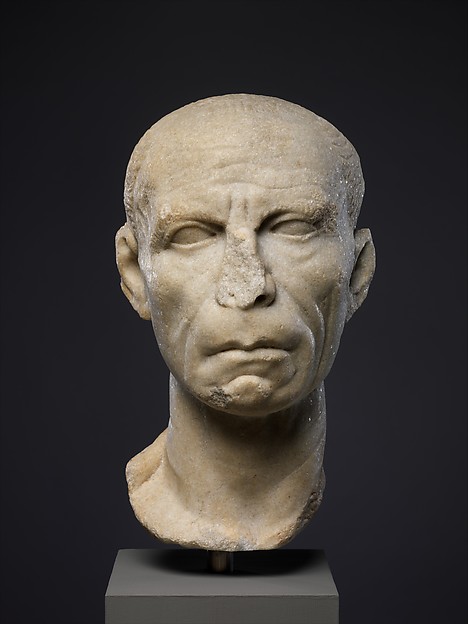 Marble portrait of an unidentified man, late 1st century BCE. The features recall portraits of Julius Caesar, but the identification as Caesar has been rejected. The Metropolitan Museum of Art, acc. 21.88.14. Public Domain.
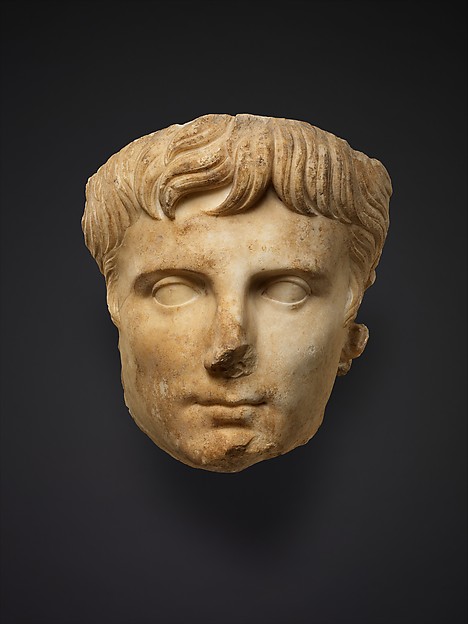 Marble portrait of Emperor Augustus, ca. 14–37 CE; a statue fragment made after the princeps' death that preserves his idealised, ageless image. The Metropolitan Museum of Art, acc. 07.286.115. Public Domain.
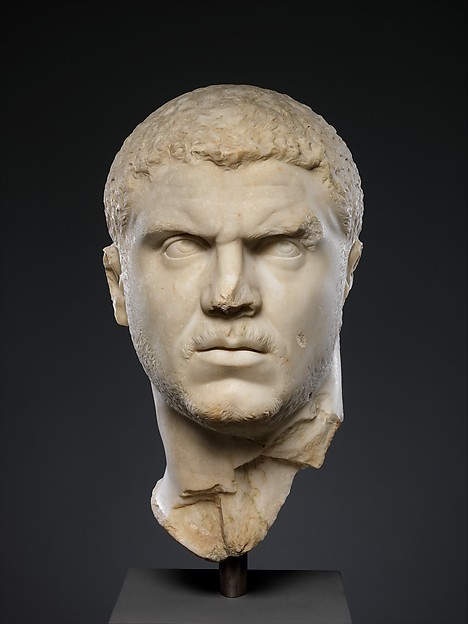 Marble portrait of Emperor Caracalla, 212–217 CE; a head from a statue probably made in an imperial workshop. The close curls and stubble belong to the official portrait type. The Metropolitan Museum of Art, acc. 40.11.1a. Public Domain.
Monumental and Narrative Relief
Relief joined sculpture to architecture. It covered altars, arches, columns, bases, temples and tombs; an image was read as the viewer moved and depended on height, light and a neighbouring inscription. On state monuments a procession, sacrifice, arrival or victory represented not a random event but an ordered society. Scale, the emperor's position and the presence of gods could matter more than unity of time and space.
The processional frieze of the Ara Pacis includes priests, magistrates, men, women and children of Augustus' family. The precise action remains debated, however: it has been connected both with the princeps' return and with the consecration of the altar site. The relief neither labels every face nor records a ceremony like reportage. It constructs an ideal image of Roman institutions, family continuity and piety, joining recognisable contemporaries to the language of Classical composition.
Trajan's Column, the Column of Marcus Aurelius and triumphal arches unfold action through sequences of episodes. A continuous frieze can show the same protagonist repeatedly; city, camp, river and battle are compressed into narrative signs. Such images are indispensable for clothing, structures and ritual, but individual details should be checked against archaeological finds and other monuments. See Trajan's Column, Column of Marcus Aurelius and Tropaeum Traiani.
Relief did not belong only to metropolitan propaganda. The gladiatorial monument from the necropolis at Pompeii's Stabian Gate compresses several moments of spectacle into a long band. It preserves local memory of public entertainment and uses narrative devices unlike the measured rhythm of the Ara Pacis. Comparing the two is more productive than seeking a single "Roman relief style."
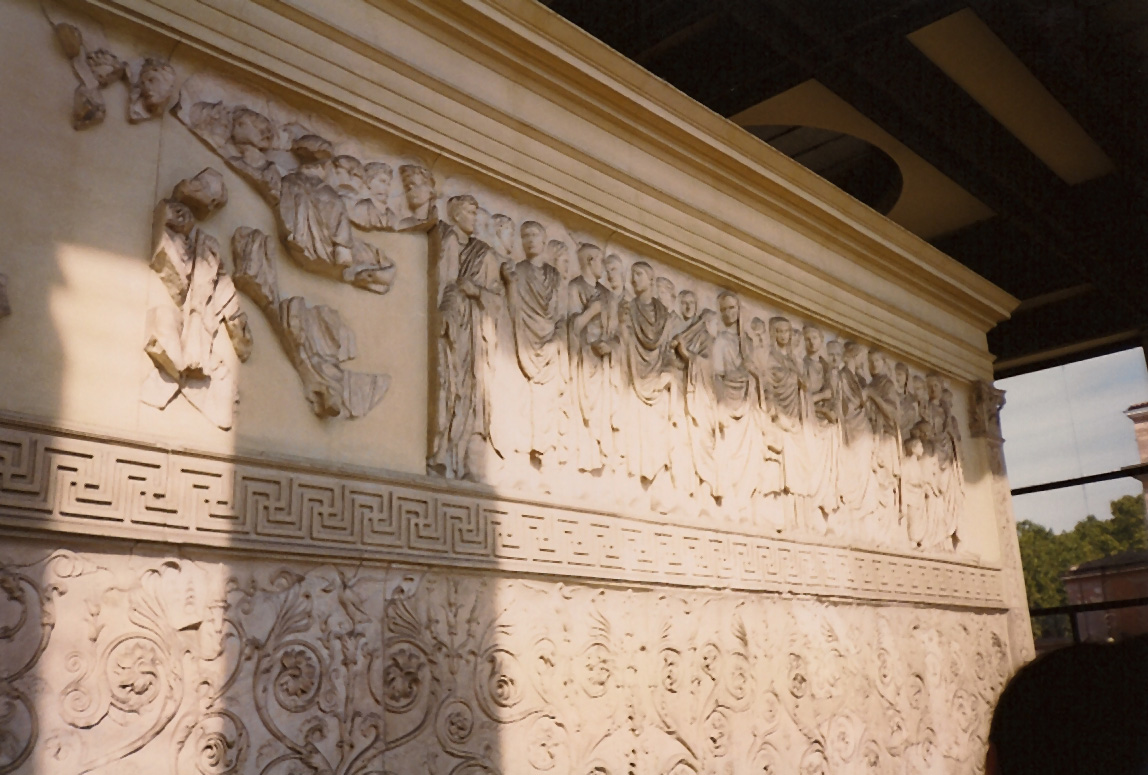 Processional frieze of the Ara Pacis Augustae in Rome. The altar was voted by the Senate in 13 BCE and dedicated in 9 BCE. The north and south sides show priests, magistrates and members of Augustus' family; the exact event and several identifications remain debated.
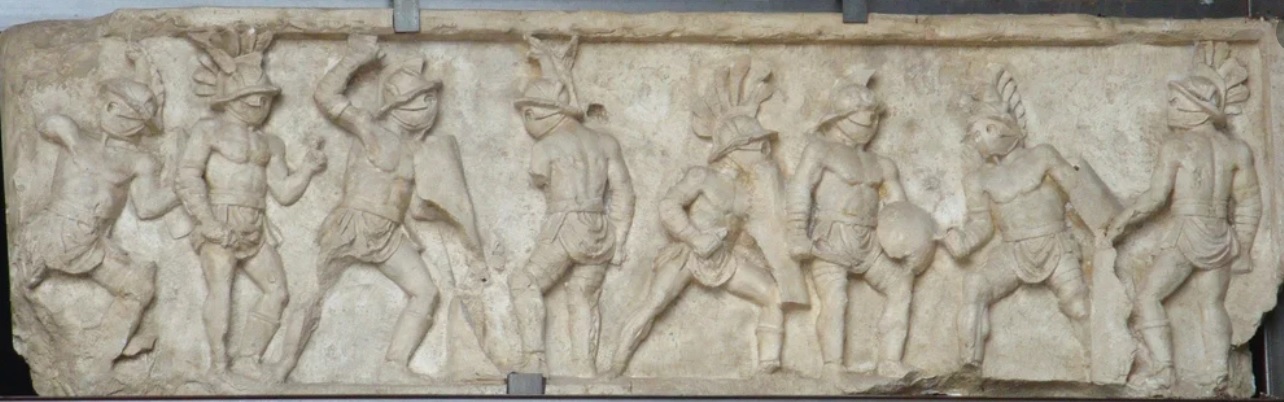 Marble relief with gladiatorial scenes from the necropolis at Pompeii's Stabian Gate, ca. 20–50 CE. National Archaeological Museum, Naples. The sequence shows how relief compresses different moments of a spectacle into a single band.
Cult Images, Household and Provinces
A cult statue was not an illustration of myth but an image through which a community addressed a deity. It stood in a temple or sanctuary, could be dressed, wreathed, illuminated by lamps and carried in processions. Scale and material depended on setting and resources: small figures in bronze, terracotta and wood existed alongside monumental marble or composite statues. Many wooden and precious-metal images have vanished, so museum evidence is biased toward stone.
Small bronzes stood in household lararia beside images of the genius, Penates and other protectors. A Lar with rhyton and patera conveys dancing movement while signalling libation. It shows sculpture entering a repeated family action rather than merely decorating a room. See Roman Household Religion, Lares and Lararium.
A provincial work should not be treated as an incompetent reflection of the capital. Patrons chose material, dress, gesture and combinations of gods intelligible to local viewers. Workshops moved models among cities, while inscriptions record Greek, Latin and local names. The Mithras group from Ostia bears the Greek signature "Kriton the Athenian made it," yet its meaning depends on a specific mithraeum within Roman baths.
The Mercury statue from Mérida is still harder to fit into a simple category: a familiar god sits beside a lyre, while the inscription records a dedication to Mithras. The object joins image, donor, text and cult setting. It demonstrates why Roman gods and Roman religion cannot be studied apart from the archaeological context of sculpture.
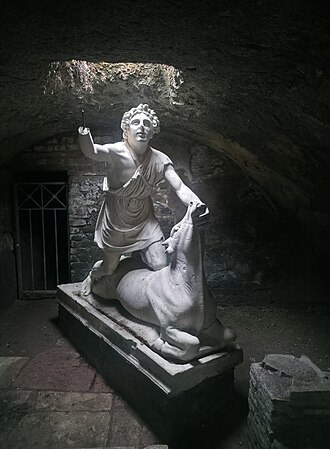 Marble group of Mithras killing the bull from the mithraeum in the service corridor of the Baths of Mithras at Ostia, 1st–2nd centuries CE; Ostia Museum, inv. 149. A Greek signature on the bull reads, 'Kriton the Athenian made it.' Wikimedia Commons, CC BY 4.0.
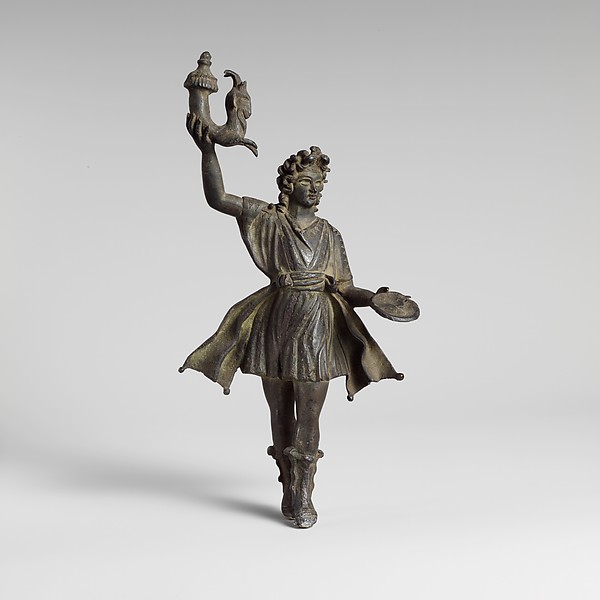 Bronze statuette of a Lar, 1st–2nd centuries CE. The household deity carries a rhyton and a patera, vessels for drinking and libation. The Metropolitan Museum of Art, acc. 19.192.3. Public Domain.
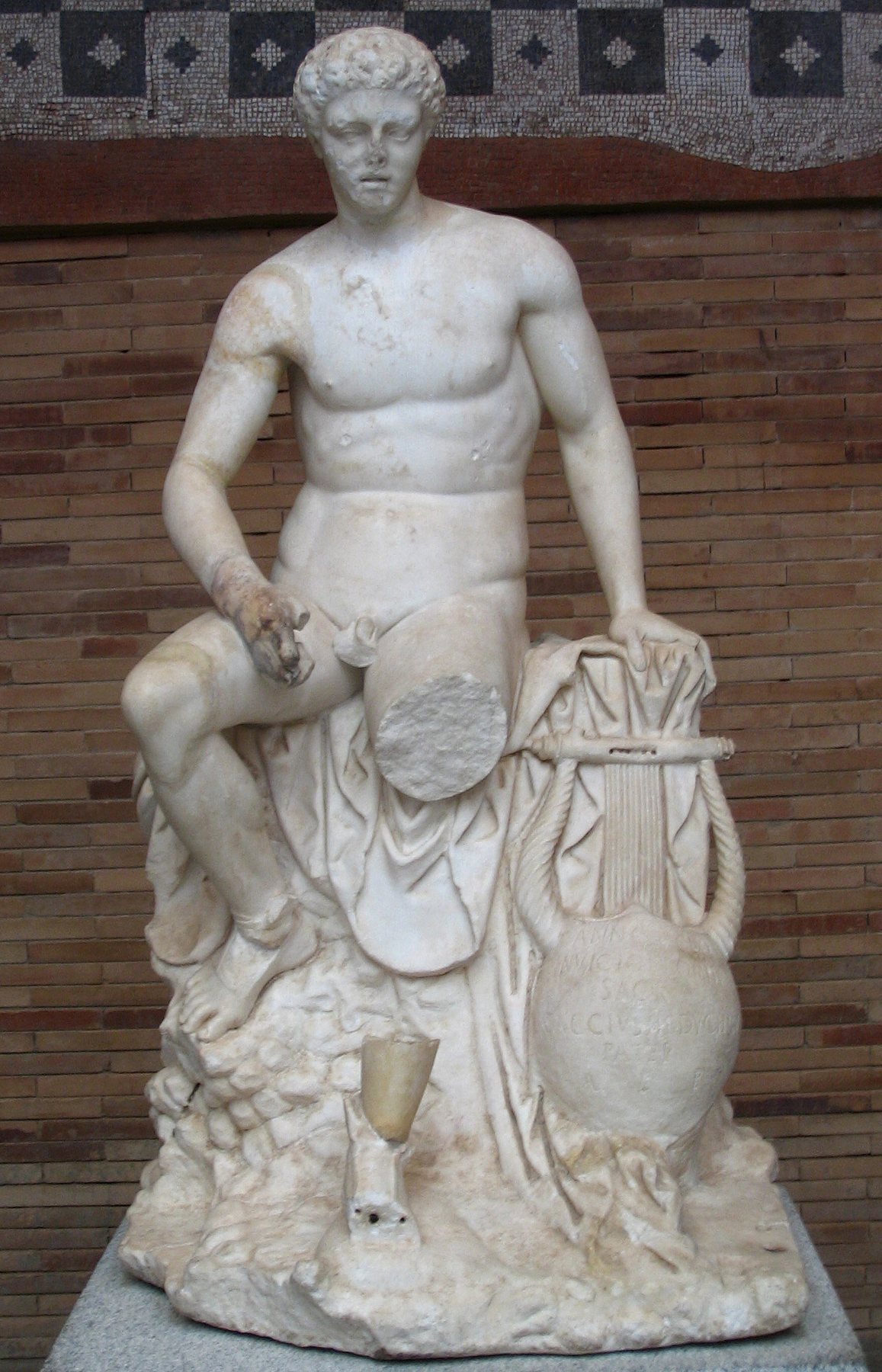 Marble statue of Mercury seated on a rock beside a tortoise-shell lyre, 2nd century CE. The inscription on the lyre states that Gaius Accius Hedychrys dedicated the statue to Mithras. Mérida, National Museum of Roman Art, inv. CE89. Wikimedia Commons, CC BY 4.0.
Funerary Sculpture and Memory
A tomb monument addressed the living beside a road, city gate or within a cemetery. Portrait, name, age, relationship, occupation and dedication to the divine Manes created a public biography of the dead. Patrons included families, spouses, companions, associations and former owners; funerary sculpture therefore preserves not only senatorial elites but freedpeople, craftspeople, women and children. Differences in size and workmanship reflect resources and local habits, not the value of human memory.
The stele of Lutatia Lupata from Mérida joins relief to a four-line Latin inscription. The sixteen-year-old girl holds a pandura, but the instrument does not make the image a literal snapshot: it might signify skill, virtue or a desired identity. Findspot, the text catalogued as AE 1959, 29 and museum number CE8241 make name, age and provenance more secure than the face alone.
From the 2nd century CE the spread of inhumation increased demand for marble sarcophagi, although cremation did not disappear at once and practice varied by region. Front panels were filled with mythological battles, Dionysiac processions, seasons, philosophers or pastoral scenes. Myth did not directly report a biography; it supplied languages of sleep, renewal, virtue, love and loss.
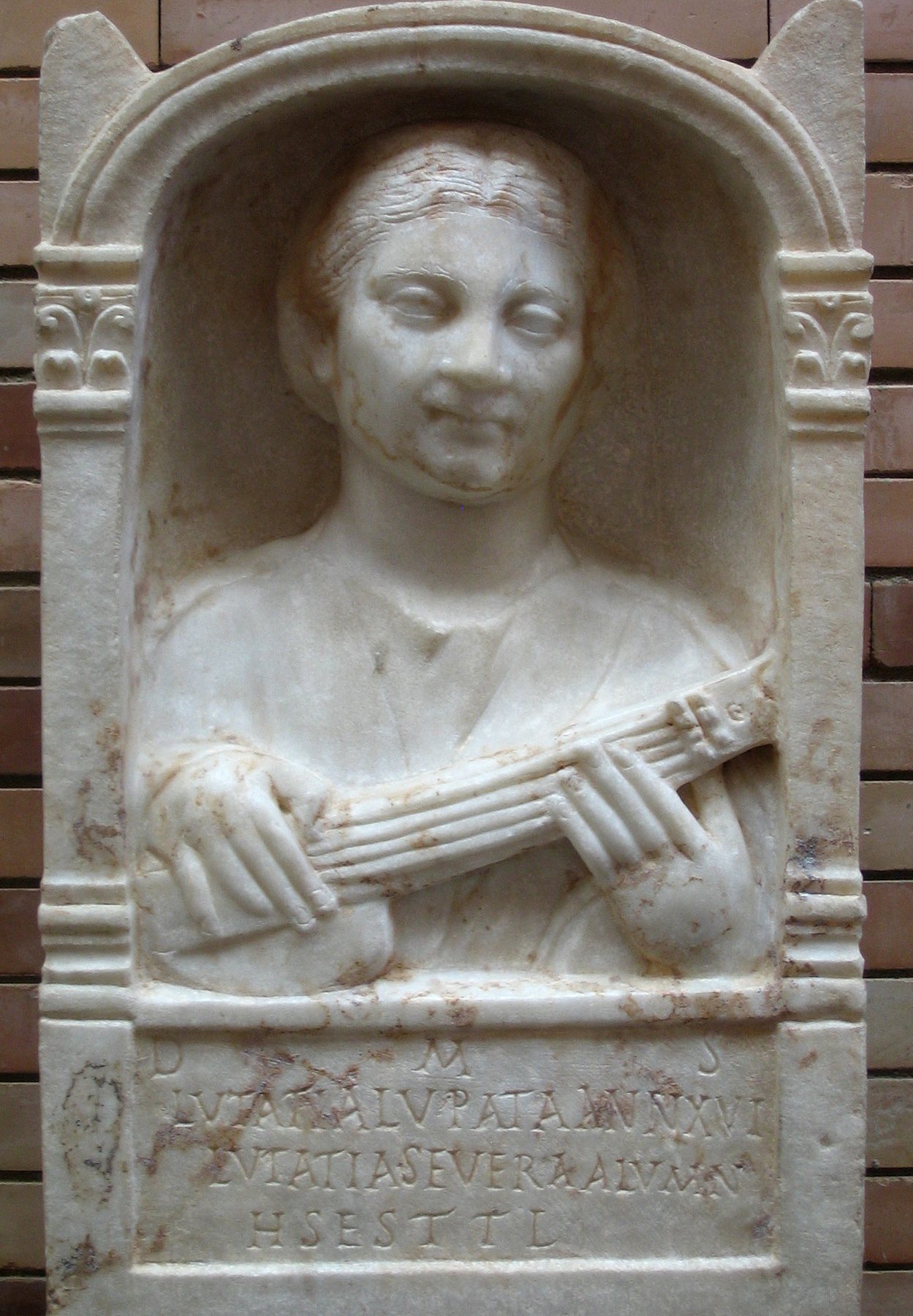 Marble funerary stele of sixteen-year-old Lutatia Lupata holding a pandura, 2nd century CE; found in 1956 in the Cerro de San Albín necropolis at Mérida. National Museum of Roman Art, inv. CE8241; AE 1959, 29. Wikimedia Commons, CC BY 4.0.
On Arria's sarcophagus, the myth of Selene visiting the eternally sleeping Endymion is joined to an inscription and the deceased woman's portrait. The image works on several levels at once: it displays the cost of the commission and virtuoso undercutting, connects death with perpetual sleep and preserves a daughter's family dedication to her mother. Without the inscribed lid, the mythological relief would lose an important part of its particular meaning.
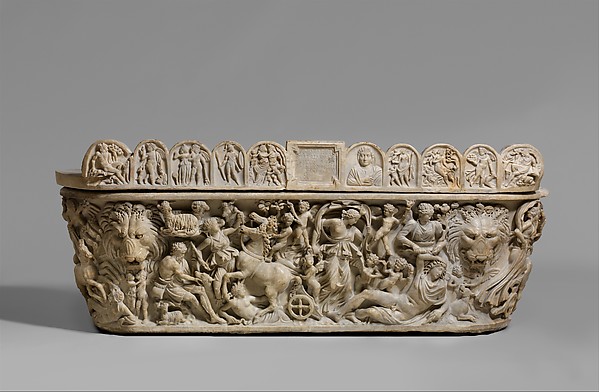 Marble sarcophagus with the myth of Selene and Endymion, early 3rd century CE. The lid inscription states that Aninia Hilara dedicated it to her mother Arria; the deceased woman's portrait is carved beside the text. The Metropolitan Museum of Art, acc. 47.100.4a, b. Public Domain.
Materials, Workshops, Colour and Late Antiquity
Marble came from Luna, Greece, Asia Minor, Egypt and other regions; coloured stones themselves became part of a design. A block might be roughed out near a quarry, finished in an urban workshop and installed by another team. Point, claw chisel, drill, abrasive and attachment marks reveal stages of labour. Similar busts did not necessarily emerge from one "factory": a template was combined with hand carving, exchangeable heads and the patron's choices.
Bronze permitted projecting arms and more open compositions, but metal was readily melted down. Large surviving bronzes are consequently exceptional; marble versions sometimes transmit the appearance of lost bronze types while adding supports for stability. Terracotta, stucco, wood, ivory and precious metals widened the palette, although preservation makes them less prominent in a general survey.
An ancient statue was not necessarily white. Marble was painted, gilded and supplemented with inset eyes, metal, textiles and ornaments. Colour could cover much of a surface or selectively mark hair, lips, eyes and dress. Traces of polychromy survive on Augustus of Prima Porta. Colour reconstruction must rest on microscopy, ultraviolet and infrared imaging, pigment analysis and comparison, not free invention.
The museum appearance of a sculpture also has a history. Early modern restorers supplied arms and attributes to works found incomplete; heads were mounted on unrelated torsos, surfaces cleaned, bases and inscriptions separated. Interpretation must establish ancient and modern parts, find context and early records. A beautiful complete silhouette may sometimes say more about an 18th-century restoration than the original monument.
Late Antique sculpture cannot be reduced to a "decline of naturalism." Constantine's colossal head preserves a recognisable imperial portrait, but enlarged scale, ordered hair and upward gaze create distance and a different presence of power. Reuse of old statues and reliefs might represent economy, a deliberate link to honoured predecessors, or both. Viewers, religion and urban space changed, and the language of the image changed with them.
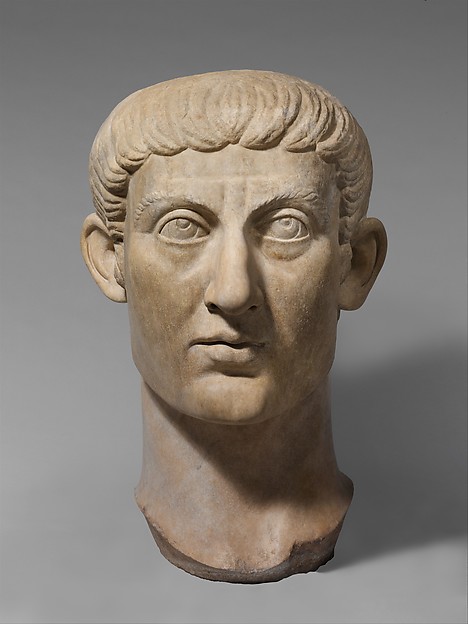 Colossal marble portrait head of Emperor Constantine I, ca. 325–370 CE; height 95.3 cm. The fragment belonged to an over-life-size bust or, more probably, a full statue. The Metropolitan Museum of Art, acc. 26.229. Public Domain.
Related Articles
- Art of Ancient Rome
- Architecture of Ancient Rome
- Painting in Ancient Rome
- Reconstruction of Augustus of Prima Porta
- Octavian Augustus
- Trajan's Column
- Column of Marcus Aurelius
- Tropaeum Traiani
- Roman Gods
- Roman Religion
- Roman Household Religion
- National Museum of Roman Art in Mérida
- Museums of Antiquity
Literature and Sources
- Polybius. Histories, VI.53–54
- Pliny the Elder. Natural History, Books XXXIV–XXXVI
- Kleiner, Diana E. E. Roman Sculpture. Yale University Press, 1992.
- Fejfer, Jane. Roman Portraits in Context. De Gruyter, 2008.
- Stewart, Peter. Statues in Roman Society: Representation and Response. Oxford University Press, 2003.
- Elsner, Jaś. Art and the Roman Viewer. Cambridge University Press, 1995.
- Brilliant, Richard. Visual Narratives: Storytelling in Etruscan and Roman Art. Cornell University Press, 1984.
- The Metropolitan Museum of Art. Roman Portrait Sculpture
- The Metropolitan Museum of Art. Polychromy of Roman Marble Sculpture
- Vatican Museums. Augustus from Prima Porta, inv. MV.2290.0.0
- Musei Capitolini. Spinario, inv. MC1186
- Museo dell'Ara Pacis. Exterior and processional frieze
- Archaeological Park of Ostia Antica. Statuary Group of Mithras, inv. 149
- Universidad de Alcalá. Funerary inscription of Lutatia Lupata, CILAE 483
- The Metropolitan Museum of Art. Sarcophagus of Selene and Endymion
- Image source: Dancing maenad with a thyrsos, Roman marble relief of the Augustan period, ca
- Image source: Marble portrait of an unidentified man, late 1st century BCE
- Image source: Marble portrait of Emperor Augustus, ca
- Image source: Marble portrait of Emperor Caracalla, 212–217 CE; a head from a statue probably made in an imperial…
- Image source: Bronze statuette of a Lar, 1st–2nd centuries CE
- Image source: Colossal marble portrait head of Emperor Constantine I, ca
Interested in Ancient Rome beyond reading? Join Legio X Fretensis or explore our reenactment directions.


